Case Study
[Customer Success Story] LFIT: Three Years of Public-Sector AI Data Projects, from Labeling to De-Identification

Hyun Kim
Co-Founder & CEO | 2026/10/30 | 7 min read
Before using video that contains people to train AI, organizations first need to define how personal information will be handled according to relevant privacy regulations.
Let’s take Korea as an example. An amendment to Korea's Personal Information Protection Act, passed by the National Assembly on August 20, 2026, introduced special provisions for the use of personal information in AI development. When development is difficult using only pseudonymized or anonymized information and a project is recognized as serving a public interest or social need, the amendment allows original data to be used, subject to strengthened safeguards and review and approval by the Personal Information Protection Commission.
Until the amendment takes effect six months after promulgation, and even after it takes effect, de-identification will remain the default for most projects that do not go through the required review process. For companies delivering public-sector AI data development projects, this is why de-identification needs to be designed into the labeling workflow itself.
LFIT integrated what had previously been a separate de-identification service into the labeling workflow in Superb Platform, eliminating duplicate review. This article reflects the project as of October 2026.
LFIT is a systems integration company founded in 2010. Its core business includes system integration, GIS solutions, and IT consulting, and it has also consistently participated in public-sector AI training data projects.
LFIT first adopted Superb Platform in 2023 for a public-sector AI training data project. It renewed its contract in 2025 and again in 2026, expanding how it used the platform as the nature of each project changed.
This case study looks back at those three years.
Challenge: The Data Changed with Every Project, but the Team Size Did Not
Every public-sector AI data development project is different. The data LFIT worked with over three years illustrates that clearly.
In 2023, the project involved labeling visible-light and thermal images with object annotations, keypoints, and image captions for an autonomous driving dataset covering neighborhood roads. In 2025, the focus shifted to high-resolution 4K images. In 2026, LFIT worked simultaneously on datasets covering urban, waterfront, and mountainous environments, along with thermal imagery.
1. Rebuilding the Labeling System for Every Project Leaves Nothing to Reuse
If class definitions, work guidelines, review criteria, and output formats have to be rebuilt in a new tool for every project, project managers spend significant time on setup. Workflows already validated in a previous project also fail to carry over to the next one.
2. A Small Internal Team Had to Manage Hundreds of Thousands of Images
Before adopting Superb Platform, LFIT outsourced labeling and received only the final deliverables. Because direct communication with annotators was difficult, misunderstandings of the labeling guidelines frequently led to rework. Delays and inconsistent quality also made project management more difficult.
LFIT now brings external annotators directly into the platform for each project. For one or two project managers to assign work to dozens of annotators and monitor individual workloads and progress, they needed an operational tool that could handle everything from inviting workers to review and submission in one place. Public-sector projects also require records of work history and compliance with submission specifications.
3. Data Containing People Required De-Identification
LFIT had previously handled de-identification as a separate outsourced service from labeling. When the two workflows were separated, the same data had to be reviewed twice, and the additional service created a separate cost.
Solution: One Platform Across Three Years of Projects
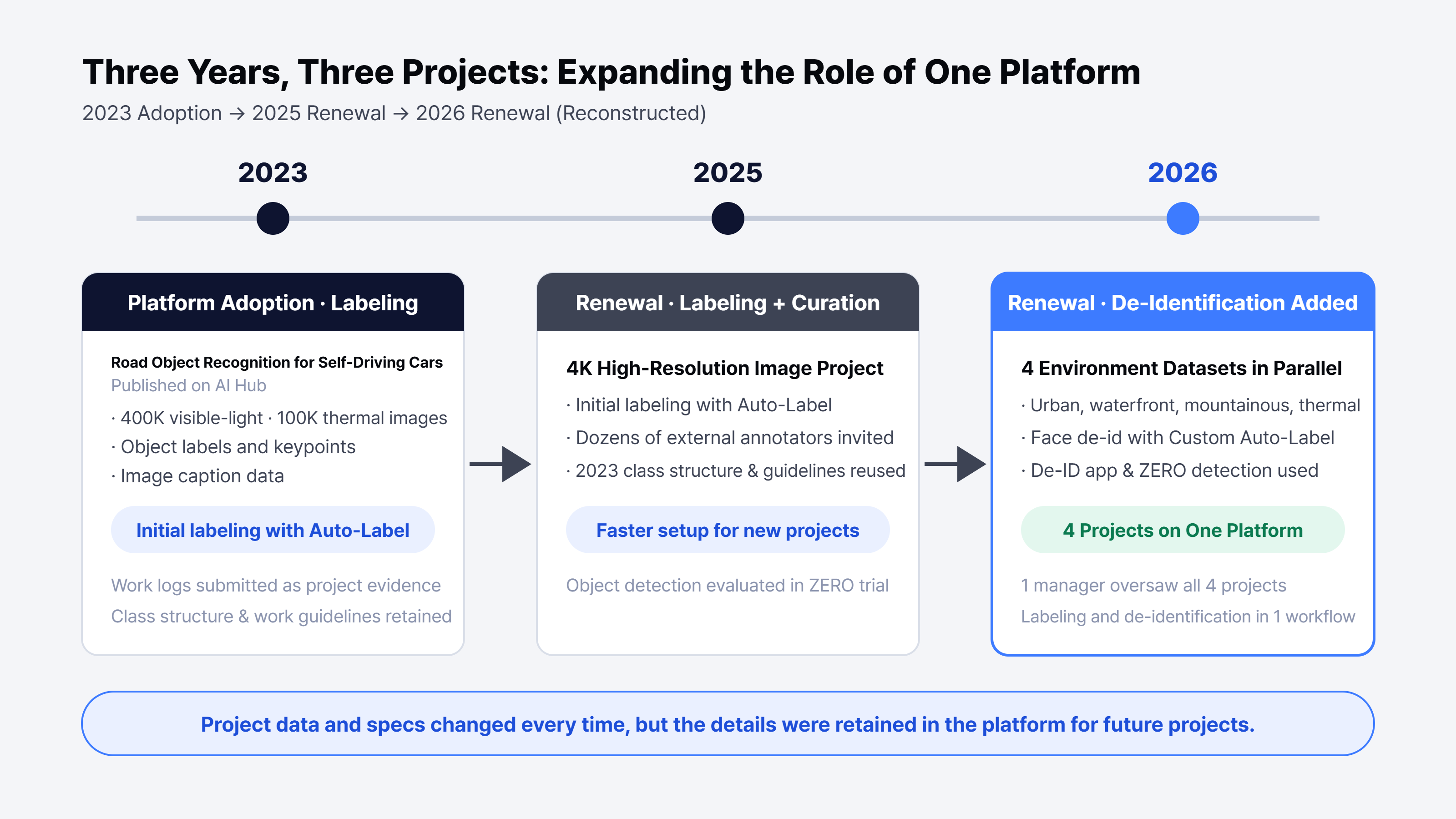
Three years, three projects: expanding how the same platform was used. Reconstructed illustration.
1. 2023: Applying Auto-Label to a 500,000-Image Public Dataset
In 2023, LFIT led the development of the Object Recognition Data for Autonomous Driving on Neighborhood Roads dataset published on Korea’s AI-Hub and adopted Superb Platform for the project.
The dataset was designed to improve recognition of dynamic and static objects in environments such as alleys and neighborhood roads, where pedestrian accident risk is relatively high.
LFIT labeled 400,000 visible-light camera images and 100,000 thermal camera images, while also building keypoint and image caption data.
Instead of outsourcing the work and receiving only the final output, LFIT shifted to a workflow in which annotators were invited directly into the platform and could communicate with project managers throughout the project.
Auto-Label generated the initial annotations, which annotators then reviewed, corrected, and supplemented. This reduced the amount of labeling that had to be created manually from scratch.
Deliverables were exported in the format required by the project. Work logs needed as project evidence were also extracted from the platform and submitted.
2. 2025: Renewing with Data Curation Added to Labeling
LFIT continued using Superb Platform because it made it easy to manage large numbers of annotators, see each worker's workload at a glance, and communicate with them in real time to make corrections immediately.
"The biggest difference we felt in practice was being able to communicate with annotators in real time and make corrections immediately," said Jeongyeon Lee, Manager in LFIT's SI Business Division.
The 2025 contract added data curation to the labeling workflow.
For a project involving high-resolution 4K imagery, Auto-Label first generated initial annotations. Dozens of external annotators were then invited into the project to correct and review the results.
Because LFIT could reuse the class structure and work guidelines established in 2023 within the same platform, less time was required to set up the new project.
A trial environment for ZERO, Superb AI's industry-focused Vision Foundation Model, was also made available during this period so LFIT could evaluate whether its object detection capabilities could be applied to new projects.
3. 2026: Bringing De-Identification into the Labeling Workflow
De-identification for privacy protection had also been required in previous projects.
Until then, however, it had been handled through a separate outsourced service from labeling. Because the two workflows were separated, the same data had to be reviewed twice, creating duplicate work.
In the 2026 contract, LFIT brought both processes together in Superb Platform.
Auto-Label first detects face regions, and blurring is then applied within the same platform. Annotators only need to review the detection results once.
Removing the duplicate review step reduced processing time and eliminated the cost of a separate de-identification service.
That same year, LFIT simultaneously developed four datasets covering urban, waterfront, mountainous, and thermal environments. Worker invitations, Auto-Label, de-identification, review, and submission were all managed within the same platform.
ZERO's detection capabilities were also used in the workflow.
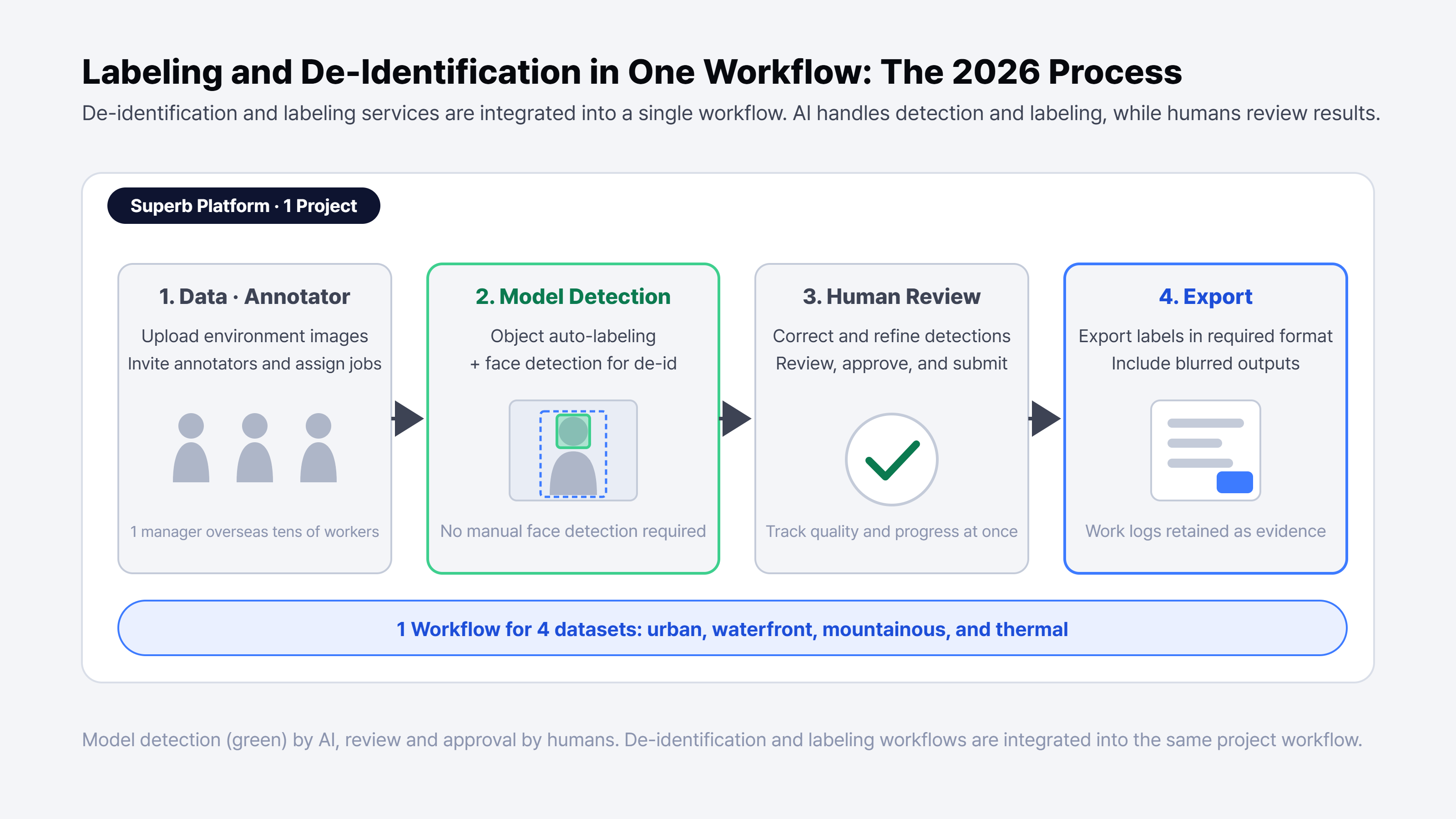
Labeling and de-identification in one workflow: LFIT's 2026 process. Reconstructed illustration, not actual customer data
Results: Easier Workforce Management, No More Duplicate De-Identification Review
- Three years and two contract renewals. After the first contract in 2023, LFIT renewed in 2025 and again in 2026. Even as the data and project requirements changed, the company continued using the same platform.
- Reduced burden of managing large annotator teams. A single project manager can invite external annotators, assign tasks, and monitor each worker's workload and progress from one place. Real-time communication and immediate corrections also reduced rework caused by misunderstandings of the guidelines. In 2026, LFIT used the same platform to run four environment-specific dataset projects simultaneously.
- Integrated de-identification workflow. De-identification that had previously been outsourced separately is now handled in the same platform as labeling. Eliminating duplicate review reduced processing time and the cost of a separate outsourced service.
- Reusable project assets. Class structures, work guidelines, and worker management processes remain in the platform and become the starting point for the next project.
Conclusion
Public-sector AI data development projects change from year to year, both in the type of data involved and in submission requirements.
Rather than introducing a new tool for every project, LFIT chose to accumulate its project experience in one platform. That approach has now continued for three years.
When the amended Personal Information Protection Act takes effect in March 2027, it will create a limited path for certain projects to use original personal data. Even then, de-identification will remain necessary for most projects that do not go through the required review process.
With a platform that handles labeling and de-identification within the same workflow, Superb AI helps companies delivering public-sector AI data projects avoid starting from scratch every time the data specifications change.
Frequently Asked Questions
Q. What Changes When You Use a Platform for a Public-Sector AI Data Development Project?
Class definitions, work guidelines, worker management, review, and conversion to the required submission format can all be managed in one place. LFIT reused the system it established in 2023 for its projects in 2025 and 2026.
Q. How Is Face De-Identification Handled?
Auto-Label first detects face regions, and blurring is then applied within the same platform. Annotators only need to review the detection results once. Labeling and de-identification are handled within the same workflow without requiring a separate outsourced service.
Q. Can the Platform Be Used with External Annotators?
Yes. External annotators can be invited on a project-by-project basis, assigned tasks, and given correction requests through real-time communication. At LFIT, a single project manager managed dozens of external annotators within the platform.
Q. Can It Handle Specialized Data Such as Thermal or 4K Images?
Yes. LFIT labeled visible-light images, thermal images, and high-resolution 4K images within the same platform. Auto-Label can be applied according to the characteristics of each data type.
Q. Can We Export the Work History Required as Project Evidence?
Yes. Work logs and submission histories can be exported and submitted as supporting documentation for the project. LFIT used this process to provide the required evidence for its 2023 project.
💬 Considering a public-sector AI data development project or a dataset that requires de-identification? Rather than starting with a sales call, we'll begin by reviewing your data types and submission requirements. Leave your details below, and a Superb AI expert will get in touch.
Superb AI is a Vision Intelligence company that transforms visual data from industrial sites into intelligence enterprises can act on. The results described in this case study come from an actual project delivered by Superb AI.
Related Posts
Case Study
[Customer Success Story] How Mobile AI CCTV Supports Permit-to-Work Safety at a Power Plant
Hyun Kim
Co-Founder & CEO | 10 min read
Case Study
[Customer Success Story] How AgTech Company Metafarmers Built Crop Recognition Datasets for Harvesting Robot Vision
Hyun Kim
Co-Founder & CEO | 5 min read
Case Study
[Customer Success Story] How a Video-Based Behavior Analysis AI Company Built a Scalable Keypoint Labeling Workflow
Hyun Kim
Co-Founder & CEO | 7 min read

About Superb AI
Superb AI is an enterprise-level training data platform that is reinventing the way ML teams manage and deliver training data within organizations. Launched in 2018, the Superb AI Suite provides a unique blend of automation, collaboration and plug-and-play modularity, helping teams drastically reduce the time it takes to prepare high quality training datasets. If you want to experience the transformation, sign up for free today.