Case Study
[Customer Success Story] How Mobile AI CCTV Supports Permit-to-Work Safety at a Power Plant

Hyun Kim
Co-Founder & CEO | 2026/10/12 | 10 min read
A significant share of maintenance and repair work at power plants is subject to legally required safety measures. For example, Article 241-2 of Korea’s Rules on Occupational Safety and Health Standards requires a fire watch to be designated and stationed at the work area when welding or cutting is performed near combustible materials.
This case study looks at how a Korean combined heat and power plant operator supplemented the verification of required safety measures with mobile AI CCTV, enabling those measures to be checked and recorded while work is underway, even in areas beyond the reach of fixed cameras.
Hot work requires measures such as having fire extinguishers on site, containing sparks, and stationing a fire watch. Confined-space work requires forced ventilation, respiratory protective equipment, and an attendant. Heavy-equipment operations and work at height require measures such as assigning a signal person and controlling access to the work area. These are standard requirements for comparable operations in Korea.
The challenge was how those measures were being verified. Until now, workers and supervisors had managed these items by checking them off manually on permit-to-work forms and checklists. The process created a record before work began, but continuously confirming that those conditions remained in place throughout the work required ongoing human monitoring.
The customer in this case is a Korean energy company that operates combined heat and power plants. The company already had an internal safety monitoring system and safety management portal in place. It wanted to take the next step by having AI help verify, at the worksite, the safety measures that people had previously checked manually.
Superb AI began working on the project in 2025. The result was a set of mobile AI CCTV units that can move with the work taking place across the plant.
Challenge: The Rules Were Clear, but Ongoing Verification Still Depended on People
The customer faced two main challenges:
1. Required Safety Measures Were Still Verified Manually
Different types of high-risk work require different safety measures:
Hot work
- Fire extinguishers on site
- Spark-containment blankets or barriers
- Fire watch in place
Confined-space work
- Forced ventilation using ventilation fans
- Respiratory protection such as supplied-air respirators or self-contained breathing apparatus
- Attendant in place
Heavy-equipment operations and work at height
- Signal person or spotter in place
- Work zones identified and controlled using traffic cones and barricade lines
The pre-work permitting process was already well established.
But a permit check captures only a snapshot before the work begins. If the job continues for several hours, confirming that the fire extinguisher is still in place or that the signal person remains on duty requires someone to keep monitoring the area.
If an incident occurs while required safety measures are missing, whether those measures were properly verified can also become relevant when responding under safety regulations.
2. Fixed CCTV Did Not Reach the Work Sites That Needed Monitoring
Unlike a typical factory, a power plant covers a large area, and the location of maintenance and equipment replacement work changes constantly.
Because it is difficult to predict where each job will take place, installing fixed CCTV across every possible work area is not practical. Even where cameras are already installed, work often takes place outside their field of view, including outdoor areas, elevated structures accessed by stairs, and confined spaces such as manholes and tanks.
Installing new power and network infrastructure for every temporary worksite would also be inefficient in both cost and time.
What the customer needed was a camera system that could move with the work.
Solution: AI That Understands the Work, in a Unit That Moves with the Site
1. Verifying the Safety Measures Required for Each Type of Work
The AI first identifies what type of high-risk work is taking place in the video.
It then checks whether the safety measures required for that type of work are in place. If a required measure cannot be confirmed, an alert appears on the monitoring dashboard.
The same unit can be used across different types of work. At a hot-work site, it checks hot-work safety measures. At a confined-space worksite, it checks the measures required for confined-space work.
2. Results Appear in the System the Team Already Uses
AI results are displayed in the existing monitoring dashboard, so operators do not need to learn a separate system.
The solution integrates with the company’s existing account system through single sign-on (SSO), allowing users to access it with their existing credentials. Video clips from detected events are also stored.
For the customer, an important benefit was retaining a record showing that work was carried out while the required safety measures were in place.
3. Mobile Units That Follow the Worksite
To extend AI monitoring into areas fixed cameras could not reach, Superb AI built mobile AI CCTV units that integrate software and hardware into a single system. The units were configured in two forms based on how they would be used in the field. Four wheeled case-style units store the components inside portable cases for transport. Once moved to the worksite, the components are unpacked and set up for operation. One enclosure-style unit integrates all components into a single housing.
The internal components are the same in both versions:
- Edge AI computer: Built on NVIDIA Jetson AGX Orin. Video is analyzed directly at the worksite, and the results are sent to the monitoring dashboard.
- PTZ dome camera: Pan, tilt, and zoom controls allow a single camera to cover a broad work area.
- 7-inch touch monitor: Operators can view live video and control the camera directly at the worksite.
- LTE connectivity: The unit connects to the monitoring network without requiring separate network installation.
- Portable battery: The system can operate in areas where a fixed power source is not readily available.
Installation is straightforward: mount the unit on a tripod and connect power. Because no network cabling is required, the unit can simply be moved whenever the work area changes.
The enclosure-style unit also incorporates a heat-dissipation structure for outdoor use. Its display is angled so field workers can view and operate it comfortably while standing. The handles were positioned on the lower sides of the enclosure so they would not interfere with the camera’s field of view.
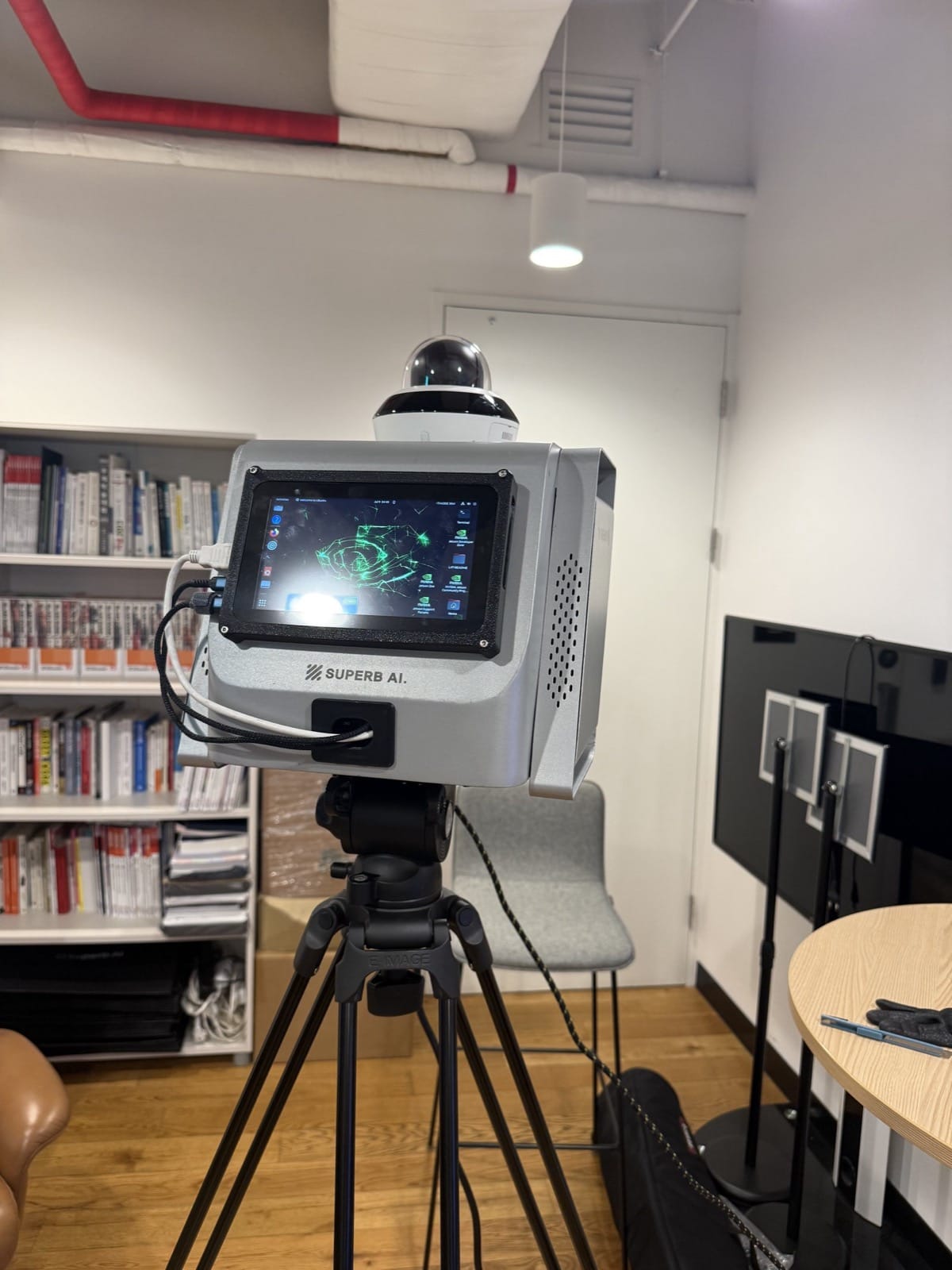
Enclosure-style mobile AI CCTV unit. A PTZ dome camera is mounted at the top, with a 7-inch touch monitor on the front. Photo taken at Superb AI headquarters
4. What AI Adds to Mobile CCTV
Mobile CCTV itself is not a new concept. Products in many different forms are already available. What made this project different was the AI and operating system built around the mobile camera:
- AI models tailored to the worksite: Equipment, protective gear, and safety devices used in high-risk work at the plant were defined by work type and used to train the models. The models continue to be improved with field data after deployment.
- One package from camera to analytics: Camera, edge computer, connectivity, power, and display are integrated into a single unit, allowing deployment without separate on-site server infrastructure.
- Designed for changing worksites: The combination of a mobile unit and an AI model that can be retrained is particularly useful in areas where network access and power are not readily available or where work conditions change frequently.
Benefits
- Supplementing manual checks: AI continues checking required safety measures during the work itself, extending the manual checks performed on the permit before work begins.
- Reducing CCTV blind spots: Temporary work areas that fixed CCTV could not cover are brought into the monitoring range.
- Minimizing installation requirements: LTE connectivity and portable batteries allow units to be moved and used without new network or power infrastructure.
- Retaining event records: Video clips from event periods are stored, creating a record of whether required safety measures were in place during the work.
- Working within the existing system: The solution integrates with the company’s account system and fits into the monitoring workflow already in use.
Next Step: From Verification to Automated Documentation
Today, the AI verifies whether required safety measures are in place and generates alerts.
The next step being discussed with Superb AI is the automatic generation of checklists and work reports.
The goal is to take permit-to-work records that are currently managed manually and generate them automatically based on the work conditions recognized by AI and the corresponding verification results.
Conclusion
This project started with a safety management system that was already working well. The required safety measures were clearly defined, and the organization and systems needed to manage them were already in place.
What AI added was the ability to perform part of that verification continuously at the worksite and extend monitoring into areas that fixed cameras could not reach. Superb AI will continue to transform visual data from industrial sites into intelligence enterprises can act on.
Frequently Asked Questions
Q. What Types of Sites Are Mobile AI CCTV Units Best Suited For?
They are well suited to sites where work locations change frequently and where existing CCTV cannot cover every area. Beyond power plant maintenance, they can also be considered for roadwork sites, industrial plants, construction sites, and other locations where real-time monitoring and AI video analytics are needed despite limited access to network infrastructure or power.
Q. What Installation Work Is Required?
The unit only needs to be mounted on a tripod and connected to power. Data communication runs over LTE, so no network installation is required. In areas without access to a fixed power source, the system can operate on a portable battery.
Q. Can It Be Used with an Existing Monitoring System?
Yes. As in this case, an organization can keep its existing safety monitoring system and use mobile units to supplement areas beyond the reach of fixed cameras. Integration with an internal account system is also supported.
Q. Can the Safety Checks Be Customized?
Yes. The verification targets can be defined around what needs to be checked at each worksite. In this project, the targets were defined and trained specifically around the requirements for high-risk work at the power plant. The models continue to be improved using field data during operation.
Q. Can This Be Applied at Our Site?
The right configuration depends on site conditions. If you contact us, we can review the work you need to monitor and the operating environment, then recommend an appropriate configuration.
Related Customer Success Stories
💬 Considering mobile AI CCTV or AI safety monitoring for high-risk work at a power plant or industrial facility? Tell us about the types of work you need to monitor and the areas your existing CCTV cannot cover. Rather than starting with a sales call, we’ll begin by reviewing those operational requirements.
Related Posts
![[Customer Success Story] How AgTech Company Metafarmers Built Crop Recognition Datasets for Harvesting Robot Vision](https://cdn.sanity.io/images/31qskqlc/production/7ee10aa76e0f471a557629050f70fcb5eac47060-3200x1800.png?fit=max&auto=format)
Case Study
[Customer Success Story] How AgTech Company Metafarmers Built Crop Recognition Datasets for Harvesting Robot Vision
Hyun Kim
Co-Founder & CEO | 5 min read
![[Customer Success Story] How a Video-Based Behavior Analysis AI Company Built a Scalable Keypoint Labeling Workflow](https://cdn.sanity.io/images/31qskqlc/production/5371223bbc093c18d5d64b667266722102072d01-3200x1800.png?fit=max&auto=format)
Case Study
[Customer Success Story] How a Video-Based Behavior Analysis AI Company Built a Scalable Keypoint Labeling Workflow
Hyun Kim
Co-Founder & CEO | 7 min read
![[Customer Success Story] How the National Fire Research Institute Built an AI Monitoring System for Early EV Fire Detection in Underground Parking Facilities](https://cdn.sanity.io/images/31qskqlc/production/dd4fc6280fd134b1d93dec8ae3982d1a02379dc5-3200x1800.png?fit=max&auto=format)
Case Study
[Customer Success Story] How the National Fire Research Institute Built an AI Monitoring System for Early EV Fire Detection in Underground Parking Facilities
Hyun Kim
Co-Founder & CEO | 7 min read

About Superb AI
Superb AI is an enterprise-level training data platform that is reinventing the way ML teams manage and deliver training data within organizations. Launched in 2018, the Superb AI Suite provides a unique blend of automation, collaboration and plug-and-play modularity, helping teams drastically reduce the time it takes to prepare high quality training datasets. If you want to experience the transformation, sign up for free today.