Case Study
[Customer Success Story] Generative AI Starts with a Blueprint: AI ISP Consulting for a Public-Sector Institution

Hyun Kim
Co-Founder & CEO | 2026/08/25 | 6 min read
![[Customer Success Story] Generative AI Starts with a Blueprint: AI ISP Consulting for a Public-Sector Institution](https://cdn.sanity.io/images/31qskqlc/production/17a72bed2d9fcfe14f67c854211991f6dbd795a7-3200x1800.png?fit=max&auto=format)
The decision to adopt generative AI can happen quickly.
What stalls is everything after that decision.
This is especially true for public-sector institutions. In many cases, they cannot simply use commercial generative AI services as they are, because they operate systems in network-isolated environments and handle data that cannot leave the organization.
Institution B, a public-sector institution, was in the same position. It had decided to adopt generative AI for internal operations, but it did not yet have internal criteria for deciding which workflows to apply it to first, which models to use, or what infrastructure those models should run on.
Before moving into a full-scale implementation project, Institution B decided to answer these questions first through ISP, or Information Strategy Planning, consulting. Superb AI carried out the engagement over approximately three months.
Diagnosis: Gathering Requirements from the Field
The consulting began by gathering requirements from the field.
Superb AI conducted focus group interviews and multiple in-person departmental interviews with both the information systems team and working-level departments, supplemented by written surveys and follow-up questions. The team also visited the data center where the institution’s data is actually stored and operated to assess the current infrastructure.
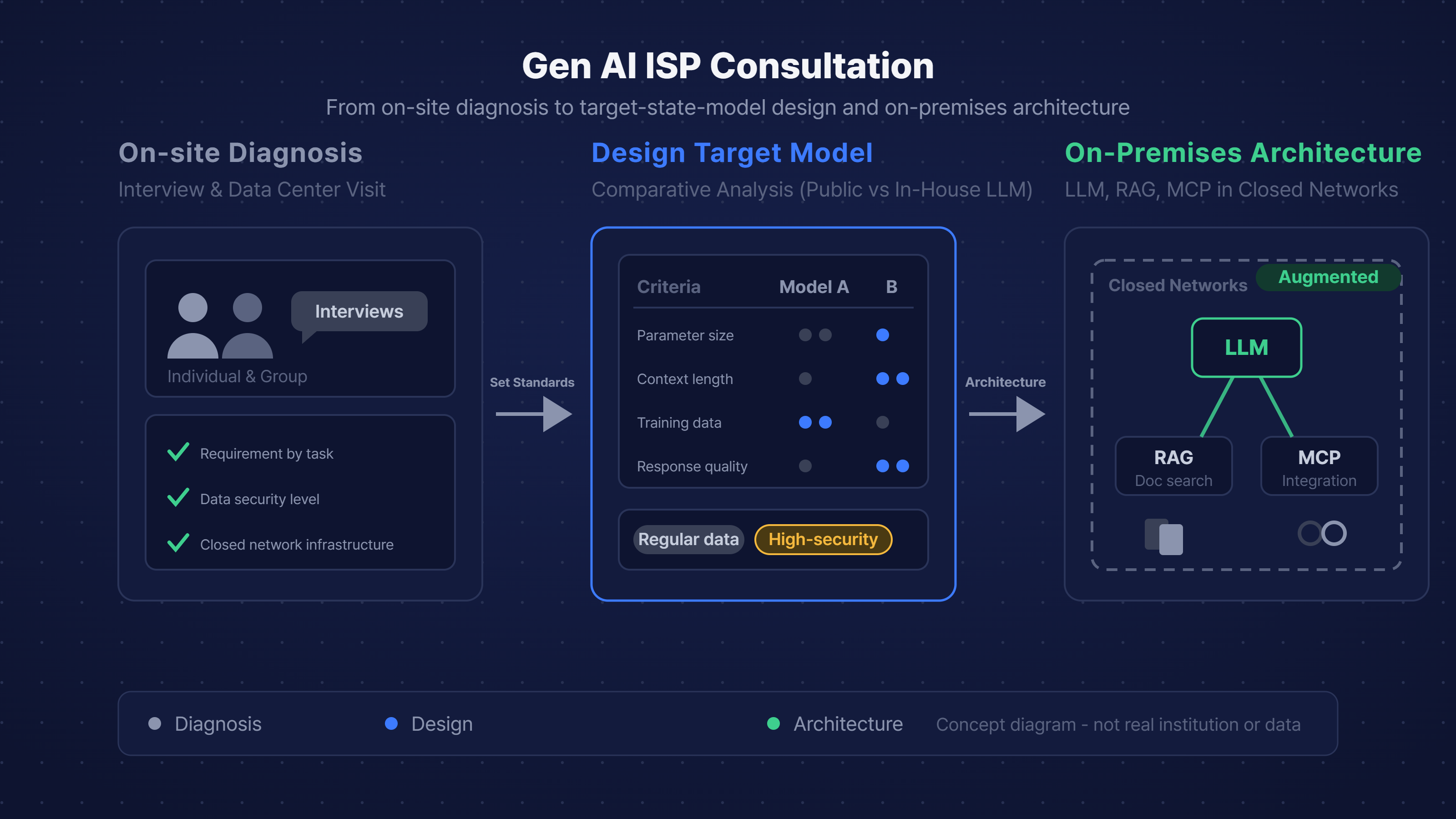
The diagnosis surfaced three key design conditions:
- Requirements differed by workflow: Each department had different expectations and priorities for generative AI. These needed to be consolidated into a single target-state model.
- Data security levels varied: General documents and higher-security documents existed side by side. The design needed to separate data processing paths by security level.
- The infrastructure was network-isolated: External cloud-based services were not an option. Every component had to run in an on-premises environment.
Target Model: Establishing Criteria for Comparison
Even the question of which model to use required clear criteria. Superb AI placed commercial LLMs and independently built models in the candidate pool, then established comparison criteria including parameter size, context length, training data, and answer quality.
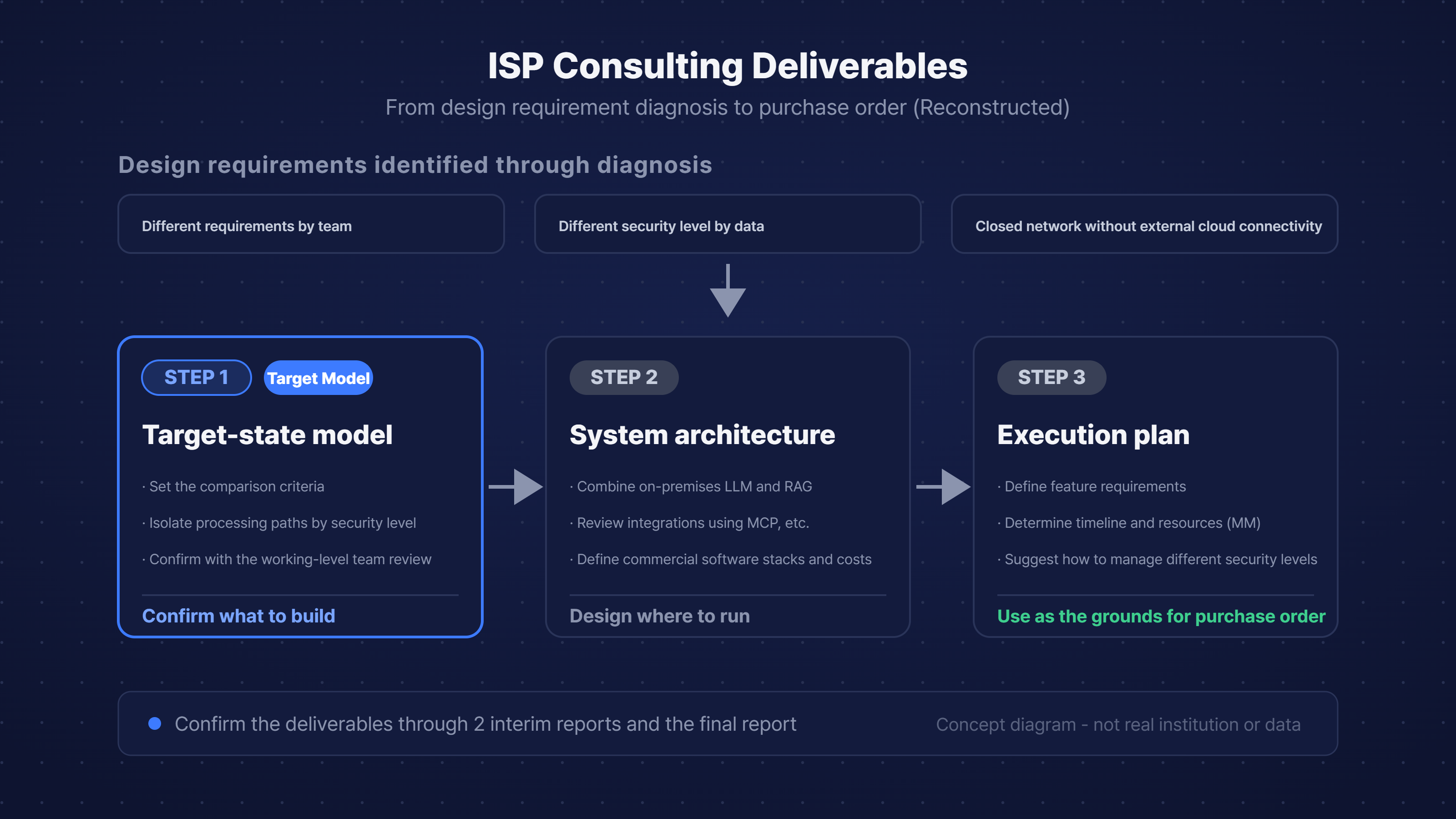
Rather than relying on vendor materials, the candidate models were reviewed against a single, common scorecard. The structure for separating processing paths by data security level was also finalized at this stage. The target-state model was restructured so that general data and higher-security data would be processed through different paths. This structure was then reviewed and confirmed by the working-level departments.
Architecture: Built to Run Inside a Network-Isolated Environment
The target-state model had to run inside a network-isolated environment.
Superb AI designed an architecture that operates an LLM in an on-premises environment and combines it with a RAG, or retrieval-augmented generation, system that searches internal documents and reflects them in responses. For integration with internal systems and data, the team also reviewed the applicability of newer connection methods, including MCP, or Model Context Protocol.
The design did not stop at a system diagram. Superb AI also itemized the commercial software stack required for implementation, including AI acceleration software and cluster operation tools, creating a basis for estimating the scale and cost of the full implementation project.
From Design to Execution Plan: Deliverables That Become the Basis for Procurement
The design was translated into an execution plan.
Superb AI defined the functional requirements needed to implement the target-state model, and estimated the development schedule and required staffing in man-months, or MM, by development phase. The team also proposed a plan for managing data based on security classification. The deliverables were refined through two interim reports, incorporating feedback from working-level departments, and the consulting engagement concluded with a final report.
What Changed Through ISP Consulting
- The adoption discussion became an implementation blueprint: With a target-state model, functional requirements, development schedule, and staffing estimates in place, Institution B secured a reference document that can be used when procuring the implementation project.
- The institution gained internal criteria for model selection: The results of comparing candidate models against a common scorecard remained as a decision basis that can be reused in future technical reviews.
- Security constraints became design conditions: Instead of treating security requirements as obstacles to adoption, Superb AI addressed them at the design stage through security-level-based data processing paths and an on-premises architecture.
Design Comes Before Adoption
Institution B’s case shows that the first step in adopting generative AI is not model selection. It is diagnosis and design.
Once workflow requirements, data security levels, and infrastructure constraints are clearly identified, the model and system architecture that should sit on top of them become much easier to define.
Superb AI supports the full journey of AI transformation, from pre-adoption diagnosis and design consulting to data construction, model development, and operation.
Frequently Asked Questions
What does the ISP consulting process look like?
It begins by diagnosing workflow requirements and the current state of data and infrastructure through interviews with working-level teams and on-site assessments. Based on that diagnosis, Superb AI designs the target-state model and system architecture, then provides an execution plan that includes functional requirements, development schedule, and staffing estimates.
Can generative AI be adopted in secure environments such as network-isolated systems?
Yes. The architecture can be designed to run LLMs and RAG systems in an on-premises environment, with data processing paths separated by security level. This case was also conducted under the assumption of a network-isolated environment.
Should we choose a commercial LLM or build our own model?
The answer depends on the organization’s data characteristics and security requirements. In this case, Superb AI established evaluation criteria including parameter size, context length, training data, and answer quality, then compared candidate models under the same conditions. The results became the basis for model selection.
How are ISP deliverables used in the full implementation project?
The target-state model, functional requirements, development schedule, and staffing estimates serve as reference documents for procuring the implementation project and evaluating proposals. Defining scope and priorities before implementation helps reduce trial and error during the full project.
Related Posts
![[Customer Success Story] How Mobile AI CCTV Supports Permit-to-Work Safety at a Power Plant](https://cdn.sanity.io/images/31qskqlc/production/cbf6328f2afc92a3e7c3ba70f68a721d02c1ed66-3200x1800.png?fit=max&auto=format)
Case Study
[Customer Success Story] How Mobile AI CCTV Supports Permit-to-Work Safety at a Power Plant
Hyun Kim
Co-Founder & CEO | 10 min read
![[Customer Success Story] How AgTech Company Metafarmers Built Crop Recognition Datasets for Harvesting Robot Vision](https://cdn.sanity.io/images/31qskqlc/production/7ee10aa76e0f471a557629050f70fcb5eac47060-3200x1800.png?fit=max&auto=format)
Case Study
[Customer Success Story] How AgTech Company Metafarmers Built Crop Recognition Datasets for Harvesting Robot Vision
Hyun Kim
Co-Founder & CEO | 5 min read
![[Customer Success Story] How a Video-Based Behavior Analysis AI Company Built a Scalable Keypoint Labeling Workflow](https://cdn.sanity.io/images/31qskqlc/production/5371223bbc093c18d5d64b667266722102072d01-3200x1800.png?fit=max&auto=format)
Case Study
[Customer Success Story] How a Video-Based Behavior Analysis AI Company Built a Scalable Keypoint Labeling Workflow
Hyun Kim
Co-Founder & CEO | 7 min read

About Superb AI
Superb AI is an enterprise-level training data platform that is reinventing the way ML teams manage and deliver training data within organizations. Launched in 2018, the Superb AI Suite provides a unique blend of automation, collaboration and plug-and-play modularity, helping teams drastically reduce the time it takes to prepare high quality training datasets. If you want to experience the transformation, sign up for free today.