Case Study
[Customer Success Story] Hanwha Food Tech Automates Pizza Production and Reinvents Quality Control with High-Precision Vision AI

Hyun Kim
Co-Founder & CEO | 2026/04/27 | 5 min read
![[Customer Success Story] Hanwha Food Tech Automates Pizza Production and Reinvents Quality Control with High-Precision Vision AI](https://cdn.sanity.io/images/31qskqlc/production/a19e6a449f3d2a93162ef8954d52c336c5be12b9-2000x1125.png?fit=max&auto=format)
The Next Stage of Food Tech: From “Automation” to “Intelligence”
The food and beverage (F&B) industry is facing a dual challenge: labor shortages and quality control. For example, according to the Korea Employment Information Service’s 2023–2033 Mid- to Long-Term Workforce Supply and Demand Outlook and Additional Workforce Demand Forecast, Korea is expected to face a labor shortfall of approximately 820,000 workers by 2033—with the restaurant industry, in particular, on the verge of a hiring cliff.
In this environment, food tech is becoming essential infrastructure. The industry is moving beyond kiosks for ordering and serving robots to a new era of hyper-automation—where the cooking process itself is automated, and quality is controlled end to end.
Global market research firms forecast that the AI market for food quality management will grow from $9.7 billion in 2024 to $60 billion by 2030, representing an explosive 35.5% CAGR. The food process automation market is also estimated to reach approximately $27.95 billion in 2025.
As a result, a new competitive advantage is emerging: Can you deliver the same taste and quality—anytime, anywhere? For global food tech leaders, the top priority is shifting quality inspection away from subjective human judgment and toward data-driven AI—ensuring consistent quality at every stage of the cooking process.
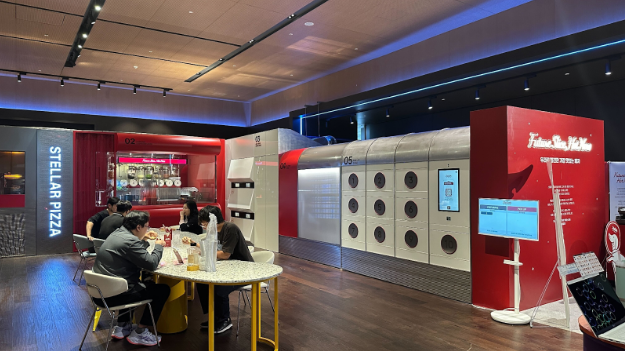
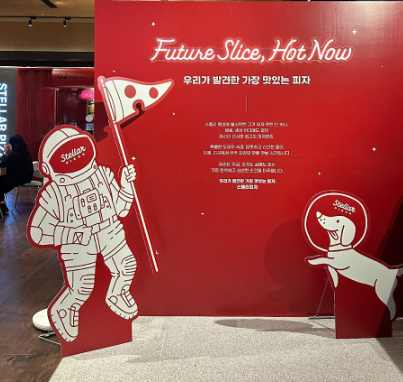
Hanwha Foodtech, a leading food tech company in Korea, is driving this shift through its robot pizza brand Stellar Pizza, building a fully automated cooking system. To manage robot-made pizza quality with precision down to 0.1 mm—and deliver the same “perfect pizza” anywhere in the world—Hanwha Foodtech adopted Superb AI’s Vision AI solution.
Challenge: How to Control the Quality of “Unstructured Food”
Hanwha Foodtech’s automated pizza-making process is handled by robots—from stretching the dough to applying sauce, adding toppings, and baking. But even with robots, outcomes can vary slightly due to factors such as dough condition, subtle temperature fluctuations in the oven, and fermentation differences.
As Hanwha Foodtech pushed toward unmanned operations, it encountered the following core challenges:
- Subjective quality judgment: Standards for questions like “Are the toppings evenly distributed?” and “Is it baked to the right golden color?” varied by worker and store, making it difficult to standardize taste.
- Lack of data-driven, real-time feedback: When defects occurred, there was no quantitative log data to immediately trace whether the root cause was the sauce nozzle, the oven conveyor speed, or another factor. And if defects were found only after the pizza was finished, ingredients and time had already been wasted.
- Complex defect types: Quality factors such as dough circularity, sauce imbalance, cheese distribution, and burn level are difficult to detect with rule-based algorithms alone. In high-speed production lines, it is also nearly impossible for humans to visually inspect every pizza in real time.
To overcome these challenges and secure a decisive quality advantage, Hanwha Foodtech set out to deploy an AI inspection system across the entire cooking process—one that could outperform the human eye in precision and consistency.
Solution: A Process-Tailored Vision AI Quality Control System
Superb AI deployed an automated Vision AI quality inspection solution tailored to Hanwha Foodtech’s robotic cooking process directly into the real-time production workflow. The focus was on controlling quality across the full cooking process in real time and establishing a data-driven operational system.
1. Building a Tailored Data Pipeline and High-Precision Analysis Model
The team collected large volumes of images generated in real operating environments and converted expert quality standards into training data. To build a precise analysis foundation, they trained extensively on diverse cases so the model could remain robust even under difficult-to-control variables such as lighting changes and the irregular shapes of real food ingredients.
2. A Data-Driven Quality Scoring System
The core of the solution was data-driven quality scoring. Rather than simply flagging defects, the system converts the condition of unstructured food into objective numerical values and manages quality through an intelligent scoring framework. This made previously ambiguous quality standards measurable and consistent.
3. Cloud-Based Real-Time Inference Architecture
To eliminate bottlenecks on a high-speed production line, the team designed a scalable cloud-based serverless architecture. This created an environment where the same quality inspection engine can continue to operate flexibly and without delay—even as global store count grows or order volume surges.
Benefit: Proven Transformation on the Production Floor—Backed by Data
This project successfully transformed the culture of the production floor from “expert intuition” to “data-driven science.”
- Fewer defects and lower costs: By detecting defects early in the process, Hanwha Foodtech minimized the cost and energy waste of allowing incorrectly made pizzas to reach the finished-product stage.
- Ensured brand consistency: Hanwha Foodtech can now deliver the same quality pizza across stores worldwide, significantly strengthening the core asset of any franchise business: brand trust.
- Data assetization and operational optimization: All production and quality data is accumulated in real time in the cloud. Managers can monitor field conditions remotely through a dashboard and take immediate action, while the accumulated data becomes a core asset for future equipment and process optimization.
In a rapidly evolving global food tech market—especially as food automation grows into a roughly $28 billion market in 2025—the key to sustained competitive advantage is no longer just reproducing taste, but achieving consistent, data-driven quality at scale. The collaboration between Hanwha Foodtech and Superb AI is meaningful not simply because it introduced AI, but because it helped shift manufacturing culture from experience to science.
This success was made possible through a data optimization process deeply rooted in on-site operations. Rather than applying a generic model, Superb AI validated the initial model by training on thousands of simulated images before store launch—embedding expert-level quality standards into the AI from day one. After launch, the team followed an “on-site optimization” cycle, continuously collecting and training on real operational data and variables from the field.
Superb AI will continue to go beyond one-time technology delivery—solving complex challenges in food and beverage manufacturing through ongoing data optimization and long-term partnership, and delivering measurable value to our customers’ businesses.
Related Posts
![[Customer Success Story] How Mobile AI CCTV Supports Permit-to-Work Safety at a Power Plant](https://cdn.sanity.io/images/31qskqlc/production/cbf6328f2afc92a3e7c3ba70f68a721d02c1ed66-3200x1800.png?fit=max&auto=format)
Case Study
[Customer Success Story] How Mobile AI CCTV Supports Permit-to-Work Safety at a Power Plant
Hyun Kim
Co-Founder & CEO | 10 min read
![[Customer Success Story] How AgTech Company Metafarmers Built Crop Recognition Datasets for Harvesting Robot Vision](https://cdn.sanity.io/images/31qskqlc/production/7ee10aa76e0f471a557629050f70fcb5eac47060-3200x1800.png?fit=max&auto=format)
Case Study
[Customer Success Story] How AgTech Company Metafarmers Built Crop Recognition Datasets for Harvesting Robot Vision
Hyun Kim
Co-Founder & CEO | 5 min read
![[Customer Success Story] How a Video-Based Behavior Analysis AI Company Built a Scalable Keypoint Labeling Workflow](https://cdn.sanity.io/images/31qskqlc/production/5371223bbc093c18d5d64b667266722102072d01-3200x1800.png?fit=max&auto=format)
Case Study
[Customer Success Story] How a Video-Based Behavior Analysis AI Company Built a Scalable Keypoint Labeling Workflow
Hyun Kim
Co-Founder & CEO | 7 min read

About Superb AI
Superb AI is an enterprise-level training data platform that is reinventing the way ML teams manage and deliver training data within organizations. Launched in 2018, the Superb AI Suite provides a unique blend of automation, collaboration and plug-and-play modularity, helping teams drastically reduce the time it takes to prepare high quality training datasets. If you want to experience the transformation, sign up for free today.