Case Study
[Customer Success Story] From Component Identification to Defect Detection: How a Manufacturer of Industrial Automation Components Built a PCB Labeling Workflow

Hyun Kim
Co-Founder & CEO | 2026/08/18 | 10 min read
“From Component Identification to Defect Detection”: A PCB Labeling Workflow for a Manufacturer of Industrial Automation Components
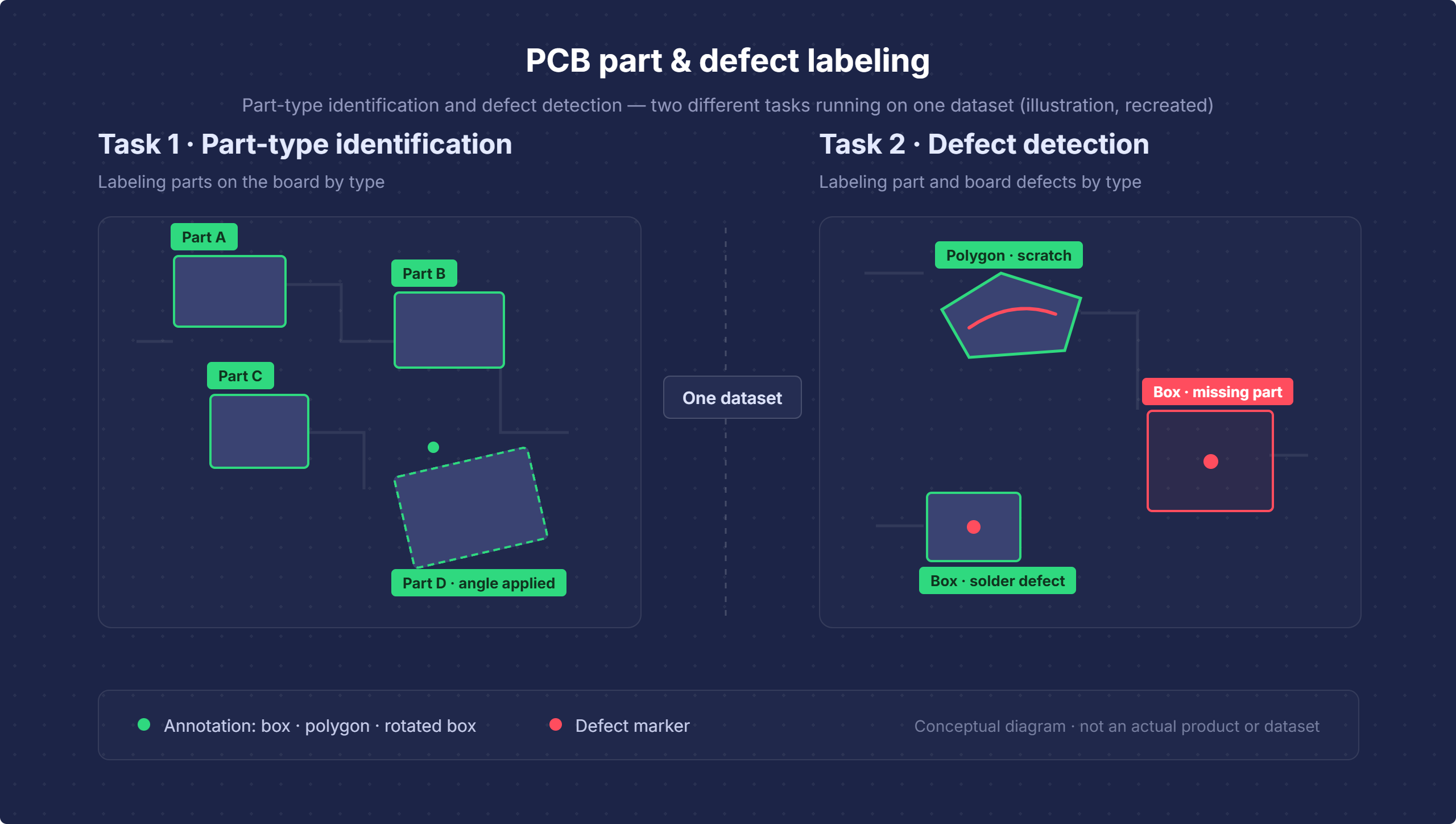
An illustrated reconstruction of a labeling structure in which component identification and defect detection are handled on the same dataset
AI adoption in manufacturing starts not with the model, but with the dataset.
That is because the labeling stage defines which components should be identified, which criteria should be used, and which conditions should be classified as defects. For research teams at manufacturing companies looking to build AI capabilities in-house, the first bottleneck is often the same: which tool and workflow should be used to operate labeling?
Many teams begin with open-source labeling tools. They are available with no upfront cost and are often sufficient for small-scale experiments.
But once the data shifts to real product data and annotation requirements become more diverse, gaps begin to appear in areas that labeling features alone cannot solve: project management, label-quality review, and dataset exploration.
The research team at a manufacturer of industrial automation components faced the same challenge. As the company prepared to develop AI for identifying component types and detecting defects on PCB boards, it began evaluating labeling tools that could serve as the foundation for dataset construction.
After comparing multiple tools, the company adopted Superb Platform and built a labeling workflow for real product data.’
Multiple Labeling Requirements for a Single PCB
The data handled by the manufacturer consisted of PCB board images.
The task had two parts: identifying the types of components mounted on the board, and detecting defects in the components and on the board itself. Because both tasks were performed on the same dataset, the difficulty of labeling increased beyond a simple sum of the two.
Annotation types differed by task
Component identification and defect detection require different annotation formats.
Some targets can be labeled sufficiently with bounding boxes, while others have irregular shapes that require polygon segmentation. Components mounted at an angle are especially difficult to capture with standard bounding boxes because too much background is included. For these cases, rotated bounding boxes that reflect the object’s angle are required.
Moving back and forth across these annotation requirements in an open-source tool became a recurring operational burden.
The tool had labeling features, but no operating system around them
The company’s labeling was performed directly by its internal research team, rather than outsourced to an external vendor.
Because the data contained product information, sending it outside the organization was difficult. In a small-team structure where the same people served as both managers and labelers, operational tasks such as assigning work, tracking progress, and managing review history became direct bottlenecks in the labeling process.
The existing open-source tools did not support this operational layer.
There was no practical way to verify label quality
Labeling errors limit model performance before training even begins.
But finding incorrect labels ultimately required people to review the data again. For a small internal team, reviewing the entire dataset manually was not a realistic option.
Quality control depended heavily on the diligence of individual workers.
From Labeling to Review: One Integrated Workflow
Superb Platform is a Vision Intelligence platform that automates the full AI model development workflow, from data collection and labeling to training and evaluation.
As the manufacturer compared labeling tools, it identified one clear priority: usability. The deciding factor was not simply which tool had the longest feature list, but how smoothly a small team could use it every day for both labeling and operations.
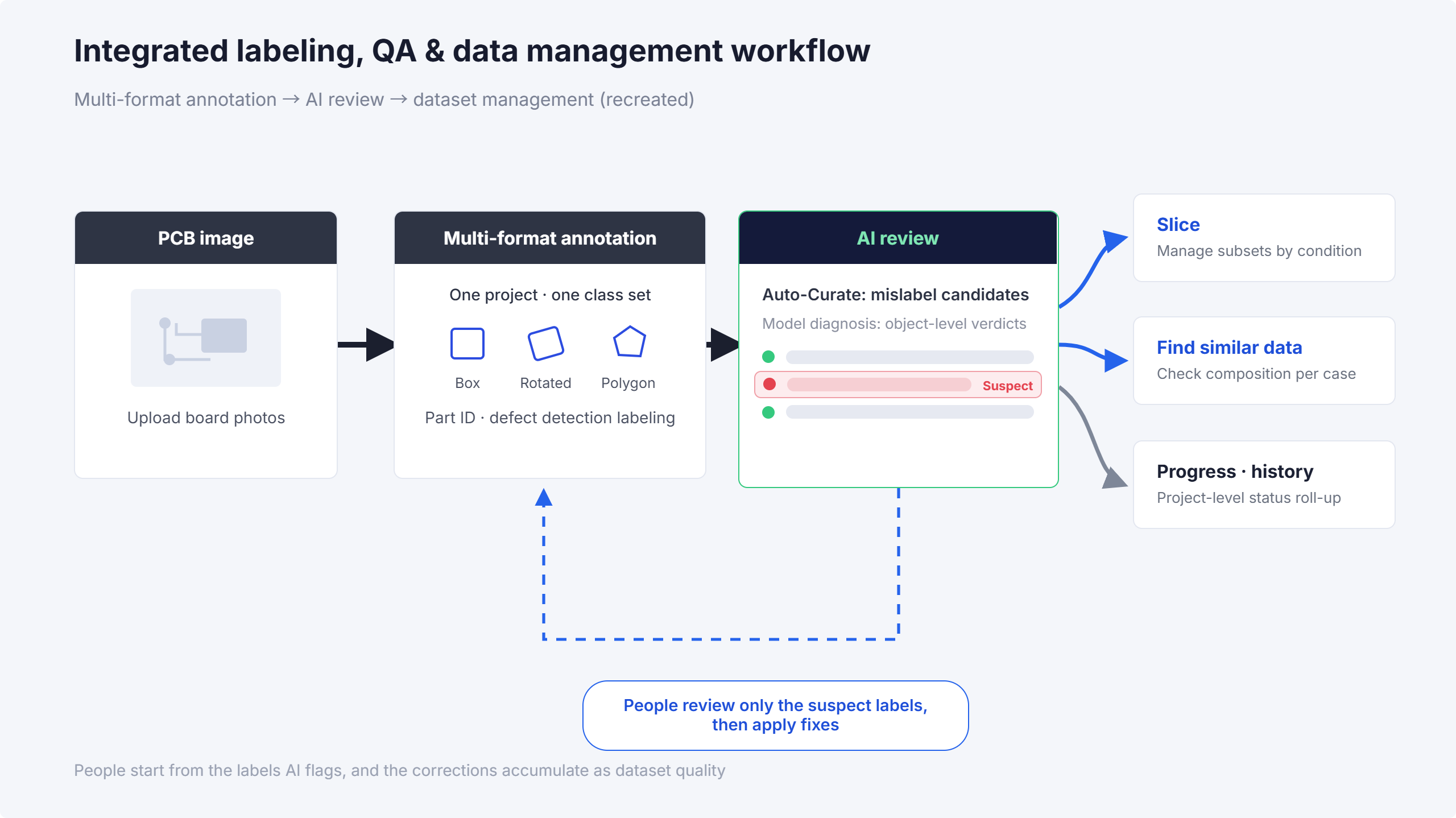
Reconstructed workflow: multi-format annotation, AI-assisted review, and dataset management
1. Multi-format annotation in a single project
The team used bounding boxes, polygons, and rotated bounding boxes together within a single project.
The class systems for component identification and defect detection were defined in one place, and the appropriate annotation type was selected based on the shape and characteristics of each target.
Annotation results from the company’s existing tool were migrated in a standard format, allowing the team to continue the work without losing continuity.
2. Automating quality review with mislabel detection
Using Auto-Curate on Superb Platform, the team automatically surfaced labels that were likely to be incorrect.
Instead of manually reviewing the entire dataset again, reviewers could start with the suspicious labels flagged by AI.
Model diagnosis features also allowed the team to inspect model predictions at the object level, narrowing down the classes and data points where performance was unstable.
3. Dataset exploration and management
With the Slice feature, the team created and managed subsets of data that met specific conditions. Using similar data search, the team gathered images similar to specific cases and reviewed the overall composition of the dataset.
Labeling progress and work history were aggregated at the project level, allowing team members who also served as managers to understand project status without maintaining separate tracking documents.
A Structure That Allows a Small Team to Manage High-Variety Product Data
The biggest change in this case was not simply labeling speed. It was the operating structure.
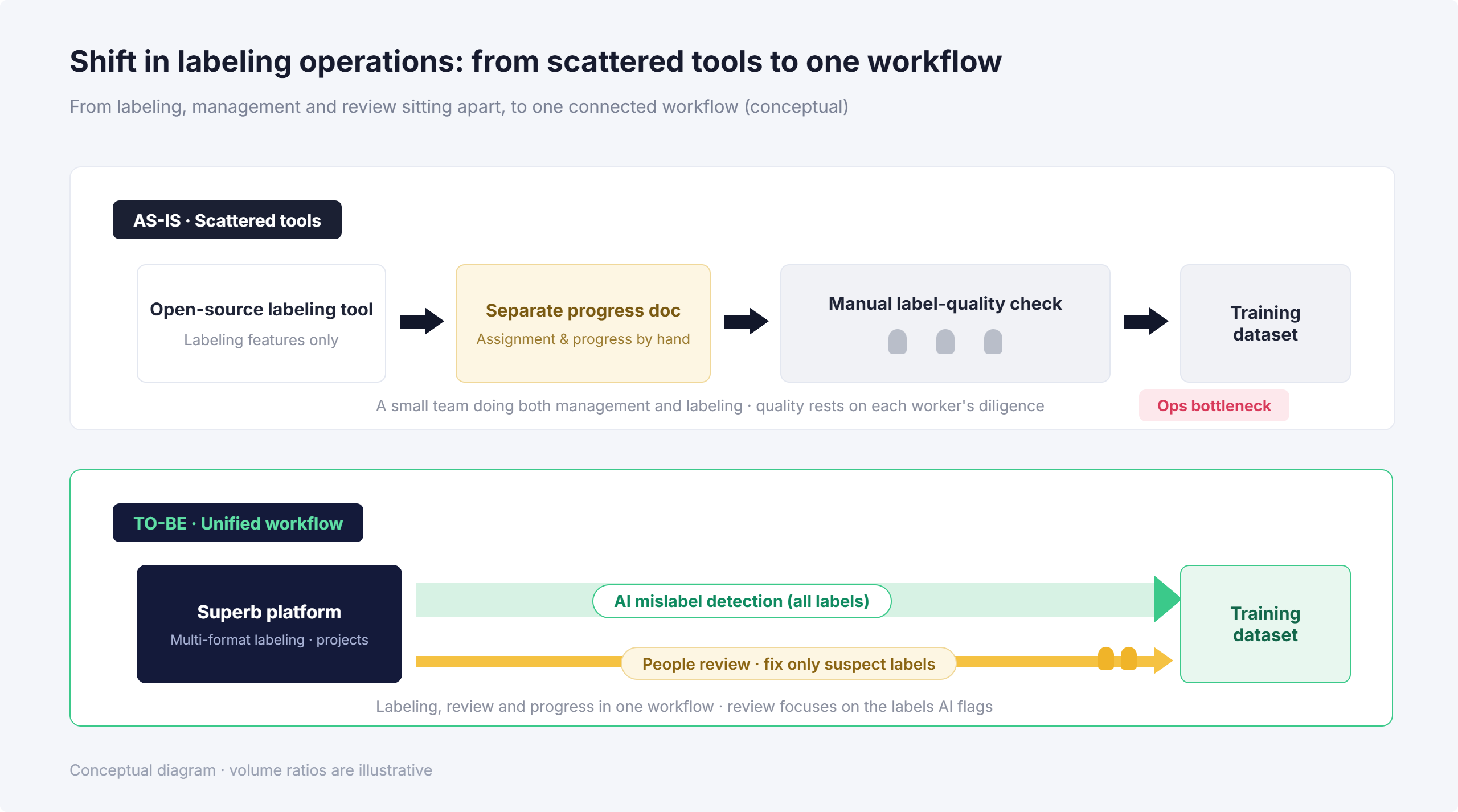
Concept diagram: From fragmented labeling, management, and review to a connected workflow
- The cost of switching between tools disappeared. Labeling, review, and data management were connected in a single workflow, without the need to split work by annotation type or maintain separate management documents.
- Label quality no longer depended on the human eye alone. AI first identified likely mislabels, creating a structure in which even a small team could inspect the quality of the entire dataset.
- Security requirements and internal AI development goals were preserved. The company was able to keep data in-house and continue building the dataset directly with internal personnel, while using the platform to supplement the operating layer it had lacked.
Building the Dataset Is the First Gateway to a Successful Manufacturing AI
In domains such as PCB inspection, where there are many component types and diverse defect patterns, the choice of labeling tool directly affects both dataset quality and the speed of construction.
This case shows where manufacturing research teams often hit limits after starting with open-source tools, and how an integrated workflow for labeling, review, and data management can resolve that bottleneck at the real product data stage.
With more than 130 million industrial visual data assets, Superb AI supports the full manufacturing AI workflow, from dataset construction to model development and operation.
Frequently Asked Questions
Can we migrate data labeled in an existing labeling tool?
Yes. Annotations exported from existing tools can be uploaded in standard formats such as JSON and used to continue the workflow. In this case, the team also began by migrating annotation results from an existing open-source tool.
Does Superb Platform support specialized annotation types such as rotated bounding boxes?
Yes. Multiple annotation types, including bounding boxes, polygons, and rotated bounding boxes, can be used together within a single project. This makes it possible to handle tasks with different characteristics, such as component identification and defect detection, on the same dataset.
Can a small labeling team operate this workflow?
Yes. Automated mislabel detection and object-level review features reduce the burden of quality control, while project-level progress and history management can replace separate operational tracking documents. This case was also carried out by a small internal team responsible for both management and labeling.
Can the platform be used with data that requires strict security?
Yes. Data is used only within the agreed scope of the project. Depending on customer security requirements, Superb AI also supports closed-environment operation, including on-premises deployment.
Related Posts
![[Customer Success Story] How Mobile AI CCTV Supports Permit-to-Work Safety at a Power Plant](https://cdn.sanity.io/images/31qskqlc/production/cbf6328f2afc92a3e7c3ba70f68a721d02c1ed66-3200x1800.png?fit=max&auto=format)
Case Study
[Customer Success Story] How Mobile AI CCTV Supports Permit-to-Work Safety at a Power Plant
Hyun Kim
Co-Founder & CEO | 10 min read
![[Customer Success Story] How AgTech Company Metafarmers Built Crop Recognition Datasets for Harvesting Robot Vision](https://cdn.sanity.io/images/31qskqlc/production/7ee10aa76e0f471a557629050f70fcb5eac47060-3200x1800.png?fit=max&auto=format)
Case Study
[Customer Success Story] How AgTech Company Metafarmers Built Crop Recognition Datasets for Harvesting Robot Vision
Hyun Kim
Co-Founder & CEO | 5 min read
![[Customer Success Story] How a Video-Based Behavior Analysis AI Company Built a Scalable Keypoint Labeling Workflow](https://cdn.sanity.io/images/31qskqlc/production/5371223bbc093c18d5d64b667266722102072d01-3200x1800.png?fit=max&auto=format)
Case Study
[Customer Success Story] How a Video-Based Behavior Analysis AI Company Built a Scalable Keypoint Labeling Workflow
Hyun Kim
Co-Founder & CEO | 7 min read

About Superb AI
Superb AI is an enterprise-level training data platform that is reinventing the way ML teams manage and deliver training data within organizations. Launched in 2018, the Superb AI Suite provides a unique blend of automation, collaboration and plug-and-play modularity, helping teams drastically reduce the time it takes to prepare high quality training datasets. If you want to experience the transformation, sign up for free today.