Case Study
[Customer Success Story] How the National Fire Research Institute Built an AI Monitoring System for Early EV Fire Detection in Underground Parking Facilities

Hyun Kim
Co-Founder & CEO | 2026/09/03 | 7 min read
Overview
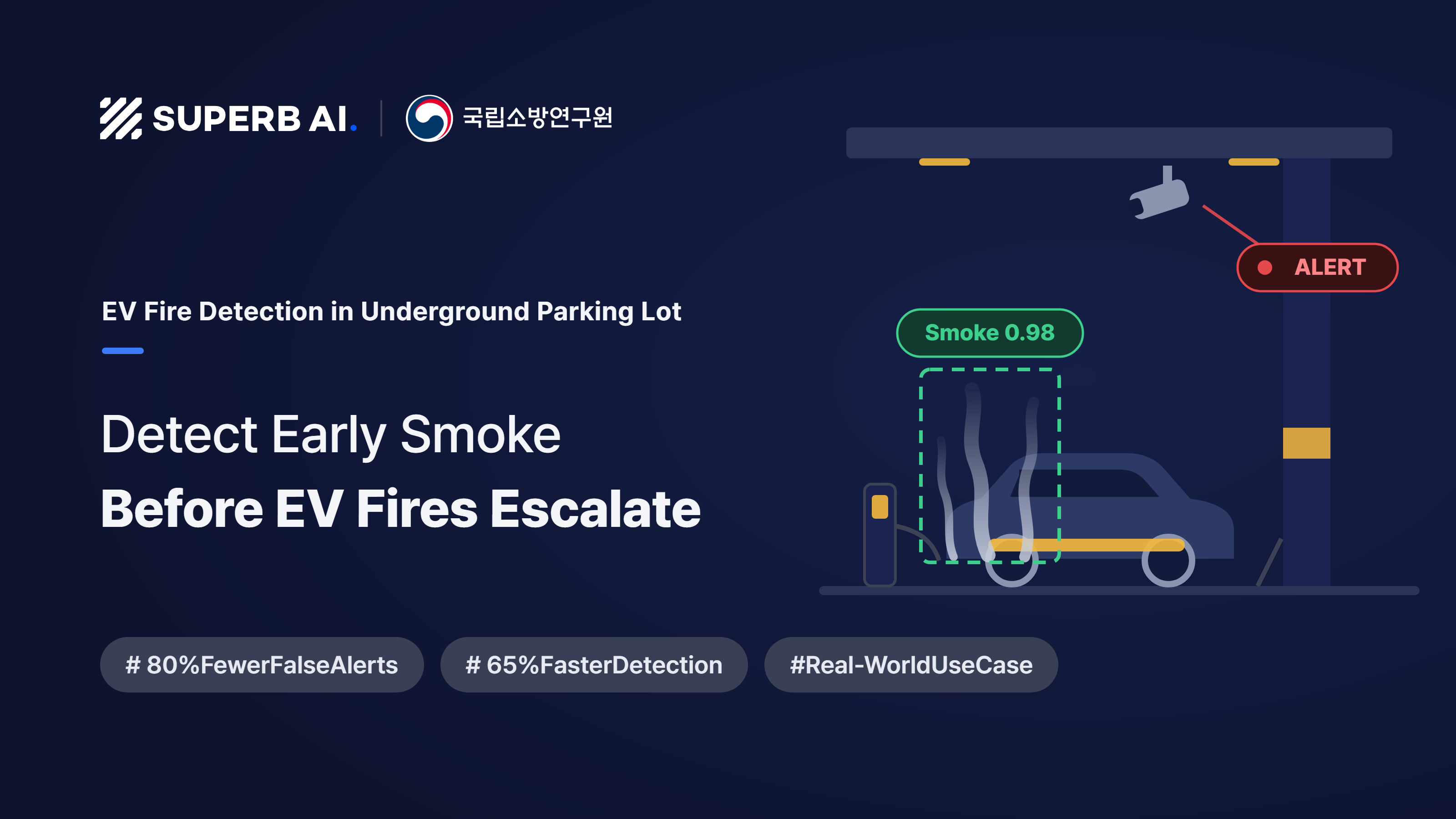
As the electric vehicle market grows, new safety challenges are emerging alongside it. To take Korea as an example — EV registrations in Korea surpassed 750,000 as of May 2025, while National Fire Agency statistics show that 238 EV fires were reported through 2024, resulting in KRW 9.5 billion (approx. USD 6.9 million) in property damage (National Assembly Budget Office, NABO Focus No. 125, November 2025). Nearly half of these fires—49.2%—occurred while vehicles were stationary, parked, or charging, highlighting the particular vulnerability of underground parking facilities where EVs are concentrated. In February 2025, the Korean government also introduced comprehensive fire safety measures for EVs in underground parking facilities.
The National Fire Research Institute (NFRI), a national research institution under the National Fire Agency of Korea, works to address fire safety challenges through research and technology development. NFRI has been collaborating with Superb AI to develop AI models for EV fire and smoke detection. The research program was structured in six-month phases, and as of 2026, the fourth and final phase is underway. This case study looks back at that journey.
Challenge: Manual Detection Is Too Slow, Conventional Systems Are Too Inaccurate
NFRI faced challenges unique to EV fires.
First, thermal runaway is difficult to detect early. Thermal runaway in lithium-ion batteries progresses differently from conventional fires. Existing fire detection systems, including smoke detectors, can struggle to identify the faint smoke generated during the early stages of thermal runaway. At the same time, false alarms can lead to unnecessary evacuations and response costs.
Second, underground environments can amplify the damage. EV fires can spread rapidly to nearby vehicles and are difficult to extinguish because of the risk of reignition. Underground parking facilities also have limited access routes, making it harder for fire engines and firefighters to reach the scene. Because the consequences grow as detection is delayed, identifying smoke within the first few minutes is critical.
Solution: From a Specialized Dataset to Real-Time Monitoring
1. Building a Dataset Specialized for EV Fires
Superb AI processed approximately 100,000 images of fire, smoke, and vehicles to build a specialized training dataset. The dataset combined data from real fire incidents with data captured in controlled experiments, while rare scenarios were supplemented with synthetic data generated using generative AI.
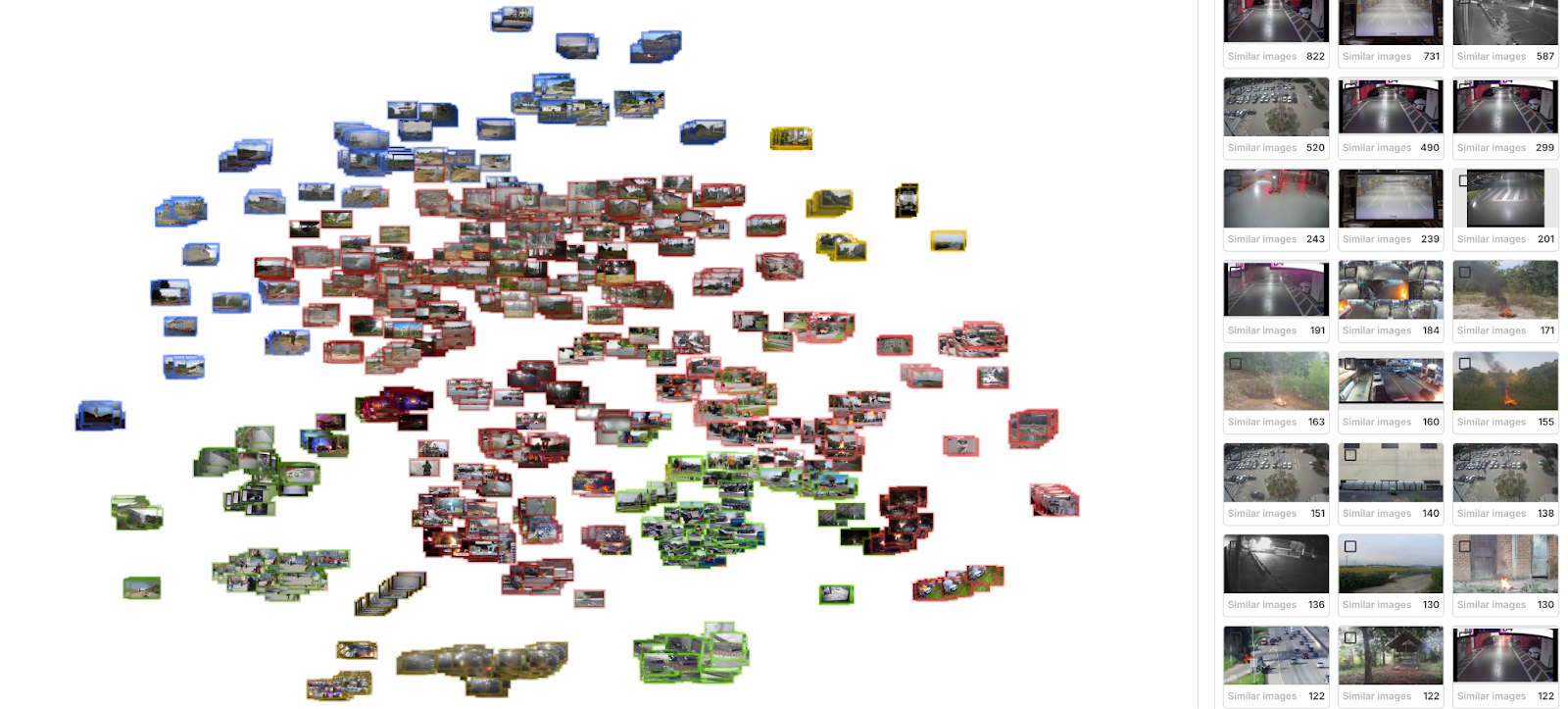
During dataset development, the team used Scatter View in Superb Platform to examine the distribution and patterns of fire and smoke data and manage overall data quality.
2. Developing a Detection Model for Real-Time Processing
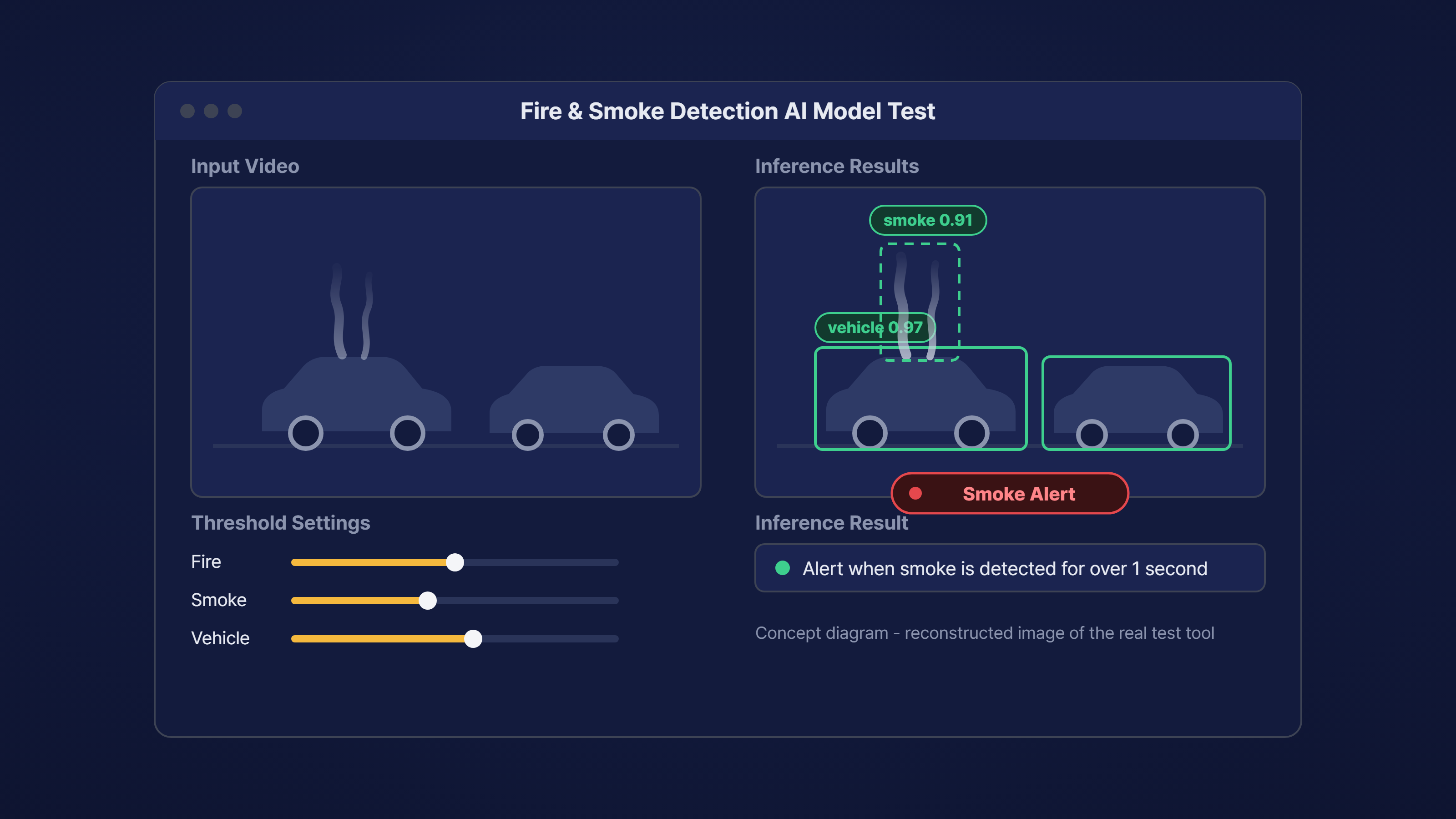
Multiple models were trained and compared using the dataset, after which the team selected the model that offered the best balance of accuracy and speed while meeting real-time processing requirements.
Because the goal was to detect faint smoke during the early stages of battery thermal runaway, validation focused not only on visible flames but particularly on smoke detection performance.
3. Building an Edge-Based Real-Time Monitoring System
The resulting model was implemented as a real-time monitoring system running on edge devices. Because video is analyzed directly on-site without passing through a cloud server, the system can be integrated with existing CCTV infrastructure. Detection events are communicated immediately through on-screen warnings and audible alarms.
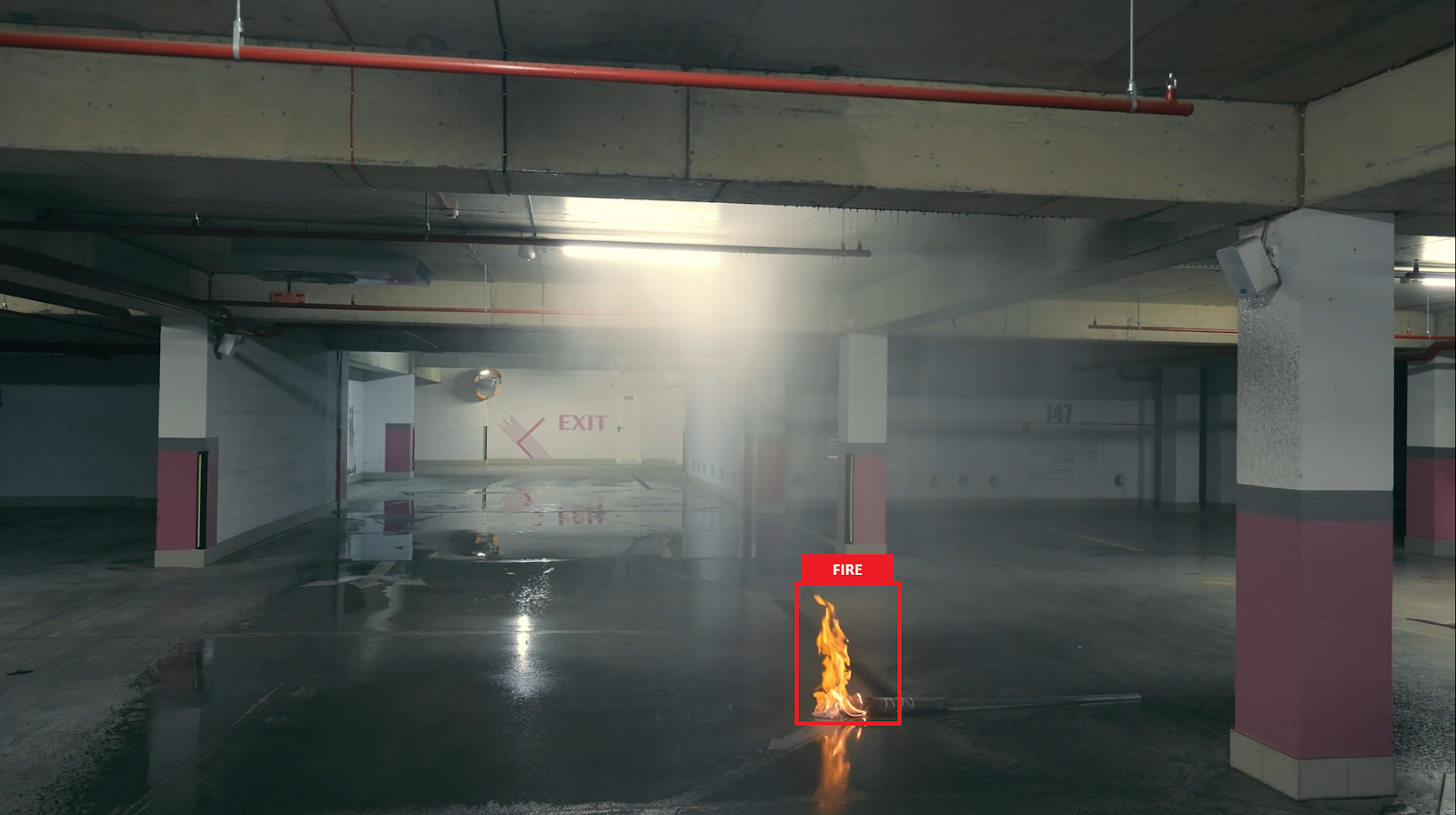
In November 2025, the team conducted a field demonstration in an actual underground parking facility to validate smoke detection performance under real-world conditions rather than only in controlled test environments.
Benefit: 80% Fewer False Alarms and 65% Faster Detection
The performance of the EV fire detection model was demonstrated through measurable results.
- 65% faster detection: The time required to detect a fire was reduced by 65% compared with the existing system. The model showed particularly strong performance in identifying early signs of battery thermal runaway.
- 80% fewer false alarms: Reducing false alarms helped minimize unnecessary evacuations and response costs.
- Field validation: In November 2025, smoke detection performance was reconfirmed under real-world conditions through a field demonstration in an actual underground parking facility.
Current State: Turning the Final Phase into a Deployable System
As of 2026, the collaboration between NFRI and Superb AI has entered its fourth and final phase. While the earlier phases focused on improving detection accuracy, the final phase is focused on turning the technology into a system that can be deployed in real-world environments.
Optimizing the model for low-cost edge devices. The team is optimizing the model to run in real time on compact edge devices rather than requiring high-performance hardware. The goal is to enable deployment without installing an expensive server in every underground parking facility.
Developing a web-based monitoring system. The team has developed a web-based monitoring system in which a local web server runs on the edge device and can be accessed from a PC on the same network. The system operates independently without relying on an external server. Fire and smoke detection events trigger both on-screen warnings and audible alarms, while event logs are recorded for later review.
Completing a full-scale fire simulation test. In August 2026, the team completed a full-scale test that recreated real fire conditions. Smoke was generated inside an underground parking environment to validate the system’s detection performance under realistic conditions.
A key differentiator of the system lies in the data used to train it. Systems trained primarily on generic fire data available online tend to recognize smoke that appears prominently near the camera. By contrast, the model developed through this research is specialized for underground parking environments and faint smoke originating beneath EVs, with the goal of detecting smoke even at greater distances from the camera.
Once the research is completed, the team plans to establish quantitative test criteria—such as the maximum detection distance and required detection time—that can help define future performance standards for EV fire detection systems.
Conclusion
This case demonstrates how AI can advance fire safety research from data development through real-world deployment. Site-specific challenges are addressed through specialized datasets and synthetic data, models run in real time at the edge, and performance is validated through field testing in actual underground parking environments.
The project has now progressed to its final step: refining the technology into a system that can be deployed in the field. Superb AI will continue advancing Vision Intelligence for industry to help create safer real-world environments.
Frequently Asked Questions
Q. What results has the project achieved?
The EV fire detection model reduced the false alarm rate by 80% and shortened average detection time by 65% compared with the existing system.
Q. What data was used to develop the model?
Approximately 100,000 images of fire, smoke, and vehicles were processed to build the training dataset. Rare scenarios were supplemented with synthetic data generated using generative AI.
Q. How is this different from existing fire detection systems?
Unlike systems trained primarily on generic fire data, this model is specialized for EV battery thermal runaway and underground parking environments. It is designed to detect faint smoke during the early stages of thermal runaway.
Q. What research is currently underway?
The project is now in its final phase, focused on real-time EV fire detection in underground parking facilities using low-cost edge devices. The team is completing a deployable system with web-based monitoring and audible alerts, while also working toward quantitative performance criteria for future testing and deployment.
Q. Can this system be deployed at our site?
Because the system is designed to add edge devices to existing CCTV infrastructure, deployment can be considered without major new construction or infrastructure changes. Contact us through the form below to discuss a configuration tailored to your site conditions.
Superb AI is a Vision Intelligence company that transforms visual data from industrial environments into actionable intelligence for enterprises. The results described in this case study were developed through a real-world project led by Superb AI.
Related Posts
![[Customer Success Story] How Mobile AI CCTV Supports Permit-to-Work Safety at a Power Plant](https://cdn.sanity.io/images/31qskqlc/production/cbf6328f2afc92a3e7c3ba70f68a721d02c1ed66-3200x1800.png?fit=max&auto=format)
Case Study
[Customer Success Story] How Mobile AI CCTV Supports Permit-to-Work Safety at a Power Plant
Hyun Kim
Co-Founder & CEO | 10 min read
![[Customer Success Story] How AgTech Company Metafarmers Built Crop Recognition Datasets for Harvesting Robot Vision](https://cdn.sanity.io/images/31qskqlc/production/7ee10aa76e0f471a557629050f70fcb5eac47060-3200x1800.png?fit=max&auto=format)
Case Study
[Customer Success Story] How AgTech Company Metafarmers Built Crop Recognition Datasets for Harvesting Robot Vision
Hyun Kim
Co-Founder & CEO | 5 min read
![[Customer Success Story] How a Video-Based Behavior Analysis AI Company Built a Scalable Keypoint Labeling Workflow](https://cdn.sanity.io/images/31qskqlc/production/5371223bbc093c18d5d64b667266722102072d01-3200x1800.png?fit=max&auto=format)
Case Study
[Customer Success Story] How a Video-Based Behavior Analysis AI Company Built a Scalable Keypoint Labeling Workflow
Hyun Kim
Co-Founder & CEO | 7 min read

About Superb AI
Superb AI is an enterprise-level training data platform that is reinventing the way ML teams manage and deliver training data within organizations. Launched in 2018, the Superb AI Suite provides a unique blend of automation, collaboration and plug-and-play modularity, helping teams drastically reduce the time it takes to prepare high quality training datasets. If you want to experience the transformation, sign up for free today.