Case Study
[Customer Success Story] How to Solve Shipbuilding’s Labor Shortage with Smart Yards and Vision AI-Powered Robot Automation

Hyun Kim
Co-Founder & CEO | 2026/04/30 | 5 min read
![[Smart Yard] How to Build a Data Pipeline for Welding Robot Training](https://cdn.sanity.io/images/31qskqlc/production/3019d33819a87ede2f94df8d63b845c120a0967d-2754x1536.png?fit=max&auto=format)
Summary: In heavy industry and shipyard environments, where harsh working conditions and severe labor shortages have become structural challenges, robot automation is no longer optional — it is a requirement for survival. The first step toward the Smart Yard era, from autonomous welding to robotic painting, is turning skilled workers’ tacit know-how into quantitative data that robots can understand, and giving those robots “eyes” through Vision AI so they can perceive and respond to the real world. From teleoperation-based robot learning design to AI model data pipeline development, here is how a global shipyard partnered with Superb AI to accelerate its Smart Yard transformation.
Smart Yard — No Longer a Matter of Choice, but of Survival
The shipbuilding and heavy industry sectors are now in the middle of the fastest and most consequential digital transformation in their history. According to the latest report from global market research firm Mordor Intelligence, the global digital shipyard market is expected to grow from $2.06 billion in 2025 to $4.7 billion by 2030, representing a steep 18% CAGR.
The biggest reason companies are investing heavily in Smart Yard initiatives is simple: a shortage of skilled labor. In Korea alone, the number of foreign workers in shipyards has reportedly increased fiftyfold over the past four years — a clear sign of how severe the shortage of experienced workers has become.
This is especially true for welding and painting, two of the most critical processes in shipbuilding and among the most physically demanding and skill-intensive. To sustain productivity while addressing labor shortages, robotics is becoming essential. In fact, major Korean shipbuilders have publicly stated goals of raising production automation rates to 70% through broader adoption of welding and processing robots.
But bringing robot arms onto the factory floor does not instantly create a Smart Yard.
Background and Core Challenge: “We Bought the Robot — But Why Can’t We Use It?”
The reason many heavy industry companies fail to see real returns from robotics is the complexity of the field environment. Unlike a controlled indoor factory, a shipyard is close to unconstrained. Block sizes and shapes change constantly. Lighting conditions shift. Weather introduces new variability. Almost every task involves a moving set of environmental variables.
Traditional repetitive robots cannot adapt to this kind of environment. For the customer pursuing Smart Yard transformation, the core challenges were clear:
- Can skilled workers’ intuition be turned into data? Experienced welders and painters with decades of field knowledge can instantly adjust the way they work based on the color of the flame, subtle sounds, or the texture of a surface. That tacit know-how had to be translated into quantitative data that machines could learn from.
- Can robots perceive changing environments on their own? No matter how precise a robot arm is, it is ineffective if it is effectively moving blind. The customer needed advanced Vision AI that could accurately recognize work targets and update trajectories in real time despite constant environmental variation.
To solve these challenges, one of the world’s leading shipyards turned to Superb AI, a specialist in AI data pipelines and Vision AI.
Superb AI’s Solution: Building a Complete Robot Learning Pipeline Around Vision AI
What is the fastest, most reliable way to start building a Smart Yard?
Superb AI went beyond labeling data. It designed an integrated robot learning pipeline that combines eyes — Vision AI — with experience — high-quality data — so robots can learn to understand, adapt, and act in the field.
Step 1: Diagnose Existing Data Assets and Build a Tailored Collection Plan
The first step was to assess the customer’s existing data assets in depth, including engineering drawings, quality inspection images, and process videos. Superb AI separated the tasks that could be learned from existing data from the more complex tasks that required new data collection. That allowed the customer to reduce unnecessary costs and establish a roadmap that could demonstrate business impact early in the AI learning cycle.
Step 2: Build a Teleoperation-Based Data Collection Lab for Skilled Worker Knowledge
This data collection lab was the core of the solution.
Skilled workers remotely operated industrial robots equipped with cameras and sensors to perform real welding and painting tasks. During this process, Vision AI cameras mounted on the robot captured the work target and the surrounding environment in high resolution, while the robot arm’s trajectory, speed, and angle were recorded in real time.
This is where tacit craftsmanship, previously difficult to explain in words, was converted into fully synchronized multimodal time-series data.
Step 3: Turn High-Quality Data into Two Strategic Assets
The high-quality data collected in this way was systematically refined and managed through Superb AI’s platform. It then became a powerful asset in two ways.
- First, as AI training data for autonomous robot models: It became the most effective training material for teaching autonomous robots powered by Vision AI.
- Second, as onboarding content for new workers: In field environments struggling with the decline of experienced workers, the same data became the most accurate and intuitive guide for training new personnel.
Step 4: Deploy Vision AI Infrastructure into the Real Smart Yard Environment
Drawing on extensive experience building large-scale datasets across a range of hardware platforms — including robotic arms and humanoids — Superb AI successfully deployed Vision AI models into the customer’s real Smart Yard environment.
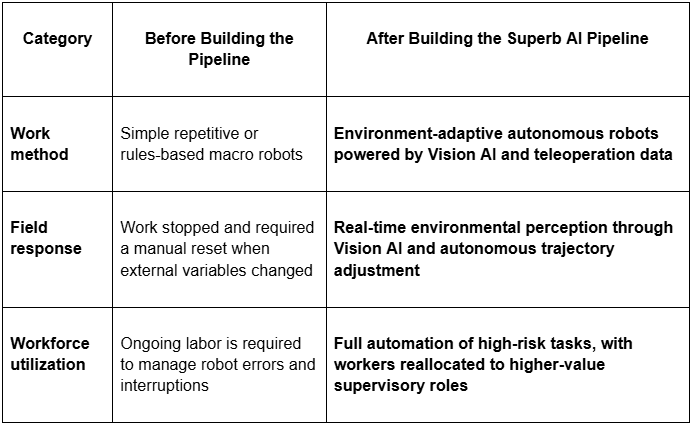
The robots could now use cameras to recognize the state of the workpiece in real time through Vision AI, and perform the optimal task using the learned data pipeline.
Business Impact: The Success of Robot Adoption Is Determined by Data
By proactively building a high-quality data pipeline for robot training, the global shipyard customer was able to achieve clear, measurable business results.
- Dramatically reduced trial and error and deployment time: What previously took months to configure and stabilize in the field could now be deployed and operationalized much faster through standardized Vision AI training data.
- Expanded the scope of automation: The customer moved beyond simple repetitive tasks and extended robot automation into areas once limited to highly skilled workers, including curved welding and painting of complex structures — moving one step closer to its 70% production automation target.
- Established sustainable quality consistency: Instead of relying on individual worker condition or skill level, the customer gained a system capable of delivering consistent, high-quality output across operations.
Start Your Smart Yard Transformation with Superb AI
In the shift from labor-constrained shipyards to digital shipbuilding operations, hardware matters — but software matters just as much. The key is not only deploying robots, but giving them the intelligence to work effectively through Vision AI and data.
The quality of your data and the accuracy of your Vision AI will determine what kind of robots you can deploy, when you can deploy them, and which processes they can successfully automate.
If you are planning a Smart Yard transformation, now is the time to talk with Superb AI’s expert team — a partner with proven experience helping companies across industries deploy AI and build the data pipelines needed to make automation work in the real world.
Related Posts
![[Customer Success Story] How Mobile AI CCTV Supports Permit-to-Work Safety at a Power Plant](https://cdn.sanity.io/images/31qskqlc/production/cbf6328f2afc92a3e7c3ba70f68a721d02c1ed66-3200x1800.png?fit=max&auto=format)
Case Study
[Customer Success Story] How Mobile AI CCTV Supports Permit-to-Work Safety at a Power Plant
Hyun Kim
Co-Founder & CEO | 10 min read
![[Customer Success Story] How AgTech Company Metafarmers Built Crop Recognition Datasets for Harvesting Robot Vision](https://cdn.sanity.io/images/31qskqlc/production/7ee10aa76e0f471a557629050f70fcb5eac47060-3200x1800.png?fit=max&auto=format)
Case Study
[Customer Success Story] How AgTech Company Metafarmers Built Crop Recognition Datasets for Harvesting Robot Vision
Hyun Kim
Co-Founder & CEO | 5 min read
![[Customer Success Story] How a Video-Based Behavior Analysis AI Company Built a Scalable Keypoint Labeling Workflow](https://cdn.sanity.io/images/31qskqlc/production/5371223bbc093c18d5d64b667266722102072d01-3200x1800.png?fit=max&auto=format)
Case Study
[Customer Success Story] How a Video-Based Behavior Analysis AI Company Built a Scalable Keypoint Labeling Workflow
Hyun Kim
Co-Founder & CEO | 7 min read

About Superb AI
Superb AI is an enterprise-level training data platform that is reinventing the way ML teams manage and deliver training data within organizations. Launched in 2018, the Superb AI Suite provides a unique blend of automation, collaboration and plug-and-play modularity, helping teams drastically reduce the time it takes to prepare high quality training datasets. If you want to experience the transformation, sign up for free today.