Tech
Three Barriers to Industrial AI and the Role of Vision Foundation Models: NAIRL Seminar Recap

Hyun Kim
Co-Founder & CEO | 2026/11/20 | 27 min read
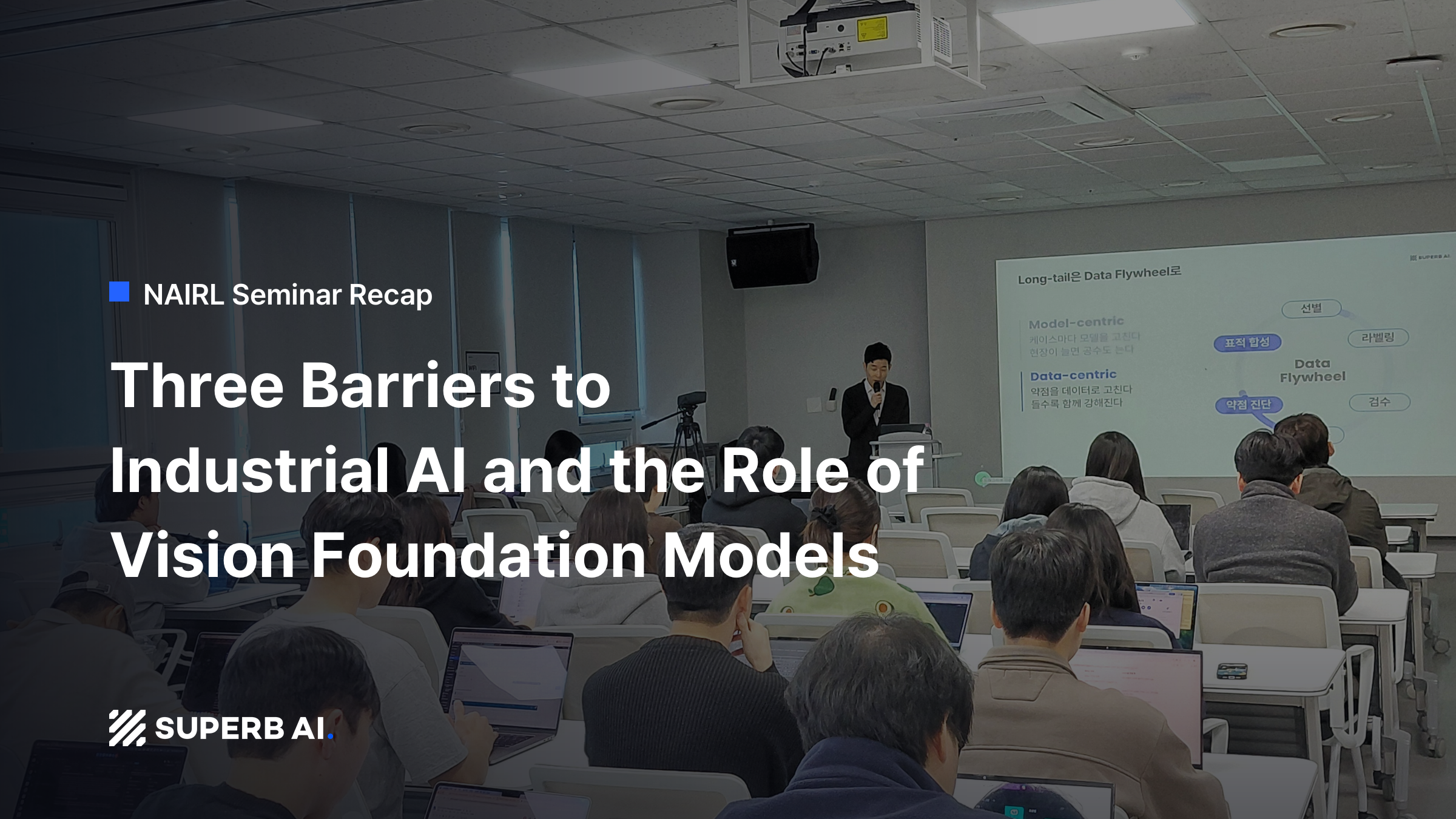
On November 10, 2026, Kye-Hyeon Kim, Chief Research Officer (CRO) at Superb AI, presented "Vision Intelligence for the Physical World" at Korea’s National AI Research Lab (NAIRL) monthly Distinguished Scholar Seminar, held at Seoul AI Hub.
His presentation explored three major barriers to AI adoption in industrial environments, the products and technologies Superb AI has developed to address each challenge, and its ongoing research into extending these capabilities to Physical AI.
📌 Key Takeaways
- Kim identified three barriers to broader industrial AI adoption: data scarcity, varying site conditions, and cost.
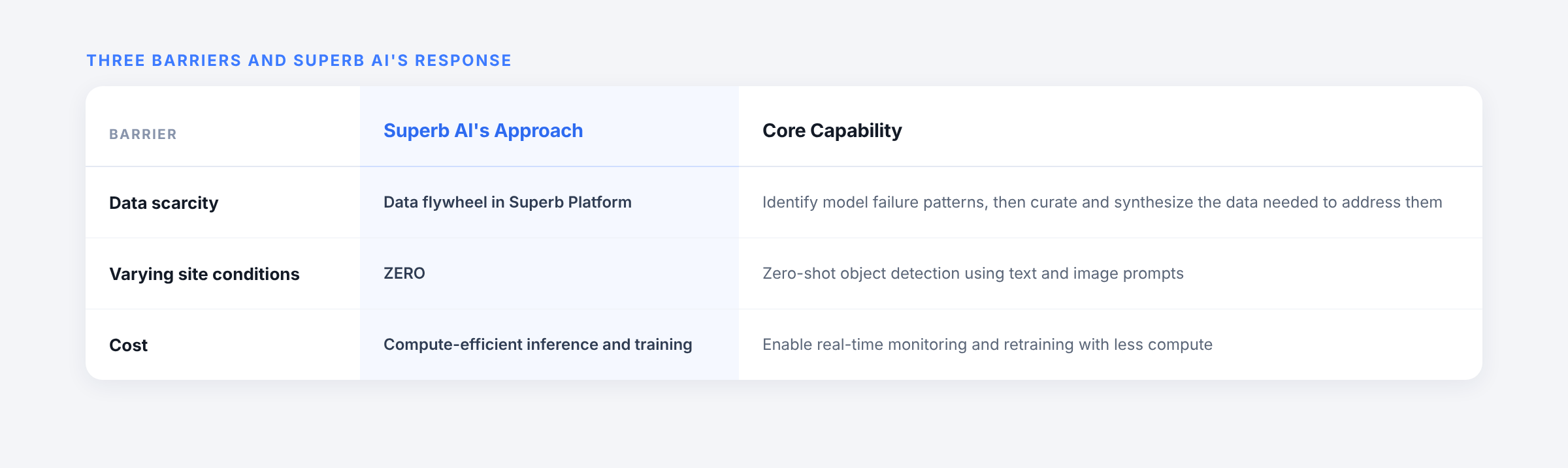
- Superb AI addresses data scarcity with its data flywheel, site-specific variability with ZERO, an industry-focused vision foundation model, and cost with compute-efficient inference and training technologies.
- Superb AI is extending these technologies into active monitoring and research on synthetic robot training data generation.
Why Is AI Adoption So Difficult in Industrial Environments?
Kye-Hyeon Kim, Chief Research Officer (CRO) at Superb AI, identified three major barriers to scaling AI across industrial environments: data scarcity, varying site conditions, and cost.
Accidents and defects occur infrequently, so training datasets tend to contain mostly routine scenarios. Even a model that performs well at one site can experience a significant drop in performance when deployed in a different environment.
Developing a custom model for every customer requires substantial time and effort from specialized engineers. Running large vision-language models (VLMs), which can interpret video and text, across hundreds of cameras around the clock can also make computing costs difficult to sustain.
Superb AI has developed corresponding products and technologies to address each barrier.
Data Flywheel: Addressing Model Weaknesses with Better Data
The presentation described Superb AI's approach to data scarcity as a data-centric process.
Superb AI analyzes the types of data on which a model makes errors, then uses additional data to address those weaknesses. Scenarios that are difficult to capture in real-world environments can be supplemented with synthetic data generated using generative AI. Each iteration of the data flywheel improves model performance. The data created to address model weaknesses also remains available for customers to reuse.
Superb Platform provides this workflow through a no-code interface, allowing teams to operate the process without dedicated machine learning experts. Superb AI has continued refining its data flywheel by applying it to the training of its own new models.
How Can AI Models Work at New Sites From Day One?
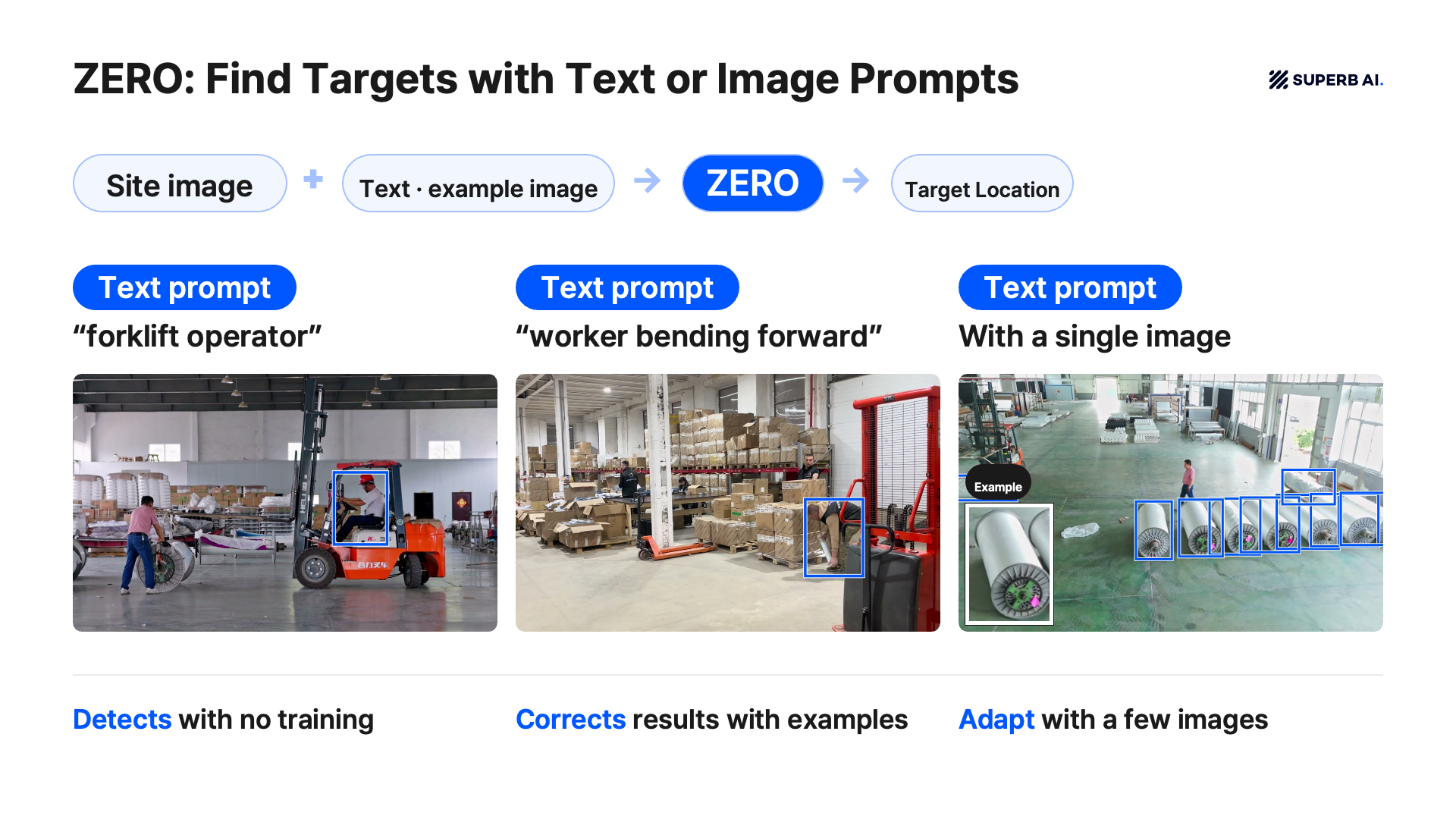
To address differences between deployment environments, Kim introduced ZERO, an industry-focused vision foundation model.
Deploying AI at a single industrial site typically requires months of data collection, labeling, training, and iterative improvement. And when a model developed for one factory is transferred to a facility in another country, teams often have to repeat much of the same process.
Superb AI has addressed this challenge by extensively applying its data flywheel in advance to develop a model that can perform across diverse industrial environments, with zero-shot detection capabilities that reduce the need for site-specific development.
ZERO is an object detection model that uses prompts to identify and locate targets. Users can describe what they want to detect in natural language, such as "forklift operator" or "worker bending forward." For objects that are difficult to describe in words, users can provide a single example image instead. If a new detection target should be added during operation, users can add a prompt for that target without additional task-specific training. Teams can begin deployment with a small number of samples and continue improving performance through the data flywheel.
ZERO was developed using Superb AI's collection of more than 130 million industrial images. It also achieved first place in the CVPR 2026 Foundational Few-Shot Object Detection Challenge.
Read more: Superb AI's ZERO Takes 1st Place in the CVPR 2026 Foundational Few-Shot Object Detection Challenge
Compute-Efficient Inference and Training: Monitoring Entire Sites with Less Compute
The presentation addressed the cost barrier from two perspectives: inference costs and training costs.
Consider a single logistics center. It may need AI for various purposes, such as inbound and outbound statistics, product inspection, process analysis, and safety monitoring. Customers want to process video from dozens of cameras around the clock using only one or two servers, while also generating reports.
A sufficiently capable VLM could address many of these needs. However, processing every frame through a VLM would make computing costs difficult to manage.
Superb AI reduces inference costs through three approaches:
- Fast detection: An ultra-lightweight version of ZERO detects and tracks objects in real time across multiple camera feeds.
- Spatiotemporal organization: Information captured by the cameras is structured and accumulated by position within the site’s 3D space and by time.
- Selective VLM processing: Most questions are answered directly using structured information. VLMs are used only when a question requires combining multiple pieces of evidence into an explanation.
For situations requiring immediate action, such as fire, a person collapsing, or someone approaching a hazardous area, alerts are triggered directly from detection results.
Superb AI has also worked to reduce training costs. The company has developed training architectures and methods that reduce the compute and memory required for retraining, and has applied them to ZERO's training process.
How Is Superb AI Extending These Technologies to Robotics?
Toward the end of the presentation, Kim introduced two areas of ongoing Physical AI research at Superb AI.
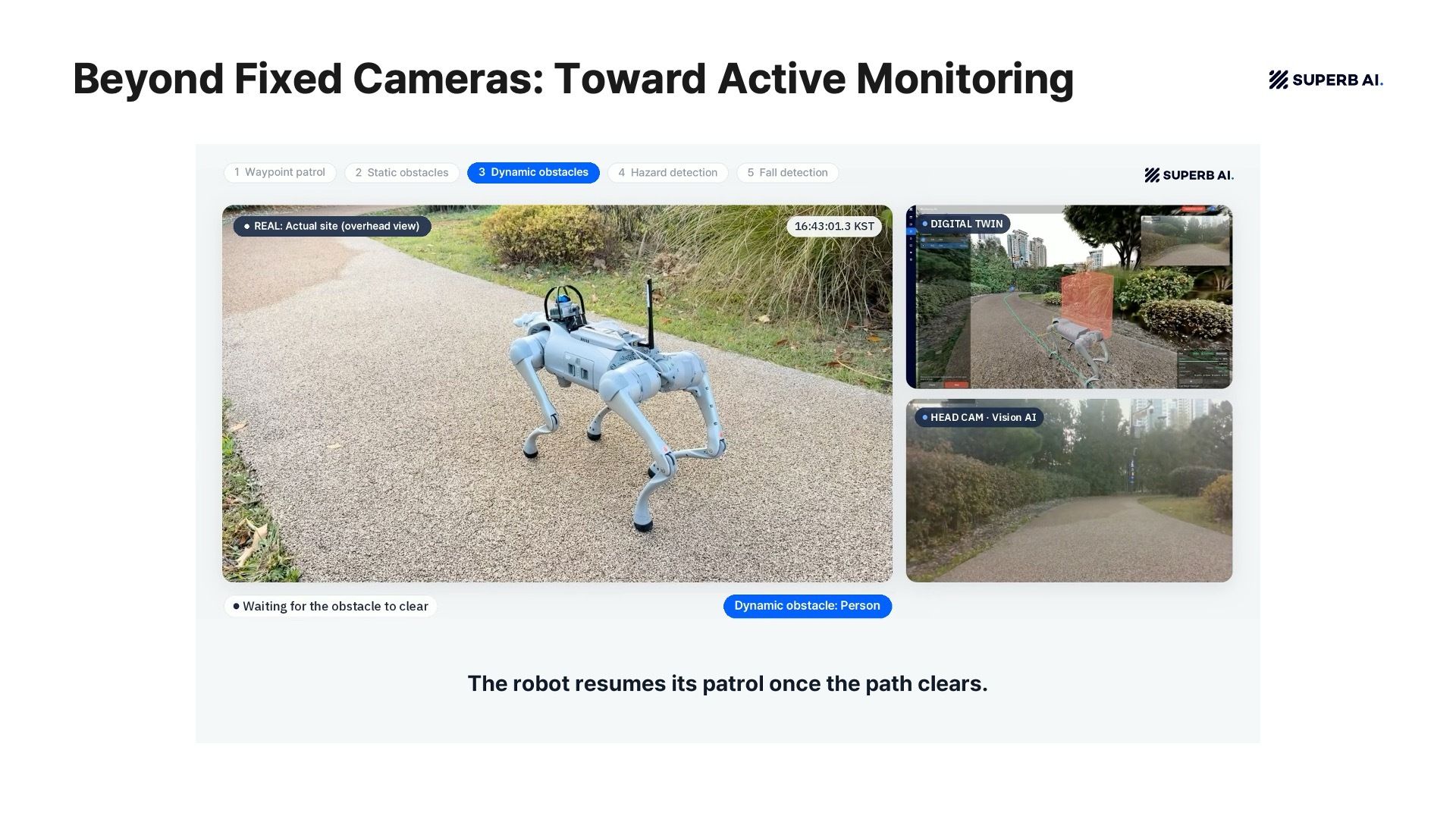
The first is active monitoring.
Fixed cameras inevitably leave blind spots, including poorly visible areas, locations too far away for clear observation, and spaces occluded by stored materials or other obstacles.
Superb AI is researching the use of quadruped robots that can move into areas beyond the view of fixed CCTV cameras to investigate conditions directly. When a robot identifies a potentially dangerous situation, it sends an alert. The robot's location and movements can also be viewed within a digital twin.
The second is technology that turns human demonstrations into robot training data.
Collecting training data across different robot types and environments through teleoperation requires considerable time and expense.
Superb AI is developing technology that converts videos of people performing tasks into training data for robots, helping reduce the time and cost of collecting robot training data.
About the Speaker
Kye-Hyeon Kim, Chief Research Officer (CRO), Superb AI
Kye-Hyeon Kim leads technical research supporting Superb AI's Vision Intelligence platform and ZERO, its industry-focused vision foundation model.
Featured Presentation: National AI Research Lab (NAIRL) Distinguished Scholar Seminar 2026, "Vision Intelligence for the Physical World"
For internal seminars or speaking engagements at external events, please submit your request using the contact form below.
Superb AI is a Vision Intelligence company that transforms visual data from industrial sites into intelligence enterprises can act on.
💬 Considering Vision AI for your operations, or looking for a speaker for an internal seminar or industry event? Tell us about your site or event and what you would like to discuss using the form below. A Superb AI representative will review your request and get back to you.
Related Posts
Tech
VLM Video Analytics: How It Differs from Traditional AI CCTV
Hyun Kim
Co-Founder & CEO | 7 min read
Tech
VLA vs RFM vs WFM vs VLM: Comparing 4 Robot AI Models
Hyun Kim
Co-Founder & CEO | 7 min read
Tech
Physical AI Glossary: 40 Terms for Robot Training Data, Simulation, and 3D Reconstruction
Hyun Kim
Co-Founder & CEO | 13 min read

About Superb AI
Superb AI is an enterprise-level training data platform that is reinventing the way ML teams manage and deliver training data within organizations. Launched in 2018, the Superb AI Suite provides a unique blend of automation, collaboration and plug-and-play modularity, helping teams drastically reduce the time it takes to prepare high quality training datasets. If you want to experience the transformation, sign up for free today.