Tech
Physical AI Glossary: 40 Terms for Robot Training Data, Simulation, and 3D Reconstruction

Hyun Kim
Co-Founder & CEO | 2026/10/21 | 13 min read
This Physical AI glossary is a reference guide that brings together the model, data, simulation, 3D reconstruction, and control terms used to train robots to perceive and act in the real world, with each term explained in one sentence. It begins with six commonly confused pairs of terms, followed by 12 core terms explained in more detail and 28 additional terms organized by category.
Each entry links to a Superb AI blog post where the term is used in practice. For an introduction to Physical AI itself, see What Is Physical AI? For the structure of Physical AI datasets, see the Physical AI Dataset Development Guide. This article focuses specifically on terminology. It reflects usage as of October 2026 and will be updated as new terms become established.
📌 Key Takeaways
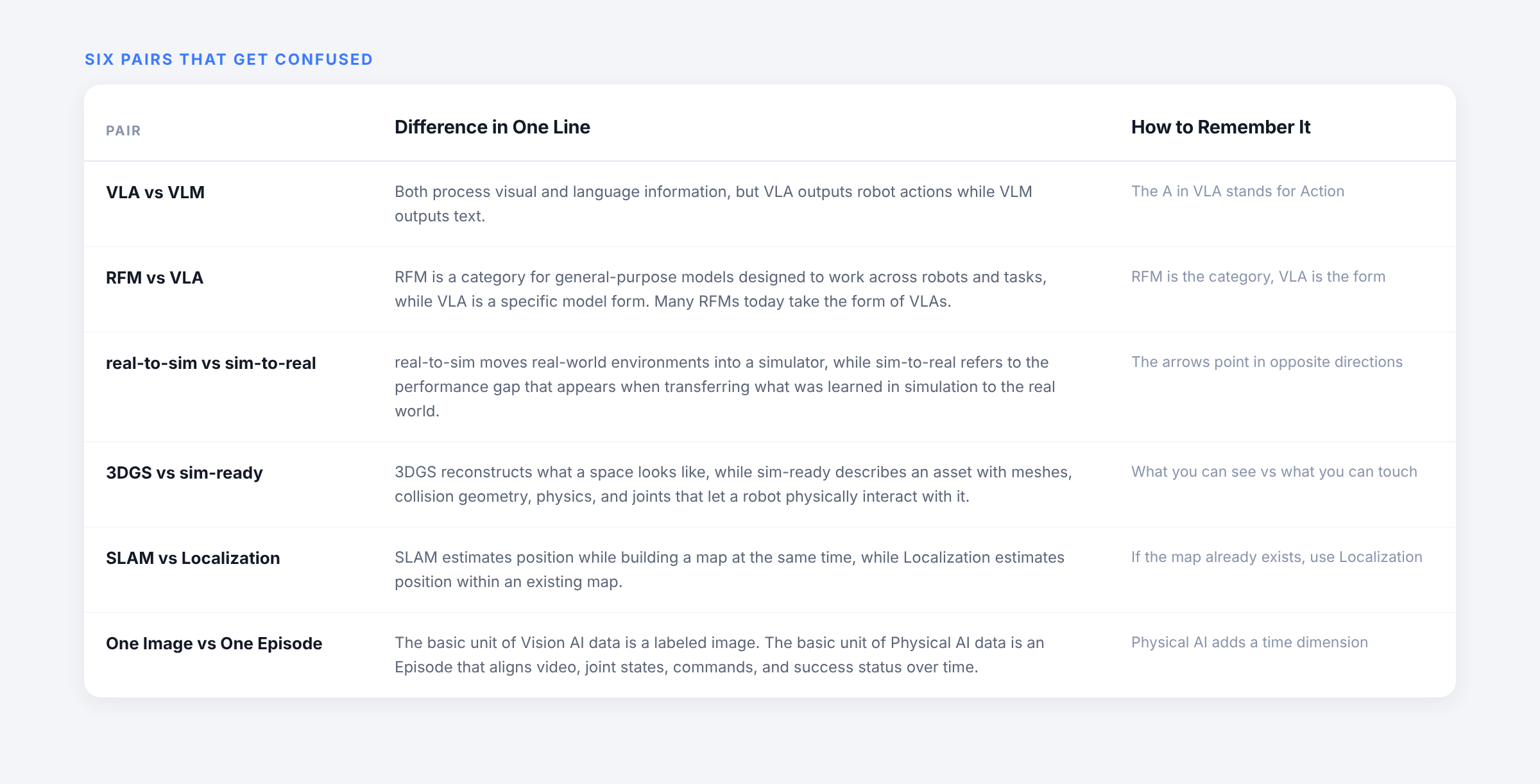
- Six pairs of terms are especially easy to confuse: VLA vs VLM, RFM vs VLA, real-to-sim vs sim-to-real, 3DGS vs sim-ready, SLAM vs Localization, and one Image vs one Episode.
- If the basic unit of Vision AI is a single image, the basic unit of Physical AI is an Episode with a time dimension. This difference changes both the data tools and the evaluation methods.
- A visually realistic 3D reconstruction and a sim-ready asset that a robot can physically interact with are different deliverables. This is one of the most common sources of confusion in project specifications and quotes.
6 Commonly Confused Pairs
People usually look up a glossary because they need to understand the boundary between two terms that sound similar. Here are six commonly confused pairs in one line each.
1. Models
VLA
Vision-Language-Action Model
A model that takes camera input and language instructions and directly outputs robot actions, such as joint targets or end-effector motion. Unlike a VLM, which focuses on perception and understanding, a VLA handles perception, understanding, and action within one model. Google DeepMind’s RT-2 helped popularize the term, and training requires Episodes in which observations and actions are recorded together.
RFM
Robot Foundation Model
A general category of robot models pretrained at scale across multiple robot embodiments and tasks, then adapted to a specific robot using a relatively small amount of data. RFM does not refer to a single architecture. It refers to generality across robots and tasks, and VLA is one of its most common implementation forms.
WFM
World Foundation Model
A model that takes the current scene and an action as input and predicts or generates what the next scene will look like. It can be used for planning by previewing the outcome of a robot action, or for data generation by expanding the amount of training video available. NVIDIA Cosmos is a representative example.
Read more → NVIDIA Cosmos Analysis
VFM
Vision Foundation Model
A vision model pretrained on large-scale image and text data that can recognize a wide range of objects without additional task-specific training. In a robot system, a VFM typically handles perception while another module handles action.
Read more → Vision Foundation Model Guide
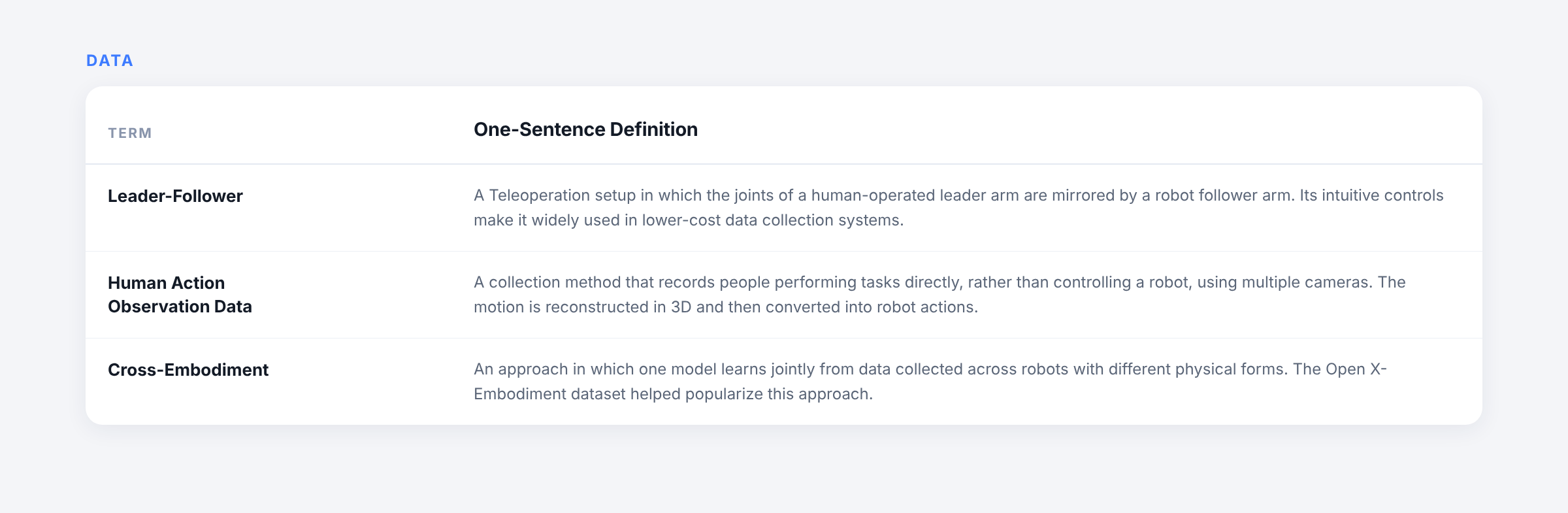
Other model terms are summarized below.

2. Data
Episode
A unit of data that captures one complete robot trial, from the start of a task to its end, along a shared timeline. Camera video, joint states, action commands, language instructions, and success status are aligned on that same timeline. What a single image is to Vision AI, an Episode is to Physical AI.
Read more → Three Paths to Robot Training Data
Teleoperation
A data collection method in which a person directly controls a robot through a remote interface while the resulting action data is recorded. Because observations and actions from the robot’s perspective are captured together, the data can be used directly for imitation learning. The main limitation is how much data can be collected per hour.
Read more → Robot Training Data Sourcing Guide
Success Rate
The percentage of trials in which a robot successfully completes the same task across repeated attempts. Because robot AI cannot be evaluated against a single fixed answer key, Success Rate is a de facto standard evaluation metric. It is most meaningful when broken down by task and operating condition.
Read more → Why Doesn’t Robot AI Have an ImageNet?
Other data terms are summarized below.
3. Simulation and Synthetic Data
sim-ready Asset
A 3D asset equipped with closed meshes, collision geometry, physical properties, and joint definitions so that a robot can move through, collide with, and manipulate it inside a simulator. It is a different deliverable from a visually realistic 3D reconstruction, so project specifications and quotes should clearly state which one is being delivered.
Read more → Reconstructing 50 Korean Homes with 3DGS
sim-to-real Gap
The drop in performance that occurs when a model trained in simulation is deployed in the real world, or the size of that performance difference. Common causes include differences in rendered appearance, physics approximation, and sensor noise. The gap is measured and managed using a real-world validation set.
Read more → Isaac Sim Synthetic Data Pipeline Guide
Domain Randomization
A technique that generates synthetic data while randomly varying conditions such as lighting, materials, camera position, and object placement so that a model does not overfit to a specific environment. It is one of the fundamental methods used to reduce the sim-to-real gap.
Read more → Build Once, Generate Endlessly: Running a Test of the Synthetic Data Pipeline
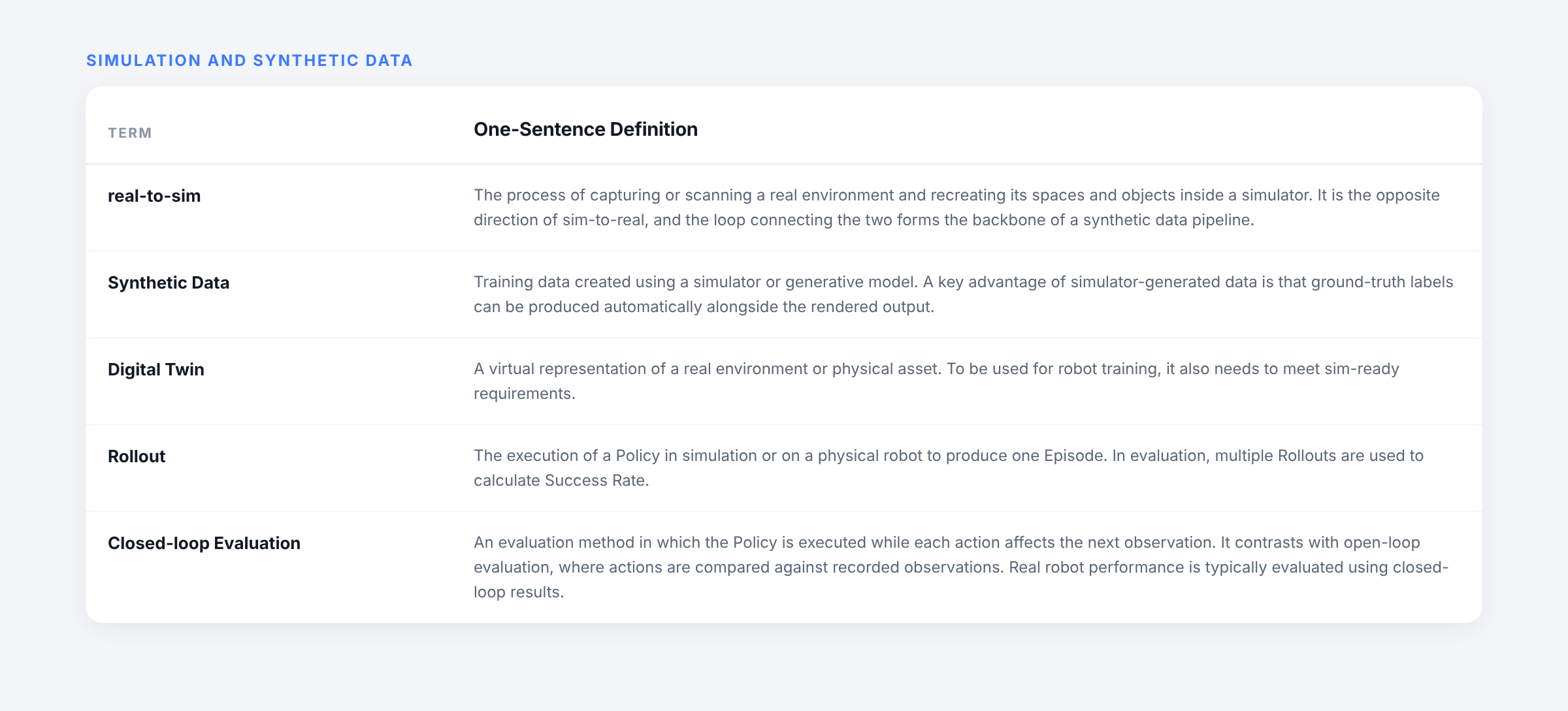
Other simulation terms are summarized below.
4. 3D Reconstruction and Spatial Perception
3DGS (3D Gaussian Splatting)
A 3D reconstruction technique that learns the light distribution of a space using a large number of Gaussian primitives and renders photorealistic views from arbitrary viewpoints in real time. Because the result is a collection of primitives rather than a physical surface, a separate mesh is required for physics simulation.
Read more → 3DGS Reconstruction Guide
Other 3D reconstruction terms are summarized below.
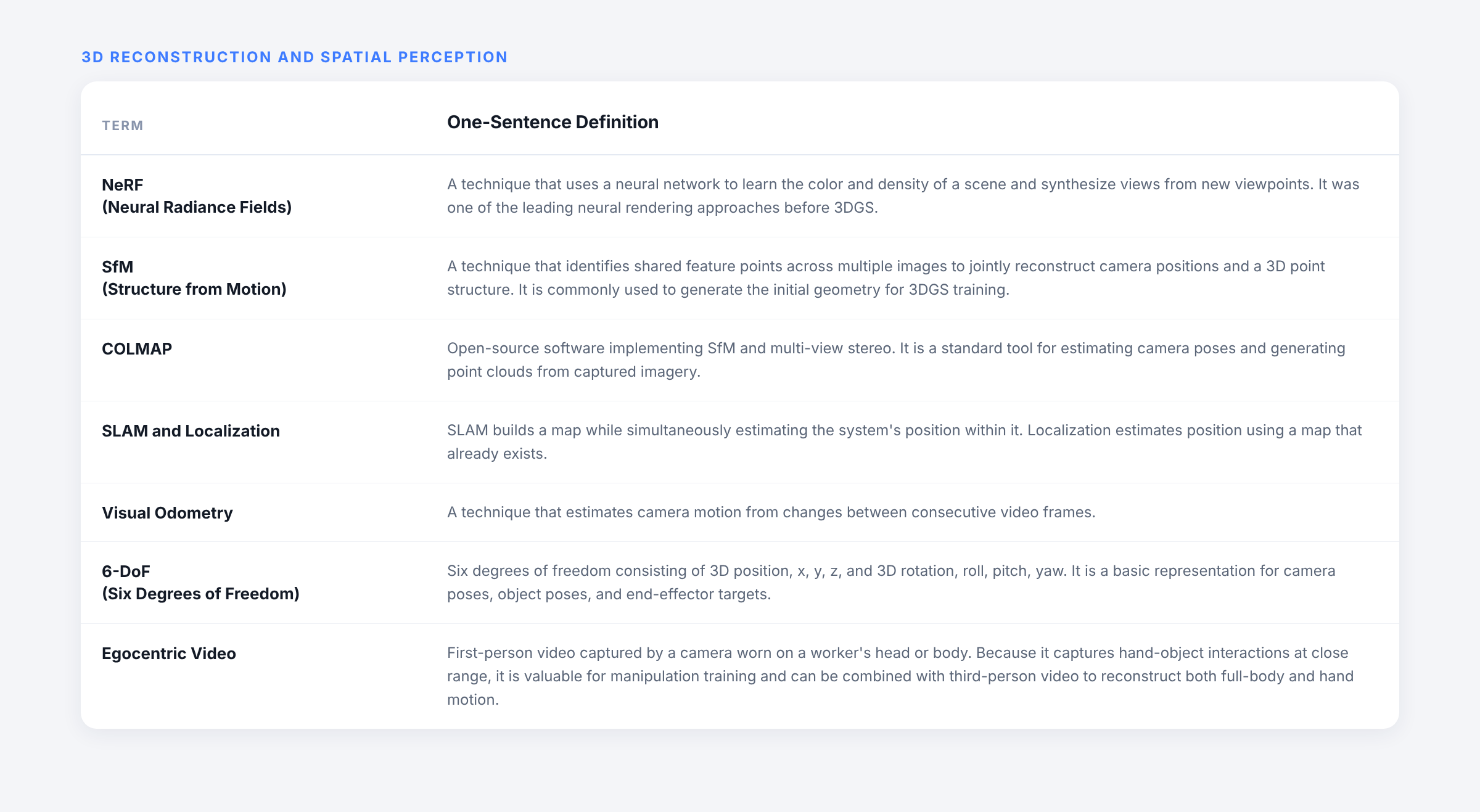
5. Human Motion and Robot Control
Retargeting
The process of converting human motion into robot motion when the human and robot have different joint structures and body proportions. Differences in arm length or hand size can otherwise create unreachable poses or physical intersections, so Retargeting typically incorporates both anchor constraints and physical constraints.
Read more → SMPL-Based 4D Action Assets
Other motion and control terms are summarized below.

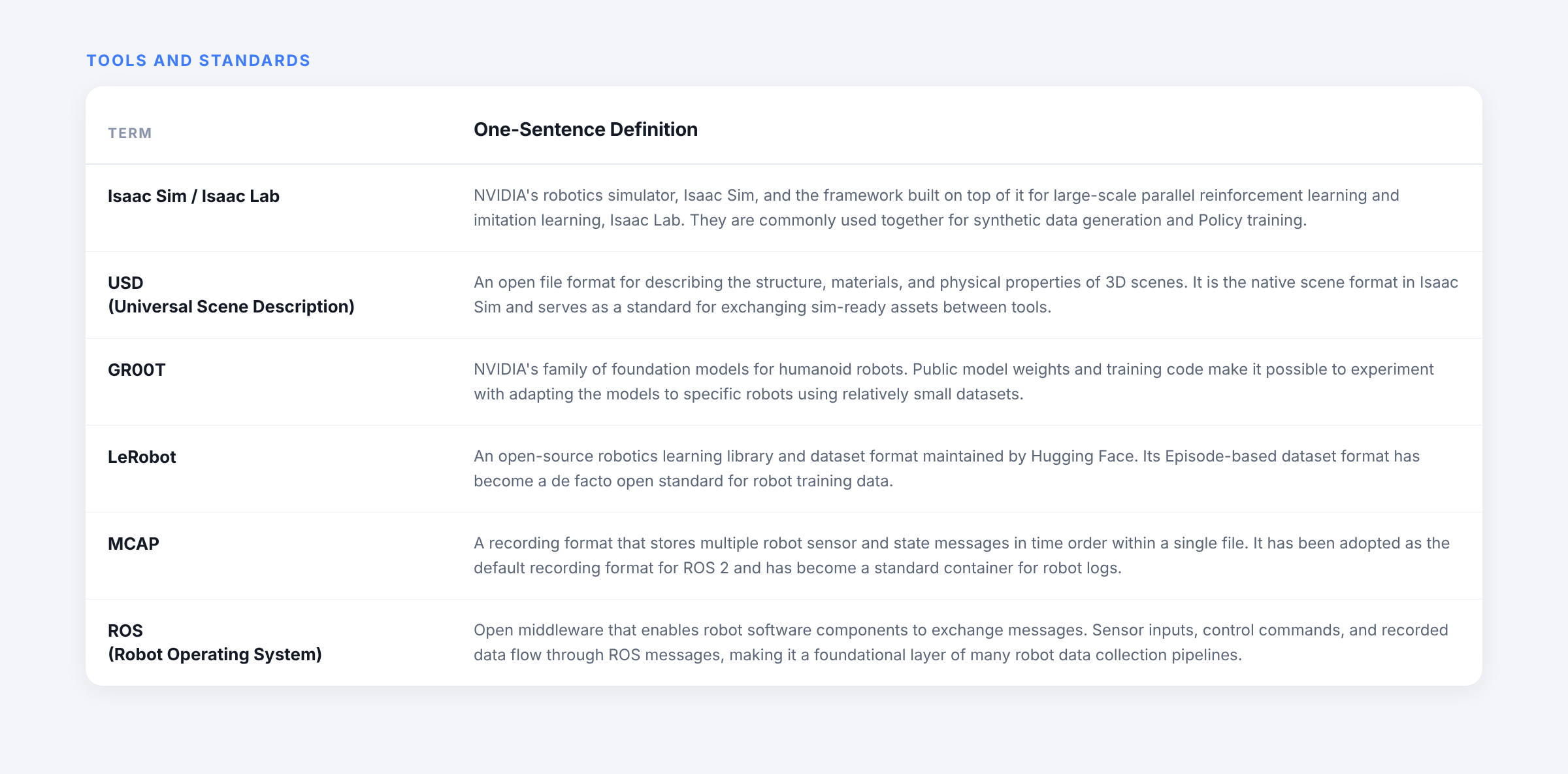
6. Tools and Standards
Tools and standards are summarized in the table below.
Superb AI is a Vision Intelligence company that transforms visual data from industrial sites into intelligence enterprises can act on. In its Physical AI Data Factory, Superb AI builds 3D spatial, action, and object assets and creates robot training data through simulation and real-world collection.
Related Content
- Physical AI Dataset Development Guide: 4 Data Types and a 3-Step Pipeline
- Robot Training Data Sourcing Guide: 4 Options and How to Choose a Training Data Provider
- Building Robot Training Data: Simulation, Real-Robot Collection, and Autonomous Patrol
💬 Considering building Physical AI data? Tell us the robot type and task below. Rather than starting with a sales call, we’ll begin by reviewing the data specifications you need.
Related Posts
Tech
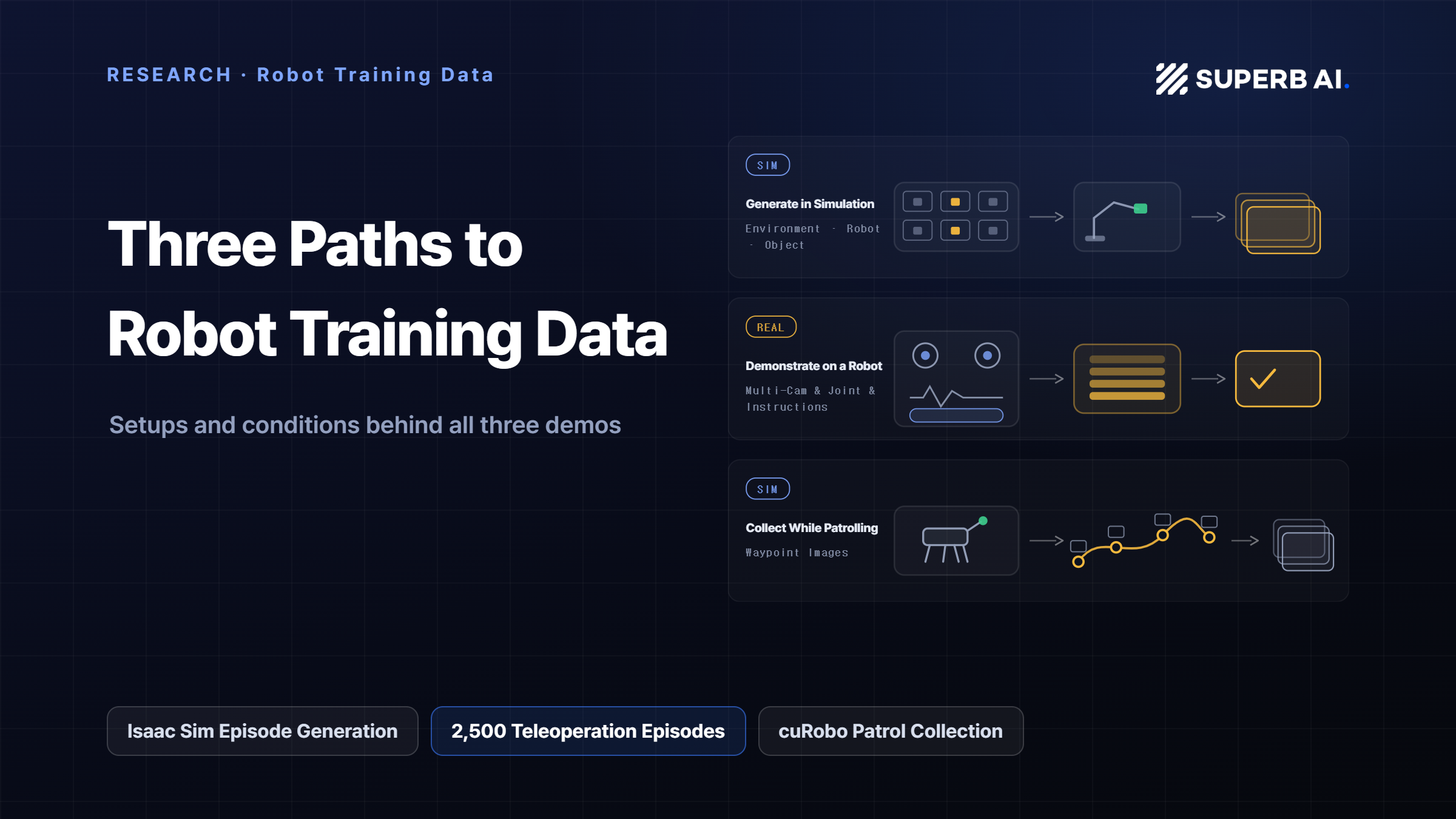
Three Paths to Robot Training Data: Simulation, Real-Robot Collection, and Autonomous Patrol
Hyun Kim
Co-Founder & CEO | 7 min read
Tech
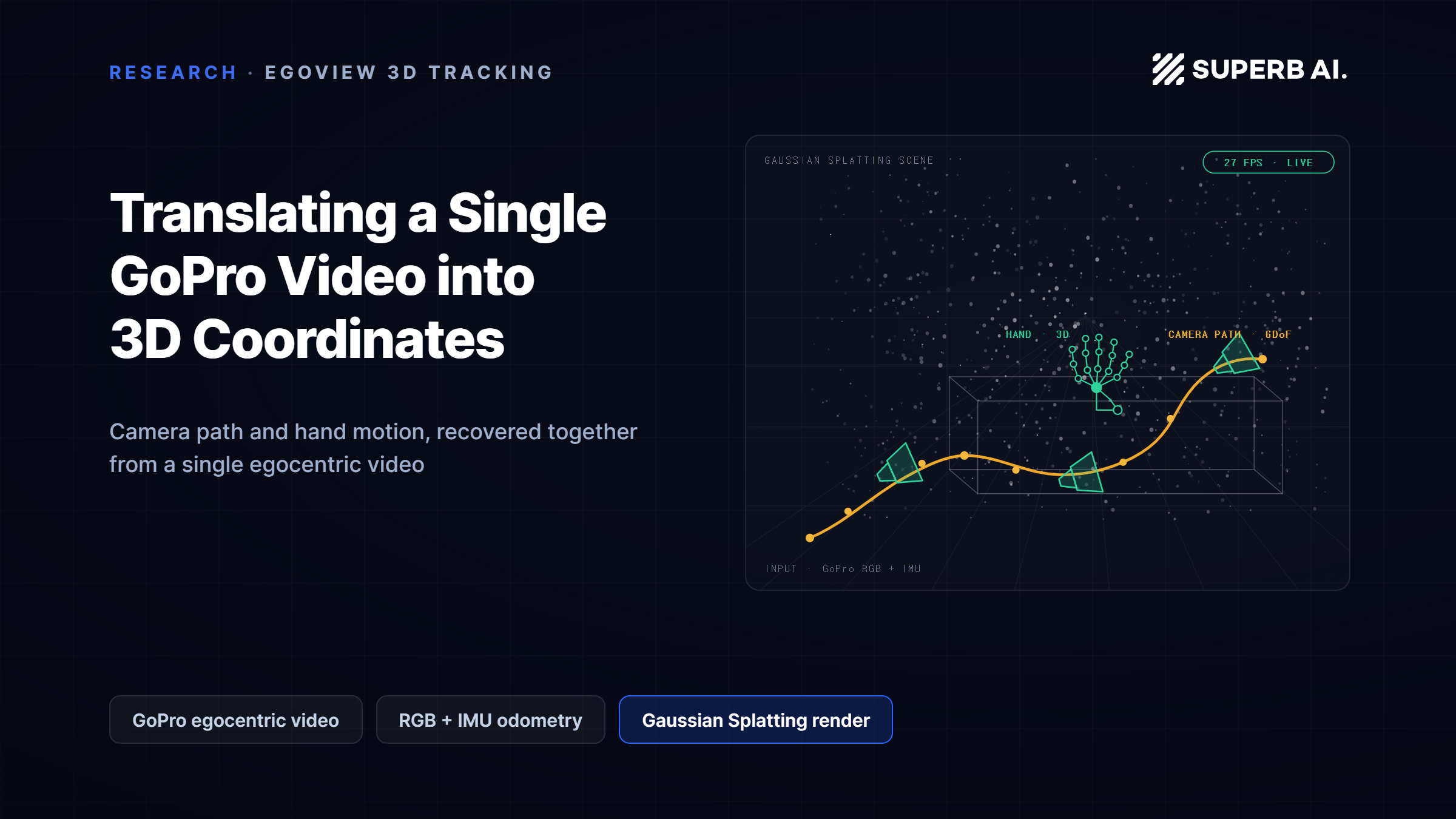
Reconstructing Camera Pose and Hand Motion in 3D from a Single First-Person Video
Hyun Kim
Co-Founder & CEO | 7 min read
Tech
Build Once, Generate Endlessly: Putting the Synthetic Data Pipeline to the Test
Hyun Kim
Co-Founder & CEO | 7 min read

About Superb AI
Superb AI is an enterprise-level training data platform that is reinventing the way ML teams manage and deliver training data within organizations. Launched in 2018, the Superb AI Suite provides a unique blend of automation, collaboration and plug-and-play modularity, helping teams drastically reduce the time it takes to prepare high quality training datasets. If you want to experience the transformation, sign up for free today.