Tech
VLM Video Analytics: How It Differs from Traditional AI CCTV

Hyun Kim
Co-Founder & CEO | 2026/10/29 | 7 min read
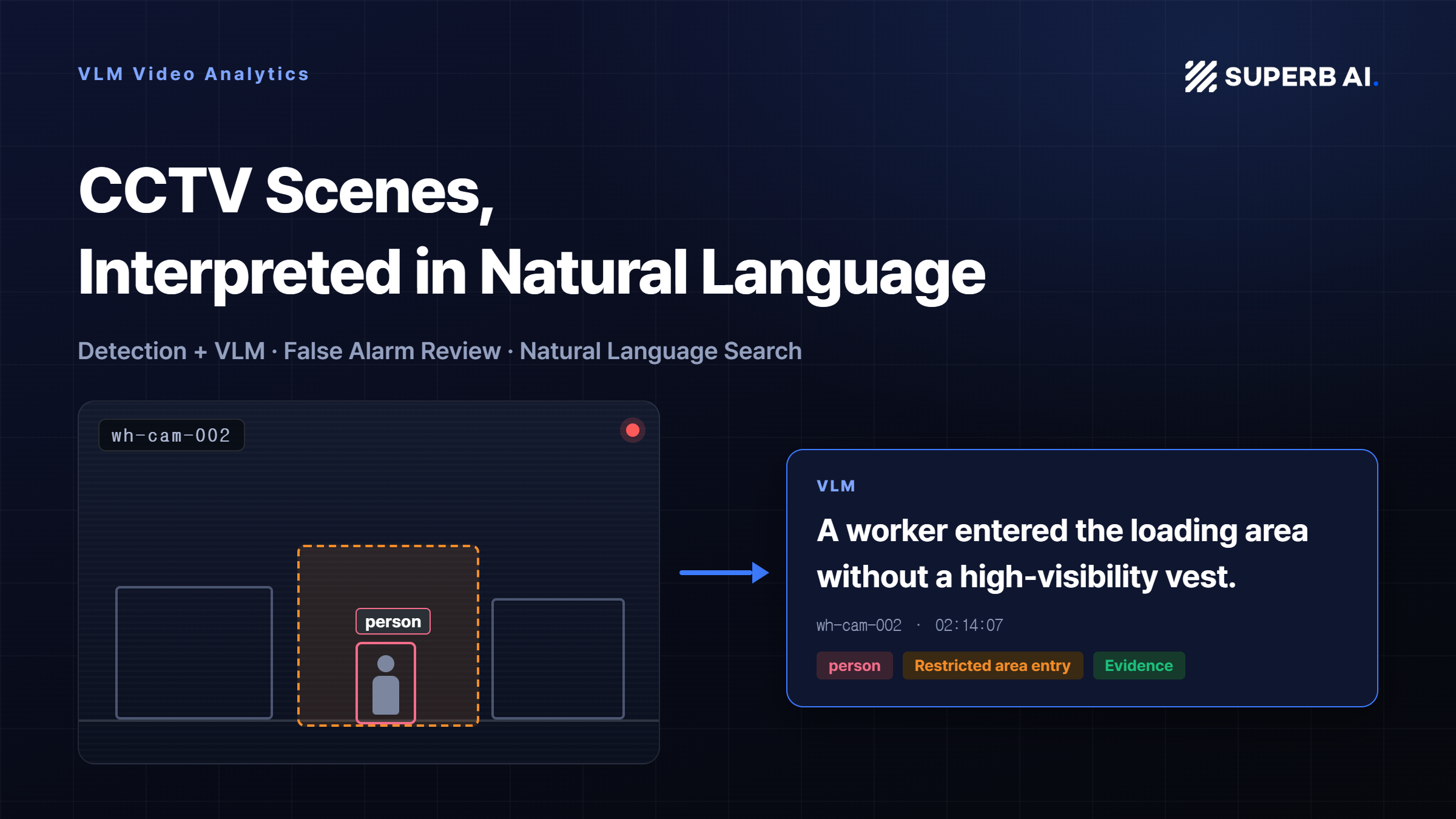
VLM video analytics uses a vision-language model (VLM) trained on visual and language data to interpret CCTV scenes in natural language and retrieve video using natural language queries. Traditional AI CCTV systems use object detection models to draw boxes around people, vehicles, flames, and other predefined targets, then trigger alerts when predefined rules are met. A VLM looks at the same scene and describes what is happening in words.
When the output changes from boxes to sentences, the way false alarms are reviewed, recorded video is searched, and servers and hardware are configured changes with it. This guide explains how the two approaches differ, how they work together, and what to check before deployment. This article reflects the state of the technology as of November 2026.
📌 Key Takeaways
- Traditional AI CCTV detection models answer "What is where?" with bounding boxes. VLMs answer "What is happening?" in natural language. The two models serve different roles within the same system.
- In practice, the architecture has two stages. Lightweight detection models on edge devices monitor all channels in real time, while a server-side VLM reviews only the scenes that trigger an event. This helps reduce false alarms while keeping compute requirements manageable.
- Natural language search, summarization, and Q&A are capabilities enabled by VLMs. Users can search recorded video for a phrase such as "a person entering the loading area without a safety vest" and receive a text summary of the day's events during shift handover.
The Difference: Models That Output Boxes vs. Models That Output Sentences
AI CCTV models can be distinguished by what they output.
A conventional object detection model is trained to recognize predefined targets such as people, vehicles, and flames and returns bounding boxes. A zero-shot detection model can detect a target from a natural language description without additional task-specific training and also returns bounding boxes. A VLM interprets a scene and outputs natural language.
The first two answer what is where. A VLM answers what is happening:
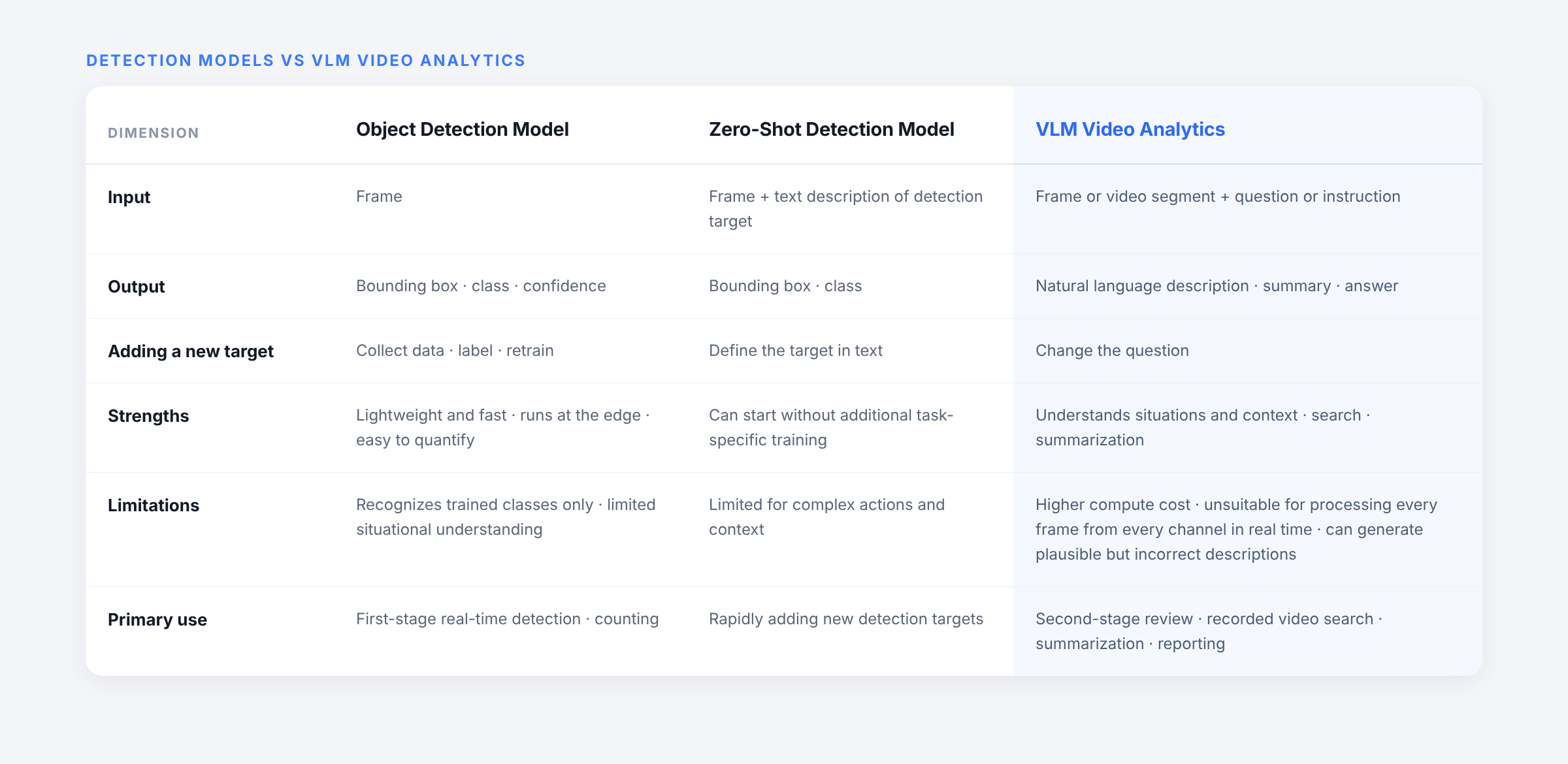
The trained and zero-shot AI approaches compared in our AI CCTV Video Monitoring Guide both operate at the detection layer. A VLM adds an interpretation layer on top.
NVIDIA similarly positions VLMs as the intelligence layer of video analytics AI agents, combining VLMs, LLMs, and retrieval-augmented generation to enable natural language video search and summarization.
For the role of VLMs in robotics, see our VLA vs RFM vs WFM vs VLM comparison.
False Alarms: The VLM Reviews What the Detection Model Flags
False alarms in AI CCTV systems often come from changes in lighting, shadows, steam and haze, reflections in glass, or objects with similar shapes.
Detection models are good at drawing boxes around objects, but they do not necessarily understand whether what is inside the box represents a hazardous situation.
Traditionally, there have been two main ways to address this: adjust sensitivity and zone boundaries, or retrain the model with site-specific data.
For specialized targets such as the early smoke signature of an EV fire, this is still the right approach. In a project with the National Fire Research Institute of Korea, a dedicated model trained on a dataset of approximately 100,000 images reduced the false alarm rate by 80%. See the case study.
VLM adds a third option.
When the detection model raises an alert, the VLM reviews the scene and describes it in natural language. For example:
"Steam rising from a pipe. No flames visible."
or
"A person is inside the restricted area but is wearing the required work permit vest."
With this additional interpretation, monitoring operators can prioritize alerts that the VLM identifies as hazardous. Other events can remain in the record for later review.
The reason VLM is not run on every frame from every camera is compute cost.
Sending all frames currently processed by detection models directly to a VLM would substantially increase server-side computation. That is why a two-stage architecture is commonly used in practice.
Superb Video Analytics follows the same approach. Camera feeds first pass through detection models running on edge devices at the site, using NVIDIA Jetson devices. Only scenes that trigger an event are sent to the server. The server then handles VLM interpretation, event storage, and dashboard display.
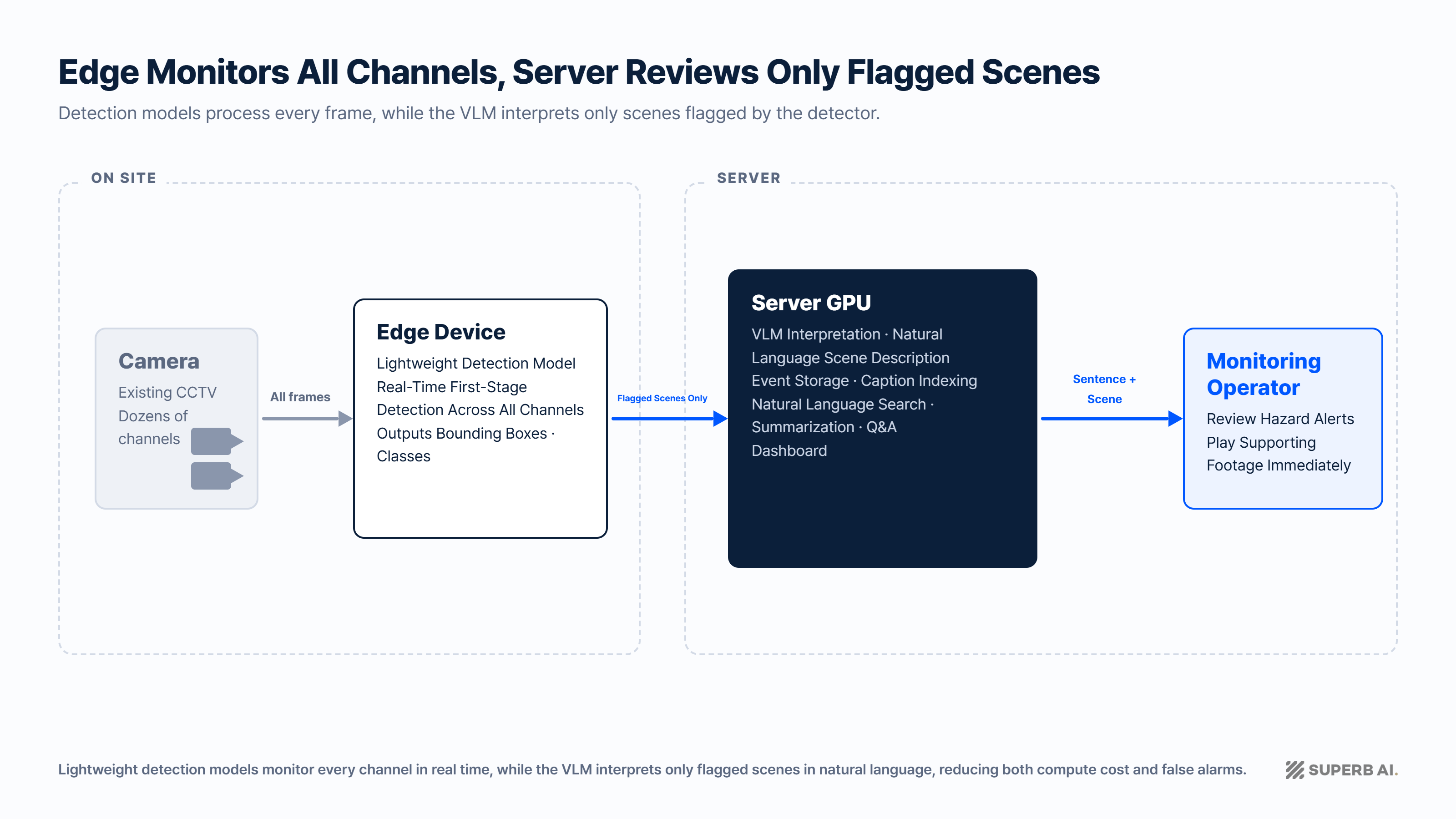
Two-stage architecture: detection models on edge devices monitor all channels, while the server-side VLM reviews only the scenes that trigger an event
Natural Language Search: Find Recorded Video with a Sentence
Traditional AI CCTV systems typically let users search recorded video by camera, time range, and event type. If you wanted to find out who entered a loading area last night, someone often had to review the relevant footage manually.
VLM changes this by generating a natural language description for each event. A scene might be captioned:
"A worker enters a hazardous area without wearing a safety helmet."
Once these descriptions accumulate, three capabilities become possible:
- Search: Enter a query such as "a person entering the loading area without a high-visibility vest" and retrieve the relevant scenes.
- Summarization: Receive a text list summarizing the events that occurred during the night shift for use during shift handover.
- Q&A: Ask questions about accumulated event records, such as "What time of day had the most forklift speeding alerts last week?", and receive aggregated results and charts.
This can easily be confused with zero-shot detection.
If you define "a person without a high-visibility vest" as a real-time monitoring rule, that is zero-shot detection. If you use the same sentence to search previously recorded footage, that is VLM-based search. The first filters events from now on. The second searches what has already been recorded.
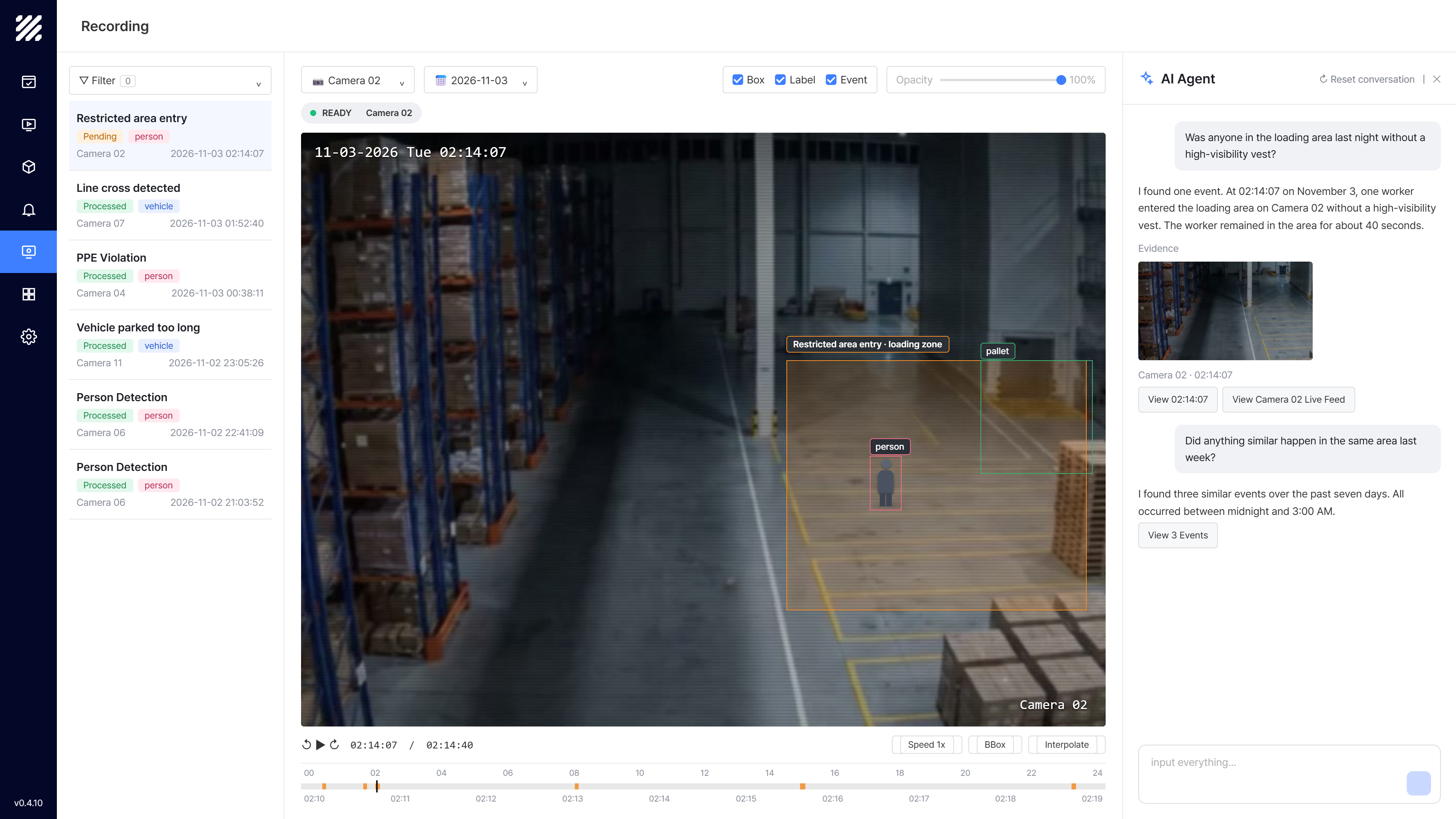
Superb Video Analytics recording screen: the event list appears on the left, the video player in the center, and the Superb Agent chat panel on the right, where users can search for scenes using natural language
Real-World Deployments: Where VLM Was Used and Where It Was Not
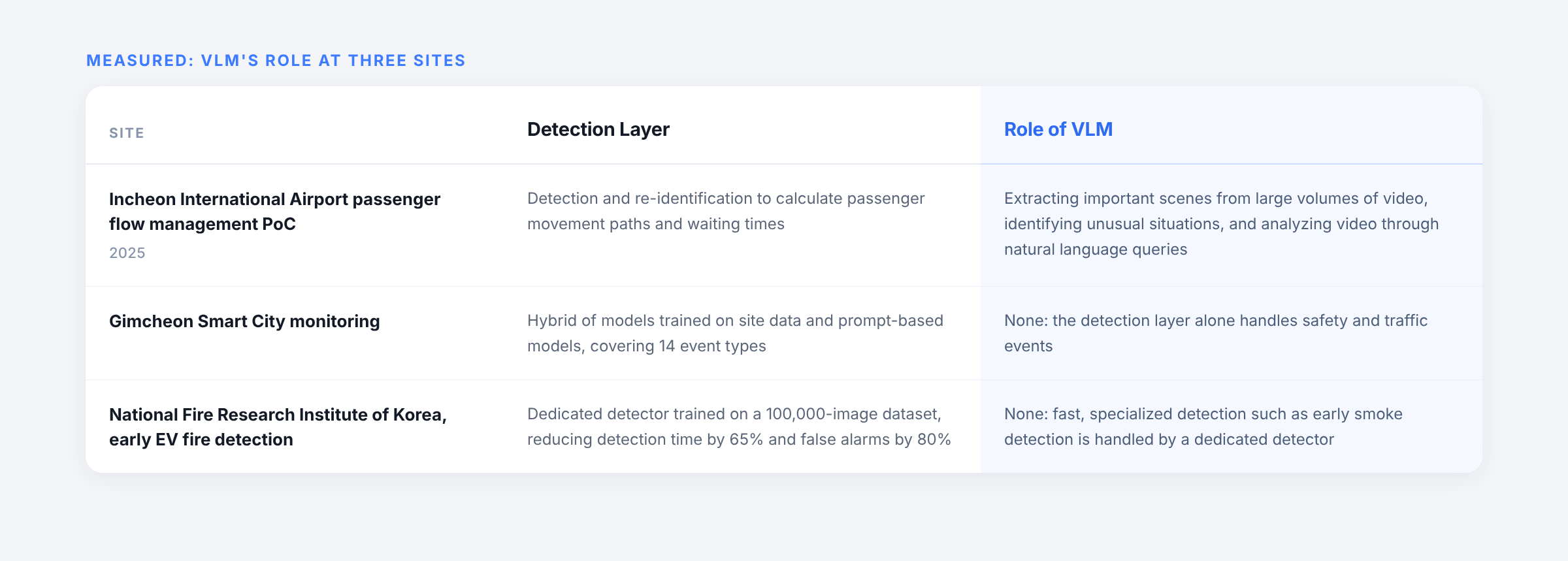
Of these three deployments, VLM was used at Incheon International Airport. The airport use case required the system to find and interpret situations in natural language across a large volume of camera footage. The other two use cases were solved at the detection layer alone. When the target is clearly defined and the priority is a fast alert, adding a VLM may not be necessary.
Public-sector demand is also beginning to move toward monitoring systems that communicate incidents in natural language. (Gimcheon City case study & National Fire Research Institute case study)
In July 2026, Korea's Ministry of Science and ICT and the National Information Society Agency announced a KRW 11.68 billion (approx. USD 8.75 million) project to upgrade approximately 18,100 public CCTV cameras with domestic NPU-based AI analytics.
The monitoring center servers analyze video in real time and send operators detailed descriptions of hazardous situations in natural language. This signals that natural-language incident descriptions are beginning to appear as a requirement in public-sector video monitoring projects.
Does VLM Mean We No Longer Need to Train Detection Models?
No. Detection models remain necessary.
Monitoring dozens of channels in real time is best handled by lightweight, fast detection models. The VLM reviews only the scenes they flag. When the detection target is highly specialized, training a dedicated detection model is still the most reliable approach. VLM reduces the human time required to review false alarms and investigate recorded events.
Can VLM Be Added to an Existing AI CCTV Server?
There are four things to check:
- Server GPU: VLM inference runs on the server side. Edge devices handle detection, while GPU resources are allocated to the server. The required server specification depends on the number of camera channels and the volume of events.
- Video storage and indexing: Natural language search requires event clips and captions to be stored and indexed. The retention period therefore determines how far back users can search.
- Where the video is processed and stored: Sites that cannot send video outside the facility can use an on-premise server configuration. Cloud deployment is also possible. In either case, face and license plate de-identification can be incorporated.
- Camera image quality: Caption and search quality depend on image quality. Most existing CCTV cameras can continue to be used, but low-light and low-resolution areas should be identified during an infrastructure assessment. Poor nighttime footage often affects caption quality first, which in turn reduces search quality.
The existing AI video analytics cost structure, where event volume and number of sites drive the quote, still applies. VLM adds server GPU requirements to that structure.
Does VLM Completely Eliminate False Alarms?
It can reduce them, but it cannot eliminate them entirely.
VLMs can still make mistakes under occlusion, low-light conditions, and poor image quality. They can also generate descriptions that sound plausible but are incorrect. That is why every VLM judgment should be linked to the supporting video frame. If the system stores which camera and which timestamp produced each judgment, an operator can verify it immediately.
During the first two to four weeks after deployment, false positives and missed detections should be reviewed just as they are with detection models, and alert thresholds should be adjusted to fit site conditions. The review process follows the same four-stage deployment process described in our AI CCTV Video Monitoring Guide.
3 Things to Check Before Adopting VLM Video Analytics
First, determine whether your current problem is missed detections or false alarms.
If missed detections are the main problem, improving the detection model should come first. If people are spending significant time reviewing false alarms and investigating past incidents, VLM is a stronger fit.
Second, determine where the video will be analyzed and stored.
In a two-stage architecture with edge detection and a server-side VLM, the choice between keeping the server on site and using the cloud affects both security requirements and cost.
Third, check whether every VLM answer is linked to supporting video evidence.
A system that outputs only a sentence still requires extra work to verify the result. During a demo, confirm that every judgment and search result includes the camera and timestamp and can immediately open the corresponding footage.
Superb AI is a Vision Intelligence company that transforms visual data from industrial sites into intelligence enterprises can act on. Superb AI provides Superb Video Analytics, which combines edge detection models with server-side VLMs on top of existing CCTV infrastructure, as well as ZERO, its industry-focused Vision Foundation Model.
💬 Considering VLM video analytics? Tell us how many cameras you operate and the types of false alarms you encounter most often. Rather than starting with a sales call, we'll begin by assessing what your existing video can support for VLM-based video interpretation and search.
Related Posts
Tech
VLA vs RFM vs WFM vs VLM: Comparing 4 Robot AI Models
Hyun Kim
Co-Founder & CEO | 7 min read
Tech
Physical AI Glossary: 40 Terms for Robot Training Data, Simulation, and 3D Reconstruction
Hyun Kim
Co-Founder & CEO | 13 min read
Tech
Three Paths to Robot Training Data: Simulation, Real-Robot Collection, and Autonomous Patrol
Hyun Kim
Co-Founder & CEO | 7 min read

About Superb AI
Superb AI is an enterprise-level training data platform that is reinventing the way ML teams manage and deliver training data within organizations. Launched in 2018, the Superb AI Suite provides a unique blend of automation, collaboration and plug-and-play modularity, helping teams drastically reduce the time it takes to prepare high quality training datasets. If you want to experience the transformation, sign up for free today.