Insight
CVPR 2025 Foundation Few-Shot Object Detection Challenge: Transforming Future Industries with AI

Hyun Kim
Co-Founder & CEO | 2025/12/02 | 10 min read
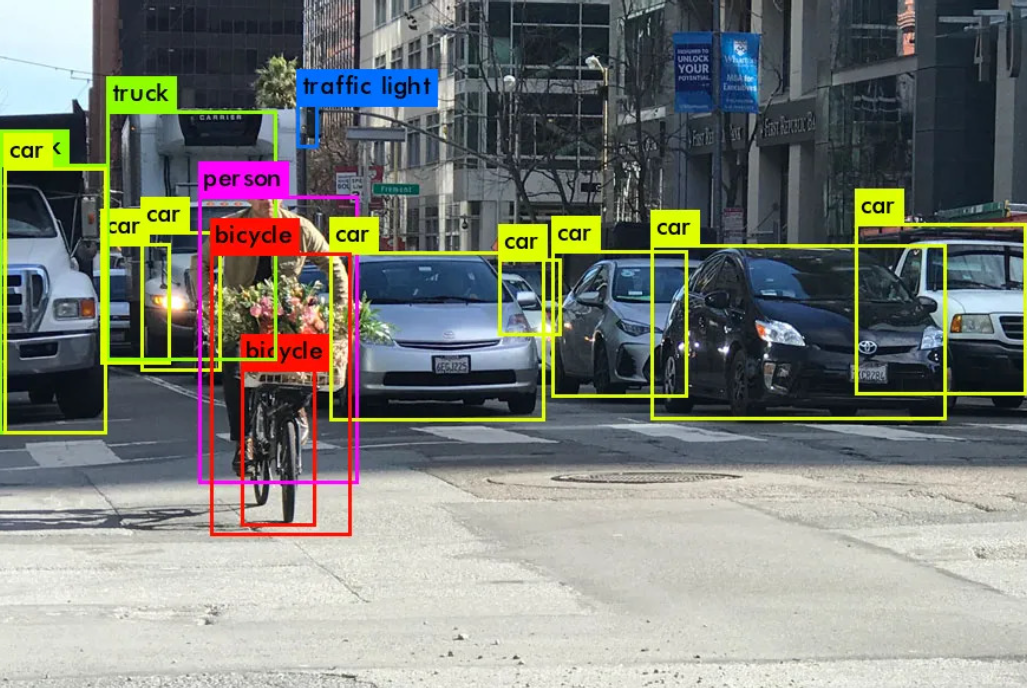
Another spotlight challenge is capturing the attention of global researchers at CVPR 2025, the world’s leading conference in computer vision. The "Foundation Few-Shot Object Detection Challenge," hosted as part of the “Visual Perception and Learning in an Open World” workshop, is drawing significant interest.
This challenge evaluates breakthrough technologies that enable AI to learn new concepts from just a few examples—like humans do—and apply them immediately in industrial environments. It serves as a critical testbed for verifying key technologies that drastically reduce the cost of AI adoption while maximizing performance in various fields, including manufacturing, healthcare, logistics, and agriculture.
To learn more about foundation models, refer to the following post: Zero-Shot Vision AI: Why One Day is All You Need to Deploy AI
Why Is Foundation Few-Shot Object Detection Important for Industry?
Limitations of Conventional AI: The Pitfalls of Data Dependency
One of the biggest barriers to deploying object detection AI in industrial settings is the high cost of data collection and the long development timeline. So far, every time a new product line, defect type, or work environment appears, companies have had to collect thousands of images, label them, and retrain models from scratch.
For example, when an automaker wants to implement a quality inspection system for a new part, the following steps are required:
- Data Collection: Capture thousands of good and defective samples
- Labeling: Experts annotate each image with defect locations and type
- Model Training: Train models for several weeks to months
- Validation and Deployment: Conduct further testing and optimization
This process is not only costly but also slow—making it a critical disadvantage in modern manufacturing environments where product life cycles are increasingly short.
How Foundation Few-Shot Object Detection Solves the Problem
Foundation few-shot object detection fundamentally addresses these limitations. Even with a small number of examples, models can learn to detect new objects—reducing data collection costs by over 90% compared to traditional methods.
Key Technical Advantages
- Human-like learning efficiency through the combined use of images and text
- Ability to learn and recognize new concepts from just a few examples
- Ready-to-deploy across vastly different domains such as healthcare, manufacturing, and agriculture
CVPR 2025 Foundation Few-Shot Object Detection Challenge: Realistic Simulation of Industrial Environments
The challenge uses the Roboflow-20VL dataset, which spans a variety of industrial sectors and reflects data that closely resembles real-world field conditions.
- Aerospace & Transportation: Aircraft maintenance, traffic system monitoring
- Medical & Healthcare: X-ray image analysis, diagnostic assistance
- Agriculture & Biology: Crop monitoring, pest detection, yield optimization
- Industrial: Product defect detection, quality control, thermal imaging analysis
- Environmental Management: Waste classification, environmental monitoring
- Document Processing: Scientific paper structures, graphs, diagrams, code, and images
- Specialized Imaging: X-ray, thermal, aerial imaging, and other specialized domains
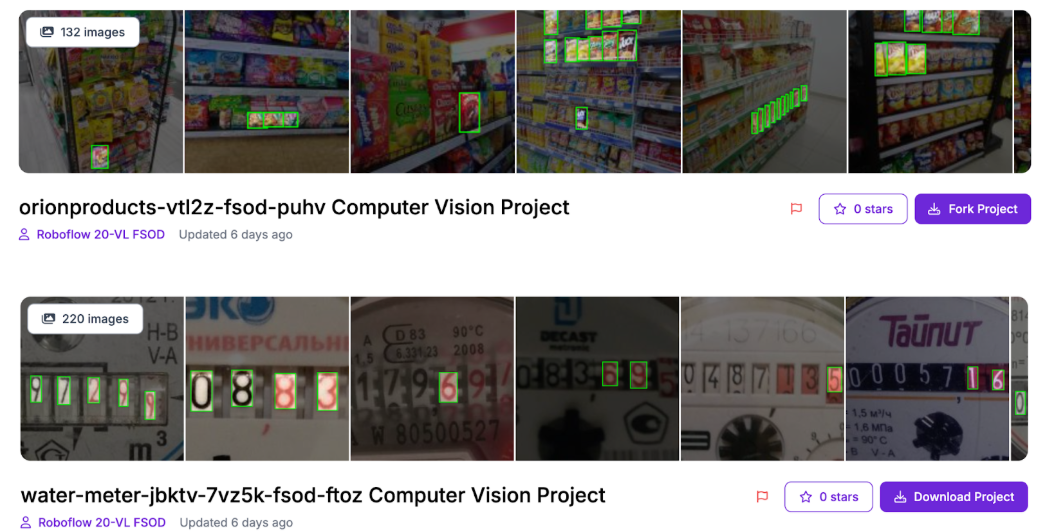
(Example images from the dataset)
Realistic Constraints: A True Test of Industrial Applicability
The challenge enforces constraints that closely mirror real industrial conditions:
- Learning from 10 images: Only 10 examples are provided per class
- Multimodal requirement: Models must use both visual examples and textual descriptions
- Test environment control: Models cannot be trained using the images of the real test environment
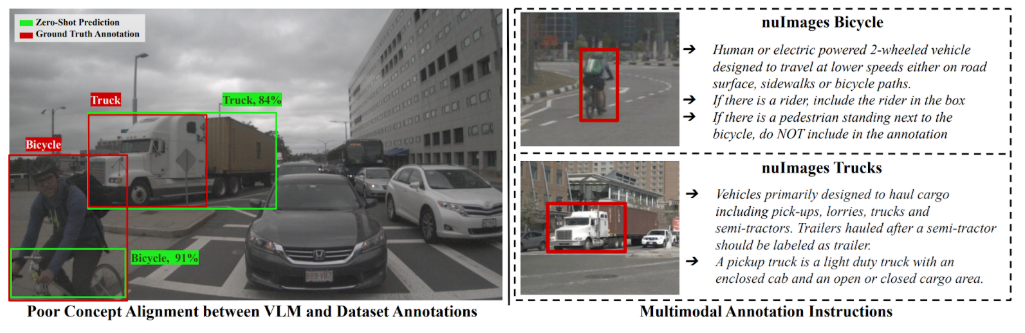
(Example image with multimodal annotation, Source: 2024 winner’s paper)
These constraints reflect the typical situations that companies encounter in real-world AI deployments. Often, companies only have product catalog images, not images taken in the actual production environment.
This challenge also highlights the growing importance of vision-language models (VLMs) in industry. VLMs process both images and text together to achieve human-like understanding. It’s not just about combining two data types—it’s about conceptual understanding and learning. VLMs don’t just summarize or describe abstractly; they can locate and describe precise regions within an image using text, making them highly practical in field applications.
The CVPR 2025 Foundation Few-Shot Object Detection Challenge is a major milestone in defining the direction of industrial AI. It demonstrates how maximum performance can be achieved with minimal data, and how models can be deployed in real-world settings immediately. We’ll soon be sharing more about Superb AI’s performance in this challenge—and how our results signal a transformative leap for real-world industrial applications. Stay tuned!
Related Posts

Insight
Why Doesn’t Robot AI Have an ImageNet? A Test You Can’t Grade with a Single Answer Key
Hyun Kim
Co-Founder & CEO | 10 min read
Insight
Robot Training Data Sourcing Guide: 4 Options and How to Choose a Training Data Provider
Hyun Kim
Co-Founder & CEO | 7 min read
Insight
Vision AI PoC Design Guide: Timeline, Data, and Success Criteria
Hyun Kim
Co-Founder & CEO | 7 min read

About Superb AI
Superb AI is an enterprise-level training data platform that is reinventing the way ML teams manage and deliver training data within organizations. Launched in 2018, the Superb AI Suite provides a unique blend of automation, collaboration and plug-and-play modularity, helping teams drastically reduce the time it takes to prepare high quality training datasets. If you want to experience the transformation, sign up for free today.