Case Study
[Customer Success Story] How a Global Electronics and Precision Equipment Manufacturer Is Transforming Visual Inspection with AI

Hyun Kim
Co-Founder & CEO | 2026/08/13 | 10 min read
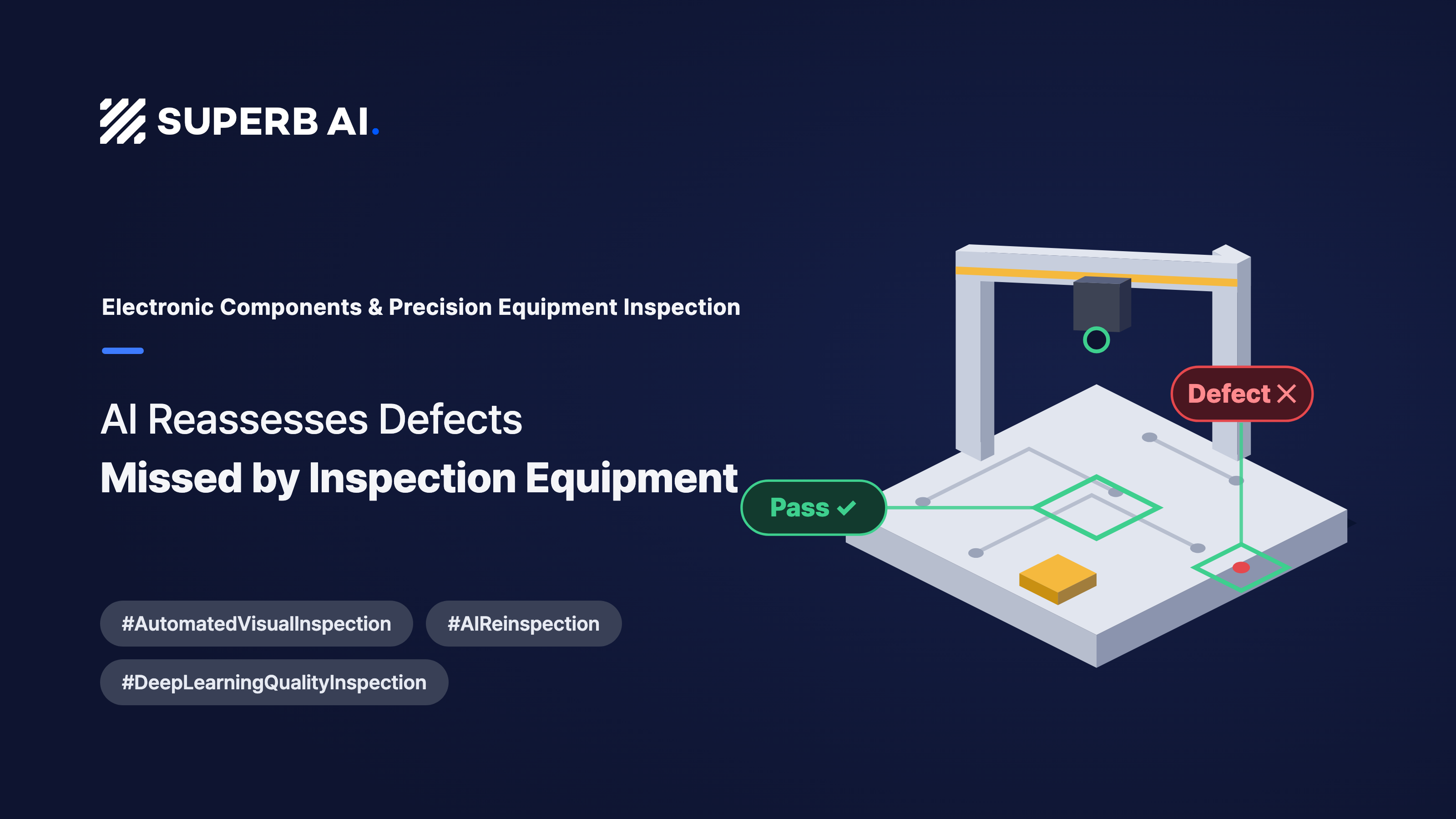
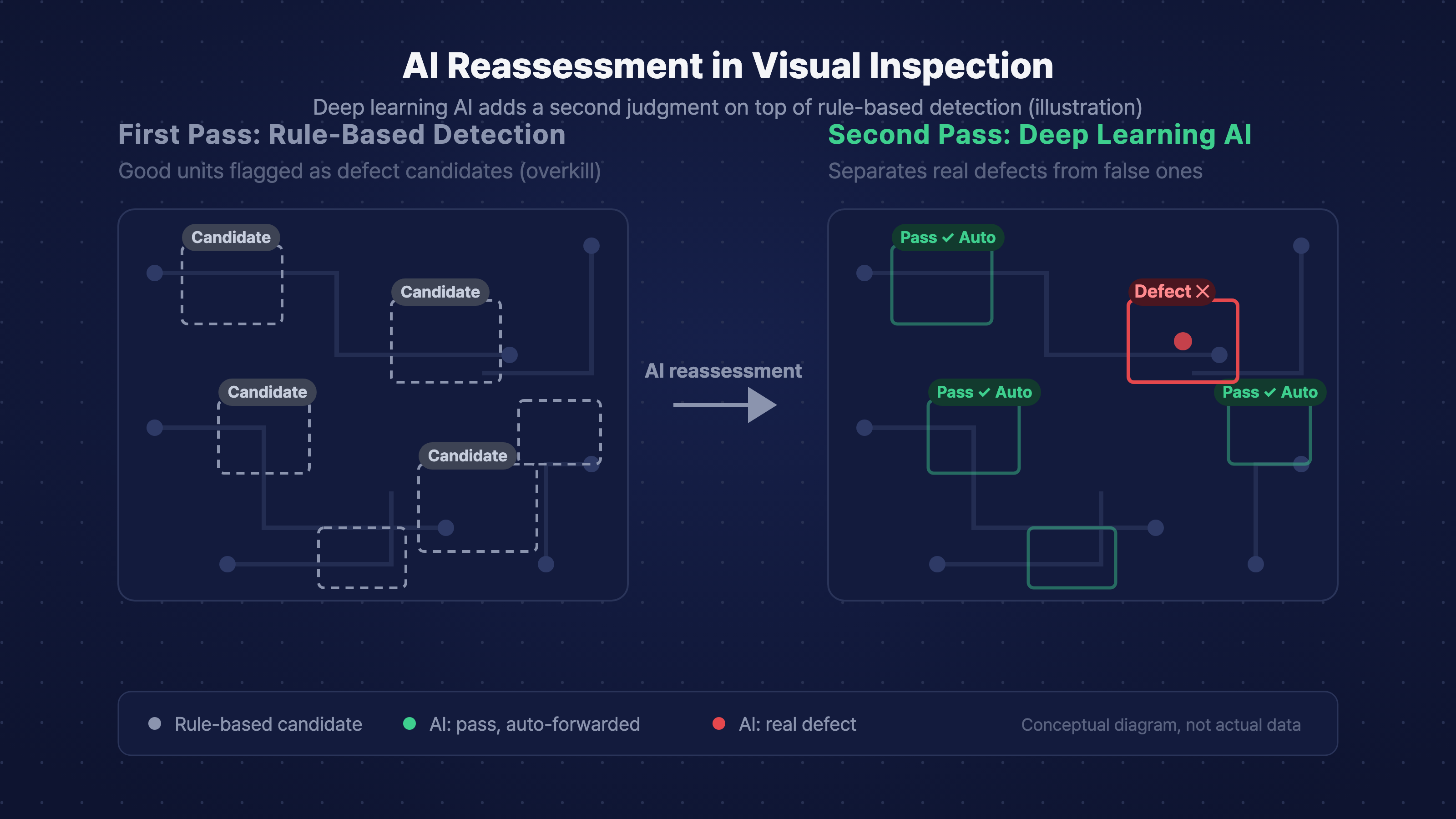
An illustrated reconstruction of a visual inspection structure that combines rule-based initial detection with deep learning-based secondary AI review
In the electronics and precision products industries, the standard for quality is moving closer to zero defects. The performance of finished products increasingly depends on the surface quality of the components and precision equipment inside them.
Investment in inspection is growing at the same pace. According to Mordor Intelligence, the global surface vision inspection equipment market is expected to grow from USD 5.09 billion in 2026 to USD 7.46 billion by 2031, driven by the demand for zero-defect manufacturing in semiconductor processes.
But investing in equipment does not automatically complete the inspection process.
Automated optical inspection equipment, including AOI and AFVI systems, detects defects based on predefined rules. As a result, its coverage drops sharply when it encounters surface defects with inconsistent shapes, such as dents, pressure marks, and fine scratches.
Tighten the rules, and even normal products flood the system as defect candidates, creating over-rejection. Loosen the rules, and true defects can slip through to customers as missed defects.
That gap ultimately has to be filled by human eyes. The more precise the product, the deeper the dependence on manual reinspection becomes.
A global electronics and precision equipment manufacturer operating production sites worldwide was caught in the same structure. To handle growing order volume, the company first needed to resolve inspection bottlenecks at its overseas production plants. But simply adding more inspection equipment was not the answer.
Together with Superb AI, the company is now moving through a phased validation process to build a deep learning-based decision system for visual inspection.
Even with Inspection Equipment in Place, the Straight-Through Rate Was Stuck
The manufacturer’s visual inspection process had a two-stage structure: automated optical inspection equipment first screened for defect candidates, and inspection personnel then made the final decision through manual visual review.
The problem was that the volume passing through without human intervention—the straight-through rate—had effectively stalled.
Low coverage from rule-based detection
Automated optical inspection equipment can only detect defects based on predefined rules. This meant that only certain defect types could be detected by equipment, while most other defects remained in the domain of human inspection.
Over-rejection created a full manual reinspection workflow
To prevent missed defects, the equipment classified even slightly suspicious cases as defect candidates. As a result, normal products also piled up in the reinspection queue, and inspection personnel effectively had to perform manual visual inspection on every item, with each product taking several minutes to review. A significant portion of factory personnel became tied to inspection work, creating a structure in which production volume depended on the size of the inspection workforce.
Inspection history data was not being accumulated
The existing inspection process did not accumulate inspection history data that could explain the basis for each decision. Even when the company wanted to analyze defect causes or improve inspection criteria, there was no underlying data to work from. Quality management was limited to decisions made case by case, day by day.
Secondary AI Review for Visual Inspection: Changing the Decision Structure Without Replacing Equipment
The manufacturer’s requirement was clear: reduce upfront cost and risk by taking a software-first approach, without replacing existing hardware.
Superb AI designed a structure in which deep learning AI performs a secondary review of the defect candidates generated by existing equipment, separating true defects from false defect candidates. The key business criterion was whether AI-based decisions could lead to a measurable improvement in the straight-through rate.
Superb Platform is a Vision Intelligence platform that automates the full AI model development workflow, from data collection and labeling to training and evaluation. The data-building and iterative training process for this project is being carried out on this pipeline.
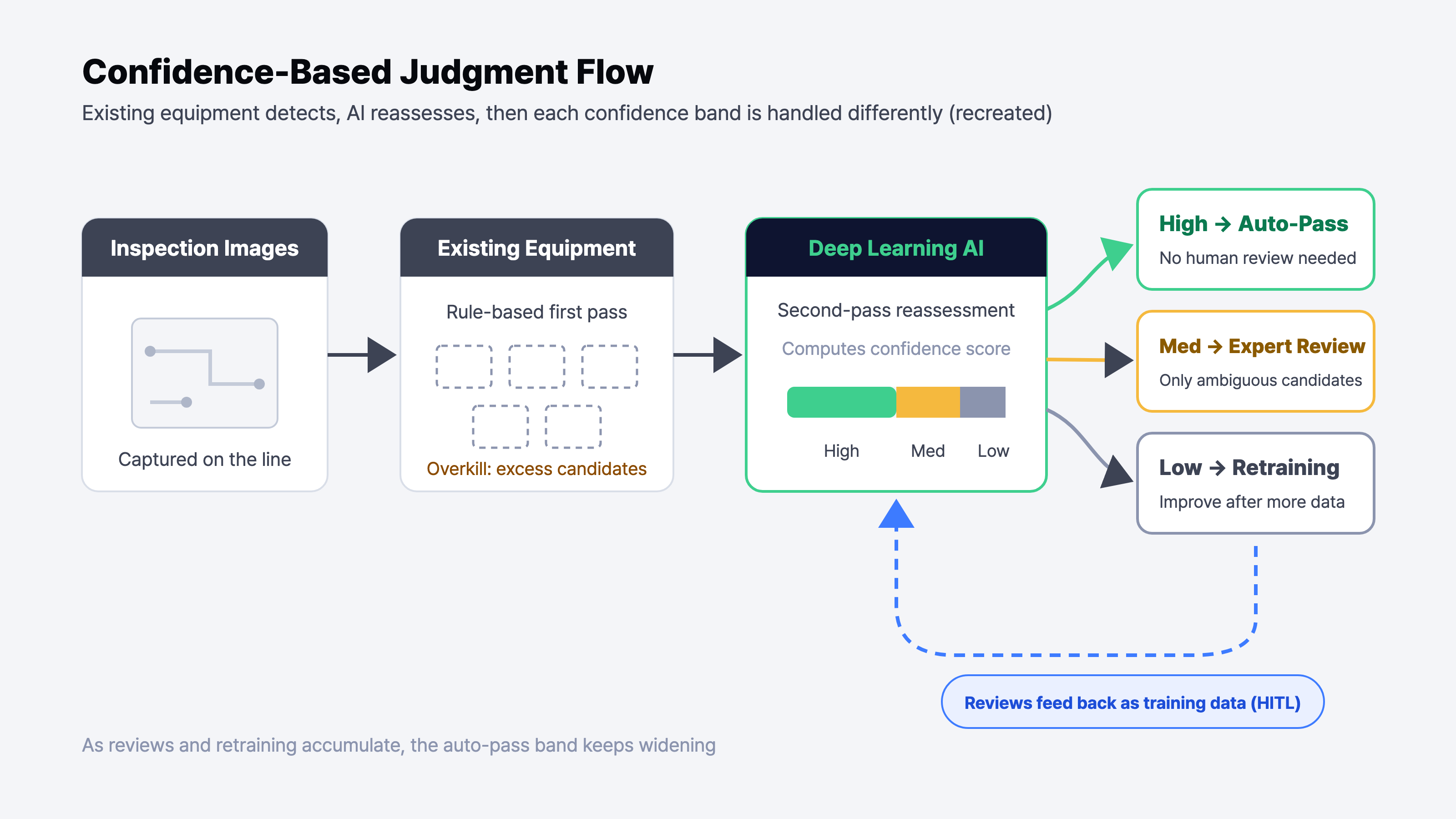
Reconstructed decision structure: first-pass detection, secondary AI review, and confidence-based automatic pass-through
1. Prioritizing target defects through full defect data analysis
The project began by analyzing large volumes of inspection images and defect data collected from the company’s overseas production plants.
When defects spread across more than 100 defect codes were reclassified based on frequency and quality impact, a Pareto structure emerged: most occurrences were concentrated in a small number of high-priority defect groups, including contamination, foreign matter, wrinkles, dents, lifting, delamination, and scratches.
Rather than attempting to cover every defect at once, the team used this analysis to prioritize the defect groups with the greatest impact on the straight-through rate.
2. Expanding defect recognition step by step through iterative training
The model is being improved through short-cycle iterations covering labeling guide development, annotation, training, and evaluation.
A Transformer-based model, which is strong at recognizing fine patterns, was applied during the preliminary validation stage. The team confirmed a trend of performance improvement through repeated training, and during the build phase, it is expanding recognition coverage by broadening both the training data and defect categories.
3. Designing a confidence-based automatic pass-through structure
Alongside model development, Superb AI designed an operating structure that divides AI decisions into three ranges based on confidence.
High-confidence cases pass through automatically without human intervention. Medium-confidence cases are reviewed by inspection experts. Low-confidence cases are classified as candidates for retraining.
The results reviewed by humans are then accumulated again as training data through a human-in-the-loop (HITL) workflow, gradually expanding the range of cases that can pass through automatically.
Changes Emerging on the Inspection Line
The goal of this project is not to replace inspection equipment. It is to transform the decision structure. As implementation progresses, the following changes are beginning to take shape.
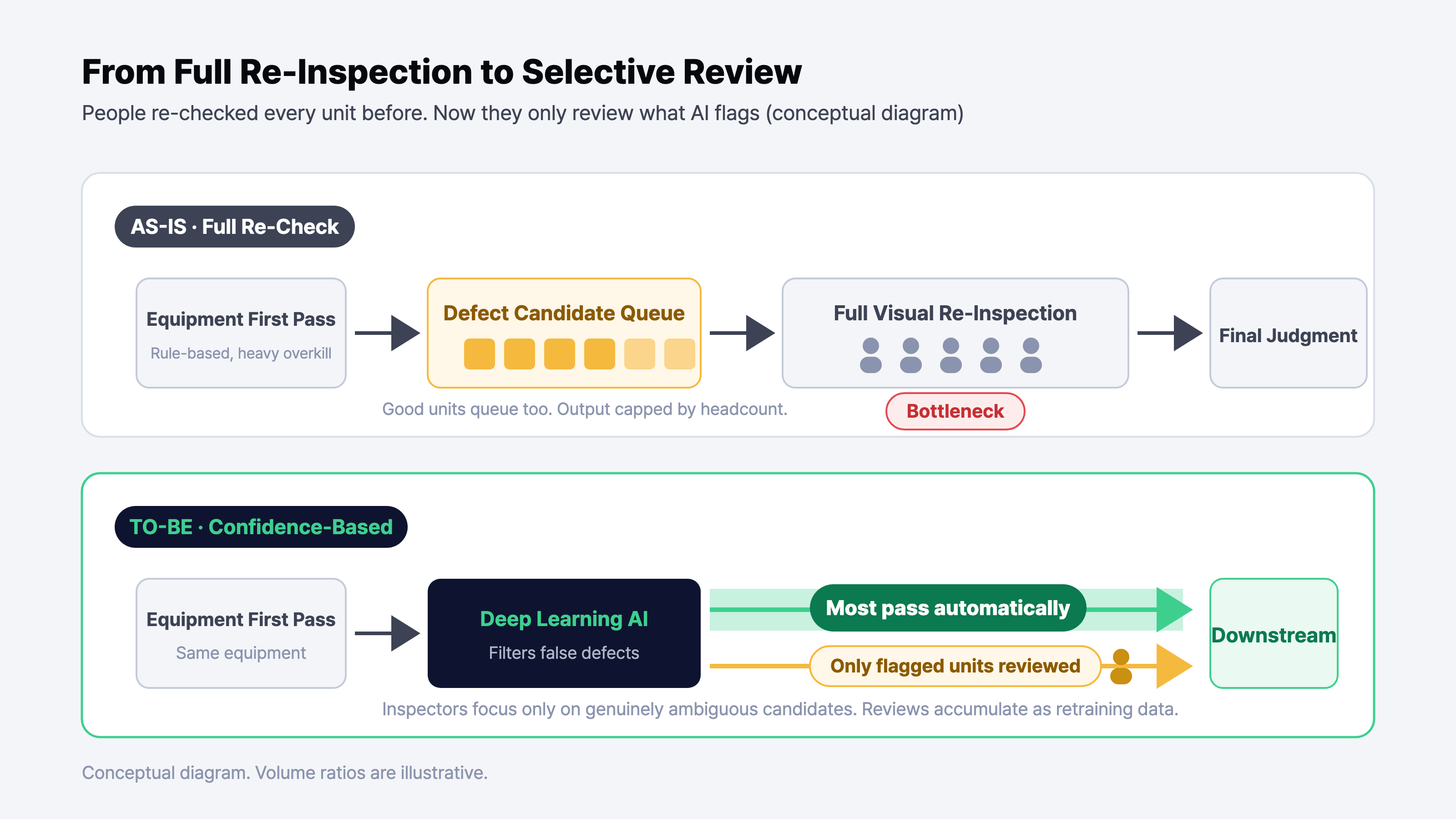
Concept diagram: From a structure where humans recheck every item to one where humans review only the suspicious cases filtered by AI
- Defects once understood only by experience are becoming data. Defects previously confirmed only through manual visual inspection are now being organized into data by type, frequency, and distribution. This is creating a defect map that shows which defects occur most often and where. The company is beginning to accumulate evidence for quality improvement.
- Inspection decisions are gaining a common standard. Decisions that previously varied from person to person are being placed on a shared standard: AI confidence ranges. This creates a foundation for reducing quality variation caused by differences in inspector experience.
- A structure for reducing the burden of manual reinspection is now in place. When AI filters out over-rejections, or false defect candidates, inspection personnel can focus only on true defect candidates that require judgment. This structure improves both the straight-through rate and inspection efficiency.
- Investment risk is being managed in phases. Before making large-scale facility investments, the company first validated feasibility through software-centered testing. It is now proceeding in stages, checking results at each step before deciding on the next investment.
From Over-Rejection Filtering to Global Rollout: A Phased Expansion Roadmap
This project was designed as a phased scenario that expands both data scope and defect coverage over time.
- Phase 1: Connect secondary AI review to existing inspection equipment to filter over-rejections, or false defect candidates, and reduce the burden of manual reinspection
- Phase 2: Expand the scope of data acquisition to include original inspection images, extending AI inspection coverage to areas missed by existing equipment
- Phase 3: Transition to an AI-centered inspection system and roll out the validated model across global production sites
In Precision Equipment Visual Inspection, Data Overcomes the Limits of Rules
Visual inspection for electronic components and precision equipment cannot be completed with rule-based equipment alone. The demand for zero defects continues to rise, while defects are becoming finer and more irregular in shape. As a result, the gap between rule-based equipment and manual inspection becomes an inspection bottleneck.
This manufacturer’s case shows that even without replacing equipment, companies can begin narrowing that gap by using deep learning AI to reinterpret the decision data produced by existing inspection systems.
Superb AI supports the full journey of introducing inspection AI into manufacturing environments, from defect data analysis and labeling to iterative training and confidence-based operating design.
Frequently Asked Questions
Do we need to replace our existing automated optical inspection equipment?
No. The system is designed so that deep learning AI performs a secondary review of images first detected by existing equipment, allowing companies to start without additional hardware investment. This case is also being carried out based on data collected from existing equipment.
Can the model be trained even if we do not have a large amount of defect data?
Yes. The process begins by analyzing the defect distribution and focusing training on the high-priority defect types with the highest frequency and quality impact. Performance is improved through short-cycle iterative training. Review results accumulated during operation are then used for retraining, allowing the system to expand gradually to rare defects.
What does the implementation process look like?
The process begins with an analysis of the inspection data you already have. Superb AI diagnoses defect distribution and data quality to identify the applicable scope, verifies performance and business impact through a small-scale validation, and then expands to full implementation through a phased approach.
How is production data security managed for overseas factories?
Data is transferred and backed up according to procedures that reflect the required security environment. Depending on customer requirements, the system can also be operated in a closed environment, including on-premises deployment. Data is used only within the agreed scope of the project.
Related Posts
![[Customer Success Story] How AgTech Company Metafarmers Built Crop Recognition Datasets for Harvesting Robot Vision](https://cdn.sanity.io/images/31qskqlc/production/7ee10aa76e0f471a557629050f70fcb5eac47060-3200x1800.png?fit=max&auto=format)
Case Study
[Customer Success Story] How AgTech Company Metafarmers Built Crop Recognition Datasets for Harvesting Robot Vision
Hyun Kim
Co-Founder & CEO | 5 min read
![[Customer Success Story] How a Video-Based Behavior Analysis AI Company Built a Scalable Keypoint Labeling Workflow](https://cdn.sanity.io/images/31qskqlc/production/5371223bbc093c18d5d64b667266722102072d01-3200x1800.png?fit=max&auto=format)
Case Study
[Customer Success Story] How a Video-Based Behavior Analysis AI Company Built a Scalable Keypoint Labeling Workflow
Hyun Kim
Co-Founder & CEO | 7 min read
![[Customer Success Story] How the National Fire Research Institute Built an AI Monitoring System for Early EV Fire Detection in Underground Parking Facilities](https://cdn.sanity.io/images/31qskqlc/production/dd4fc6280fd134b1d93dec8ae3982d1a02379dc5-3200x1800.png?fit=max&auto=format)
Case Study
[Customer Success Story] How the National Fire Research Institute Built an AI Monitoring System for Early EV Fire Detection in Underground Parking Facilities
Hyun Kim
Co-Founder & CEO | 7 min read

About Superb AI
Superb AI is an enterprise-level training data platform that is reinventing the way ML teams manage and deliver training data within organizations. Launched in 2018, the Superb AI Suite provides a unique blend of automation, collaboration and plug-and-play modularity, helping teams drastically reduce the time it takes to prepare high quality training datasets. If you want to experience the transformation, sign up for free today.