Case Study
[Customer Testimonial] AI-Powered Monitoring Transforms Public Safety and Transportation in Gimcheon City

Hyun Kim
Co-Founder & CEO | 2025/12/19 | 15 min read
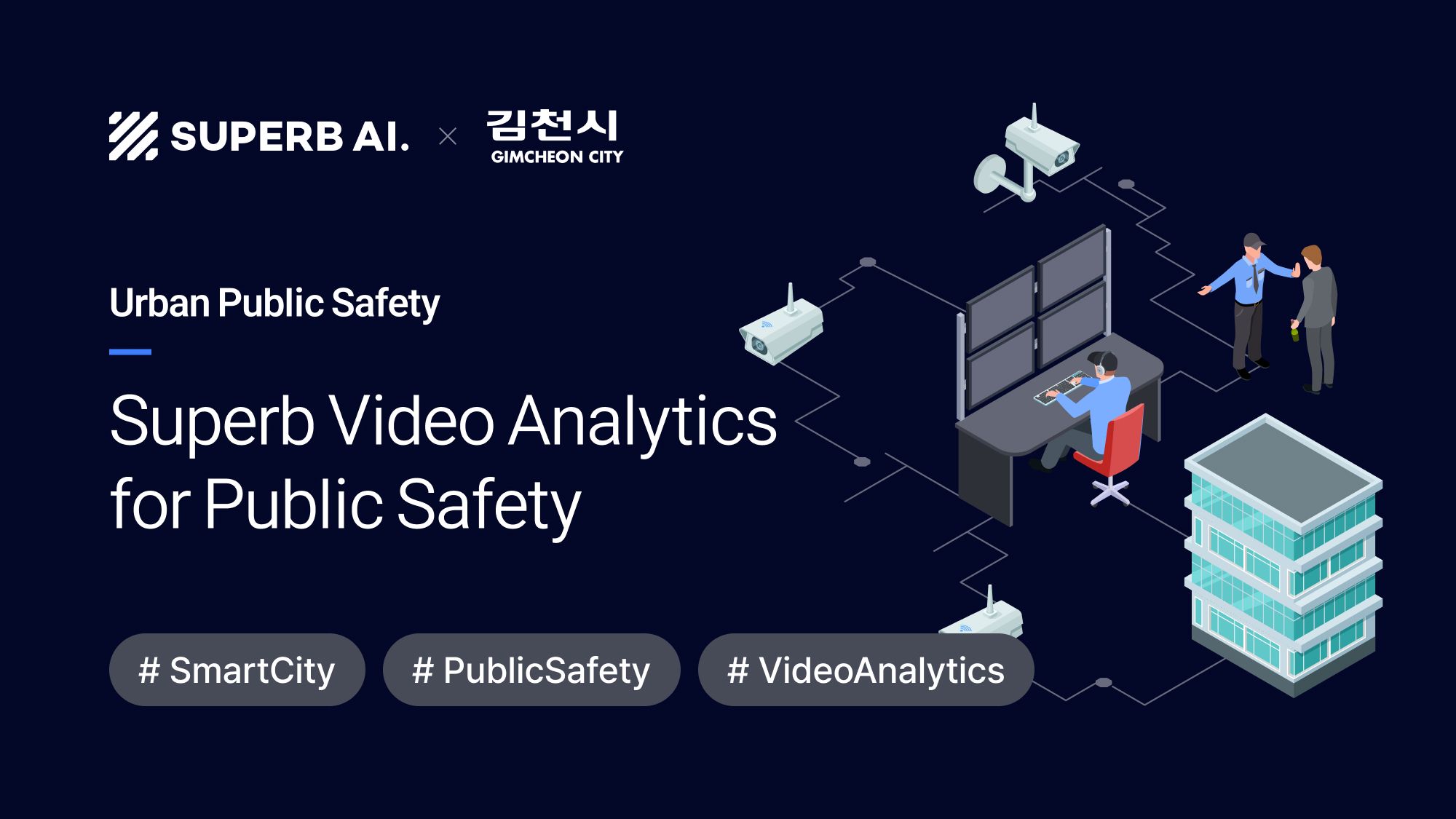
Cities worldwide face a complex mix of unprecedented opportunities and challenges driven by rapid urbanization and population growth. In response, governments are turning to "smart city" initiatives, leveraging artificial intelligence and data to build more efficient, sustainable, and livable urban environments. According to MarketsandMarkets, the global smart city market is projected to grow from $699.7 billion in 2025 to $1.446 trillion by 2030, at a robust compound annual growth rate (CAGR) of 15.6%.
Notably, the public safety sector within this market is expected to grow even faster, at a CAGR of 19%. As cities become more advanced and densely populated, traditional, human-operated security systems are reaching their limits. Proactively ensuring citizen safety with AI-driven intelligent monitoring is now seen as a prerequisite for all other smart services.
Before diving into this case study, it’s important to understand a fundamental problem facing cities everywhere: the inherent limitations of manual monitoring. A small team of operators watching hundreds or even thousands of CCTV feeds 24/7 is not only inefficient but also inevitably leads to surveillance gaps due to human fatigue. This reactive approach—reviewing footage only after an incident—can no longer meet the escalating safety demands of a growing city. The time has come to empower our cities with "intelligent eyes" and shift the paradigm from reactive response to proactive prevention.
Challenge: The Hidden Costs of Gimcheon City's Growth
As a rapidly expanding innovation hub in South Korea, Gimcheon City faced a complex set of problems. Its administrative and safety infrastructure couldn't keep pace with its physical growth, putting citizen safety and operational efficiency at serious risk—a common growing pain for developing cities worldwide.
1. Legacy System Limitations: Passive, Reactive Surveillance Gimcheon City's primary concern was that its hundreds of expensive CCTV cameras were not being used to their full potential. The control center relied on a small staff to manually monitor a vast number of screens simultaneously. This system was fundamentally reactive, focused on tracking suspects or gathering evidence after an incident had already occurred. Real-time detection of emergencies like medical collapses, fires, or traffic accidents was nearly impossible unless an operator happened to be looking at the right screen at the right time. The true cost wasn't just operators' salaries; it was the immense social cost of preventable incidents and the erosion of public trust.
2. Overburdened Infrastructure: A Bottleneck to Urban Growth Gimcheon City's population and economy were booming, but this success led directly to an overloaded road network. Chronic traffic congestion during peak hours wasted citizens' time and fuel, increased air pollution, and hampered the city's overall productivity. The existing traffic system operated on fixed signal schedules, unable to adapt to real-time traffic fluctuations. The very infrastructure meant to support growth had become a barrier to it.
3. Growing Public Safety Threats: Unpredictable Risks in Public Spaces Urban expansion brought new public recreational areas like parks and reservoirs. However, these spaces often became management blind spots and were exposed to unpredictable safety risks. There were no proactive measures to address incidents like falls or assaults in secluded areas, or potential crowd crushes during festivals. The fear that public spaces meant for relaxation could become danger zones undermined confidence in the city's administration. A preventive safety system that could detect and warn of abnormal signs—not just passively watch—was urgently needed.
Solution: Transforming Urban Data into an AI-Powered Monitoring System
To solve Gimcheon City's multifaceted challenges, Superb AI implemented a systematic, four-step solution that went beyond simple technology adoption to transform urban data into an intelligent asset. This end-to-end approach covered everything from data acquisition to AI model implementation and dashboard integration.
Step 1: Turning Urban Data into a Strategic Asset
High-quality data is the foundation of any intelligent system. Superb AI began by systematically collecting vast amounts of data from across Gimcheon City, including CCTV footage, public datasets, and drone videos. In this process, 8.5 million images were processed to build a robust foundation for the AI model.
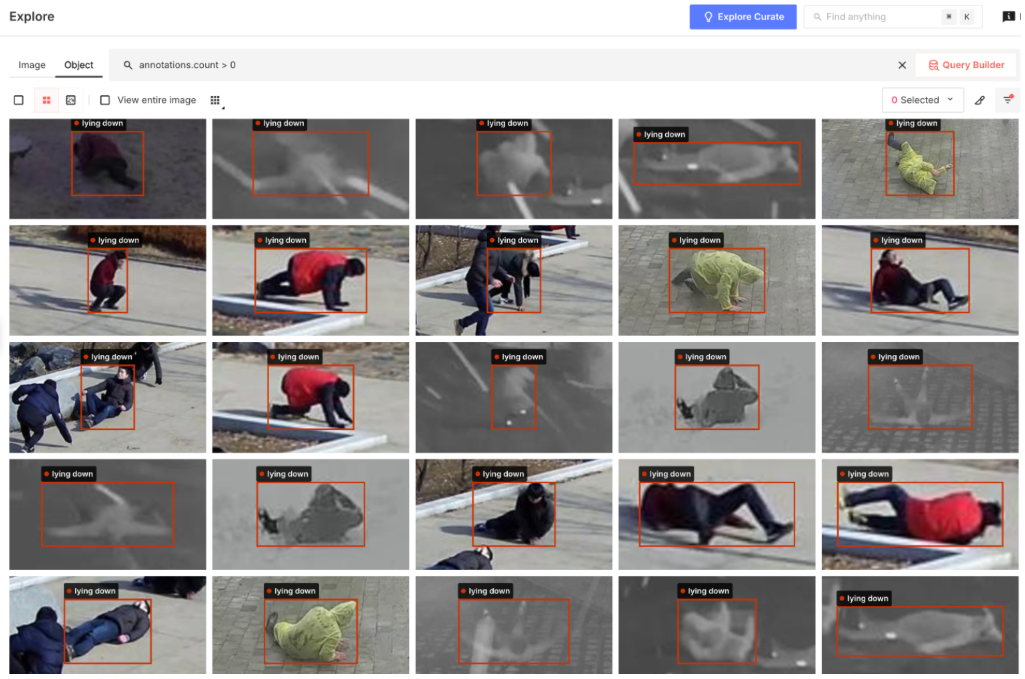
(Sample synthetic data generated on Superb Platform)
A key differentiator was the active use of synthetic data for disaster scenarios that are extremely difficult to capture in the real world. Large-scale disasters like fires, floods, and building collapses occur so infrequently that there is a severe lack of real-world training data. This is why most standard AI systems, while effective in everyday situations, fail during critical emergencies. A government's ability to respond to disasters is a matter of life and death, and a system that fails in a crisis is a failed investment. Using advanced simulation technology, Superb AI generated large volumes of realistic synthetic disaster data to train the AI model, ensuring Gimcheon City's monitoring system was prepared not just for daily life but for worst-case scenarios.
Step 2: A Hybrid AI Strategy for Unmatched Precision and Flexibility
Traditional AI development is slow and costly, requiring a new model for every new task. Superb AI’s Video Analytics solution flips this script with a revolutionary hybrid approach, combining the power of specialized, fine-tuned models with the on-demand adaptability of a prompt-based foundation model.
1. High-Precision Detection with Fine-Tuned Models: To tackle Gimcheon City's most critical challenges, Superb AI deployed a suite of specialized models, fine-tuned through MLOps pipelines for maximum accuracy. These models were dedicated to:
- Real-Time Public Safety Threats: Instantly detecting critical events like falls in parks, fire and smoke in buildings, illegal U-turns, jaywalking, and assaults.
- Intelligent Traffic Flow Analysis: Precisely identifying and tracking vehicles, pedestrians, and emergency responders to analyze traffic volume, predict flow, and support data-driven city planning.
2. On-Demand Flexibility with a Foundation Model: To handle unpredictable incidents, the solution integrates Superb AI's Vision Foundation Model (VFM), ZERO. Without any prior training, ZERO can identify virtually any object or event from simple text or visual prompts. For example, an operator can instantly task the system with a new objective—like "Find people entering the restricted area of the park"—eliminating lengthy development cycles for new or unforeseen challenges.
This hybrid strategy gave Gimcheon City a powerful, future-proof AI infrastructure. The city can now rely on the surgical precision of fine-tuned models for its core operational needs while leveraging the instant adaptability of a foundation model to handle any new situation that arises.
Step 3: Implementing an Integrated Monitoring Dashboard
Finally, an intuitive, integrated dashboard was built to allow city managers to quickly understand all AI-analyzed information and respond swiftly. The dashboard serves as a critical bridge between the AI's analytical power and human decision-making. Key features include:
- Real-Time Unified Monitoring: Control and monitor CCTV feeds from across the city on a single screen.
- AI-Powered Automated Event Alerts: When the AI detects an incident like a fall, fire, or traffic violation, a pop-up alert with the relevant video, location, and time is immediately sent to the operator.
- Data Visualization and Statistical Analysis: AI-detected objects are marked with bounding boxes on the video feed. Accumulated data, such as traffic volume by time of day or incident frequency in specific areas, is presented as visualized statistics to support long-term policy planning.
Step 4: Triggering Immediate Field Response with Automated Alerts
Superb AI's solution moves beyond simple detection to automate the critical "response" phase. The system assesses the urgency of each event and, for high-priority incidents like a medical emergency or fire, automatically sends SMS text alerts directly to designated city officials or first responders. This feature eliminates delays waiting for control center dispatch, creating a direct line from AI analysis to real-world action. It resolves a key bottleneck in the traditional "detect-judge-respond" workflow and establishes an unprecedentedly fast administrative response system.
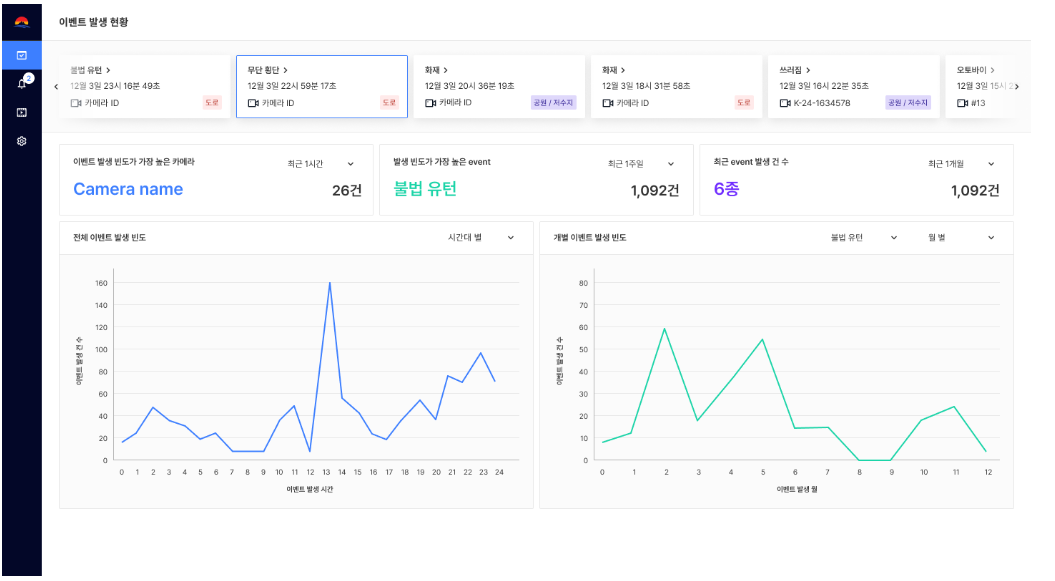
(Example of the Superb platform's integrated monitoring dashboard)
This integrated system embodies the concept of Augmented Intelligence, where AI acts as a powerful tool to enhance, not replace, human operators. This created an efficient framework for managing the entire city 24/7 with minimal personnel.
Benefit: A Safer, More Efficient City Proven by Data
After implementing Superb AI's Video Analytics solution, Gimcheon City experienced transformative changes backed by clear data. The project delivered both quantitative results proving its technical reliability and qualitative value that directly improved citizens' quality of life, establishing Gimcheon City as a leading smart city model in South Korea.
1. Quantitative Results: Proof of Technical Reliability Technical reliability is one of the most critical factors for any public system. The AI models applied in Gimcheon City underwent rigorous performance evaluations by certified testing agencies and demonstrated high accuracy.
- General CCTV Object Detection Accuracy: The model achieved 90% accuracy in detecting key objects like people and vehicles from city-wide CCTV footage.
- Smart Intersection Object Detection Accuracy: In complex traffic environments, the model achieved approximately 85% accuracy.
These figures are more than just numbers; they are objective indicators of the system's operational stability. An accuracy rate of over 85% minimizes administrative waste from false alarms and builds confidence that real crises will not be missed. This technical robustness empowered the control center to trust the AI's analysis and make swift decisions, leading to the tangible public benefits below.
2. Qualitative Outcomes: Creating Value for Citizens The ultimate goal of technology is to improve people's lives. Through AI adoption, Gimcheon City achieved the following key qualitative outcomes:
- Enhanced Public Safety: A proactive detection and rapid response system for emergencies like crimes, accidents, and disasters was established. The AI could instantly detect a citizen collapsing in a park, allowing an ambulance to arrive within the golden hour, or identify signs of a potential traffic accident to prevent chain-reaction collisions. This created a comprehensive, intelligent safety net across the city, marking a paradigm shift from reactive measures to a preventive approach that protects lives and property.
- Improved Traffic Flow: By optimizing traffic signal systems based on real-time traffic analysis, the city significantly reduced chronic congestion. Citizens could spend less time commuting and more time with their families, while logistics efficiency improved, boosting the city's economic vitality. This also created a virtuous cycle of environmental benefits, including reduced air pollution and carbon emissions.
- Maximized Administrative Efficiency: The 24/7 automated monitoring system enabled the city to manage safety and security efficiently with minimal staff. Human operators were freed from tedious, repetitive monitoring tasks and could focus on higher-value work, such as analyzing AI-flagged events, coordinating with other departments, and managing emergency responses. This maximized public sector productivity and enabled the delivery of superior public services with a limited budget.
- Accelerated Administrative Response and Improved Citizen Experience: The automated SMS alert system dramatically shortened reaction times. By instantly notifying the right personnel, emergency services were dispatched faster and traffic incidents were controlled more quickly, allowing citizens to directly experience the benefits of a more responsive government. This has been a decisive factor in increasing public trust.
Expansion Potential: A Future-Proof Infrastructure for a Sustainable Smart City
Superb AI's Video Analytics solution is not a one-time installation; it is a living infrastructure that can evolve and expand with the city's growth. The Gimcheon City project, starting with public safety and traffic management, holds limitless potential to develop into a sustainable smart city platform that encompasses all areas of urban life.
1. Instant Expansion of AI Capabilities Cities are constantly changing and presenting new challenges. Superb AI’s platform is designed to respond flexibly to these changes. In addition to providing capabilities for continuous improvement of the 14 AI models in place, the system's monitoring scope can be expanded to recognize new objects or situations as needed. For example, new mobility options like electric scooters, vehicles carrying specific hazardous materials, or new types of construction equipment can be taught to the AI, constantly increasing the precision of city management.
2. Predictive Monitoring Through Large-Scale AI If the current system is centered on "detection," the future system will evolve to be centered on "prediction." Superb AI is envisioning a next-generation monitoring system for Gimcheon City based on large-scale AI models. This system would go beyond detecting single events to analyze multiple data sources (CCTV, weather data, social media, etc.) to predict and warn of disasters before they happen. For example, it could analyze crowd density and movement to issue an early warning for a potential crowd crush, or combine heavy rain forecasts with drainage sensor data to predict flood-risk areas and issue proactive evacuation orders. This would elevate urban safety management from "response" and "prevention" to the next level: "prediction."
3. Integration with Other Public Services The AI and data infrastructure built through this project is a core city asset that is not limited to safety and transportation. This powerful platform can be easily extended to other public service areas :
- Environmental Management: Analyze CCTV footage to monitor illegal waste dumping and combine it with air quality sensor data to track pollution sources.
- Energy Efficiency Management: Analyze the installation of solar panels on rooftops and link it with smart metering data to form the basis of a smart grid that optimizes the city's energy consumption.
- Infrastructure Management: Automatically detect minute cracks or abnormalities in aging city infrastructure like bridges, roads, and water pipes to maximize maintenance efficiency.
The AI monitoring platform established through this initial investment will serve as the city's "central nervous system," integrating and analyzing all urban data. This breaks down administrative silos and enables true data-driven governance, managing the entire city as a single, organic entity and exponentially increasing the value of the initial investment.
A successful smart city is built not just by adopting advanced technology, but through a strategic partnership that accurately diagnoses a city's unique problems, systematically turns data into an asset, and implements a custom AI solution that continuously evolves.
Superb AI was more than just a software provider for Gimcheon City. We were a strategic partner that worked alongside the city to realize its vision—from formulating a data collection strategy and generating rare disaster data, to implementing 14 custom AI models tailored to the city’s needs, deploying an integrated dashboard, and planning for future expansion.
Our approach is not to sell a one-size-fits-all product, but to deeply understand the unique characteristics and needs of each city. We co-design and develop the optimal AI systems and, through continuous technical support and updates, we help the system grow together with the city.
Related Posts
![[Customer Success Story] How Mobile AI CCTV Supports Permit-to-Work Safety at a Power Plant](https://cdn.sanity.io/images/31qskqlc/production/cbf6328f2afc92a3e7c3ba70f68a721d02c1ed66-3200x1800.png?fit=max&auto=format)
Case Study
[Customer Success Story] How Mobile AI CCTV Supports Permit-to-Work Safety at a Power Plant
Hyun Kim
Co-Founder & CEO | 10 min read
![[Customer Success Story] How AgTech Company Metafarmers Built Crop Recognition Datasets for Harvesting Robot Vision](https://cdn.sanity.io/images/31qskqlc/production/7ee10aa76e0f471a557629050f70fcb5eac47060-3200x1800.png?fit=max&auto=format)
Case Study
[Customer Success Story] How AgTech Company Metafarmers Built Crop Recognition Datasets for Harvesting Robot Vision
Hyun Kim
Co-Founder & CEO | 5 min read
![[Customer Success Story] How a Video-Based Behavior Analysis AI Company Built a Scalable Keypoint Labeling Workflow](https://cdn.sanity.io/images/31qskqlc/production/5371223bbc093c18d5d64b667266722102072d01-3200x1800.png?fit=max&auto=format)
Case Study
[Customer Success Story] How a Video-Based Behavior Analysis AI Company Built a Scalable Keypoint Labeling Workflow
Hyun Kim
Co-Founder & CEO | 7 min read

About Superb AI
Superb AI is an enterprise-level training data platform that is reinventing the way ML teams manage and deliver training data within organizations. Launched in 2018, the Superb AI Suite provides a unique blend of automation, collaboration and plug-and-play modularity, helping teams drastically reduce the time it takes to prepare high quality training datasets. If you want to experience the transformation, sign up for free today.