Insight
Superb AI SOP Monitoring—Setting the New Standard for Quality and Productivity in the Era of Physical AI

Hyun Kim
Co-Founder & CEO | 2026/02/09 | 7 min read
Physical AI isn’t built on robot hardware alone. It requires a three-part foundation: “eyes” (vision) to interpret complex physical environments, a “brain” to make decisions, and “actions” to carry them out in the real world. As a vision AI company, Superb AI is developing two core pillars that sit at the heart of the Physical AI ecosystem: spatial understanding and object interaction.
The SOP Monitoring feature we’re introducing today is designed for the “interaction” and “judgment” layer—fundamentally transforming how manufacturers manage safety and quality on the shop floor.
1. Why SOP Compliance Matters—and Why Monitoring Is Hard
Standard Operating Procedure (SOP) monitoring is the on-site operating baseline for executing work “the right way, at the right quality, within the right time.” In manufacturing, process standards govern tasks such as assembly, machining, and inspection. In retail and logistics, SOP execution directly shapes customer experience and profitability.
- Retail (stores): Planogram (stowing) compliance, price tag and promotion execution, restocking, and out-of-stock response all rely on SOP discipline. The moment SOP breaks down, revenue and margin losses follow. On average, store inefficiencies caused by non-compliance with the SOP are estimated to drive about a 5.5% loss in sales.
- Fulfillment and distribution centers: End-to-end workflows—picking → packing → labeling → sealing → shipping—can quickly result in mis-shipments, damage, rework, and customer claims when SOP deviations occur. Many operations aim to manage “best-in-class” picking accuracy at ≥99.68%, because even small deviations translate directly into cost.
- Returns and reverse logistics pressure: Across retail, returns in 2025 alone are estimated at 15.8% (about $849.9 billion), underscoring how operational accuracy has become business-critical (with online returns estimated at 19.3%).
In short, SOP execution is tightly linked to on-site safety, quality (accuracy), and productivity (throughput).

The challenge is that SOPs keep getting more detailed, while consistently monitoring them based on the same standard is becoming more unrealistic. In retail, for example, it’s practically impossible to have staff manually check the entire merchandising conditions every day. Manual inspections are labor-intensive, error-prone, and expensive. As a result, “gut feel and spot checks” are no longer enough—and video-based monitoring that provides “the same eyes, all the time” is increasingly becoming the new standard for SOP operations.
2. Superb AI’s SOP Monitoring: Learning Standard Workflows and Detecting Process Deviations
Superb AI advances vision AI one step further with SOP Monitoring—a capability that automatically learns “standard” on-site workflows and then detects and explains deviations in subsequent work. In other words, AI learns the baseline, identifies the moment a process diverges from it, and tells you why it was considered a deviation.
SOP Monitoring operates in two stages.
2-1. Automatically Extracting the Standard Workflow (Baseline)
When you upload a video of a correctly executed process, vision AI automatically analyzes and extracts the workflow’s stages, sequence, pace, and key objects. Just as a human would create an operational guide, AI builds a “standard workflow model.”
- Manufacturing: Checking assembly sequence, tool usage timing, and missed inspection steps
- Logistics/packaging: Standardizing sequences such as box assembly → insert cushioning → insert product → include inserts (invoice/manual) → seal → apply label → place into sorting
- Retail: Standardizing replenishing and stowing steps (e.g., fill by category, pacing, promotion attachment)
2-2. Deviation Check: Comparing Against the Baseline and Providing “Root Cause + Evidence Clips”
When you upload another work video, SOP Monitoring compares it against the standard workflow model to identify skipped steps, reordered sequences, abnormal speed (bottlenecks), and mismatches in key objects. It then explains what went wrong—and provides supporting clips from the exact segments in question.
This allows managers to immediately pinpoint what changed and where, and quickly take action through rework, training, or line balancing.
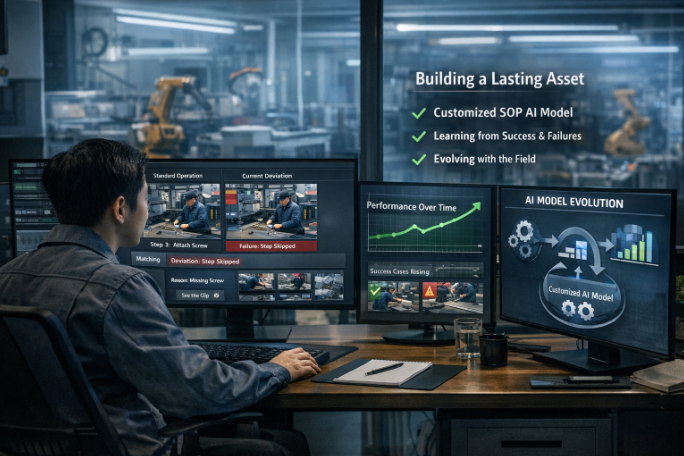
As shown in the demo, results are visualized so you can see the deviation point, the root cause, and the evidence clip on a single screen.
NVIDIA’s Pegatron customer story illustrates this concept clearly: a vision AI agent detects assembly errors in real time (for example, missing a screw) and triggers alerts so workers can correct issues immediately.
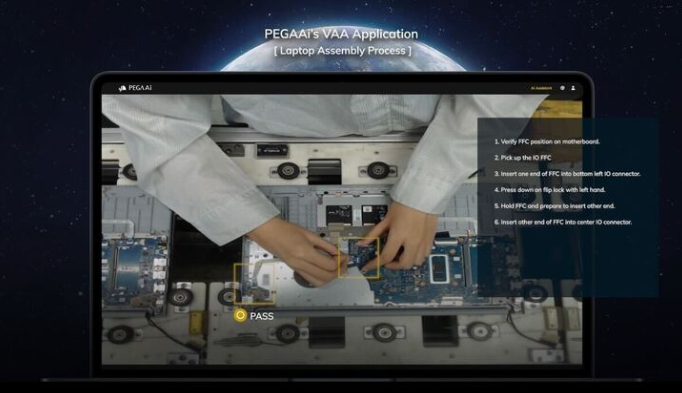
By leveraging technologies such as NVIDIA VSS and Omniverse, they also achieved outcomes such as 7% labor cost reduction per line, 67% defect reduction, and a 40% reduction in new factory build time.
The moment SOP Monitoring moves from a proof-of-concept to the real world, requirements rise sharply:
- A large-scale video pipeline (storage / search / summarization / querying)
- Edge and server infrastructure
- Standardization and scalability for operational deployment
All of these must work together for SOP Monitoring to become not a “demo,” but a true production system.
Superb AI was introduced at CES 2026 as a key vision AI partner in NVIDIA’s Physical AI ecosystem, and is expanding industrial deployments by collaborating with robotics and enterprise software companies within the NVIDIA ecosystem. SOP Monitoring is not a single feature—it is a full-stack capability built for real-world operations. For customers, alignment between Superb AI and the NVIDIA ecosystem directly translates into reduced deployment risk across performance, operations, and scalability.
As one example, CS WIND, the world’s largest wind tower manufacturer, has adopted Superb AI’s vision AI technology alongside NVIDIA’s AI computing infrastructure to automate and optimize production workflows—expanding SOP Monitoring into a productivity system that turns on-site time into data and reduces bottlenecks.
Superb AI combines its VFM “ZERO” with VLMs to understand video timelines and context, automatically compute cycle time by process step, and detect workflow delays in real time. In addition, by indexing video metadata based on the NVIDIA VSS blueprint, Superb AI enables managers to quickly search and analyze the exact scenes they need using natural language queries.
3. A Data Asset Strategy That Makes the Workplace Safer Over Time
A core differentiator of Superb AI’s SOP Monitoring is data assetization. By continuously feeding both successful and failed SOP cases back into AI training, Superb AI helps build custom AI models that become more precise over time.
This is not about temporarily “borrowing” an AI model. It means leaving your organization with a long-term asset: an AI monitoring model tailored to your specific operations. If a deployed AI model remains unchanged, it eventually becomes outdated and less useful as real-world conditions evolve. In contrast, Superb AI’s SOP Monitoring is designed to optimize itself the more it is used, compounding competitiveness over time. By ensuring data is retained and continuously learned from, organizations can build a durable safety asset for the shop floor.
4. SOP Monitoring in the Era of Physical AI—And What Comes Next
So what role will Superb AI’s SOP Monitoring play in the broader Physical AI landscape?
In industrial settings, the ability to determine whether robots or human workers are following defined procedures is a fundamental requirement for building AI agents that are safe and reliable in the physical world. Superb AI’s SOP capability serves as the “brain” layer of an AI agent—one that internalizes a company’s SOP and continuously evaluates whether real work is being executed according to that standard. Because SOP-trained AI assesses operations using the same procedure and compliance criteria every time, it functions as a key safety mechanism in the era of Physical AI.
For business decision-makers, adopting SOP Monitoring carries meaning beyond automation. It is a process of converting your company’s standards and know-how into data—and embedding them into AI. Over time, the resulting AI models become smarter with accumulated operational experience, turning into organization-specific AI assets. Superb AI brings the latest AI technology into the field in the most practical and reliable way: ensuring that whether the work is done by humans or robots, processes are executed against the exact same standard—every time. This will be a critical success factor for future smart factory innovation and the Physical AI era. With Superb AI’s SOP capability, you can experience a new operating standard where safety and efficiency move together.
Related Posts
Insight
Why Doesn’t Robot AI Have an ImageNet? A Test You Can’t Grade with a Single Answer Key
Hyun Kim
Co-Founder & CEO | 10 min read
Insight
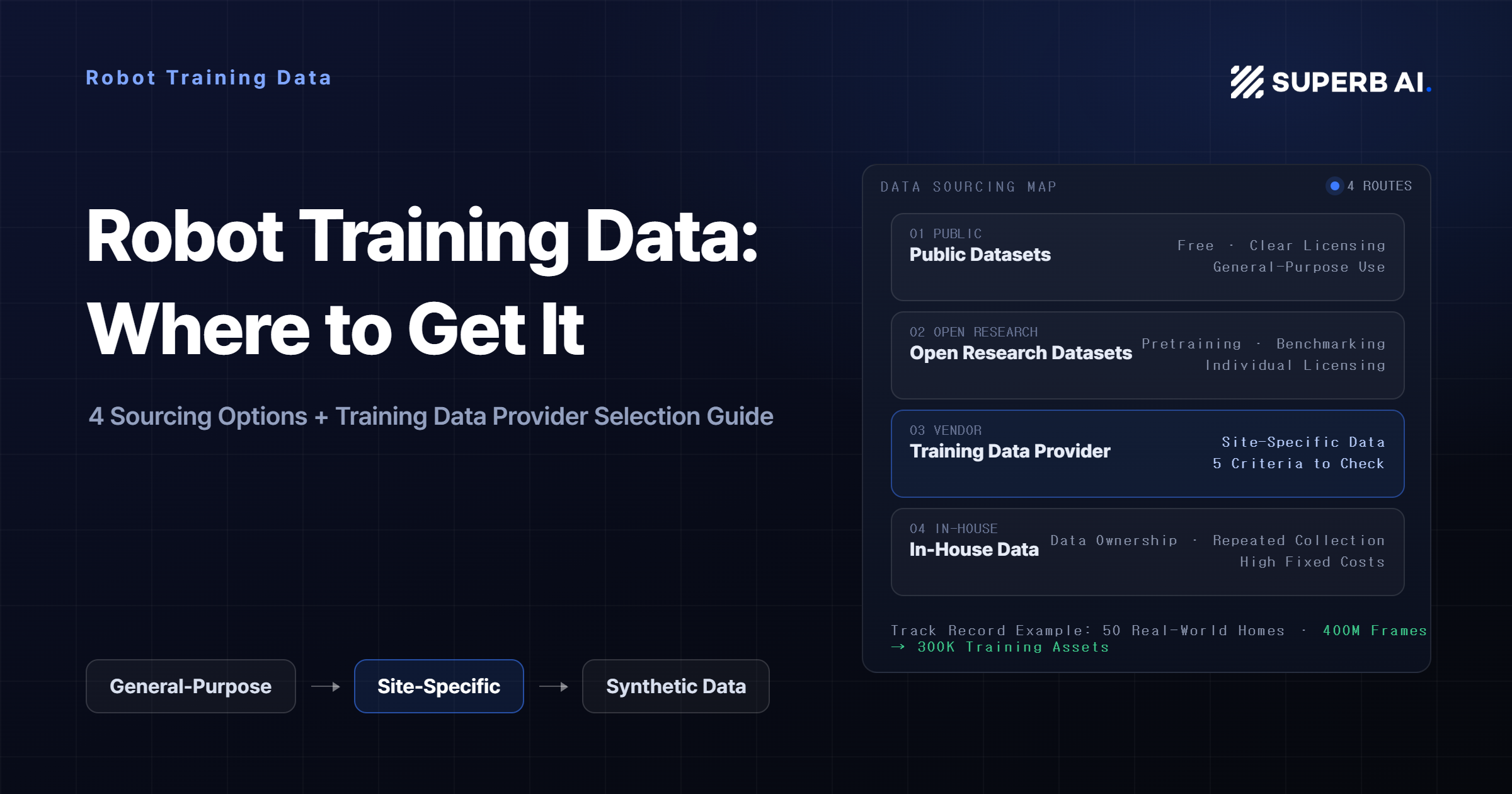
Robot Training Data Sourcing Guide: 4 Options and How to Choose a Training Data Provider
Hyun Kim
Co-Founder & CEO | 7 min read
Insight
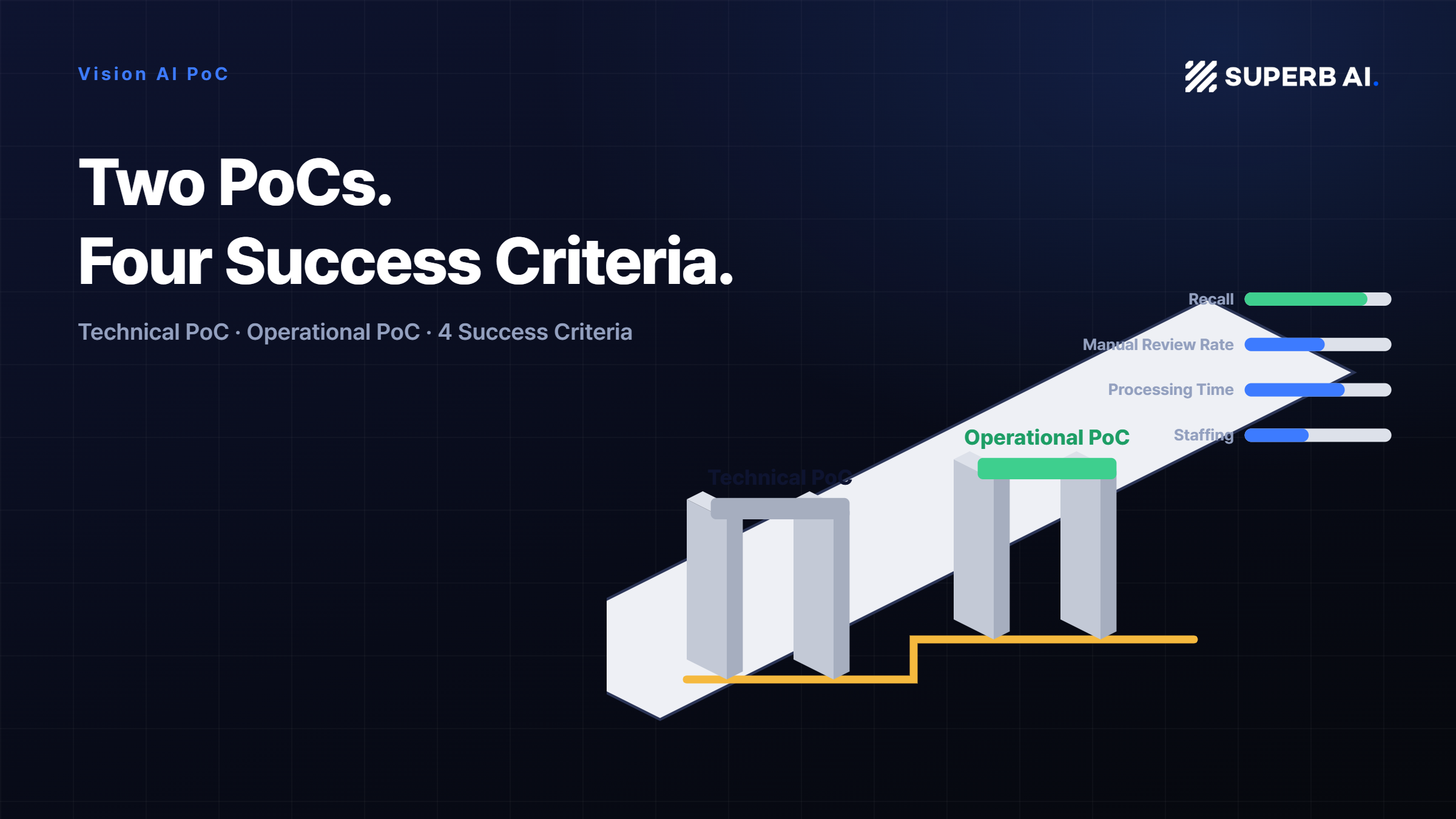
Vision AI PoC Design Guide: Timeline, Data, and Success Criteria
Hyun Kim
Co-Founder & CEO | 7 min read

About Superb AI
Superb AI is an enterprise-level training data platform that is reinventing the way ML teams manage and deliver training data within organizations. Launched in 2018, the Superb AI Suite provides a unique blend of automation, collaboration and plug-and-play modularity, helping teams drastically reduce the time it takes to prepare high quality training datasets. If you want to experience the transformation, sign up for free today.