Announcements
Vision Intelligence for Public Safety: SWIPE Presentation Recap

Hyun Kim
Co-Founder & CEO | 2026/11/04 | 7 min read
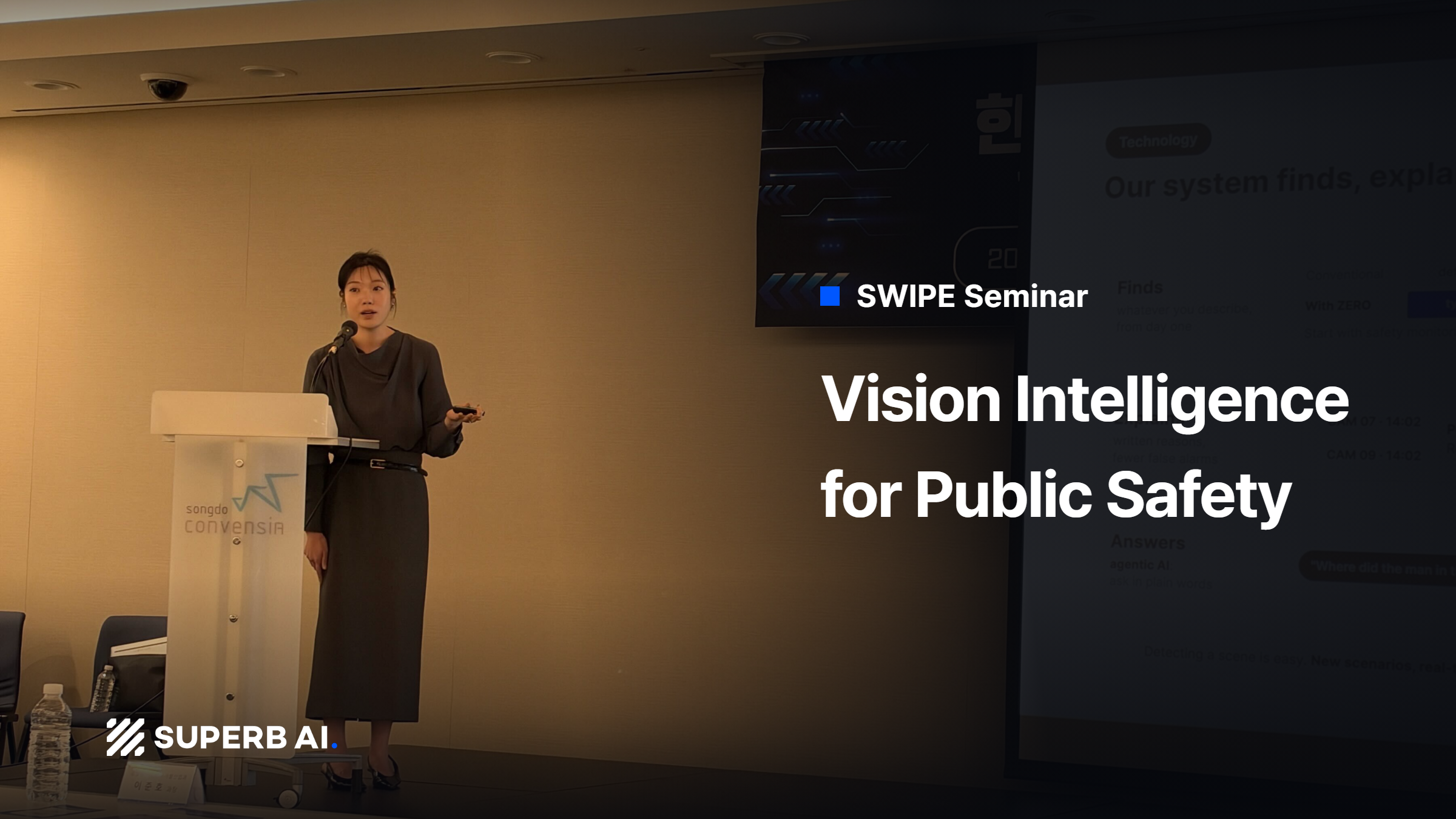
On October 22, 2026, Superb AI presented "Vision Intelligence for Public Safety" at the Korea-Singapore Safer World Innovations Programme (SWIPE) presentation seminar.
The presentation introduced a public safety monitoring approach that uses patrol robots and 3D digital twins to extend coverage beyond fixed CCTV cameras, while ZERO, Superb AI's industry-specialized vision foundation model, helps provide supporting evidence for each alert.
As a company selected for SWIPE, Superb AI also received a certificate of appreciation and a trophy from the Commissioner General of the Korea National Police Agency.
The presentation was delivered by Lena Park, Global GTM & Partnerships Manager. This article recaps the key points of the 10-minute presentation.
📌 Key Takeaways
- Cities continue to install more CCTV cameras, but blind spots remain outside their fields of view, and footage from different cameras often remains disconnected. These were the two challenges at the heart of the presentation.
- Superb AI introduced an approach that creates a 3D digital twin from video captured while walking through a site with a smartphone, then integrates CCTV and patrol robot feeds on a single 3D map. Robots can be dispatched to investigate areas fixed cameras cannot see.
- ZERO lets operators define detection targets in natural language, supports alerts with written explanations, and helps answer questions from monitoring operators. The final decision on whether to dispatch a response remains with the human operator.
What Is SWIPE?
SWIPE, short for the Korea-Singapore Safer World Innovations Programme, is a collaborative initiative between Korea and Singapore focused on science and technology for public safety and policing.
The presentation seminar was organized by the Police Research and Development Industry Division of the Korea National Police Agency as part of the official program of KPEX 2026 (Korea Police World Expo), held at Songdo ConvensiA in Incheon from October 21 to 24.
Pain Points: More Cameras, but Blind Spots Remain
The presentation began with a practical challenge in urban surveillance. Cities add more CCTV cameras every year. Yet cameras cannot cover every location, and footage from each camera is often stored and monitored separately. When an incident occurs outside a camera's field of view, the control room may have no way of detecting it or responding in time. Some areas are also too dangerous for people to patrol.
Superb AI introduced two ways to address these gaps. First, send robots where fixed cameras cannot reach. Second, bring video from every camera and robot together on a single 3D map. The presentation described this ability to understand an entire physical environment as Spatial Intelligence.
How Do Digital Twins and Robot Monitoring Work Together?
The presentation outlined a five-step operational workflow:
Step 1. Capture the Site
An operator walks through the site while recording video with a smartphone or conventional camera. The process does not require CAD or BIM drawings or expensive, complex sensors such as LiDAR.
Step 2. Reconstruct the Digital Twin
Superb AI's 3D digital twin technology reconstructs the environment from the recorded footage. This lower-cost approach makes digital twin deployment more practical across a wide range of sites.
Step 3. Localize the Robot
The robot identifies its position within the digital twin in real time. Monitoring operators can continuously see where the robot is and what it is observing.
Step 4. Dispatch the Robot
An operator can dispatch a robot with a single click on the digital twin.
Step 5. Stream Live Video
The robot's camera feed appears on the same 3D map as the fixed CCTV feeds. If the robot detects a person who has collapsed, fire, smoke, loitering, or another potential hazard, the location is marked on the digital twin, and an alert is sent to the monitoring operator.
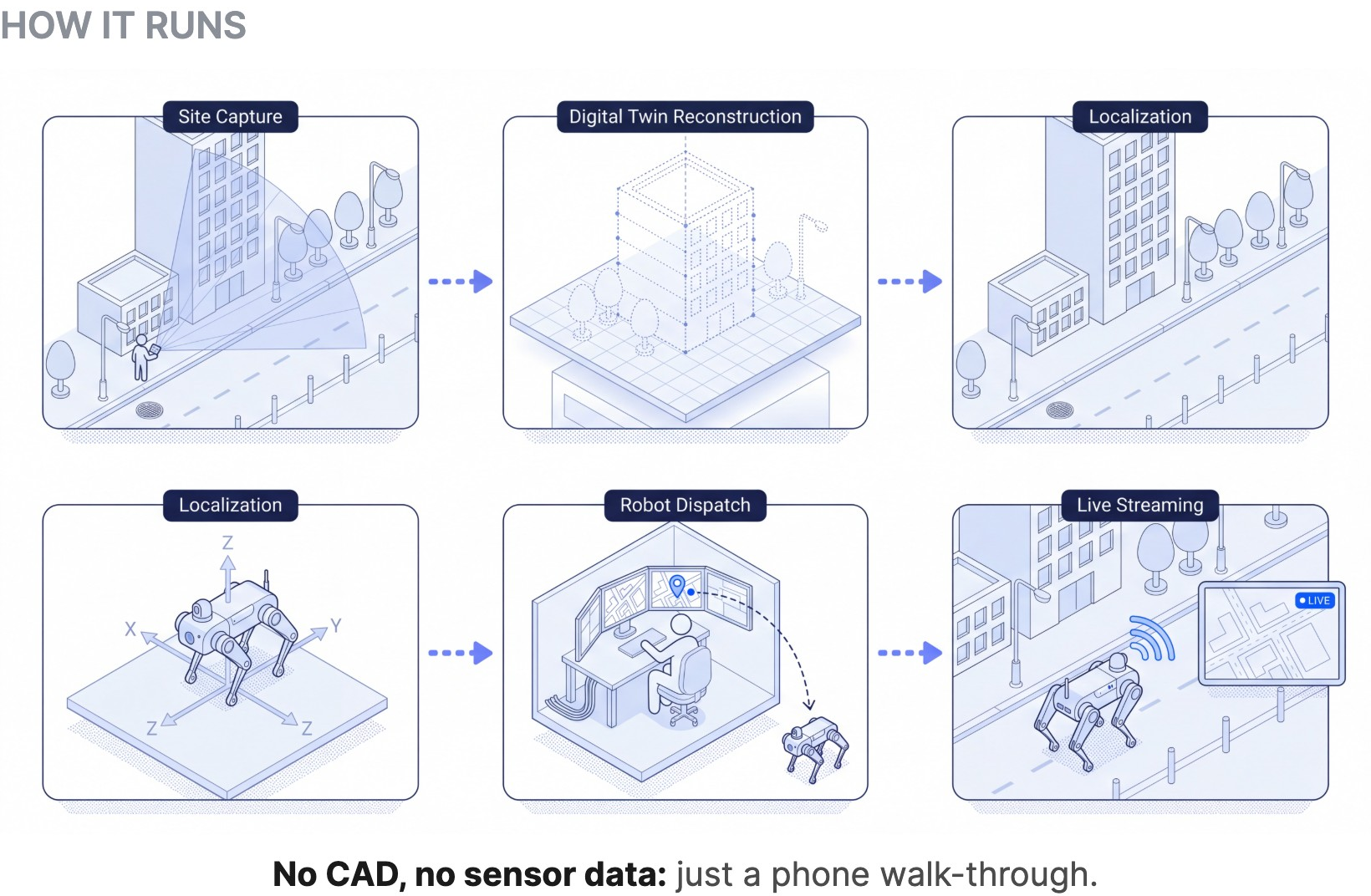
Five-step workflow: site capture, digital twin reconstruction, robot localization, robot dispatch, and live video streaming
Superb AI handles the vision part of the Physical AI. Because we do not manufacture robot hardware, our technology is not tied to a particular robot model. Whether footage comes from fixed CCTV cameras, robots, or drones, the AI models interpret the video and integrate the results into the same 3D digital twin.
What each camera and robot sees becomes part of a connected view on a single dashboard.
Read more → AI CCTV Video Monitoring Guide
What Monitoring AI Does: Find, Explain, and Answer
Traditional video analytics systems, AI CCTV, and patrol robots generally detect predefined targets they have been trained to recognize, such as fire or a person who has collapsed.
The presentation organized the capabilities of a ZERO-based monitoring system into three functions. In all three, the final decision remains with the monitoring operator:
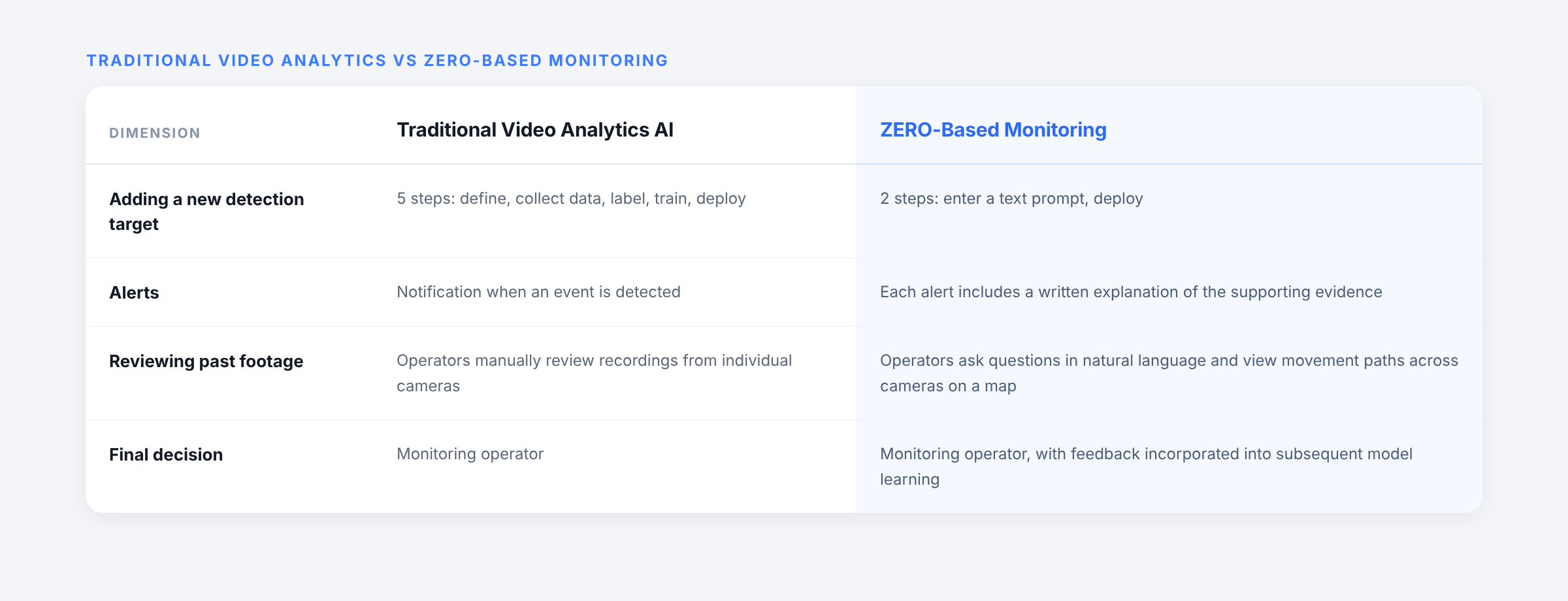
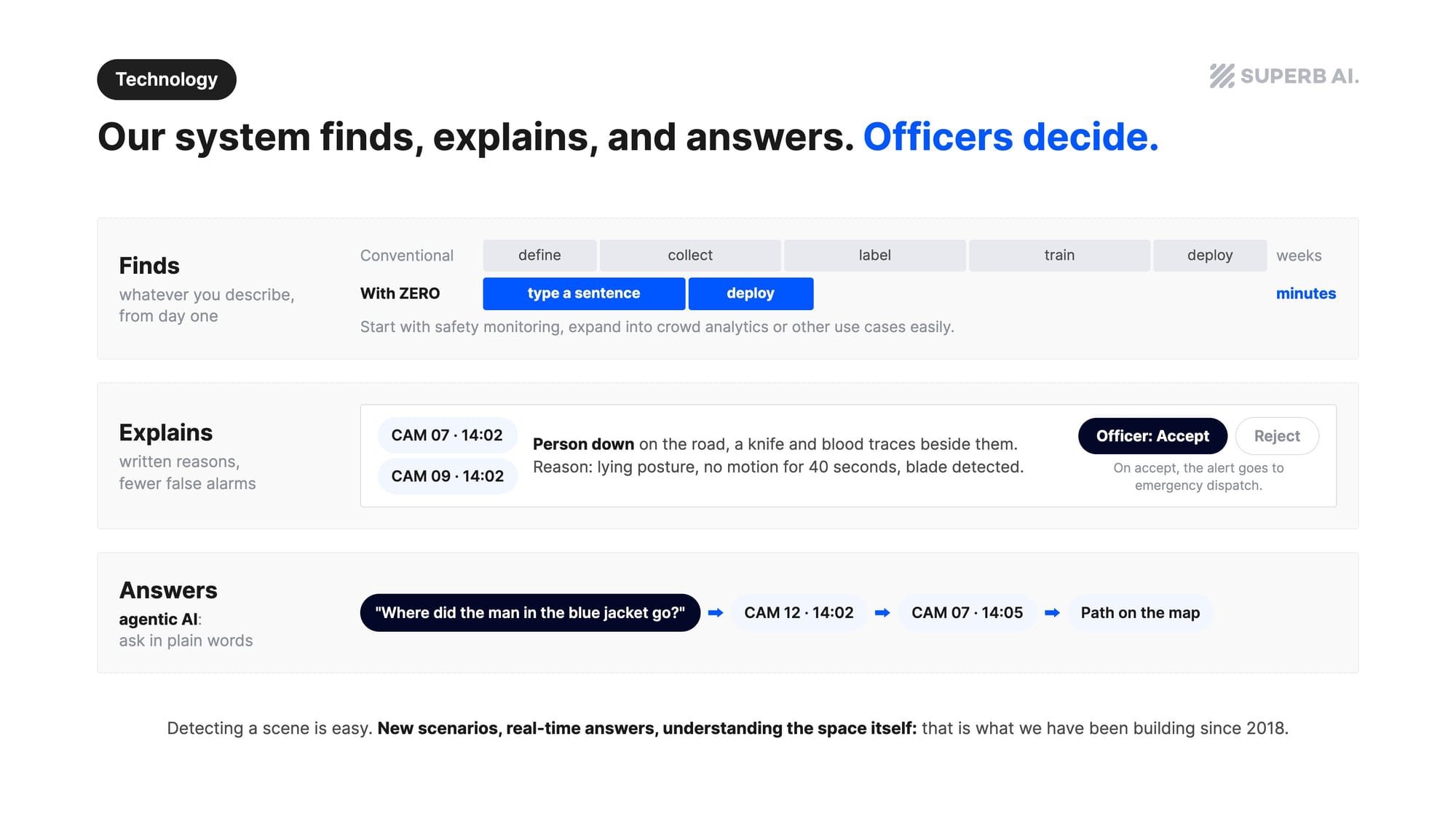
Find, explain, and answer: monitoring operators make the final decisions
1. Find: Define Detection Targets in Natural Language
Operators can describe what they want to detect in plain language, and ZERO can begin detecting the target without additional task-specific training. For example, the system might monitor fire and smoke today, then be configured to search for missing persons tomorrow.
Because ZERO is pretrained on visual data from industrial environments, expanding to new use cases does not require retraining the model for each task. A system that starts with safety monitoring can therefore expand to other applications, such as crowd analysis.
ZERO ranked first in the CVPR 2026 Foundational Few-Shot Object Detection Challenge, achieving an average mAP of 53.9 across 20 industrial domains.
Read more → Superb AI's CVPR 2026 Challenge Results
2. Explain: Provide Supporting Evidence for Every Alert
Each alert includes an explanation of what the system observed and why it matters.
An example shown during the presentation read:
"A person is lying on the road, with a knife and bloodstains visible nearby. Evidence: prone position, no movement for 40 seconds, blade detected."
The monitoring operator reviews the explanation and decides whether to dispatch a response or dismiss the alert. Approved alerts are forwarded to the emergency response system.
This process allows false alarms to be filtered before anyone is dispatched. Operator approvals and rejections are also fed back into the model, allowing it to continue learning from how monitoring operators make decisions at that particular site.
3. Answer: Let Monitoring Operators Ask Questions
The dashboard includes Agentic AI capabilities.
An operator can ask:
"Where did the man in the blue jacket go?"
The system searches hours of recorded footage and visualizes the person's movement across multiple cameras on a map.
In the presentation, the person appeared on Camera 12 at 2:02 PM and Camera 7 at 2:05 PM. The system connected these observations into a movement path on the map. The monitoring operator can then check the person's current location or dispatch a robot to investigate.
Real-World Results: Operational and Validated Deployments
The presentation highlighted two sites: one with an operational system and another where a proof of concept had been validated. Both used cameras that were already installed.
Gimcheon Smart City: Real-Time Detection of Safety Risks at Intersections and Parks
In Gimcheon City, the system detects potential hazards in real time, including people who have collapsed in parks, fire and smoke in buildings, illegal U-turns and jaywalking at intersections, and violent behavior.
When an event is detected, the alert is sent to the city's monitoring center. A monitoring operator reviews the event before notifying the responsible agency, such as the fire department or police. The system achieved 90% accuracy in detecting key objects such as people and vehicles in CCTV footage.
Read more → Gimcheon Smart City: AI for Public Safety
Incheon International Airport: Passenger Flow Analysis with NVIDIA AI Blueprint VSS
At Incheon International Airport, a proof of concept combined Superb Video Analytics with the NVIDIA AI Blueprint for Video Search and Summarization (VSS) to validate passenger flow analysis.
The system analyzed congestion at check-in counters and departure areas and predicted passenger waiting times. Object re-identification technology also enabled passenger movement to be tracked across multiple cameras, demonstrating the potential to locate missing persons more quickly.
Read more → Incheon International Airport Passenger Flow Management PoC
Across both sites, the principle remains the same: the system determines which events to flag, while people make the final decisions.
What Public Safety Applications Can This Support?
The presentation introduced six public safety applications:
- Missing person search: Track individuals across multiple cameras.
- Crowd safety: Monitor crowd density and waiting times in real time.
- Fire and smoke detection: Deliver immediate alerts with natural language descriptions.
- Traffic and illegal parking: Track license plates and monitor congestion.
- Digital twins: Reconstruct physical environments in 3D in real time.
- Drones and counter-drone systems: Detect small, low-contrast targets.
Beyond CCTV and robot cameras, the technology can also identify small, low-contrast targets in X-ray imagery and drone footage.
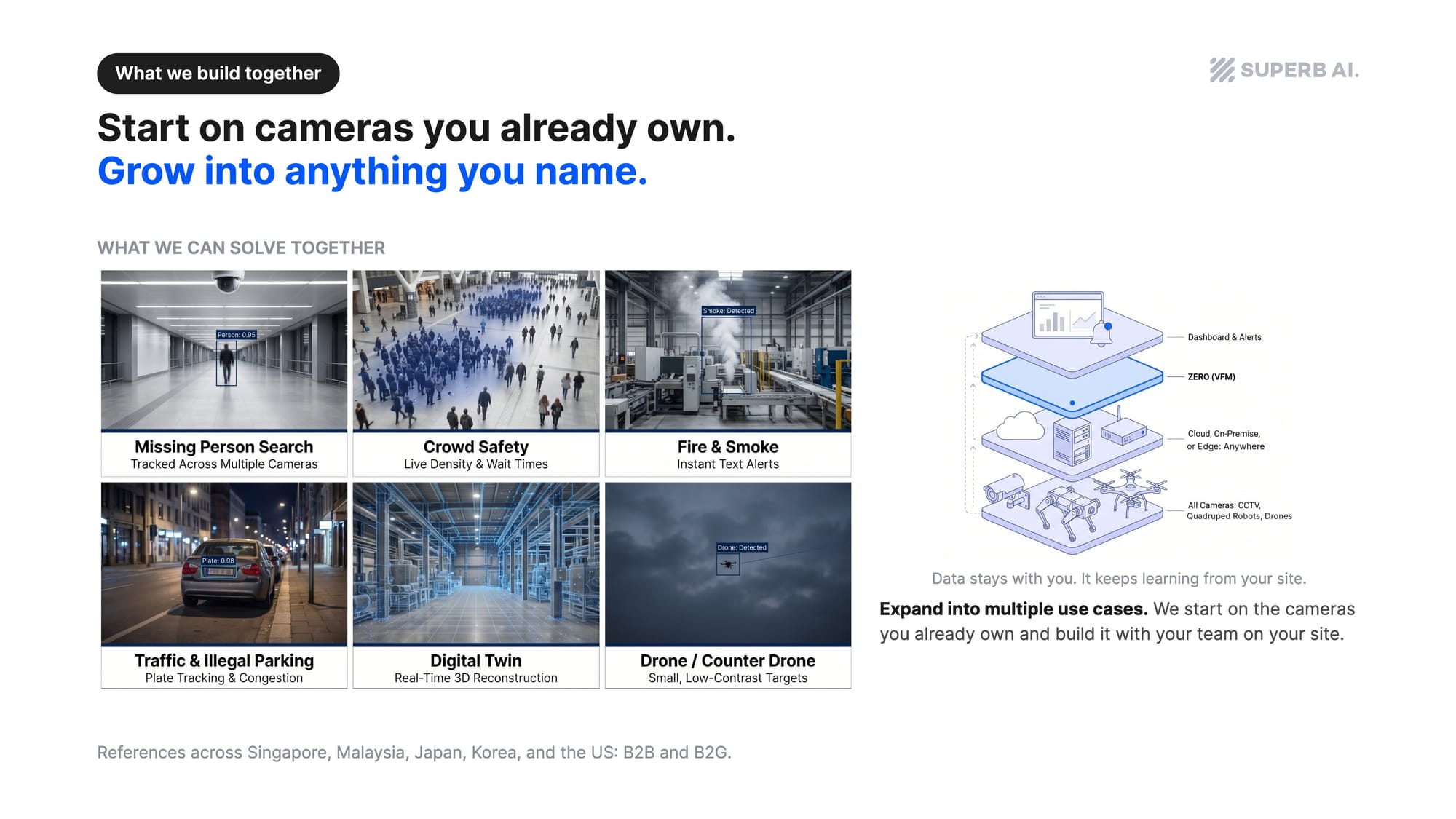
Start with existing cameras and expand to additional use cases as needed
3 Things Public Agencies Should Check Before Deployment
1. Can the System Use Existing Cameras?
Both Gimcheon City and Incheon International Airport began with their existing camera infrastructure. Before introducing new hardware, agencies should check whether their current cameras can support the intended AI applications.
2. Can the Data Remain Within the Agency's Infrastructure?
ZERO can run in cloud, on-premises, or edge environments, using the hardware and infrastructure already available to the agency. The system can operate within a closed network and continue improving with data from the deployment site.
3. What Is Needed to Get Started?
A sample video or test environment, along with one problem the agency wants to solve, is enough to begin. The next steps can then be developed together based on actual site conditions.
Superb AI is a Vision Intelligence company that transforms visual data from industrial sites into intelligence enterprises can act on. Superb AI builds public safety monitoring systems that integrate and interpret video from existing CCTV cameras, robots, and drones within a single 3D digital twin.
💬 Considering Vision AI for public safety monitoring? Tell us about your existing camera infrastructure and the problem you want to solve. Rather than starting with a sales call, we'll begin by identifying a use case we can test using footage from your site.
Related Posts
Announcements
Where Do Robots Practice? Introducing "Right Now, Somewhere," Superb AI's Second Physical AI Brand Film
Hyun Kim
Co-Founder & CEO | 7 min read
Announcements
Building the Eyes and Hands of Physical AI: Advancing to Phase 3 of Korea’s Sovereign AI Foundation Model Project
Hyun Kim
Co-Founder & CEO | 7 min read
Announcements
Superb Academy Is Live: Learn Superb Platform in One Place
Hyun Kim
Co-Founder & CEO | 3 min read

About Superb AI
Superb AI is an enterprise-level training data platform that is reinventing the way ML teams manage and deliver training data within organizations. Launched in 2018, the Superb AI Suite provides a unique blend of automation, collaboration and plug-and-play modularity, helping teams drastically reduce the time it takes to prepare high quality training datasets. If you want to experience the transformation, sign up for free today.