Insight
AI CCTV Video Monitoring Guide: Comparing Approaches and Deployment Steps

Hyun Kim
Co-Founder & CEO | 2026/10/02 | 10 min read
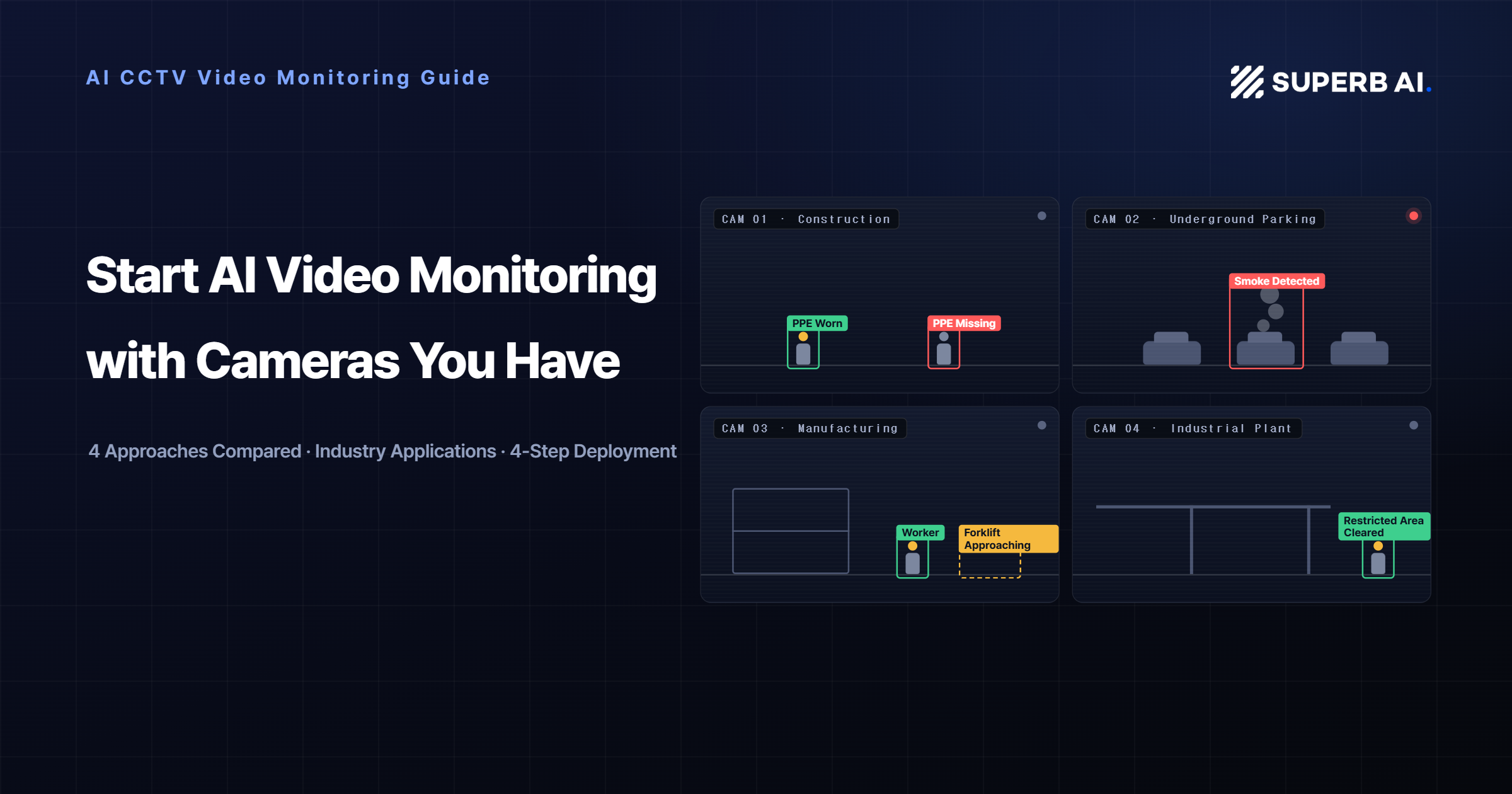
AI CCTV video monitoring uses AI to interpret video from CCTV cameras already installed at a site, detect hazardous or abnormal situations in real time, alert the appropriate personnel, and retain a record of what happened. Instead of requiring people to continuously watch multiple screens, AI monitors the video so people can focus on judgment and response.
AI CCTV, intelligent CCTV, AI video analytics, and AI video monitoring are different terms commonly used in the industry for the same general type of system. This guide explains that system from five angles: what it is, how the different approaches compare, industry-specific results, costs, and the deployment process. This post reflects information available as of September 2026.
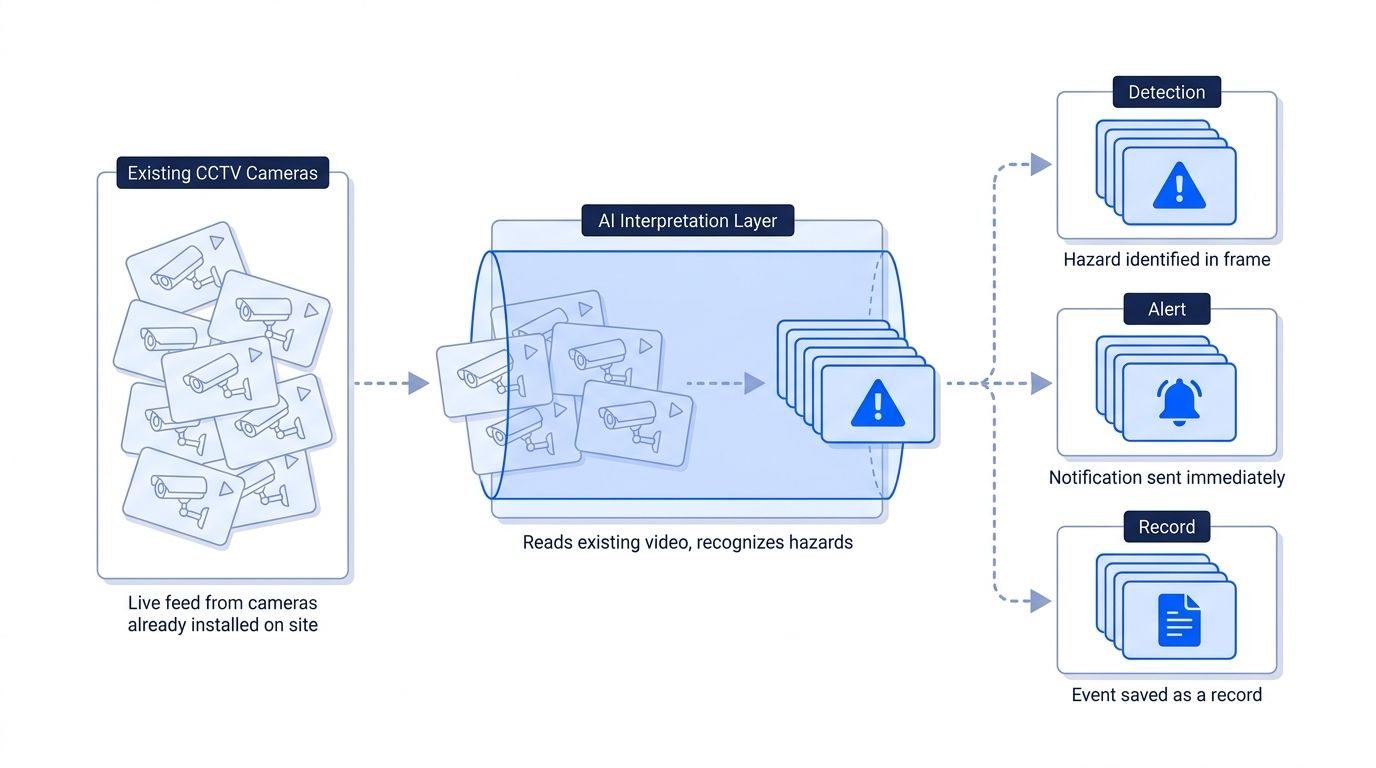
Conceptual diagram: AI adds an interpretation layer on top of existing CCTV video to detect events, send alerts, and retain records. Replacing the cameras is not a prerequisite
Key Takeaways
- AI CCTV video monitoring adds an AI interpretation layer to existing CCTV feeds, so replacing cameras is not necessarily required. The four main approaches are manual monitoring, rule-based detection, task-specific AI (training required), and foundation-model AI that can begin without additional task-specific training.
- Measured results include a 65% reduction in EV fire detection time and an 80% reduction in false alarms with the National Fire Research Institute of Korea, more than a 95% reduction in truck safety management time at a logistics company, and an increase in PPE compliance from 75% to 98% at a manufacturing company.
- When existing CCTV can be reused, a pilot can begin within two weeks without installing new cameras. With a foundation-model approach, deployment can begin by defining the events to detect rather than first building a task-specific training dataset.
Why Now? Both Small and Large Sites Have More to Monitor Than People Can Watch
According to provisional 2025 occupational fatality statistics released by Korea's Ministry of Employment and Labor in March 2026, 605 workers died in accidents subject to investigation. Of these, 351 were in the category below 50 employees—or, for construction projects, below KRW 5 billion (approx. USD 3.70 million)—representing 58% of the total. Smaller workplaces often cannot maintain a dedicated control room or keep safety personnel on watch at all times. CCTV cameras may already be installed, but in many cases no one is continuously watching the footage.
The remaining 254 fatalities occurred in the category at or above the 50-employee—or KRW 5 billion (approx. USD 3.70 million) construction-project—threshold, four more than the previous year. The same Ministry of Employment and Labor release noted that major accidents at construction projects worth KRW 5 billion (approx. USD 3.70 million) or more contributed to the increase in construction fatalities. Serious accidents therefore remain a challenge even at large sites with dedicated safety teams and control rooms. Although these figures are specific to Korea, they illustrate a broader challenge for large industrial sites: even with dedicated safety personnel and monitoring rooms, there can still be more to watch than people can monitor effectively.
Once the number of cameras reaches the hundreds, it exceeds what a single operator can follow simultaneously. During periods when contractor personnel are moving in and out of different zones, a violation may appear on screen without anyone seeing it. As organizations scale, manually documenting how safety procedures were carried out also becomes increasingly difficult.
AI CCTV video monitoring addresses both situations. Instead of adding more cameras, organizations use AI to monitor footage from cameras they already have. At smaller sites, AI can take over much of the continuous screen-watching that would otherwise require dedicated personnel. At larger sites, it narrows hundreds of feeds down to the scenes that require attention.
Comparing Monitoring Approaches: Manual vs. Rule-Based vs. Task-Specific AI vs. Vision Foundation Model-Based AI Monitoring
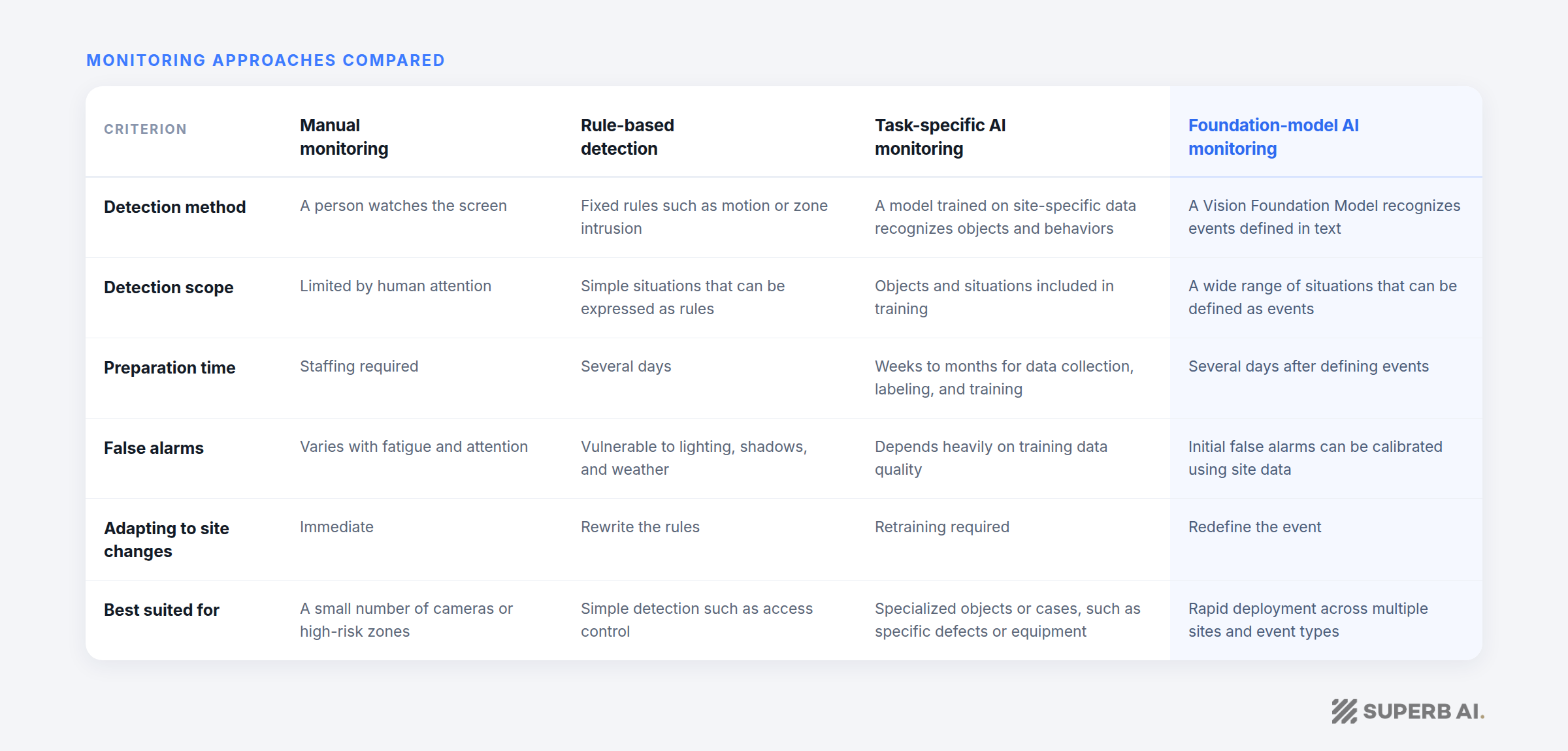
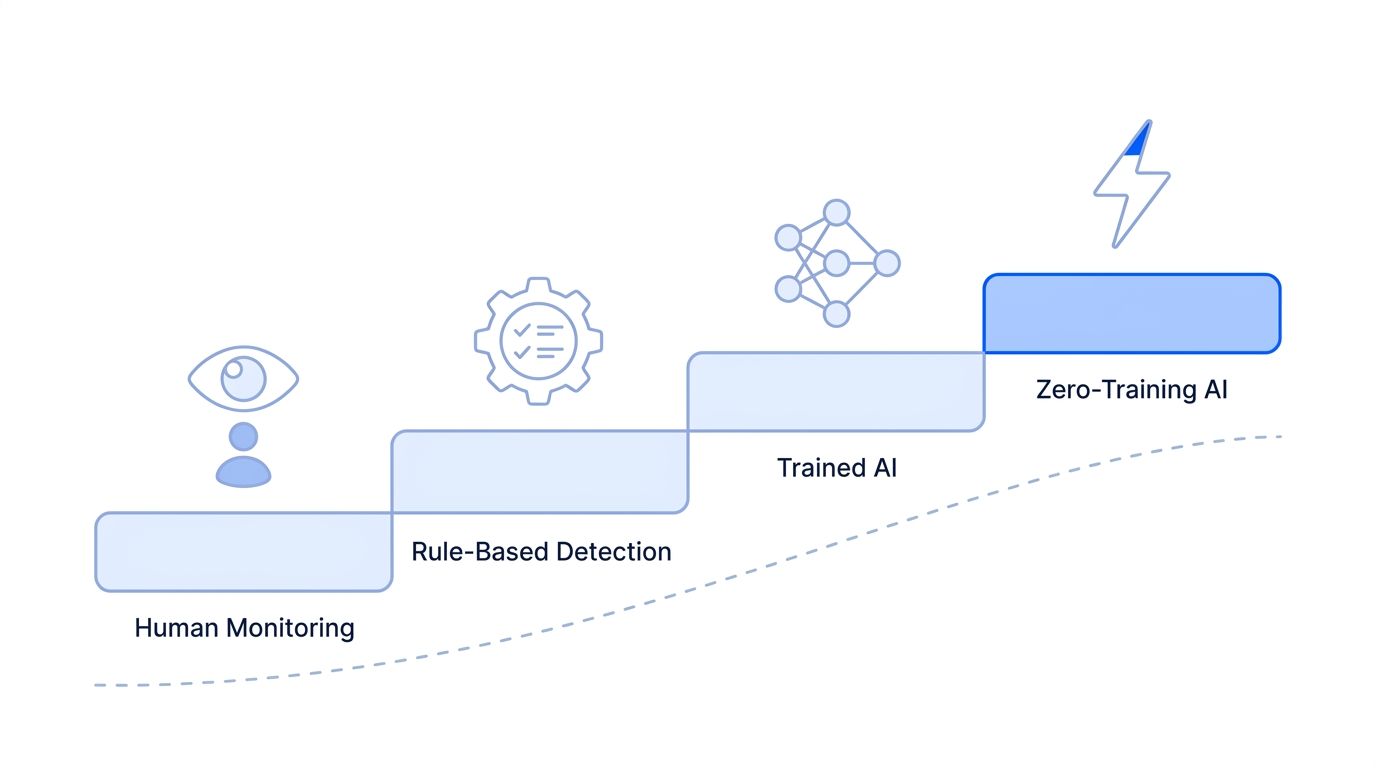
Comparison diagram: Moving to the right generally shortens preparation time and makes it easier to adapt to changing site conditions. In practice, all four approaches can be used together
These approaches are often combined in real deployments. A common pattern is to begin with a foundation-model approach that does not require additional task-specific training, then use site data to improve only the events that generate too many false alarms. Human operators review the scenes that trigger alerts.
When the detection target is highly specialized, as in the National Fire Research Institute's EV fire detection project, building a task-specific dataset may be more appropriate. That project used a dataset of approximately 100,000 images. When event types are more varied, as in Gimcheon City's smart city deployment, fine-tuned models and prompt-based AI can be combined.
What Can AI CCTV Detect? 5 Event Categories
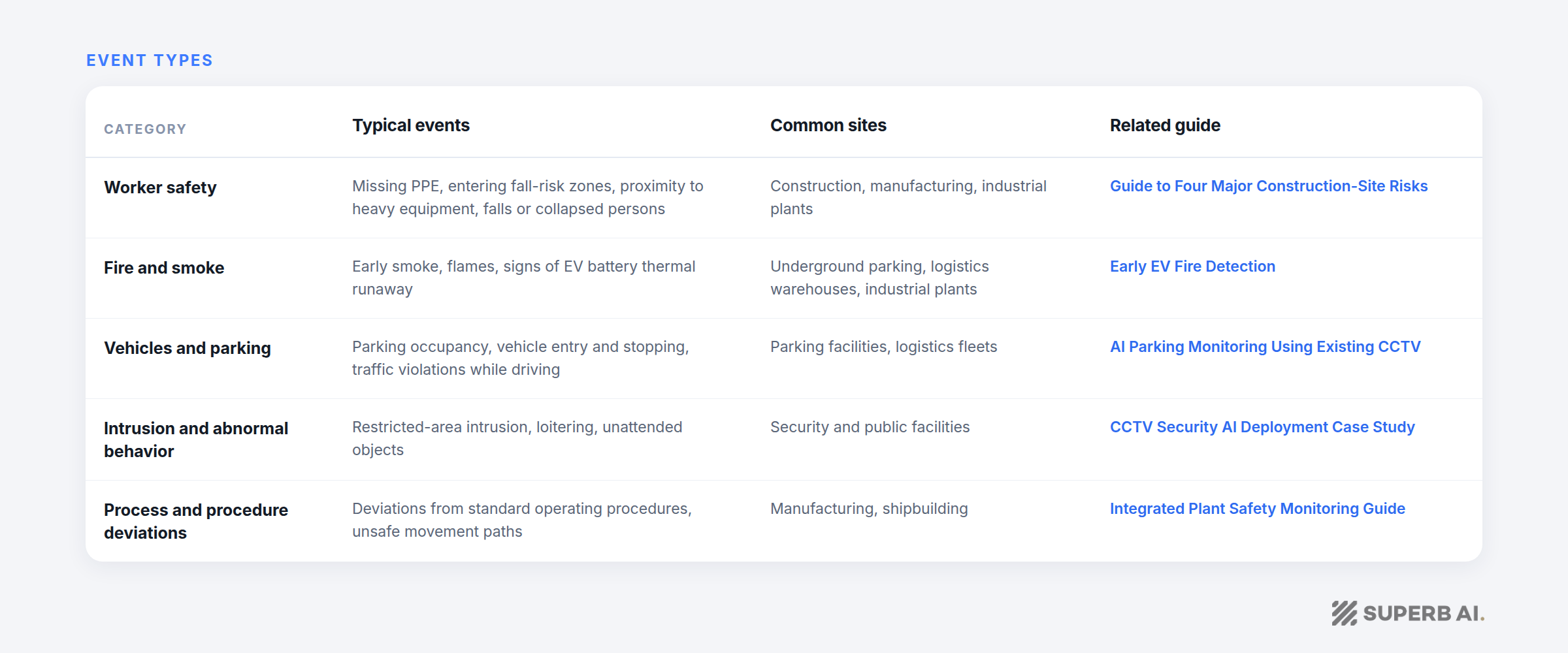
Note: The guides can be found on our blog
A single camera can monitor multiple event categories at the same time. For example, a parking camera could track parking occupancy while also detecting a collapsed person or signs of smoke. The number of events you define is also one of the biggest variables affecting deployment cost.
Industry Applications: The First Event Is Different at Every Site
Construction. Falls, heavy equipment, structural hazards, and PPE are four major risk areas that can be monitored through video. Because construction environments change every day, fixed rule-based detection can be difficult to maintain over time, making a foundation-model approach that can begin without additional task-specific training an early option to consider.
Manufacturing. PPE compliance and forklift movement are often among the first events to monitor. One manufacturing company increased PPE compliance from 75% to 98% and reduced daily violations by approximately 90% using video monitoring without additional task-specific training. We cover forklift collision risks separately in our forklift safety case study.
Industrial plants, shipbuilding, and energy. These sites cover large areas and often include personnel from multiple contractors. Different zones require different rules, making a unified monitoring interface particularly important. Our integrated plant safety monitoring guide explains the common challenges across shipbuilding, steel, energy, and chemical facilities.
Logistics and vehicles. Dashcam footage can also become a monitoring source. One logistics company replaced quarterly manual reviews of dashcam footage from more than 1,000 vehicles with AI video monitoring, reducing management time by more than 95% and major traffic violations by 90%.
Parking and building facilities. A common path is to begin with parking occupancy analysis and later expand to events such as person-down detection and fire detection. Our AI parking monitoring guide explains how to get started without replacing existing equipment.
EV fires. In collaboration with the National Fire Research Institute, an early detection model for EV fires in underground parking facilities reduced detection time by 65% and false alarms by 80%. The task-specific approach combined synthetic data with a dataset of approximately 100,000 fire, smoke, and vehicle images. (Read more)
Public safety and smart cities. At city scale, safety and traffic monitoring can expand to dozens of event types. Gimcheon combines fine-tuned models with prompt-based AI and an automated retraining pipeline.
What Changes at Large Enterprises: Multiple Sites and Evidence Records
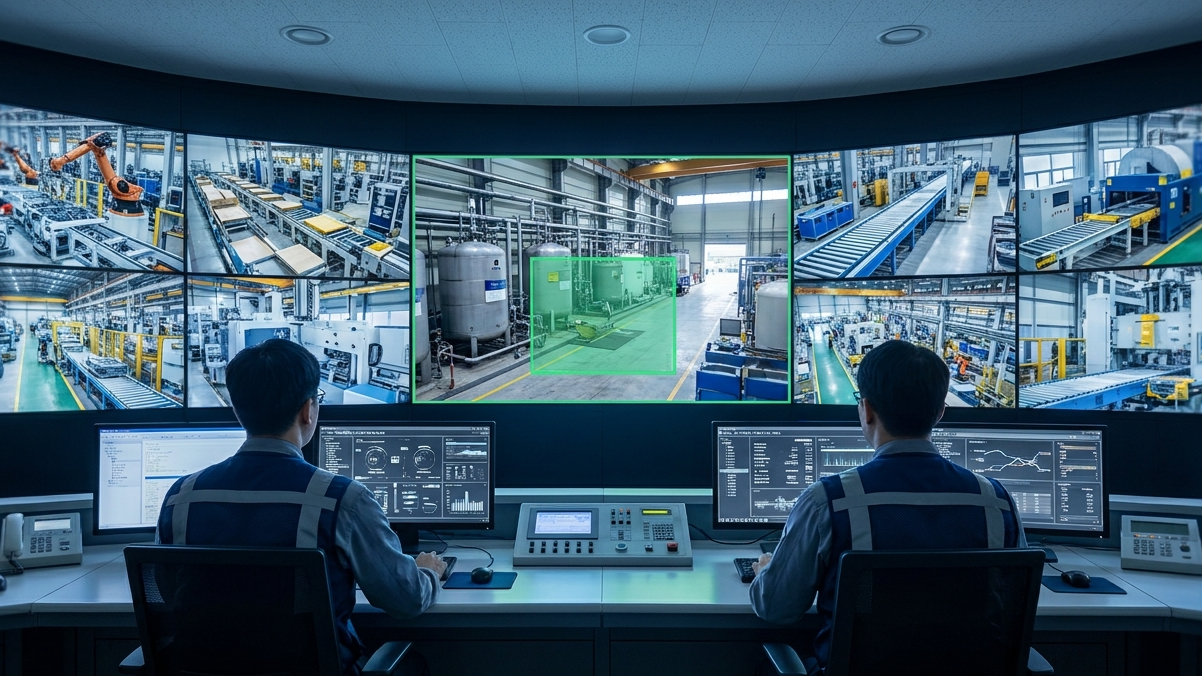
Illustration: At large multi-site operations, AI narrows the screens operators need to watch down to scenes that trigger alerts (Generated image; does not depict a specific customer)
Organizations operating multiple sites tend to see the biggest differences in three areas rather than in the accuracy of any single camera.
- Standardization. If every site uses different rules and vendors, headquarters cannot monitor risk consistently from a single interface. A foundation-model approach can make multi-site expansion easier because the same event definition can be applied across locations without building a new task-specific training dataset for each site. One logistics company reviewed more than 1,000 vehicles across approximately 100 branches using a consistent set of criteria.
- Contractor workforce management. Large construction sites and industrial plants often have significant contractor workforces, with access rules differing by zone. This makes zone-specific event definitions and a unified monitoring interface important.
- Automated evidence records. For organizations that need to demonstrate how their safety management processes are being implemented, automatically retaining detected scenes, timestamps, and response histories can become an important system selection criterion. Manual recording becomes increasingly difficult as the number of sites grows.
Measured Results from Real Deployments
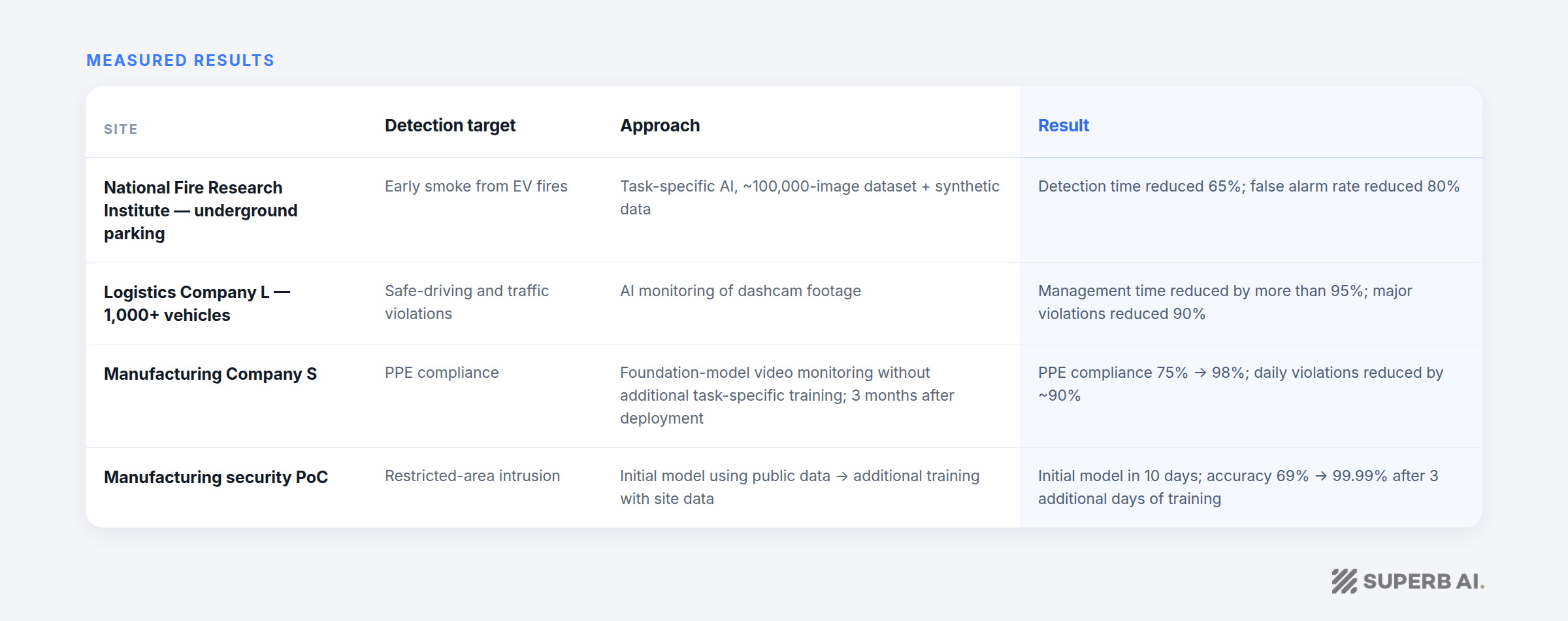
One thing all four deployments have in common is that they did not begin by installing new cameras. What mattered was selecting the right first event and establishing a process for reducing false alarms.
AI CCTV and Safety Regulations: Role and Limitations
AI CCTV video monitoring can support workplace safety programs in two ways. First, it can detect hazardous situations in real time and help teams take preventive action. Second, it can retain timestamps, scenes, and response records that document what happened and how the organization responded.
Installing an AI CCTV system alone does not satisfy applicable safety requirements. Legal obligations vary by country, industry, and workplace, and most safety frameworks focus on how hazards are identified, addressed, and documented rather than requiring a specific AI or CCTV technology.
The response workflow—who receives an alert, what they do next, and how the action is recorded—therefore needs to be designed alongside the technology. Organizations should review the safety and compliance requirements that apply in their jurisdiction when planning a deployment.
Cost: Event Count and Site Count Drive the Quote
Deployment costs fall into four categories: hardware, software, deployment and customization, and operations.
If existing CCTV can be reused, hardware requirements may be reduced primarily to the analytics server. If the selected approach does not require additional task-specific training, upfront data collection and labeling costs can also be reduced.
Two of the biggest variables in a quote are the number of detection events and the number of sites. Our AI video analytics system cost guide breaks down each cost category and explains ways to reduce costs, including reusing existing CCTV and applicable government support programs.
Deployment Process: 4 Steps
- Assess the existing infrastructure. Review camera locations, resolution, network bandwidth, and recording servers. Many sites can run a pilot with their current CCTV infrastructure.
- Define the detection events. Start with two or three situations that happen most often or would have the greatest consequences. The number of events affects both cost and the effort required to manage false alarms.
- Validate in a pilot area. Use a small number of cameras for two to four weeks and measure detection performance and false alarms. Some deployments using existing CCTV have been able to begin within two weeks.
- Connect alerts to the response workflow. Define who receives each alert, through which channel, what action they should take, and how the response is recorded. Without this step, the system can detect an event without necessarily preventing an incident.
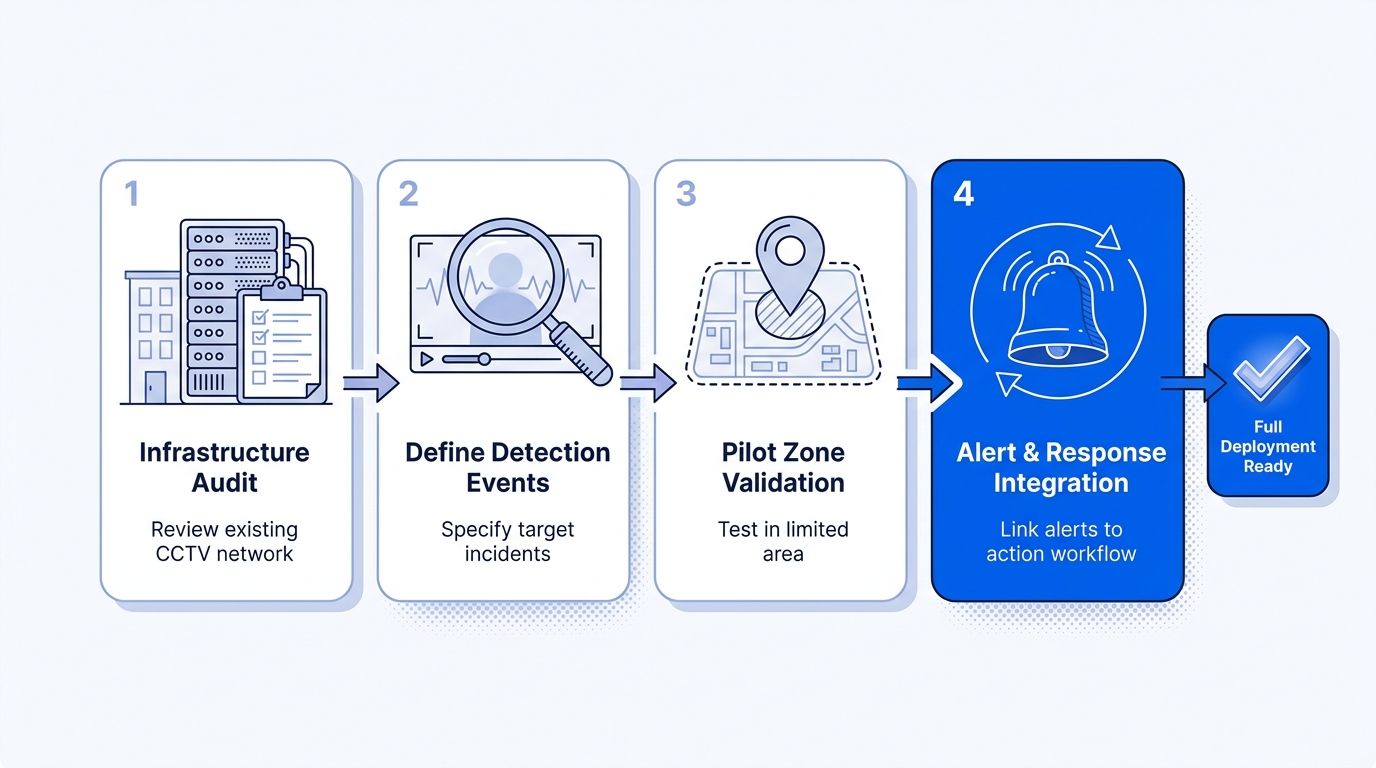
Process diagram: Assessment → Event Definition → Pilot → Response Workflow. Without the fourth step, detection can work without translating into prevention
5 Criteria for Evaluating a Solution
These are the five questions to ask vendors during the evaluation stage.
- Can we use our existing CCTV? If the solution requires specific camera replacements upfront, hardware costs increase immediately.
- Can we start without collecting task-specific training data? If data collection, labeling, and model training are mandatory before deployment, it may take months to see the first results.
- How are false alarms reduced? Ask about the initial false alarm rate and the process for calibrating the system with site data. If false alarms remain frequent, operators may begin ignoring alerts.
- Are response records retained? The operational and audit value of the system depends in part on whether detected scenes, timestamps, and response status are recorded automatically.
- How easy is it to add sites and events? After the first deployment, check whether expanding to another site or adding a new event requires retraining or rebuilding the system.
Frequently Asked Questions
Q. Are AI CCTV, Intelligent CCTV, and AI Video Monitoring Different?
They are different terms commonly used for the same overall type of system. In public procurement and security, intelligent CCTV is a common term, while safety management teams often use AI video monitoring or AI video analytics.
Some products with AI processing built directly into the camera are also called AI CCTV. In many deployments, however, video from existing cameras is analyzed on a separate server.
Q. Can We Really Start with Existing CCTV?
Yes, as long as the resolution and network conditions are suitable. None of the four measured examples in this guide began by installing new cameras. Any cameras that do need replacement can be identified during the infrastructure assessment before the pilot.
Q. Isn't AI Monitoring Without Additional Task-Specific Training Less Accurate?
There can be false alarms at the beginning. In one measured case, site data was used to calibrate the system, and PPE compliance ultimately reached 98%.
For highly specialized detection targets such as early smoke from an EV fire, building a dedicated dataset and using task-specific training may be the better approach.
Q. Do Large Sites Still Need AI CCTV If They Already Have a Control Room and Safety Managers?
The challenge at large sites is often the number of screens. AI video monitoring can narrow the feeds an operator needs to review to scenes where an alert has been triggered, while automatically retaining the scene and response history.
In the Korean Ministry of Employment and Labor's provisional 2025 statistics, 254 fatalities occurred in the category at or above 50 employees—or KRW 5 billion (approx. USD 3.70 million) for construction projects—four more than the previous year. The figure illustrates that serious-accident risk remains relevant at larger operations as well.
Q. How Much Does It Cost?
There is no single price list. Cost depends on the number of cameras, detection events, and sites, as well as whether the solution is subscription-based or deployed as a dedicated system. Our separate cost guide explains the four cost categories and what to check when reviewing a quote.
Contact Us
Considering AI CCTV video monitoring for your site? Tell us your site type and number of cameras below. Rather than starting with a sales call, we'll begin by assessing your existing infrastructure.
Superb AI is a Vision Intelligence company that transforms visual data from industrial environments into actionable intelligence for enterprises. Superb AI provides video monitoring solutions that work with existing CCTV infrastructure, together with ZERO, its industry-focused Vision Foundation Model, within a unified platform.
Related Posts
Insight
Why Doesn’t Robot AI Have an ImageNet? A Test You Can’t Grade with a Single Answer Key
Hyun Kim
Co-Founder & CEO | 10 min read
Insight
Robot Training Data Sourcing Guide: 4 Options and How to Choose a Training Data Provider
Hyun Kim
Co-Founder & CEO | 7 min read
Insight
Vision AI PoC Design Guide: Timeline, Data, and Success Criteria
Hyun Kim
Co-Founder & CEO | 7 min read

About Superb AI
Superb AI is an enterprise-level training data platform that is reinventing the way ML teams manage and deliver training data within organizations. Launched in 2018, the Superb AI Suite provides a unique blend of automation, collaboration and plug-and-play modularity, helping teams drastically reduce the time it takes to prepare high quality training datasets. If you want to experience the transformation, sign up for free today.