Insight
AI Video Analytics System Costs: 4 Factors That Determine Your Quote

Hyun Kim
Co-Founder & CEO | 2026/09/14 | 7 min read
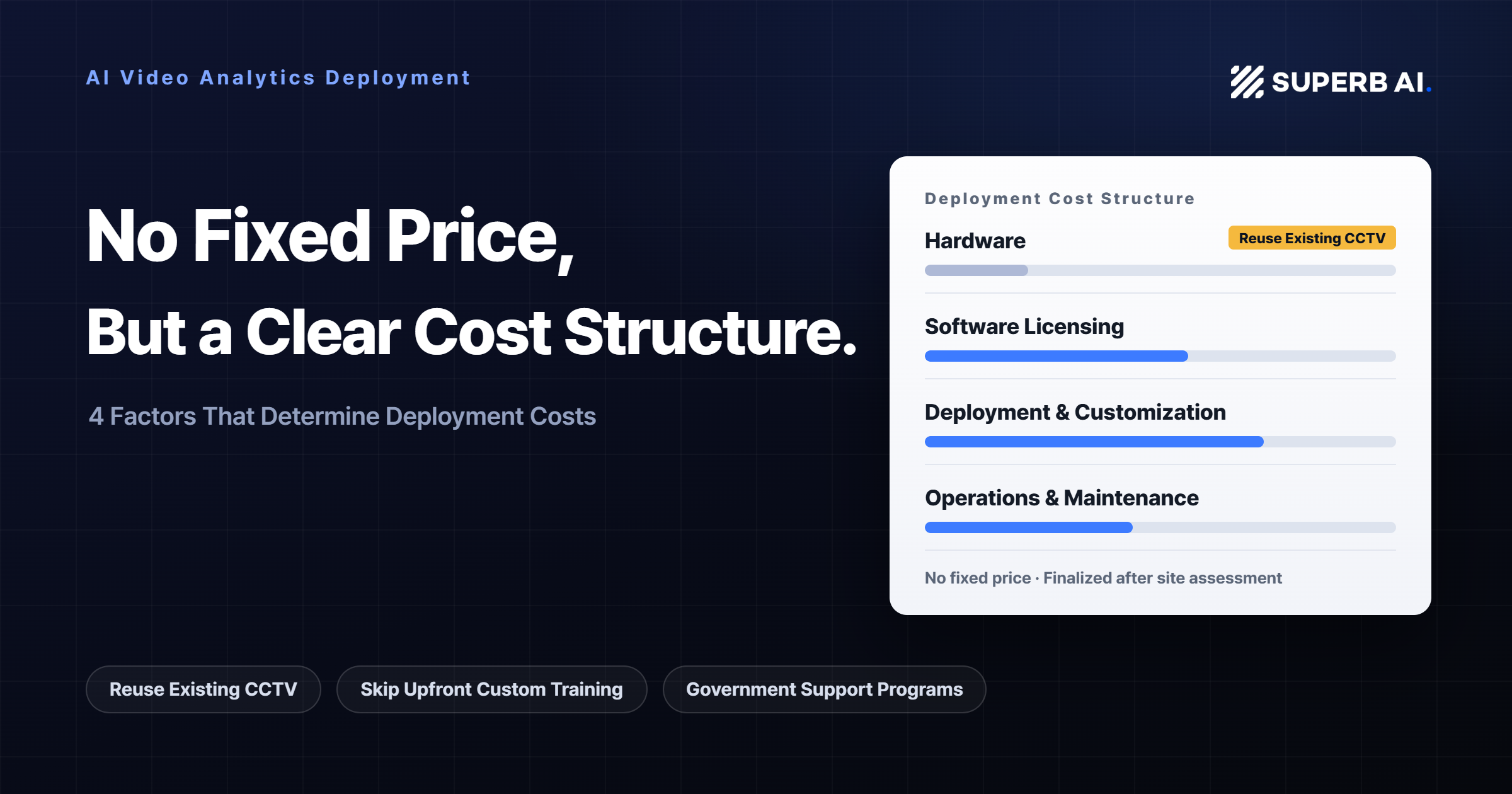
There is no standard price for implementing an AI video analytics system. Even two sites with the same 20-camera setup can receive very different quotes depending on what the system needs to detect and the existing infrastructure. What is consistent, however, is where those costs come from: hardware, software, deployment, and operations. Understanding this structure makes it easier to compare quotes—and identify where costs can be reduced.
More companies are evaluating AI video analytics as adoption continues to grow. The global AI video analytics market is projected to expand from USD 5.04 billion in 2025 to USD 17.23 billion by 2031, at a CAGR of 22.72% (Mordor Intelligence). As interest grows, one question comes up more than any other: How much does it cost?
📌 Key Takeaways
- For manufacturing, construction, and logistics sites, AI video analytics deployment costs are determined by four factors: hardware, software licensing, deployment and customization, and operations and maintenance.
- Two of the biggest variables are whether existing CCTV infrastructure can be reused and whether custom model training is required.
- Government support programs such as Korea’s AI Voucher Program—up to KRW 200 million (approx. USD 149,000) per project, based on the 2025 program announcement—can also help reduce the cost burden.
Cost Structure: 4 Key Components
1. Hardware: Cameras and Analytics Servers
The first question is whether new cameras need to be installed.
If existing CCTV and IP cameras can be reused, camera purchase and installation costs can be removed from the quote. The remaining major hardware requirement is the GPU server that analyzes the video streams.
Superb AI has previously introduced a configuration capable of analyzing 20 CCTV camera feeds with a single GPU. As the number of channels increases, server costs typically increase in steps rather than linearly.
2. Software: Subscription vs. Perpetual Licensing
Software licensing generally falls into two categories: subscriptions paid monthly or annually, and perpetual licenses purchased as part of an on-premises deployment.
Subscriptions typically require less upfront investment, while perpetual licensing can become more cost-effective over longer operating periods.
This is also where the choice between cloud and on-premises deployment comes into play. For sites with security requirements that prohibit video from leaving the premises, on-premise deployment may effectively be required.
3. Deployment and Customization: Detection Requirements Drive the Cost
What the system needs to detect is one of the biggest drivers of deployment cost.
General objects such as people and vehicles can often be detected using existing models. Site-specific events, however, may require custom development and additional training data.
This is where zero-shot technology can significantly change the cost of building training data. With an industry-specific vision foundation model such as ZERO, which can detect previously unseen objects without additional task-specific training, companies can start a PoC with as few as around 10 images.
That creates a fundamentally different cost structure from an approach that begins by building and labeling a training dataset from scratch.
4. Operations and Maintenance: Costs Continue After Deployment
Ongoing costs include false-positive tuning, model updates, troubleshooting, and expansion work when additional cameras are added.
This is also one of the most commonly overlooked items when comparing quotes. Total cost should therefore be evaluated across the full operating period—not just based on the initial deployment cost.
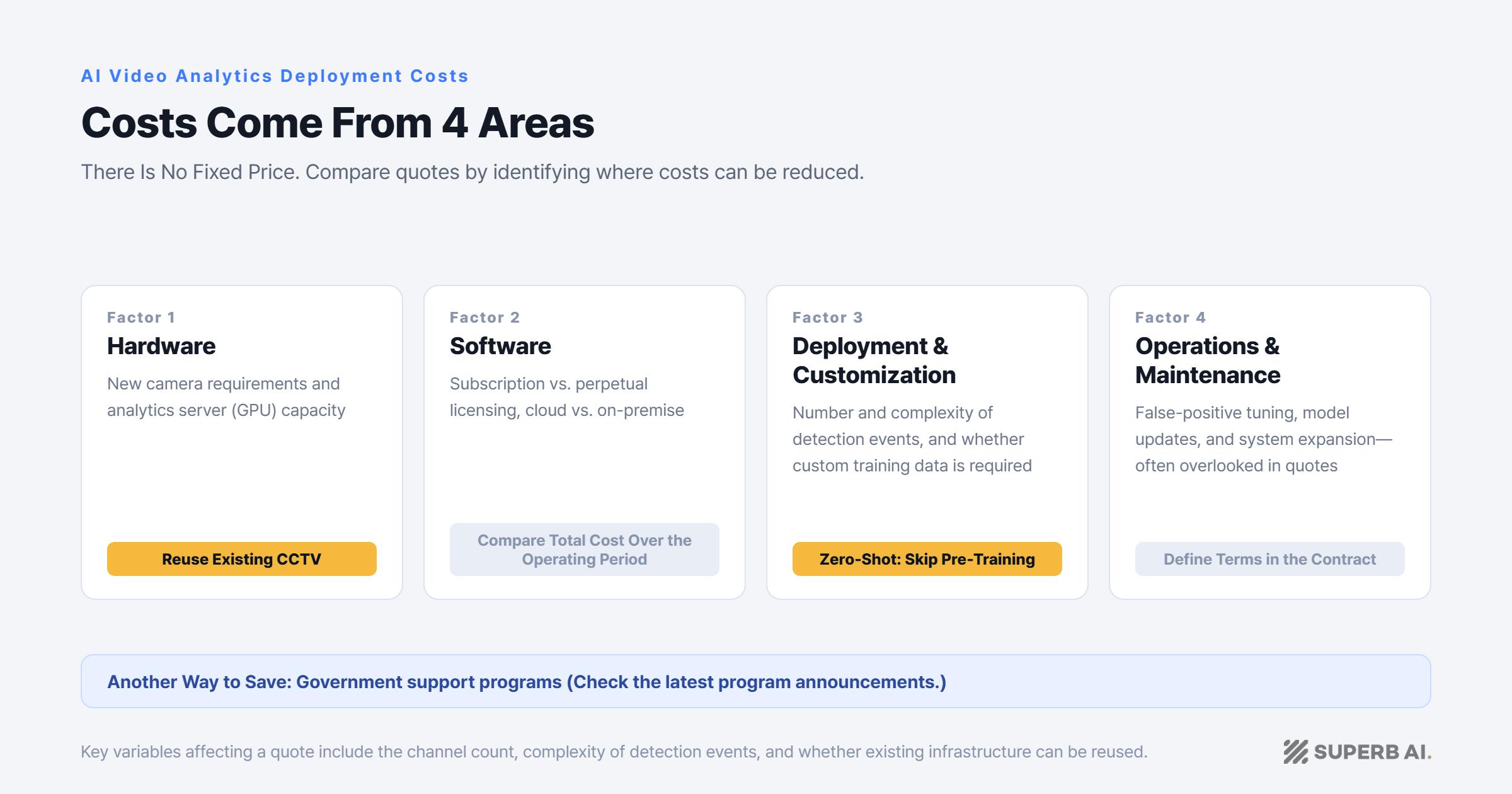
Conceptual diagram: costs come from four areas, while savings can come from reusing existing CCTV infrastructure, avoiding upfront model training, and leveraging government support programs.
5 Variables That Shape a Quote
- Number of channels: Determines the scale of the analytics server infrastructure.
- Number and complexity of detection events: Determines whether existing models are sufficient or custom training is required.
- Whether existing CCTV can be reused: Determines whether new camera purchases and installation work are necessary.
- On-premise vs. cloud: Changes how costs are distributed between upfront investment and ongoing operations.
- Scope of integration: Includes the level of integration required with existing video management systems (VMS) and alerting systems.
3 Ways to Reduce Costs
Reuse Existing CCTV Infrastructure
Using existing video feeds instead of installing new cameras and cabling can significantly reduce hardware costs.
We covered the process of deploying AI video analytics using existing CCTV infrastructure in a separate post.
Start Without Building a Training Dataset Upfront
Starting a PoC with a zero-shot model can remove training-data development costs from the initial phase.
A more cost-efficient approach is to first validate performance through a pilot, then add custom training only for the specific detection events that require further improvement.
Use Government Support Programs
To take Korea as an example, the AI Voucher Program provides eligible companies with up to KRW 200 million (approx. USD 149,000) per project, based on the 2025 program announcement.
Manufacturing companies may also consider the advanced track of the Smart Factory Deployment Support Program, which provides up to KRW 200 million (approx. USD 149,000) per company, covering up to 50% of eligible costs, based on the 2025 inter-ministerial program announcement.
Such programs’ application periods and eligibility requirements vary by year, so companies should review the latest program announcements before applying.
How to Get an Accurate Quote: 4 Steps
Step 1: Assess the Site
Review the field of view, resolution, and installation position of existing cameras, and identify how many channels can be reused.
Step 2: Define Detection Events
List the situations the system needs to detect and separate those that can be handled by existing models from those that require custom development.
Step 3: Run a PoC or Pilot
Validate detection accuracy and alert frequency on a limited number of channels. The results of this stage reduce uncertainty in the final quote.
Step 4: Scale in Stages
Expand the number of channels using the validated configuration. Operations and maintenance terms should also be clearly defined in the contract at this stage.
Frequently Asked Questions
Q. How much does AI video analytics cost per channel or camera?
There is no fixed per-channel price. Even with the same number of cameras, costs vary depending on the complexity of the detection events and whether custom model training is required. A meaningful quote can only be prepared after the site and detection requirements have been assessed.
Q. How much can we save by reusing our existing CCTV system?
If the existing infrastructure is suitable for reuse, camera purchase and installation costs can be removed from the quote. The amount saved depends on site conditions, so we recommend making an assessment of the existing CCTV infrastructure the first step of the quoting process.
Q. Which is more cost-effective: on-premise or cloud?
Cloud deployments often have lower upfront costs, while on-premise deployments tend to become more cost-effective as the number of channels and the operating period increase. If security requirements prohibit video from leaving the site, on-premise deployment may be required. The most meaningful comparison is based on total cost of ownership over the full operating period.
Q. Is government funding available?
If you are based in Korea, potential options include the AI Voucher Program, which provides up to KRW 200 million (approx. USD 149,000) per project, and the advanced track of the Smart Factory Deployment Support Program, which provides up to KRW 200 million (approx. USD 149,000) per company, covering up to 50% of eligible costs. Both figures are based on 2025 program announcements. Eligibility requirements and application schedules should be confirmed in the latest annual announcements. If you're based outside Korea, consider checking whether similar government support programs are available in your country.
💬 Considering an AI video analytics system for your site? Tell us your site type and number of cameras below. Rather than starting with a sales call, we’ll begin by reviewing how much of your existing infrastructure can be reused and what the cost structure would look like.
Superb AI is a Vision Intelligence company that transforms visual data from industrial environments into actionable intelligence for enterprises. Superb AI provides video analytics solutions that work with existing CCTV infrastructure, along with ZERO, an industry-specific vision foundation model—all within a unified platform.
Related Posts
Insight
Robot Training Data Sourcing Guide: 4 Options and How to Choose a Training Data Provider
Hyun Kim
Co-Founder & CEO | 7 min read
Insight
Vision AI PoC Design Guide: Timeline, Data, and Success Criteria
Hyun Kim
Co-Founder & CEO | 7 min read
Insight
Physical AI Dataset Development Guide: 4 Data Types and a 3-Step Pipeline
Hyun Kim
Co-Founder & CEO | 7 min read

About Superb AI
Superb AI is an enterprise-level training data platform that is reinventing the way ML teams manage and deliver training data within organizations. Launched in 2018, the Superb AI Suite provides a unique blend of automation, collaboration and plug-and-play modularity, helping teams drastically reduce the time it takes to prepare high quality training datasets. If you want to experience the transformation, sign up for free today.