Insight
AI Visual Inspection Costs: 5 Factors to Clarify Before Requesting a Quote

Hyun Kim
Co-Founder & CEO | 2026/11/18 | 7 min read
The cost of implementing an AI visual inspection system falls into four categories: optical hardware, inspection software, training data, and operations. Even with the same cameras, a production line with many product variants and few defect samples will incur higher training data costs when using site-specific deep learning models. Facilities that cannot send production footage outside the factory will also need to account for additional server or edge hardware costs. This article reflects conditions as of November 2026.
📌 Key Takeaways
- Rule-based machine vision requires new rules whenever a new product variant is introduced, while site-specific deep learning models need images of new variants for retraining.
- Five factors drive the quote: frequency of new product introductions, defect sample availability, optical setup, number of production lines and takt time, and where production data can be processed. Clarifying these factors upfront makes it easier to compare vendor quotes on equal terms.
- To reduce upfront investment, start with a proof of concept (PoC) covering one inspection task on one production line. In operation, automate high-confidence decisions first, then expand to additional product variants and lines.
Cost Components by Inspection Approach
Optical hardware includes cameras, lighting, and lenses. Inspection software covers detection models and decision rules. Training data costs include collection, labeling, and retraining. Operations include servers, maintenance, and adjustments when inspection criteria change.
The table below compares how these costs differ across three inspection approaches.
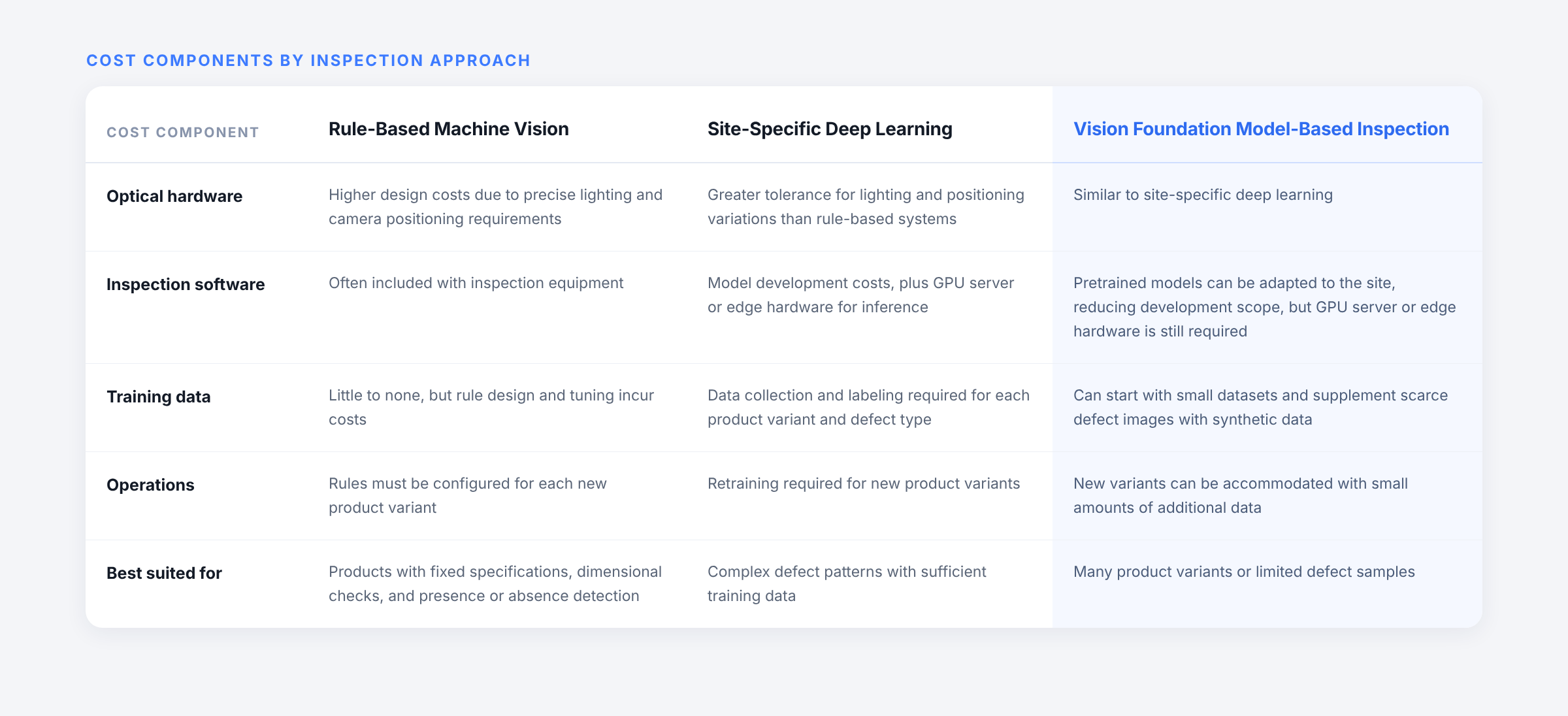
Rule-based machine vision requires little to no training data. However, on production lines where new product variants are introduced frequently, the time spent configuring new rules adds to operating costs.
Site-specific deep learning models are effective at identifying defects with irregular shapes, but collecting and labeling data for each product variant and defect type adds to the cost.
Models pretrained on industrial imagery, such as ZERO, Superb AI's industry-focused vision foundation model, require less data to get started.
For example, Superb AI's manufacturing solution supports PoCs using zero-shot detection and small datasets of around 10 images. Scarce defect data can be supplemented with synthetic data.
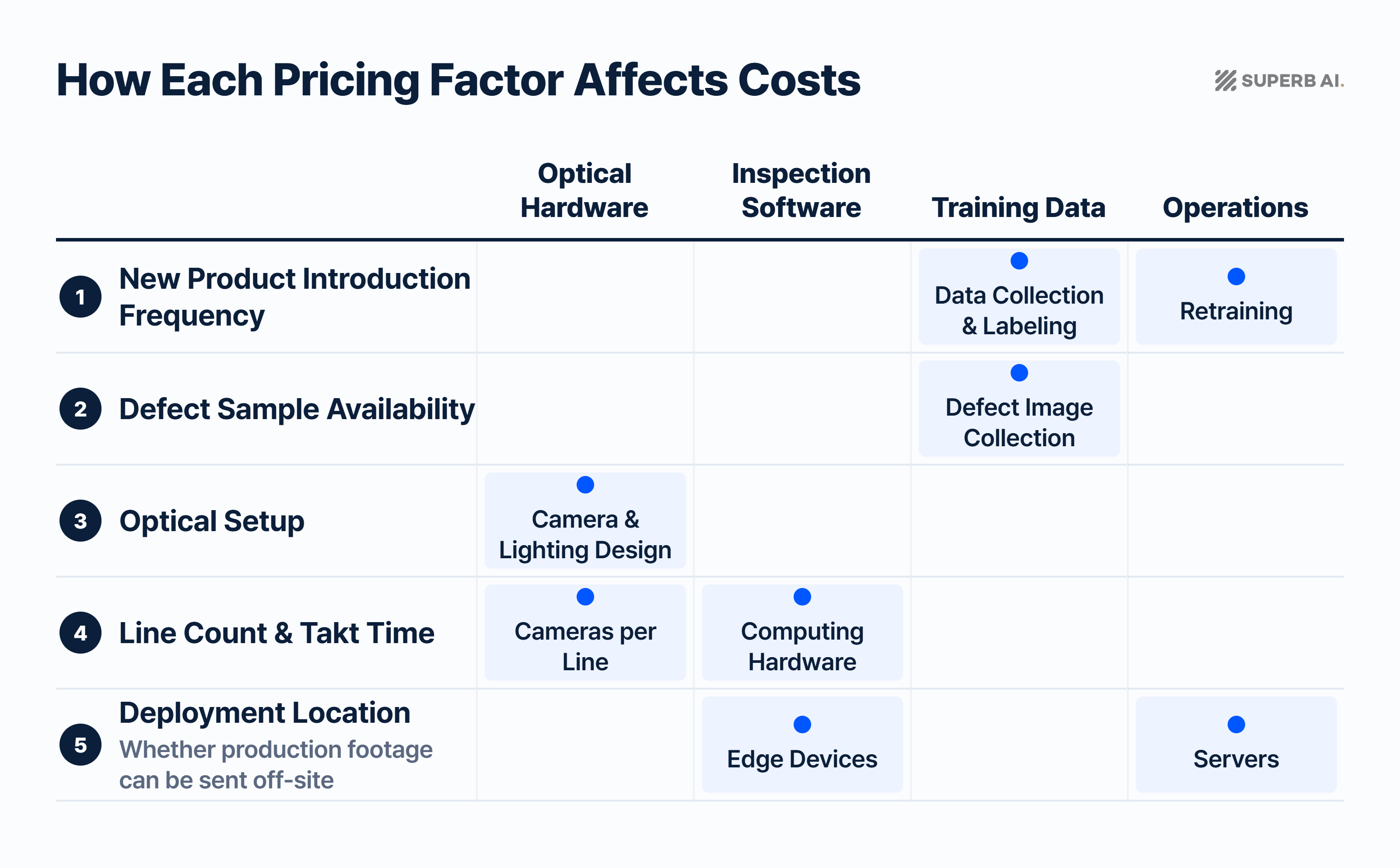
Five pricing factors and the cost components each factor affects
5 Factors That Determine Your Quote
1. How Often Are New Product Variants Introduced?
Rule-based systems require new rules whenever a new product variant is introduced, while site-specific deep learning models require additional images and retraining.
Switching back to an existing variant typically only requires loading its saved settings, so additional costs arise primarily when introducing new variants.
Ask vendors how long it takes and how much it costs to add one new product variant.
When requesting a quote, include both the number of product variants currently in production and how frequently new variants are introduced.
2. How Many Defect Samples Can You Collect?
Production lines with low defect rates often lack enough defect images for training.
Waiting several months to collect sufficient samples means continuing to pay for manual inspection during that period.
Three approaches can help when defect images are scarce: anomaly detection trained only on normal images, learning from small datasets, and synthetic data augmentation.
Synthetic data augmentation involves generating images that replicate real defects and using them to supplement training data.
3. Do the Cameras and Lighting Need to Be Redesigned?
Small defects, such as microcracks or dark spots, may not appear in captured images if the resolution or lighting angle is unsuitable.
The first step is therefore to check whether the defects are visible in footage from existing inspection cameras.
If they are not, the optical setup needs to be redesigned.
When optical design and inspection software are provided by different vendors, the responsibility for readjusting camera positions or lighting can sometimes fall outside both quotes.
4. How Many Production Lines Are There, and What Is the Takt Time?
The less time available to inspect each product, the faster the required computing hardware must be.
If each production line requires dedicated computing hardware, equipment costs increase with the number of lines.
When multiple lines inspect the same product, ask whether the inspection model and training data developed for the first line can be reused on subsequent lines.
5. Can Production Footage Leave the Factory?
Facilities that cannot send production footage or engineering drawings outside the factory typically choose on-premise or edge deployment.
In these configurations, server or edge hardware costs are included in the quote, while cloud usage fees are avoided.
Superb AI's manufacturing solution supports on-premise, edge, and cloud deployment. On-premise and edge configurations can operate directly on the production line without an internet connection.
For more details, see our Vision AI Deployment Guide: On-Premise vs. Cloud.
Q. Can I Get a Quote with Almost No Defect Data?
Yes.
If actual defective products are rare, synthetic data can be used to supplement defect images during the PoC.
When requesting a quote, provide the number of normal images available and the number of images collected for each defect type.
Q. How Do Costs Change If I Already Have Machine Vision Equipment?
One option is to retain the existing inspection equipment and add AI only at the decision stage.
In this approach, AI performs a second-stage inspection of defect candidates flagged by the existing system, helping reduce false rejects.
Because the existing optical hardware is reused, additional optical equipment costs are minimal. Most of the quote covers inspection software and training data.
Return on investment is calculated based on how much the AI system reduces the volume of manual reinspection.
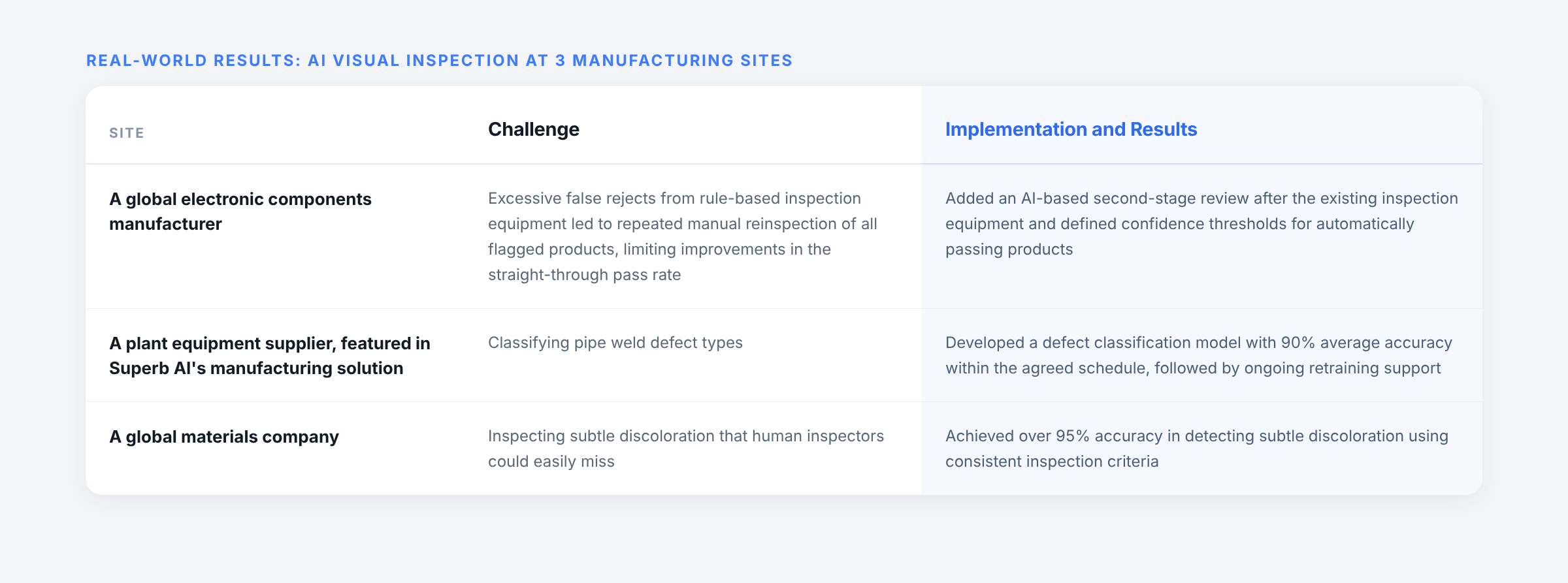
Real-World Results: AI Visual Inspection at 3 Manufacturing Sites
Q. How Can You Reduce Upfront Investment?
Step 1. Start with One Inspection Task and One Production Line
Begin with the defect type that generates the highest volume of reinspection.
Step 2. Run a PoC with Existing Images
Use the normal images and defect images already collected to determine which inspection tasks can be handled reliably. For guidance on defining PoC success criteria, see our Vision AI PoC Design Guide.
Step 3. Automate High-Confidence Decisions First
Allow the system to process high-confidence decisions automatically, while human inspectors review only low-confidence results.
Step 4. Expand to More Product Variants and Production Lines
Retrain the model using data collected during operation, then apply it to additional product variants and a second production line.
Q. Can Government Incentives Help Cover AI Visual Inspection Costs?
Government grants and manufacturing modernization programs may help offset the cost of adopting AI visual inspection. The availability, funding scope, and eligibility requirements vary by country and region, so manufacturers should check which programs apply to their facilities.
South Korea provides one example of this type of support.
In October 2025, Korea's Ministry of SMEs and Startups announced its AI-Based Smart Manufacturing Innovation 3.0 Strategy, setting a goal of deploying 12,000 AI-centered smart factories by 2030 and achieving a 10% AI adoption rate among small and medium-sized manufacturers (Government Policy Briefing, October 24, 2025).
In 2026, the ministry announced the Manufacturing AI Specialized Smart Factory Support Program on March 19. Under the AI Factory Development category, eligible projects could receive up to KRW 200 million (approx. USD 148,000) over a period of up to nine months, covering no more than 50% of total project costs (2026 Program Announcement). Applications for the 2026 program closed on April 20.
For manufacturers outside Korea, it is worth checking whether comparable AI adoption, smart manufacturing, or industrial modernization incentives are available locally. Regardless of the country, funding schedules and eligibility requirements should be verified against the latest official program announcements.
3 Things to Check in an AI Visual Inspection Quote
First, the cost and lead time for adding one new product variant.
Check whether the quote specifies these as separate items.
Second, who is responsible for optical readjustments.
If no optical design provider is identified in the quote, the contract may not specify who is responsible for adjusting cameras and lighting when defects are not visible in the captured images.
Third, the number and cost of retraining cycles.
If retraining the model with data collected during operation is not included in the quote, it may require a separate contract.
Superb AI is a Vision Intelligence company that transforms visual data from industrial sites into intelligence enterprises can act on. Powered by ZERO, its industry-focused vision foundation model, Superb AI helps manufacturers begin visual inspection with small datasets and continuously improve model performance using real-world production data.
💬 Evaluating the cost of AI visual inspection? Tell us what products you need to inspect, how many variants you produce, and what defect images you have available. Rather than starting with a sales call, we'll begin by assessing which inspection tasks are feasible with your existing images.
Related Posts
Insight
Vision AI Inspection Guide for Manufacturing: 5 Tasks and How to Choose the Right Approach
Hyun Kim
Co-Founder & CEO | 7 min read
Insight
Why Doesn’t Robot AI Have an ImageNet? A Test You Can’t Grade with a Single Answer Key
Hyun Kim
Co-Founder & CEO | 10 min read
Insight
Robot Training Data Sourcing Guide: 4 Options and How to Choose a Training Data Provider
Hyun Kim
Co-Founder & CEO | 7 min read

About Superb AI
Superb AI is an enterprise-level training data platform that is reinventing the way ML teams manage and deliver training data within organizations. Launched in 2018, the Superb AI Suite provides a unique blend of automation, collaboration and plug-and-play modularity, helping teams drastically reduce the time it takes to prepare high quality training datasets. If you want to experience the transformation, sign up for free today.