Insight
Why Doesn’t Robot AI Have an ImageNet? A Test You Can’t Grade with a Single Answer Key

Hyun Kim
Co-Founder & CEO | 2026/10/14 | 10 min read
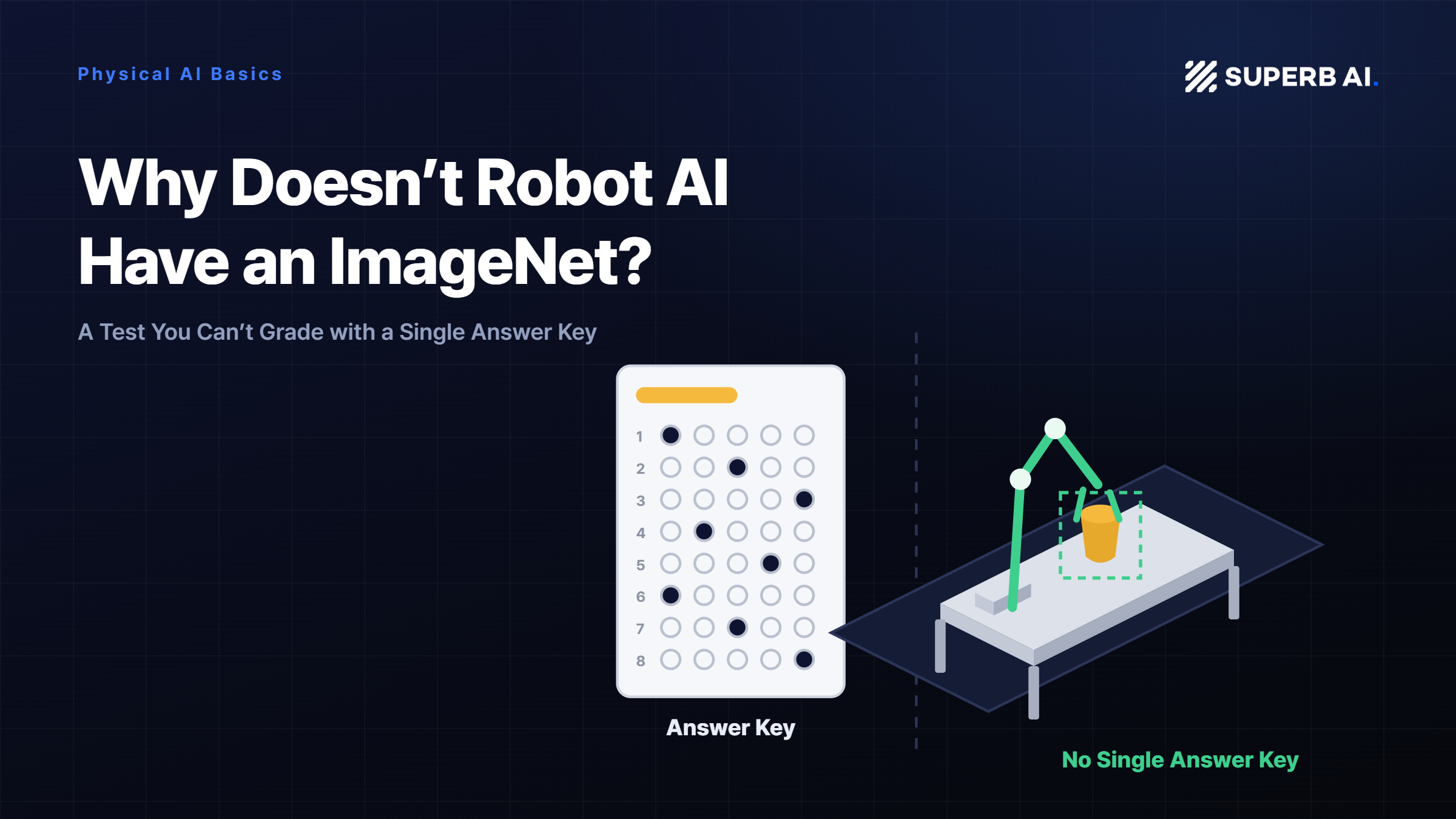
Robot AI does not have a common benchmark like ImageNet or COCO. Vision AI can be evaluated automatically by comparing a model’s output against fixed ground truth for a fixed set of images. Robot AI is different: there are effectively countless valid answers, the same physical test cannot be repeated exactly, and every action changes what the robot encounters next. That means robot behavior cannot be graded against a single fixed answer key in the same way.
Instead, robot AI is evaluated by running tasks, recording the outcomes, and repeating the trials. This article uses the analogy of an exam to explain where Vision AI evaluation and robot AI evaluation diverge, and how robot systems are evaluated in practice. It was written in response to a question raised during an internal Physical AI session: “Why doesn’t robotics have a test set like Vision AI?” This post reflects the state of the field as of October 2026.
📌 Key Takeaways
- Vision AI is like a multiple-choice test graded automatically against a fixed answer key. Robot AI is closer to an open-ended oral exam: there are countless valid answers, grading takes real time, and each answer changes the next question.
- The third difference is the most fundamental. A demonstration shows what worked in the situation someone else encountered. Your robot is not in that exact situation, so there may be no single ground-truth action to compare against.
- Of the approaches available today, simulation is effectively the only practical way to create a reproducible test environment. Success-rate matrices, failure-mode classification, and batch simulation rollouts are evaluation tools built on top of it, while the sim-to-real gap remains an open challenge.
What Does a Vision AI Test Look Like?
When evaluating an object detection model, you can use a fixed dataset such as COCO, where each image comes with ground-truth bounding boxes. Classification models can be evaluated against the ground-truth labels in ImageNet.
The questions are files, and the answer key is also a file. Anyone can run the same test at any time, and a machine can score thousands of images almost instantly. That makes it possible to place results from different companies or research teams in the same table and compare them directly.
It is like feeding a multiple-choice answer sheet through an automated scanner. If robot AI evaluation is also a test, it differs in three fundamental ways. The table below summarizes them before we look at each one in detail.
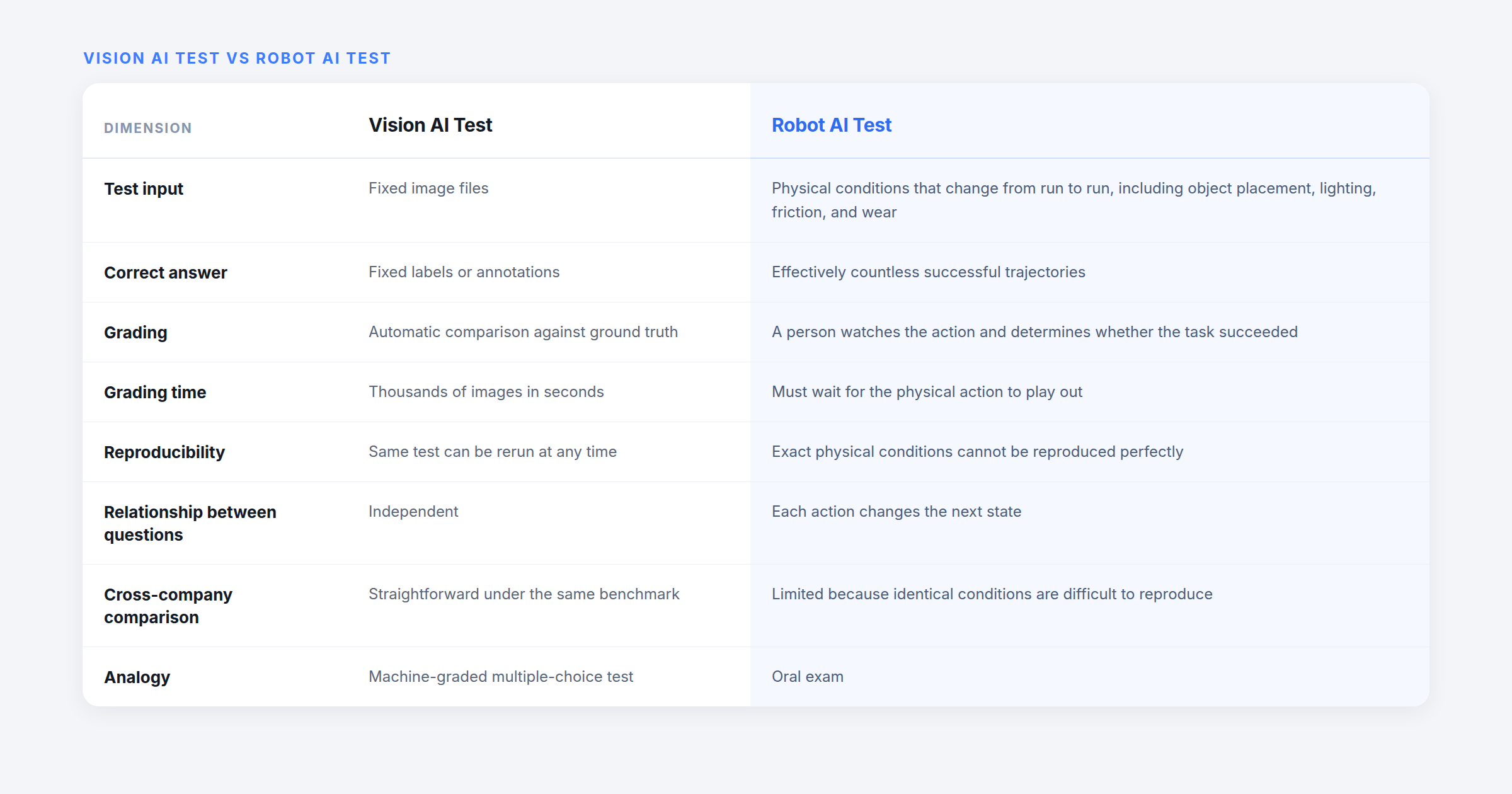
Difference 1: There Are Countless Valid Answers, and Grading Runs at Physical Speed
Object detection is scored against fixed ground truth. For a robot moving a cup, however, there may be thousands of ways to complete the task successfully. The number of valid trajectories is effectively unlimited. In the end, an evaluator has to determine whether what the robot did counts as success. A multiple-choice question has become an open-ended one with more than one valid answer.
There is also a speed problem. A system can evaluate 10,000 images in seconds. But if a robot takes 30 seconds to complete an action, those 30 seconds have to pass before you can see the result. In the physical world, you cannot simply fast-forward the interaction. It is more like conducting a live oral exam than grading a stack of answer sheets.
Difference 2: You Cannot Repeat Exactly the Same Test Twice
Vision AI uses fixed test images, so anyone can run the same test set at any time. A robot’s “test paper” is the physical world. Object placement, lighting, floor friction, gripper wear, and other conditions vary from run to run. Yesterday’s test cannot be recreated perfectly today. It is like every school administering a slightly different exam and then trying to compare the scores.
This lack of reproducibility is one reason there is no single, broadly agreed-upon benchmark for physical robot performance. Benchmarks do exist inside simulation. But with physical robots, reproducing the same task under exactly the same conditions is difficult, which makes it hard to put Company A’s success rate and Company B’s success rate side by side as if they came from the same test.
Difference 3: Your Answer Changes the Next Question
Vision AI evaluates a fixed input. A robot changes the world as it acts. The moment it touches or moves an object, the state changes, and the robot must make its next decision from the new state it just created. If the robot nudges a cup slightly to the left, the next question becomes: What should I do with the cup now that it has moved left? If it pushes the cup to the right, it creates a different next question.
At every moment, the robot is solving a new problem on top of the state created by its previous action. Even among open-ended tests, this is closer to an oral exam than a written essay. The interviewer’s next question depends on your previous answer.
Chess offers a similar analogy. Once a move takes the game away from a known line, every later position depends on the sequence of moves that came before it.
This third difference is the most fundamental because it removes the premise required for grading against a single fixed answer key. An expert demonstration is an answer to the situation that the expert encountered. Your robot may never encounter exactly that same state. There may therefore be no single ground-truth action that can serve as the answer key for what the robot should do next.
The first two differences make evaluation difficult. The third removes the assumption that one fixed answer key should exist at all.
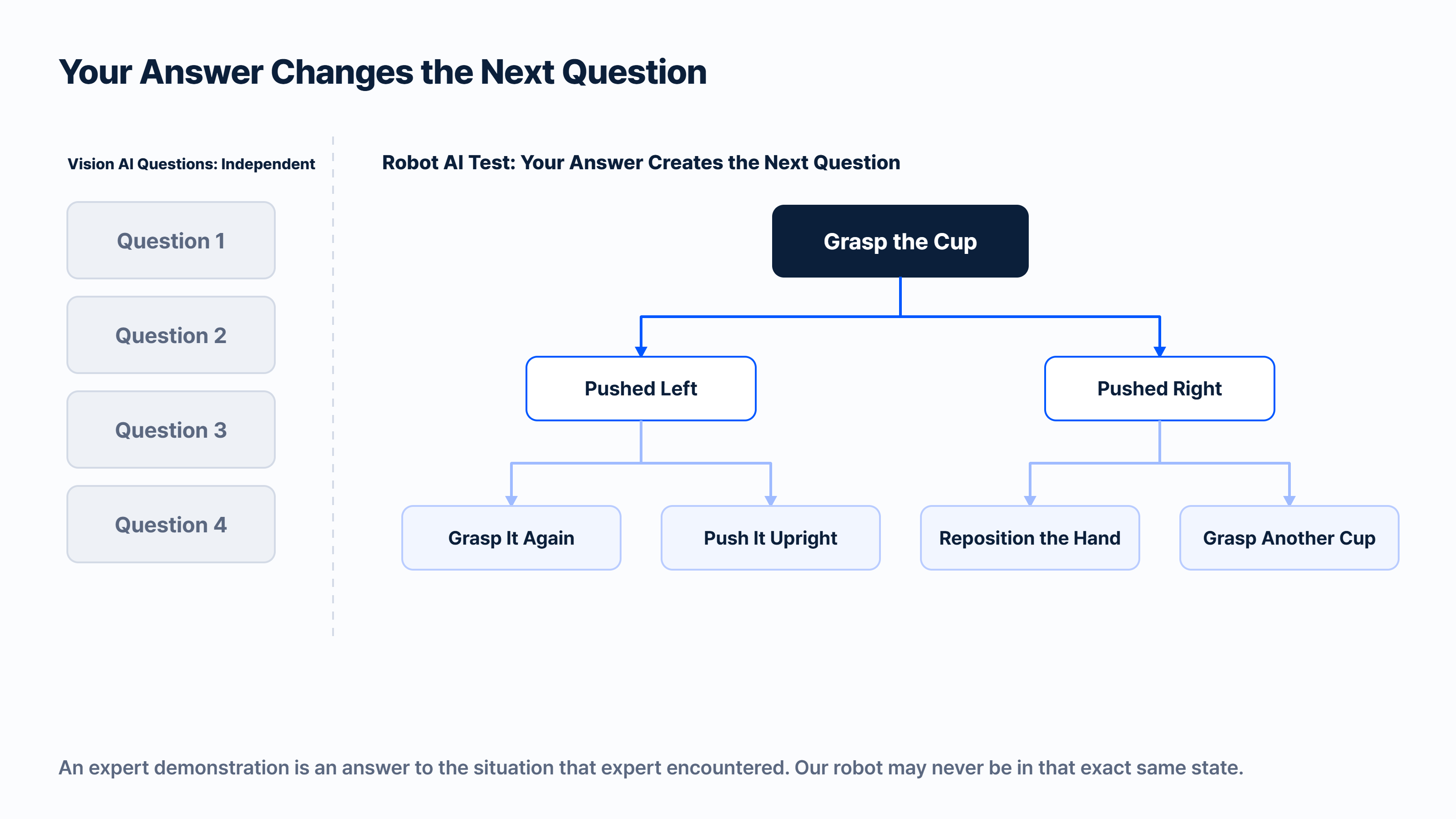
At every moment, a robot solves a new problem on top of the state created by its previous action
So How Is Robot AI Evaluated?
If there is no single fixed answer key, the practical alternative is straightforward: run the task and count the outcomes.
A robot policy is given a task and executed. The outcome is recorded, and the trial is repeated multiple times to calculate a success rate. This is generally called closed-loop evaluation because the robot’s actions affect the observations it receives next, and the system is evaluated with that feedback loop intact.
In practice, three tools are commonly used together:
- Success-Rate Matrix: Tasks and environmental conditions are placed along the rows and columns, and a success rate is recorded for each combination. A single overall success rate tells you less than a breakdown such as: “The robot can reliably grasp cups but struggles to open drawers.” That breakdown shows where additional training data or model improvement is needed.
- Failure Type Classification: Failed trials are grouped into categories such as grasp failure, collision, timeout, or trajectory deviation. When the same failure type appears repeatedly, it becomes easier to determine whether the underlying problem comes from the data, the policy, or another part of the system.
- Batch Simulation Rollouts: The same task can be run hundreds of times in parallel inside a simulator. In the physical world, a 30-second task requires waiting 30 seconds for each trial. In simulation, many trials can run concurrently.
The video below shows a demo from Superb AI’s research team in which environments are varied, episodes are generated, and policies are executed. It illustrates the basic evaluation loop: run the same task across multiple environments and count the outcomes.
How Should You Read a Success-Rate Number?
A high success rate does not automatically mean a robot AI system is good. You also need to know which tasks, under which conditions, produced that number. The number of trials, diversity of environments, and whether human intervention was allowed can all change the meaning of the same percentage.
That is why task-by-task and condition-by-condition matrices are more useful than a single headline number.
Why Simulation Is the Closest Thing to a Common Test Set
Return to the second difference: cross-company comparison is difficult because the physical test environment cannot be reproduced exactly.
Simulation changes that. Scene configurations and random seeds can be saved, which means the test environment itself can at least be recreated. Of the approaches available today, simulation is effectively the only practical way to create a reproducible test environment for robotics. This is part of the reason simulation benchmarks such as LIBERO and BEHAVIOR exist.
Two caveats are important.
First, perfect reproducibility is still conditional. Simulator versions and nondeterminism in GPU computation can produce differences between runs. Being able to save the test environment does not guarantee that every execution will produce an identical trajectory.
Second, a score in simulation does not automatically translate to the same score on a physical robot. That is the sim-to-real gap. Simulation results therefore need to be calibrated against a smaller amount of real-world validation. We discuss this decision process in our Synthetic Data Pipeline Guide.
How Evaluation Changes the Way Robot Training Data Is Built
The fact that robot behavior cannot simply be compared against a single fixed answer key also changes what needs to be recorded in the training data.
In Vision AI, data quality often centers on whether the labels are correct.
In robot AI, an episode also needs metadata about whether the attempt succeeded, what type of failure occurred if it failed, and whether a person intervened. That information helps determine which episodes should be used for training and which should not.
A failed episode does not automatically provide the correct action to learn from. This is why we record success status and conditions alongside each episode.
How Far Can Vision AI Evaluation Methods Be Used for Robots?
They still work at the perception stage. Whether a robot correctly detects or recognizes an object can be evaluated using standard Vision AI methods.
But once perception leads to action and an outcome in the physical world, there is no single fixed answer key for the sequence of actions the robot should take. That stage needs closed-loop evaluation: run the task and measure the result.
Separating these two layers of evaluation makes it easier to see where performance is being lost.
Related Content
- Physical AI Dataset Development Guide: 4 Data Types and a 3-Step Pipeline
- Building Superb AI’s Synthetic Data Pipeline with NVIDIA Isaac Sim
💬 Reviewing how to evaluate and validate robot training data? Tell us the task type and robot type below. Rather than starting with a sales call, we’ll begin by reviewing how your data should be structured.
Superb AI is a Vision Intelligence company that transforms visual data from industrial sites into intelligence enterprises can act on. In its Physical AI Data Factory, Superb AI builds 3D spatial, action, and object assets and creates robot training data through simulation and real-world collection.
Related Posts
Insight
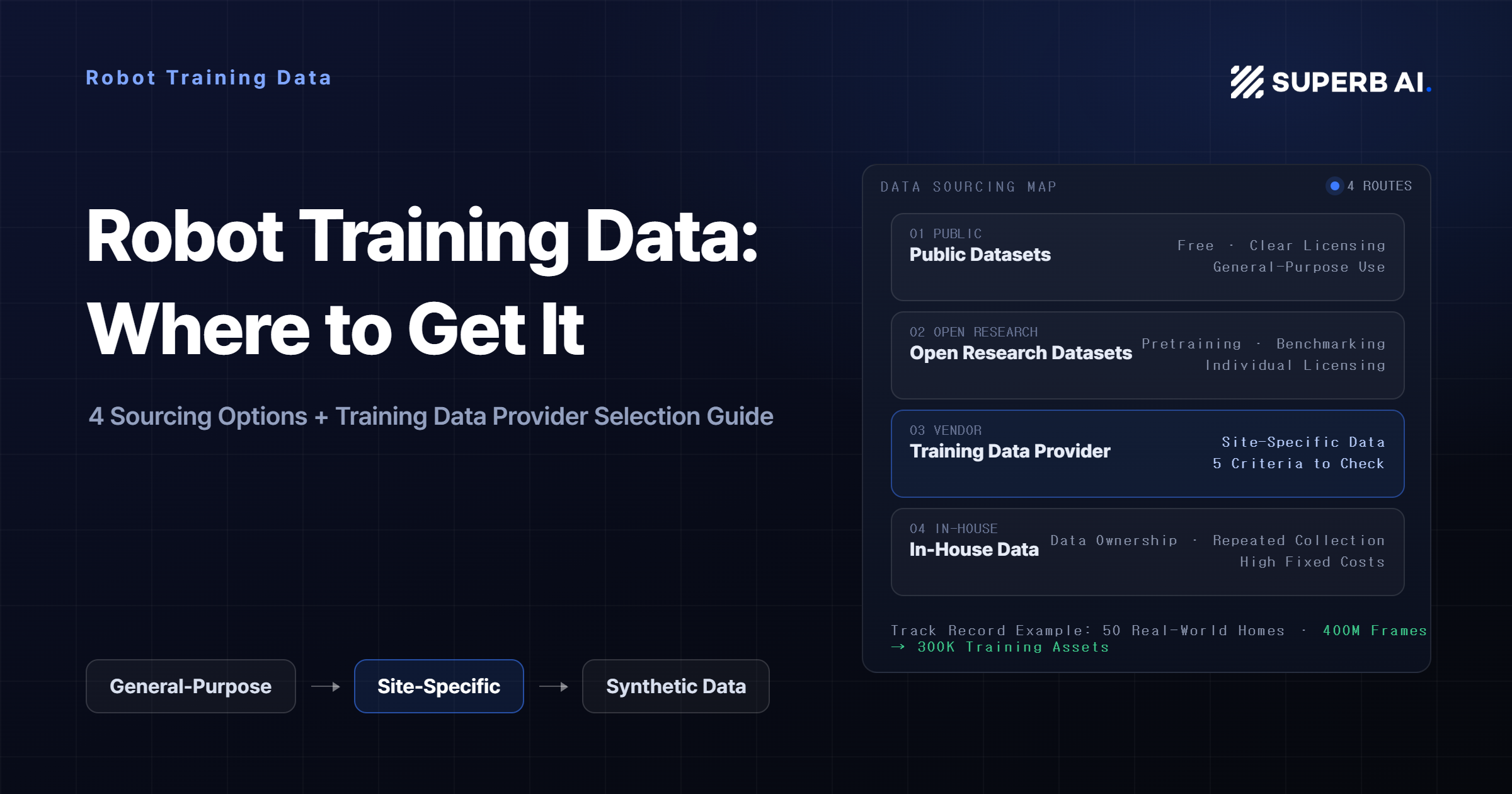
Robot Training Data Sourcing Guide: 4 Options and How to Choose a Training Data Provider
Hyun Kim
Co-Founder & CEO | 7 min read
Insight
Vision AI PoC Design Guide: Timeline, Data, and Success Criteria
Hyun Kim
Co-Founder & CEO | 7 min read
Insight
Physical AI Dataset Development Guide: 4 Data Types and a 3-Step Pipeline
Hyun Kim
Co-Founder & CEO | 7 min read

About Superb AI
Superb AI is an enterprise-level training data platform that is reinventing the way ML teams manage and deliver training data within organizations. Launched in 2018, the Superb AI Suite provides a unique blend of automation, collaboration and plug-and-play modularity, helping teams drastically reduce the time it takes to prepare high quality training datasets. If you want to experience the transformation, sign up for free today.