Insight
Vision AI Inspection Guide for Manufacturing: 5 Tasks and How to Choose the Right Approach

Hyun Kim
Co-Founder & CEO | 2026/11/16 | 7 min read
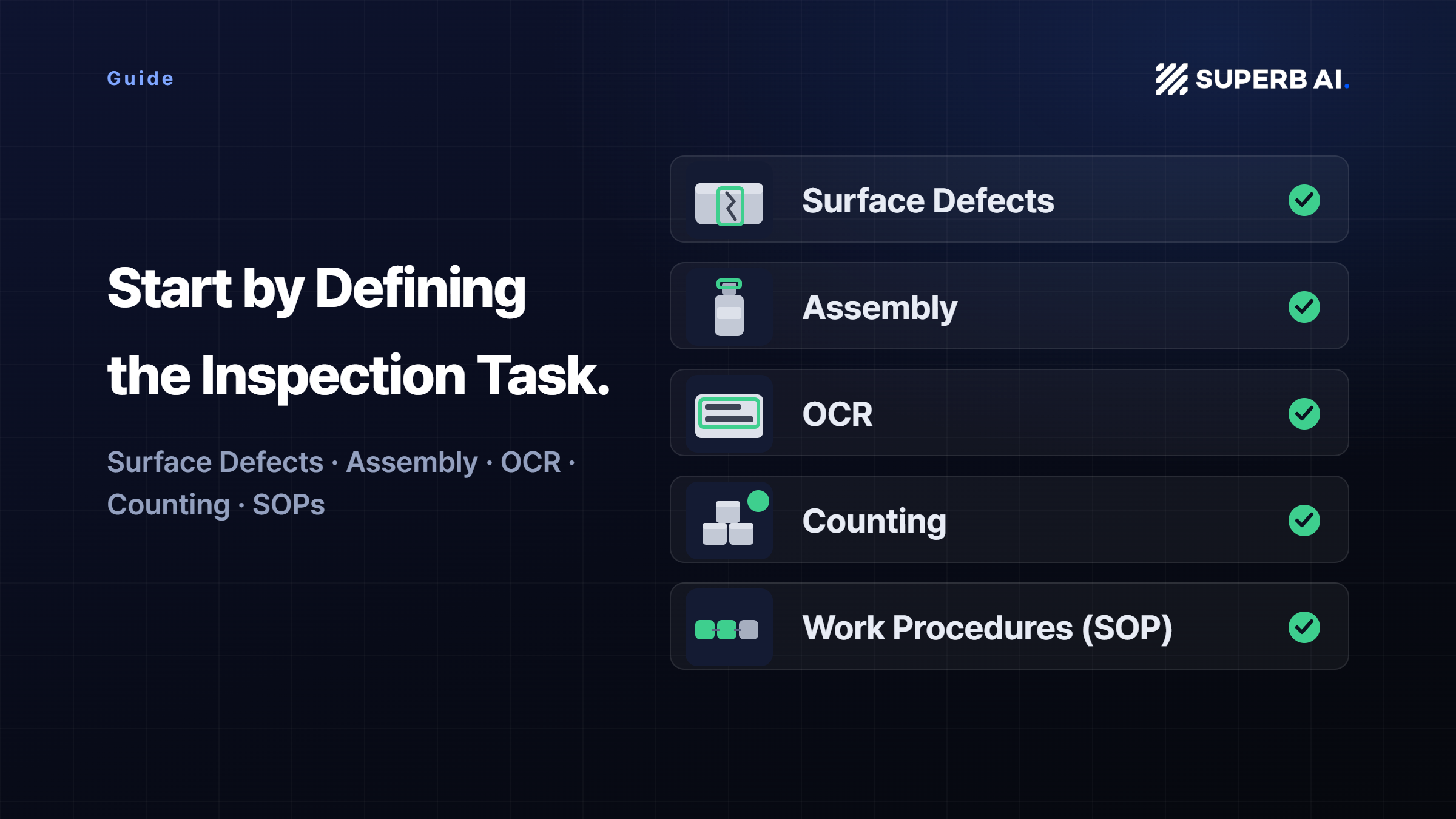
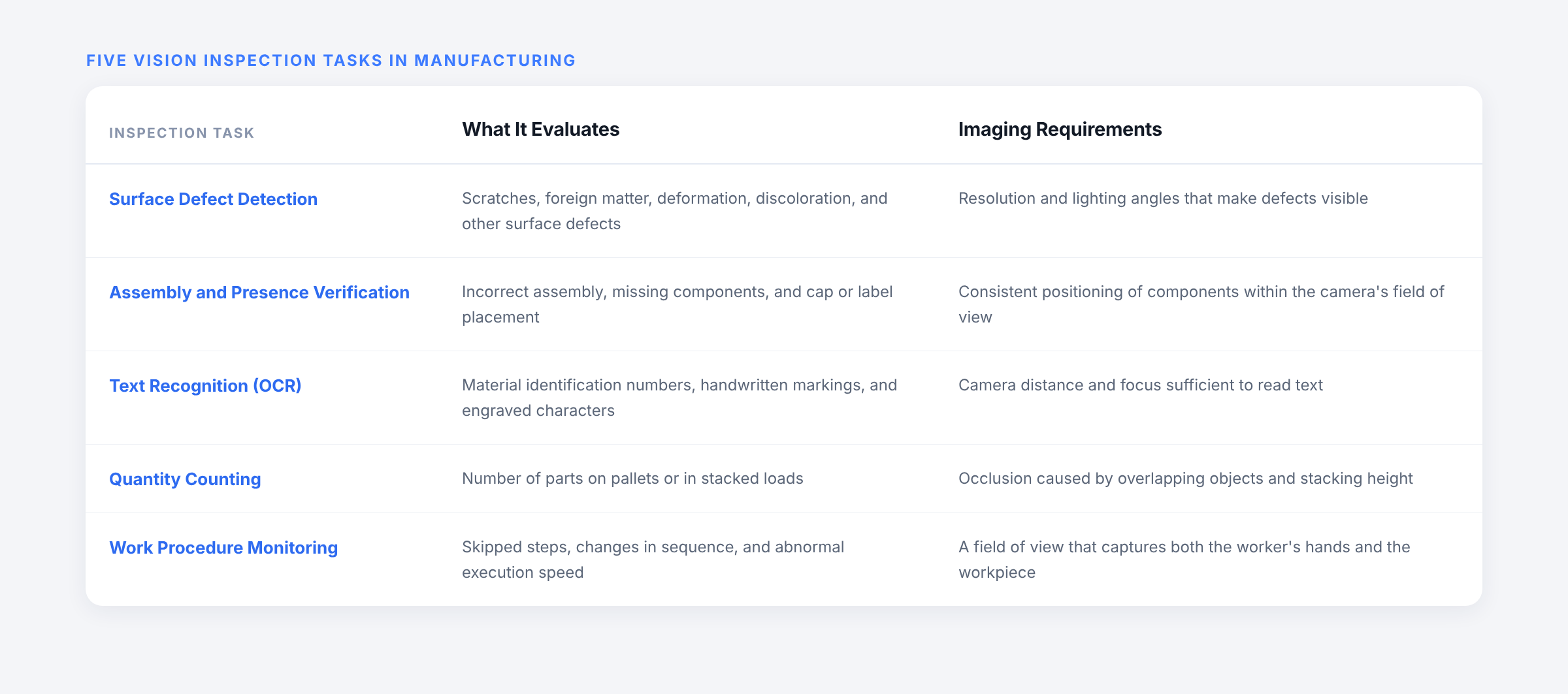
Vision AI inspection in manufacturing can be divided into five tasks based on what needs to be evaluated: surface defect detection, assembly and presence verification, text recognition, quantity counting, and work procedure (SOP) monitoring. Surface defect inspection requires cameras positioned to capture product surfaces up close, while work procedure verification requires a camera with a field of view that covers the entire workstation.
In one example from Korea, the Ministry of Trade, Industry and Resources reported that a review of 42 manufacturing facilities participating in its AI Factory initiative found an average productivity increase of 30.1% and an average defect rate reduction of 15.5% (Ministry of Trade, Industry and Resources, August 4, 2026).
This guide covers the five inspection tasks, how to prepare training data when defect images are scarce, and how to integrate AI with existing inspection equipment. It reflects conditions as of November 2026.
📌 Key Takeaways
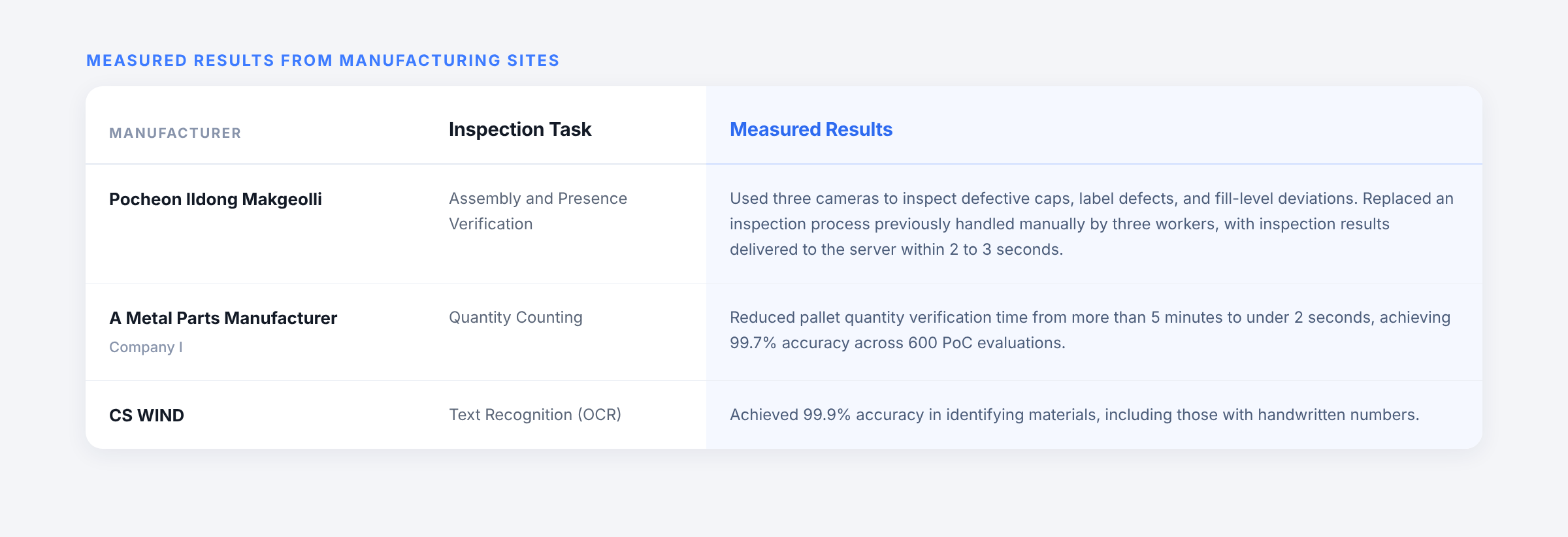
- Text recognition and quantity counting have clearly defined outputs in the form of characters and numbers. A metal parts manufacturer (Company I) achieved 99.7% accuracy in a quantity-counting proof of concept (PoC), while CS WIND, a turbine tower manufacturer, achieved 99.9% accuracy in identifying materials, including those with handwritten numbers.
- Production lines with limited defect images can start with anomaly detection using normal images, few-shot learning, or synthetic data augmentation. ZERO, Superb AI's industry-focused Vision Foundation Model, ranked first in the CVPR 2026 Foundational Few-Shot Object Detection Challenge, which evaluated models using 10 reference images per class.
- Manufacturers that want to retain their existing inspection equipment can add an AI-based secondary review stage, using confidence levels to determine which products pass automatically and which require human review.
5 Vision AI Inspection Tasks in Manufacturing
Superb AI's manufacturing solution brings surface defect detection, material and inventory counting, and process bottleneck identification together on one platform. Manufacturers can start with surface inspection and expand to other applications, such as inventory management.
Q. How Do I Choose the Right Inspection Approach?
Look at two things. First, whether the criterion is fixed: a measurement such as a dimension, or a present/absent check. Second, how many defect images you can gather.
Rule-based machine vision is well suited to dimensional and presence checks for a single product with fixed specifications. Production lines with diverse defect patterns and sufficient defect images can use deep learning models trained on site-specific data. Lines with many product variants or limited defect samples can use vision foundation models pretrained on industrial imagery.
Text recognition and quantity counting produce clearly defined answers in the form of characters and numbers, making their results straightforward to evaluate. In its PoC, a metal parts manufacturer (Company I) evaluated 300 cases under standard conditions and another 300 under challenging conditions involving overlapping objects to measure accuracy before automating pallet quantity verification.
Q. How Do I Prepare Data When Defect Images Are Scarce?
Production lines with low defect rates can use anomaly detection based on normal images, few-shot learning, or synthetic data augmentation.
- Anomaly Detection Using Normal Images: The model learns the characteristics of defect-free products and flags regions that differ from the normal baseline as potential defects. This approach is useful for surface inspection when defect types are difficult to define in advance.
- Few-Shot Learning: Model training begins with a small number of images for each defect type. A ZERO-based system ranked first in the CVPR 2026 Foundational Few-Shot Object Detection Challenge, achieving an average mAP of 53.9 across 20 domains under conditions that provided 10 reference images per class. Around 10 images can provide a starting point for a PoC, while images collected during operation can support subsequent model training.
- Synthetic Data Augmentation: Images that replicate real defects are generated and added to the training dataset. This approach helps supplement rare defect types that are difficult to capture in production.
These approaches can also be combined. For example, anomaly detection can first identify potential defects using normal images, and the collected defect candidates can then be used to train a model that classifies specific defect types.
Q. How Can AI Be Integrated with My Existing Inspection Equipment?
Manufacturers that want to retain their existing inspection equipment can add an AI-based secondary review stage after the current system.
The existing equipment first flags potential defects. AI then reviews those candidates to distinguish actual defects from over-rejections, where acceptable products are incorrectly classified as defective.
A global electronic components manufacturer designed an operating workflow that divided AI inspection results into three confidence levels.
- High confidence: Products pass automatically without human intervention.
- Medium confidence: Inspection experts review the results.
- Low confidence: Cases are flagged for model retraining.
Q. Can Vision AI Verify Work Procedures?
Yes. Vision AI can verify work procedures by comparing videos of actual operations against a reference video showing the correct process.
Superb AI's SOP (standard operating procedure) Monitoring extracts workflow stages, sequence, execution speed, and key objects from a video of a correctly performed process. When another work video is uploaded, the system identifies skipped steps, changes in sequence, abnormal execution speed, and mismatches in key objects. It presents these deviations alongside video clips of the relevant segments. In one demonstration, the system automatically generated a 26-step standard workflow from a single reference video.
Work procedure verification requires a camera angle that captures both the worker's hands and the workpiece. For fast-moving processes, the video must be recorded at a sufficient frame rate to capture each step without missing critical movements.
Real-World Results: Vision AI Inspection in Manufacturing
Q. How Can I Define the Scope of My First PoC?
Start with one inspection task that generates the highest volume of manual reinspection, on a single production line.
A global electronic components manufacturer reclassified approximately 100 defect codes based on occurrence frequency and impact on quality, then prioritized the highest-impact defect groups for AI inspection.
During the PoC, measure not only accuracy but also the manual review rate, the percentage of inspection decisions that still require human verification. For guidance on timelines and success criteria, refer to the Vision AI PoC Design Guide.
Facilities that cannot send production footage outside the factory can use on-premises or edge deployments to operate within the production line without an internet connection.
For a comparison of deployment options, see the Vision AI Deployment Guide.
Superb AI is a Vision Intelligence company that transforms visual data from industrial sites into intelligence enterprises can act on. With ZERO, Superb AI's industry-focused Vision Foundation Model, the company brings surface defect detection, quantity counting, and process bottleneck identification together on one platform.
Related Articles
- Vision AI PoC Design Guide: Timeline, Data, and Success Criteria
- How to Restart an AI Project That Stalled for Lack of Data, with Just 10 Images
💬 Considering Vision AI inspection for your manufacturing line? Tell us what you need to inspect, which products are involved, and what inspection images you already have. Rather than starting with a sales call, we'll begin by assessing which inspection tasks are feasible with your existing images.
Related Posts
Insight
Why Doesn’t Robot AI Have an ImageNet? A Test You Can’t Grade with a Single Answer Key
Hyun Kim
Co-Founder & CEO | 10 min read
Insight
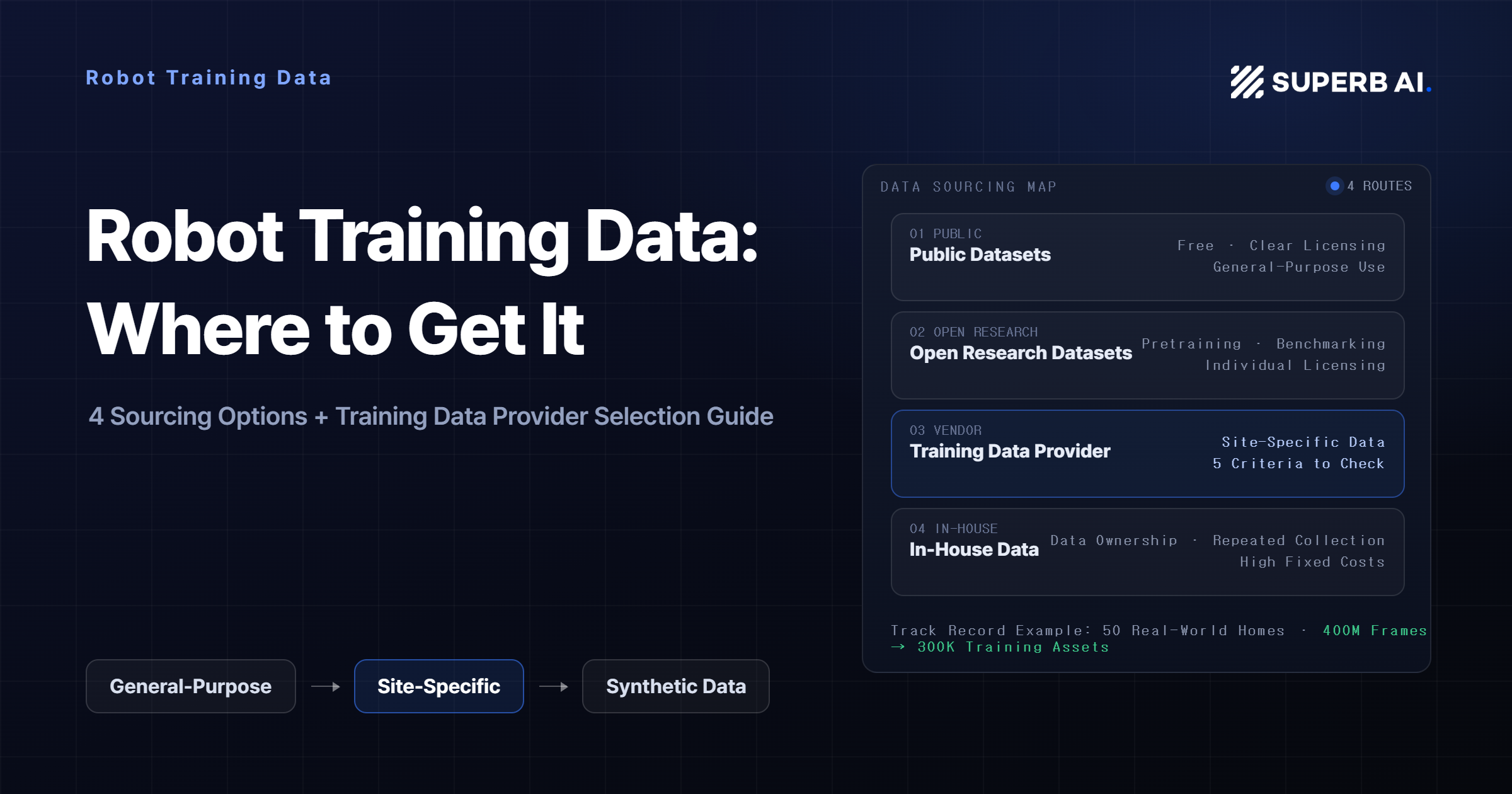
Robot Training Data Sourcing Guide: 4 Options and How to Choose a Training Data Provider
Hyun Kim
Co-Founder & CEO | 7 min read
Insight
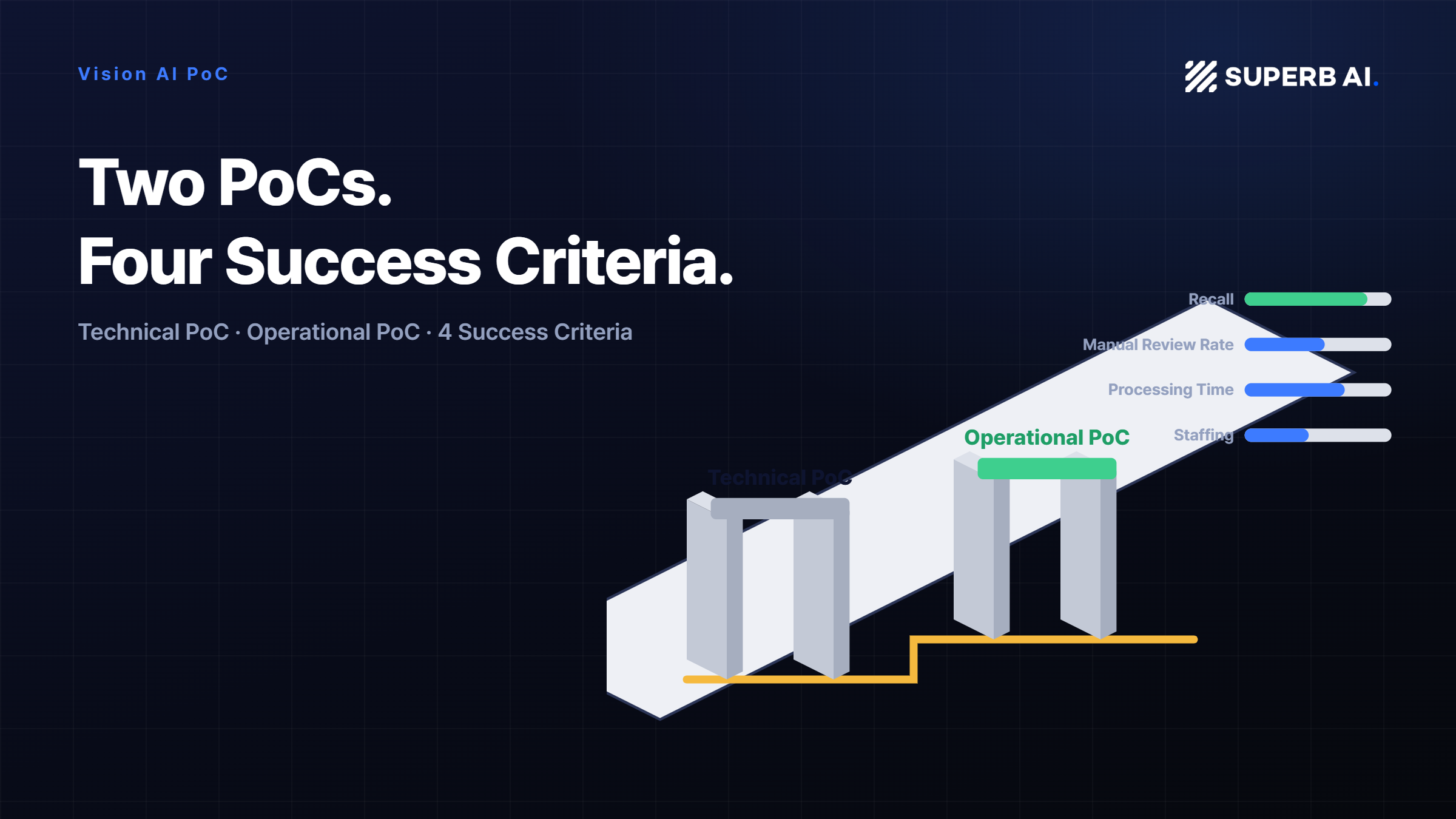
Vision AI PoC Design Guide: Timeline, Data, and Success Criteria
Hyun Kim
Co-Founder & CEO | 7 min read

About Superb AI
Superb AI is an enterprise-level training data platform that is reinventing the way ML teams manage and deliver training data within organizations. Launched in 2018, the Superb AI Suite provides a unique blend of automation, collaboration and plug-and-play modularity, helping teams drastically reduce the time it takes to prepare high quality training datasets. If you want to experience the transformation, sign up for free today.