Insight
Integrated Plant Safety Monitoring: Common Challenges and Deployment Steps for Shipbuilding, Steel, Energy, and Chemical Facilities

Hyun Kim
Co-Founder & CEO | 2026/09/24 | 7 min read
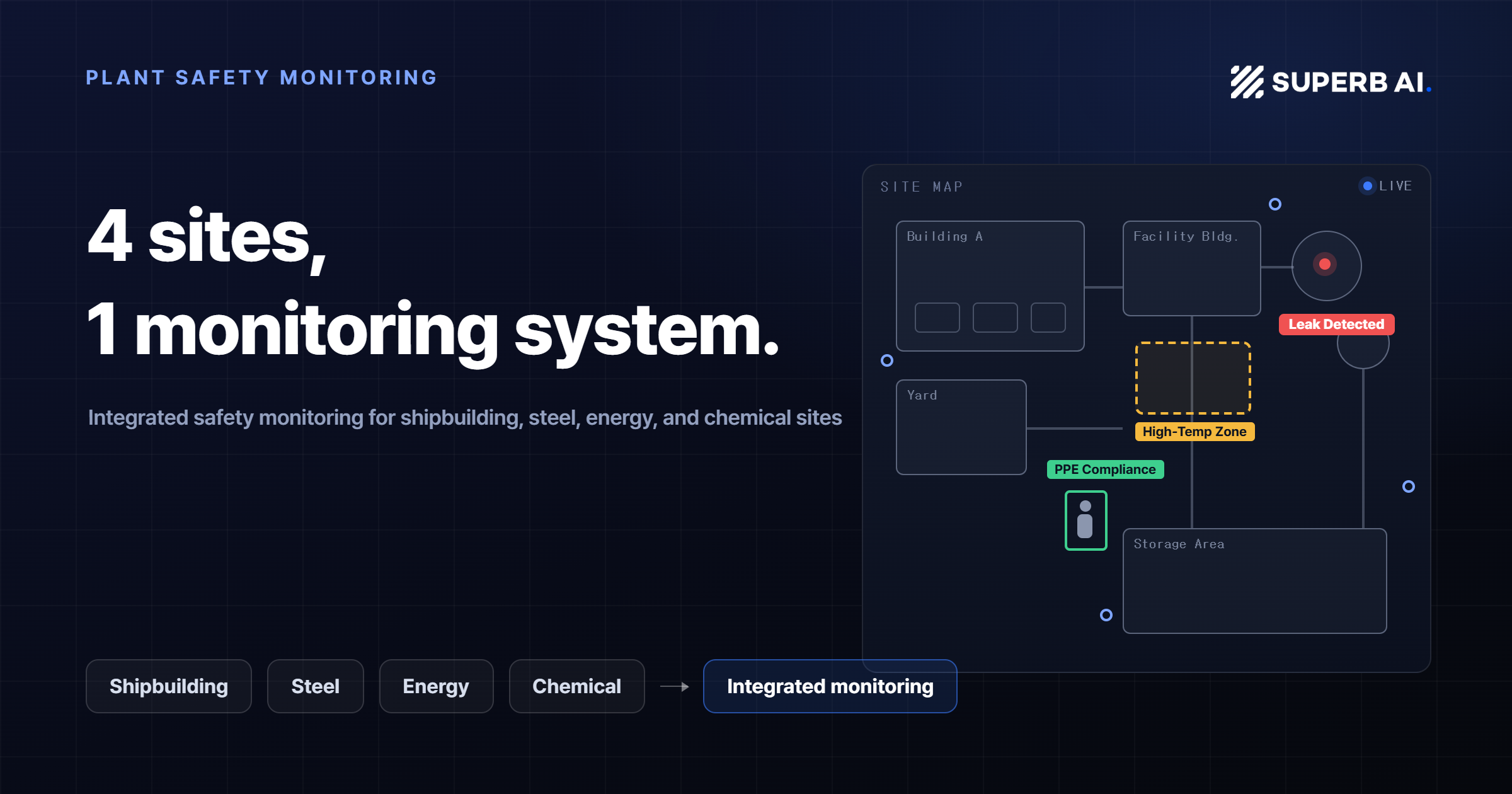
The challenges of plant safety monitoring are similar across industries: monitoring hazardous areas spread across large facilities from a single screen, detecting both unsafe worker behavior and equipment anomalies within the same system, and getting started without replacing existing CCTV infrastructure. Most of the inquiries Superb AI has received from energy, shipbuilding, steel, and chemical facilities center on these three requirements.
Accident statistics also reveal seasonal patterns. To take an example of Korea—according to the National Fire Research Institute's 2025 Statistical Analysis of Chemical Accidents, there were 282 chemical accidents in South Korea in 2025, with incidents peaking during the hot summer months: 33 in July and 34 in August (BridgeNews).
As high temperatures increase chemical volatility and pressure inside storage containers, the need to monitor both equipment and workers intensifies. Monitoring teams working in shifts cannot easily manage this growing workload alone.
Why Plant Safety Monitoring Needs to Be Integrated
Industrial plants share three characteristics that call for an integrated safety monitoring system rather than monitoring individual cameras separately.
First, facilities are large, and hazardous areas are spread across multiple locations. Fixed CCTV cameras leave blind spots, while the number of video feeds a single operator can monitor simultaneously is limited. Areas beyond camera coverage, such as those surrounding mobile cranes or inside confined spaces, can become accident hotspots.
Second, risks come from both people and equipment. Monitoring unsafe behavior, such as failing to wear a hard hat or entering a restricted area, and detecting equipment anomalies, such as leaks, overheating, or smoke, have traditionally been handled by separate systems. When alerts from these systems appear on different screens, incident response becomes fragmented as well.
Third, workers from multiple contractors are regularly present on-site. At facilities where maintenance, repair, and logistics personnel frequently come and go, safety training for a company's own employees alone cannot ensure compliance. A continuous monitoring system that applies consistent safety standards across the entire site becomes necessary.
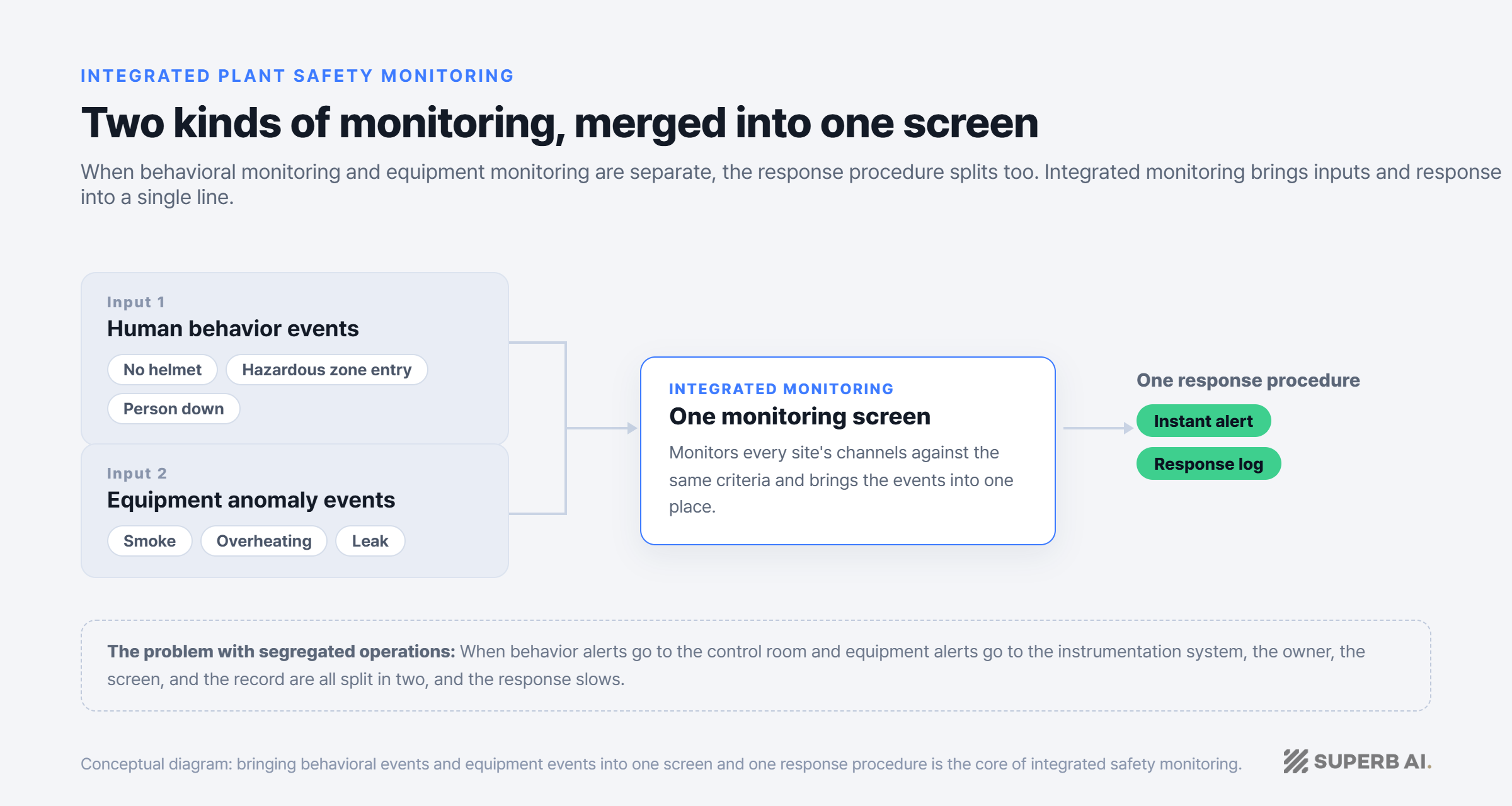
Conceptual illustration: The core of integrated safety monitoring is bringing worker behavior events and equipment events together into a single monitoring interface and incident response workflow
Industry Scenarios: Shared Challenges, Different Environments
Shipbuilding: Shipyards combine confined spaces, work at height, and multiple operations taking place in the same areas. Superb AI has previously introduced a safety management approach for a large shipyard that detects hazardous situations in real time without additional task-specific training and reduces incident investigation time by 90% through natural-language video search.
Featured post: Real-Time Safety in Large Shipyards: How to Respond 90% Faster with AI
Energy: Energy facilities often combine power generation equipment with large outdoor yards. An energy company addressed blind spots in its fixed CCTV coverage by introducing mobile AI video analytics. When a hazardous situation occurs, an edge device detects the event and issues an on-site warning in under one second.
Featured post: [Customer Testimonial] “Zero Blind Spots” in Safety Monitoring: How Energy Company E Upgraded Safety Compliance with AI Video Analytics
Steel: Steel plants bring high-temperature equipment, heavy machinery, and worker movement into close proximity. Access control around blast furnaces and rolling lines, along with proximity detection near heavy machinery, are key monitoring requirements. We covered three major safety challenges in manufacturing and how to address them in a separate post.
Featured post: Top 3 Safety Issues in Manufacturing: What Kind of Video Monitoring Is Needed to Address Them?
Chemicals: Chemical facilities contain numerous explosion-protected areas and storage facilities. Early detection of fire, smoke, and leaks, along with verification of personal protective equipment (PPE) compliance, takes priority. During periods of high summer temperatures, more areas may require heightened monitoring.
How Is It Different from Conventional Monitoring Systems?
Conventional AI monitoring systems detect only events they have already been trained to recognize. Recognizing a new type of hazard can require three to six months of data collection and model retraining, while obtaining training data for hazardous situations remains a recurring challenge.
Superb Video Analytics is built on ZERO, Superb AI's industry-focused Vision Foundation Model, enabling detection without additional task-specific training. Detection events can be defined according to the incident types relevant to each site, and new event types can be added without waiting for a model retraining cycle. After detection, natural-language video search helps reduce the time required to investigate incidents.
The results can be measured. In one case, a manufacturing company increased its PPE compliance rate from approximately 75% to 98% using this approach and established a system capable of issuing warnings and initiating a response within 30 seconds of a violation.
Deployment Process and Requirements
Implementing integrated safety monitoring does not require replacing all existing equipment. A standard approach involves four steps: assessing existing CCTV infrastructure, defining detection events, validating performance in a pilot area, and scaling the deployment.
Plants with stringent security requirements often operate within closed networks. Superb Video Analytics supports on-premises deployment, allowing facilities to operate without transferring video data outside their networks.
Procurement can also be streamlined for public-sector organizations and state-owned enterprises. Superb VA, Superb AI's video analytics solution, has been designated an Innovative Product by a Korean government agency, the Public Procurement Service, making it eligible for direct procurement contracts.
For organizations evaluating return on investment, we recommend calculating both the direct and indirect costs of a single accident alongside the operating costs of safety monitoring personnel. We explain this calculation framework in our AI Video Analytics ROI Analysis.
Frequently Asked Questions
Q. Can hundreds of CCTV channels across multiple facilities be integrated into a single system?
Yes. However, successful deployment depends less on the number of channels than on how detection events are defined. We recommend creating an event list based on the incident types relevant to each facility and expanding the system in stages, starting with the highest-risk areas.
Q. Can the same system monitor both worker behavior and equipment anomalies?
Yes. Both can be monitored using the same video inputs. The core of integrated safety monitoring is bringing behavioral events, such as missing hard hats and unauthorized entry into hazardous areas, together with equipment events, such as smoke, overheating, and leaks, within a single monitoring interface and incident response workflow.
Q. Can the system be deployed at a facility operating within a closed network?
Yes. With on-premises deployment, video data does not need to leave the facility for an external cloud environment. For sites requiring a security assessment, we can also design the network architecture during the initial planning stage.
Q. Can we use our existing CCTV cameras if their image quality is low?
It depends on the individual camera. Before assessing image quality, it is important to determine whether the camera's field of view and installation position adequately cover the hazardous area. During the pre-deployment assessment, we identify which existing channels can be reused and which require upgrades or additional coverage.
💬 Considering integrated safety monitoring for your facility? Tell us your industry—shipbuilding, steel, energy, or chemicals—and the areas or situations you need to monitor. We'll start by assessing how much of your existing CCTV infrastructure can be reused.
Superb AI is a Vision Intelligence company that transforms visual data from industrial environments into actionable intelligence for enterprises. We build industrial safety monitoring systems that work with existing CCTV infrastructure.
Related Posts
Insight
Robot Training Data Sourcing Guide: 4 Options and How to Choose a Training Data Provider
Hyun Kim
Co-Founder & CEO | 7 min read
Insight
Vision AI PoC Design Guide: Timeline, Data, and Success Criteria
Hyun Kim
Co-Founder & CEO | 7 min read
Insight
Physical AI Dataset Development Guide: 4 Data Types and a 3-Step Pipeline
Hyun Kim
Co-Founder & CEO | 7 min read

About Superb AI
Superb AI is an enterprise-level training data platform that is reinventing the way ML teams manage and deliver training data within organizations. Launched in 2018, the Superb AI Suite provides a unique blend of automation, collaboration and plug-and-play modularity, helping teams drastically reduce the time it takes to prepare high quality training datasets. If you want to experience the transformation, sign up for free today.