Insight
A Guide to Implementing HITL: Manufacturing AI Adoption Fails Without On-Site Know-How

Hyun Kim
Co-Founder & CEO | 2026/01/30 | 7 min read
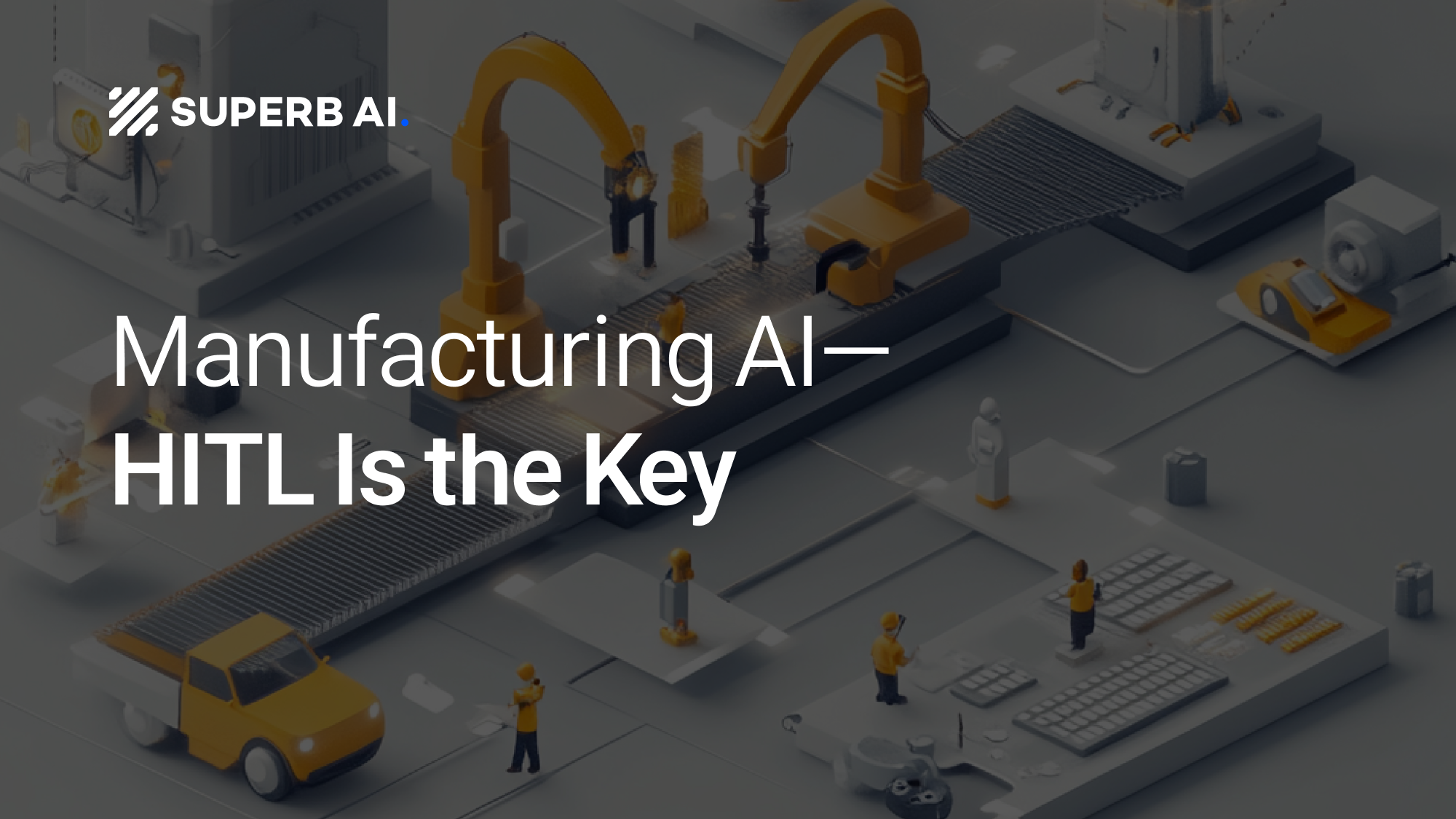
Many manufacturers considering AI adoption first picture “full automation,” where machines run without people. But once AI is deployed, complaints often surface on the shop floor: “How can we trust it if it’s not 100% accurate?” and “We’re doing even more work fixing the errors AI creates.”
Bottom line: The key to successful manufacturing AI is not “removing people,” but “adding human experience to AI.” That is exactly what HITL (Human-in-the-Loop) is.
In this guide, we’ll break down—clearly and simply—why on-site expertise is essential to AI operations and how it translates into real business outcomes.
1. What Is HITL? A Team of a Newbie (AI) and a Veteran Expert (Human)
Does the term HITL (Human-in-the-Loop) sound complicated? Let’s put it in simple terms.
- AI (the new hire): It never gets tired and can process data at an incredible speed. It excels at repetitive tasks. But it struggles to handle unexpected situations.
- Human (the expert): It may be slower than AI, but it can read the context of the site and take “judgment” and “accountability” for complex problems.
HITL is the system that pairs these two into a “two-person team.” AI handles the first pass quickly, and a human expert steps in only when AI is uncertain or when a critical decision is required.
HITL is not “humans helping because AI isn’t good enough.” It is a prerequisite for making AI usable in real-world operations.

2. Why HITL Matters More Than “99% Accuracy”
Many people fixate on an AI model’s accuracy. But in real business environments—especially manufacturing—“operational trust” matters far more than a numeric accuracy score.
Most failures of AI on-site come down to the following:
- AI doesn’t understand context: It’s hard for AI to tell whether a worker has collapsed or is lying down to repair equipment—because it can look identical on CCTV.
- Humans must be accountable: If AI misses a defect and it leads to hundreds of millions of won in losses, you can’t hold AI responsible. Ultimately, final approval and control must remain in human hands.
With a HITL system, business operations change in these ways:
- Reduced anxiety on-site: AI doesn’t act unilaterally. When something is ambiguous, it asks a human—removing uncertainty and distrust.
- Risk control: Experts can block the “one major incident” risk—where AI performs well 99 times but fails catastrophically once.
- Maximum efficiency: People focus only on the truly critical 1–5% of exceptions, while AI handles the rest—reducing workload fatigue.
3. Turning On-Site “Instinct” and “Expertise” Into an Asset
Manufacturing sites are not like offices. Processes are highly complex, exceptions happen frequently, and equipment, workers, safety, and productivity are tightly interlocked like gears.
In this environment, a single wrong AI judgment can immediately lead to severe quality losses, safety incidents, or production line shutdowns.
- What matters more than “high-accuracy AI” is “AI that doesn’t cause incidents.” Even if an AI model scores 99 out of 100, you can’t use it if one irrational mistake stops the factory. In manufacturing, it’s far more important to be able to control AI so it doesn’t make the wrong call than to maximize how often it is “right.”
- Uncontrolled automation is simply a risk. If there is no safeguard that can immediately correct the impact when AI makes a bad decision, that automation system is a ticking time bomb.
That’s why manufacturing AI adoption should not be “full automation” that hands everything to machines at once. It must be “gradual automation” built on human judgment. And HITL is the core of that safe operating structure.
Manufacturing sites also contain tacit knowledge that doesn’t exist in manuals.
“This machine is still normal even if it sounds a bit different on rainy days.”
“This part isn’t defective even if there’s a light reflection here.”
This kind of veteran know-how (tacit knowledge) cannot be taught to AI through data alone. HITL is the process of transferring that expertise to AI—through experts correcting AI outputs and providing feedback.
Over time, the AI in your factory begins to align with the standards and judgment of on-site experts. That is the true meaning of “turning data into an asset.”

4. It’s Not About Technologies—Success or Failure Depends on “Operational Design”
HITL is not simply an option of “having a person take another look.” It is the difference in operating structure that determines whether AI actually works on-site—or stops.
❌ AI Without Design (No HITL)
- Structure: AI Detection → Immediate Action
- Result: When AI malfunctions, the site stops trusting it. Because false alarms go off constantly, workers eventually turn off alerts or bypass the system. This is the classic pattern of AI adoption failure.
⭕ AI With Design (With HITL)
- Structure: AI Detection and Recoomendation → Human Judgment and Accountability → Action
- Result: AI plays a supporting role, and humans make the final decision. As human judgment data accumulates, AI becomes smarter over time—and operational quality keeps improving.
The key is “who designs it, and how.” What to delegate to AI, when humans should intervene for maximum efficiency, and how to turn those judgment outcomes into assets—everything must be designed in advance with precision. Without this design, HITL remains a slogan, and AI stalls after a proof of concept (PoC), unable to scale.
5. Going Beyond a Mere Concept, Superb AI Incorporates HITL Into “Real-World Design”
HITL isn’t something you achieve by simply saying, “Let’s involve humans.” Superb AI brings deep, differentiated experience and technical expertise by treating HITL not as a concept, but as an operations design challenge.
1) We design for “on-site performance” before model scores
Superb AI doesn’t focus only on improving AI metrics. We start with the question, “What does this AI need to actually run on site?”
- We analyze the site’s workflow and decision-making structure from the earliest stage—before AI is deployed.
- We define exactly where human intervention is essential.
- We design realistic operating standards on the assumption that false positives and edge cases will occur.
2) We go beyond just consulting—and deploy PI (Process Innovation) combined with on-site experience
Superb AI has hands-on improvement experience from a PI (Process Innovation) perspective—analyzing processes, safety, and operations in real manufacturing and industrial environments.
- We break down complex on-site situations and convert them into decision structures AI can understand.
- We don’t treat HITL as a one-off project deliverable—we accumulate it as a reusable operational asset.
- As a result, we go beyond vague statements like “human judgment is needed” and provide concrete operating blueprints for where, how, and to what extent humans should intervene.
3) We turn HITL into patented assets—across both technical and operational dimensions
Superb AI clearly defines HITL as (1) an AI decision structure, (2) a human intervention mechanism, and (3) an operational feedback loop—and has turned them into our practical assets through patents.
- Uncertainty-based selective verification: When AI is not confident (high uncertainty), it flags only that data for human review—so people don’t have to check everything. (e.g., Patent 10,902,291)
- Difficulty estimation: AI automatically completes easy tasks and classifies only hard cases that require human review. (e.g., Patent 10,885,388)
- Collaborative labeling system: AI learns from human corrections, building a virtuous cycle where it makes more accurate judgments next time. (e.g., Patent 102117543)
This is clear evidence that Superb AI approaches HITL as a systematically designed, scalable technical system.
The key to successful AI operations in manufacturing isn’t making AI “smarter” in isolation. The outcome depends on how well you structure human judgment and divide roles between AI and people.
HITL is no longer optional. In manufacturing environments with high variability and high risk, it is an essential strategy for turning AI into real business results.
But it’s not a strategy just anyone can execute. Proper HITL design requires a deep understanding of on-site context, the ability to deconstruct processes, and proven experience handling both technology and operations end-to-end.
Superb AI isn’t a company that merely talks about HITL. We are a company that has directly designed and operated HITL in real-world sites.
“Will AI adoption be safe in our factory?” “Will our staff actually be able to use it?”
If those questions are on your mind, talk to Superb AI’s HITL experts—already proven across numerous manufacturing sites. We won’t just deliver technology. We’ll design the optimal operating structure to drive your business success.
Related Posts
Insight
Why Doesn’t Robot AI Have an ImageNet? A Test You Can’t Grade with a Single Answer Key
Hyun Kim
Co-Founder & CEO | 10 min read
Insight
Robot Training Data Sourcing Guide: 4 Options and How to Choose a Training Data Provider
Hyun Kim
Co-Founder & CEO | 7 min read
Insight
Vision AI PoC Design Guide: Timeline, Data, and Success Criteria
Hyun Kim
Co-Founder & CEO | 7 min read

About Superb AI
Superb AI is an enterprise-level training data platform that is reinventing the way ML teams manage and deliver training data within organizations. Launched in 2018, the Superb AI Suite provides a unique blend of automation, collaboration and plug-and-play modularity, helping teams drastically reduce the time it takes to prepare high quality training datasets. If you want to experience the transformation, sign up for free today.