Insight
⑦ Why Synthetic Data Is the Key to Training Physical AI

Kye-Hyeon (KH) Kim
Chief Research Officer | 2026/03/18 | 5 min read
![[Physical AI Series 7] What If You Have No Training Data for Physical AI?](https://cdn.sanity.io/images/31qskqlc/production/95696f519132b24098e74c1f78d2b81094bc47fb-2000x1125.png?fit=max&auto=format)
In 2025, one topic dominated the tech industry: Physical AI.
When NVIDIA CEO Jensen Huang declared at CES that “the next frontier of AI is Physical AI,” it marked a turning point. Since then, industries have been rapidly reorganizing around robotics, autonomy, and real-world AI systems.
Global leaders like BMW, Amazon, Foxconn, and Hyundai are no longer just deploying robots—they’re building digital twins, or virtual factories, to simulate and optimize real-world operations.
The results are already measurable, according to the 2025 World Economic Forum report:
- Amazon reports 25% efficiency gains from AI-powered robotics
- Foxconn reduced deployment time by 40% using digital twins
- BMW expects up to 30% cost savings through NVIDIA Omniverse-based virtual factories
So why are companies investing so heavily in virtual environments? Simple.
Because Physical AI has a fundamental bottleneck: data.
The Core Problem: The Physical World Has No “Internet”
Large language models thrive on internet-scale data. Robotics does not.
Physical AI systems must learn through real-world interaction, and that creates a massive data gap:
- No scalable data source: While LLMs have trillions of text storages like Common Crawl, there is no equivalent of the internet for physical interactions. Every data point must be collected through real-world trials—one interaction at a time.
- Exponential cost and risk: Deploying a single robot in an industrial environment or on a public road can cost tens to hundreds of thousands of dollars, with significant safety and regulatory risks.
- Extremely rare but critical edge cases: Performance depends not on the 99% of normal scenarios, but the 1% of rare events—like unexpected obstacles, poor visibility, or extreme conditions. These are incredibly difficult to capture in real-world datasets.
And unlike LLMs, where failure means incorrect output, failure in Physical AI can mean real-world accidents.
The Breakthrough: Synthetic Data
To address this gap, synthetic data is emerging as a core building block.
Synthetic data is generated in a simulation rather than collected from the real world. It allows teams to create large-scale, labeled datasets without the cost and constraints of physical data collection.
And it’s growing fast:
- MarketsandMarkets predicted the synthetic data market to grow from $300M (2023) to $2.1B (2028)
- Gartner predicts synthetic data will dominate AI training datasets by 2030
But there’s a catch.
Models trained in simulation often fail in the real world—a challenge known as the Sim-to-Real gap.
This happens because simulations approximate reality. They can’t fully capture physical nuances like friction, lighting variation, or sensor noise.
So the real challenge isn’t just generating data—it’s bridging simulation and reality.
1. Domain Randomization: Scaling Data Through Simulation (SDG)
Simulation platforms like NVIDIA Isaac Sim enable highly realistic virtual environments.
Within these environments, developers use domain randomization—a technique that programmatically varies parameters like lighting conditions, object textures and positions, and camera angles. By generating thousands of variations, models learn the core structure of tasks, rather than memorizing specific scenes. Instead of learning a specific object in a specific setting, the model learns how to perform the task itself (e.g., “how to hold a can”) — the nature of the task. This significantly improves generalization.
2. The Sim-to-Real Problem: When Virtual Perfection Fails in Reality
Even with high-quality simulation, models often fail when deployed in the real world. This is the Sim-to-Real problem.
It stems from subtle but critical differences between simulated and real environments:
- Physics mismatch — friction, mass, and material behavior are approximations
- Sensor noise — real cameras introduce blur, distortion, and noise
- Unpredictability — real-world environments are infinitely more complex
At its core, this is a distribution mismatch problem. The data distribution in the simulation does not perfectly match reality. The goal, therefore, is not perfect simulation but closing the gap between the two distributions, which is why a data-centric approach is required.
3. The Hybrid Approach: Bridging Simulation and Reality
Strategy 1: Pretrain in simulation, fine-tune in reality
The most effective strategy today is a hybrid data pipeline. Train models on large synthetic datasets, then refine them with smaller, high-quality real-world data. This allows models to learn general behavior in simulation and adapt to real-world specifics.
Strategy 2: Imitation learning and hard case mining
More advanced pipelines introduce a feedback loop:
- Train a model on mixed real + synthetic data
- Deploy it in the real world
- Identify failure cases (e.g., difficult lighting, reflective surfaces)
- Recreate those scenarios in simulation with heavy variation
- Generate targeted synthetic datasets
- Retrain the model to address weaknesses
This approach focuses on where the model fails, not just where it succeeds.
Building the Data Engine for Physical AI
This hybrid approach requires a sophisticated data engine that can unify simulation and real-world data, analyze real-world failure cases, and feed those insights back into synthetic data generation.
Platforms like Superb AI play a critical role here. They enable teams to manage data across multiple sources, identify real-world failure scenarios, and seamlessly integrate them back into the training loop.
In particular, Superb AI’s synthetic data capabilities make it possible to efficiently generate these hard-to-collect edge cases, helping teams systematically improve model robustness.
The Future: Simulation + Reality
The future of Physical AI isn’t simulation or reality—it’s simulation and reality. Synthetic data accelerates development, but its value depends on how well it reflects the real world.
Ultimately, success in Physical AI will come down to data strategy. The companies that win won’t just build better models—they’ll build better data systems. Moving beyond model-centric thinking to data-centric MLOps—spanning simulation and real-world data—is what will unlock truly intelligent systems that can operate in the physical world.
In the era of Physical AI, the real advantage belongs to those who control the data. Only companies that move beyond model-centric thinking and adopt a data-centric MLOps strategy—spanning both simulation and the real world—will be able to build the kind of intelligence that can truly operate in the physical world.
Related Posts
Insight
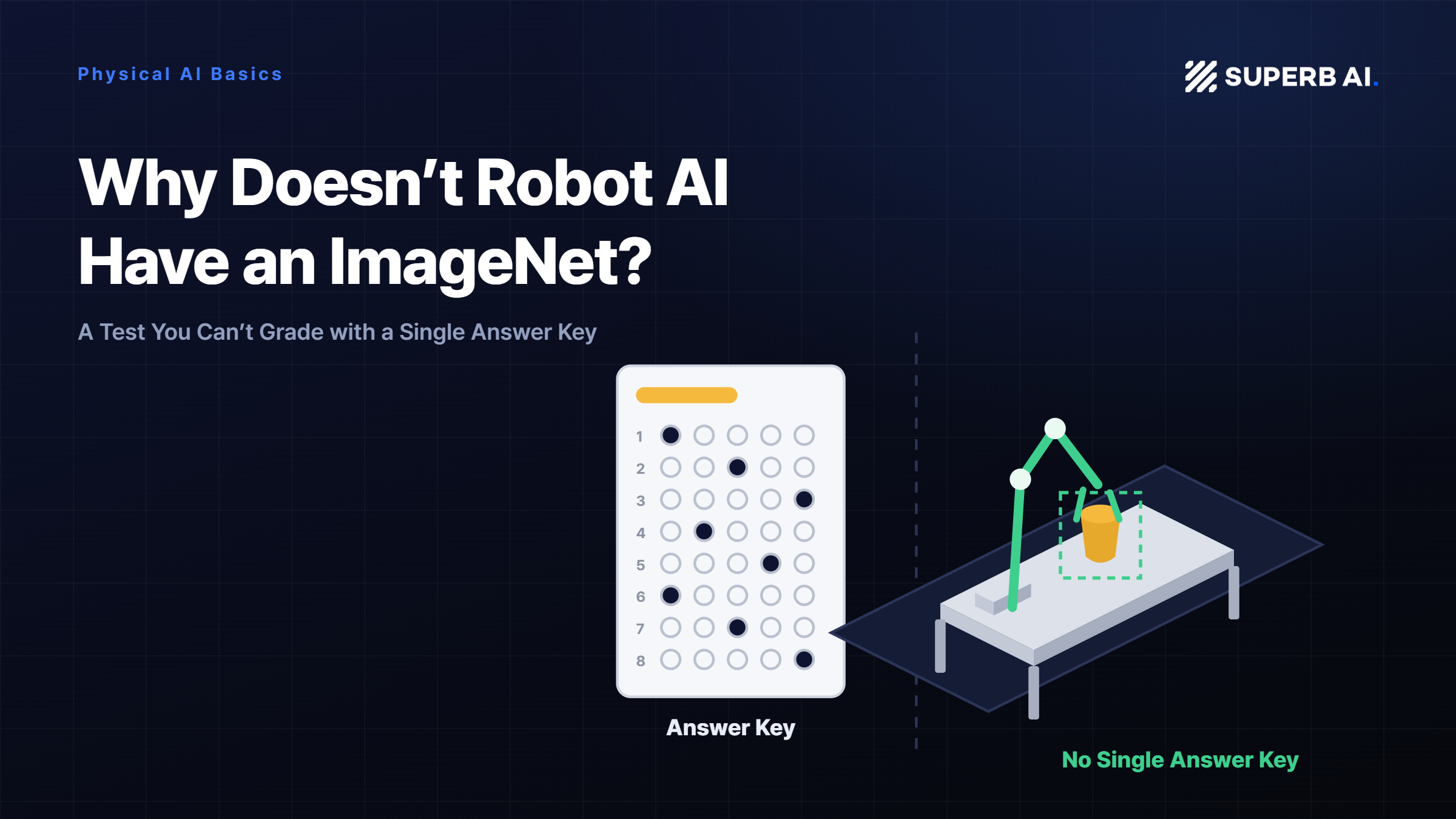
Why Doesn’t Robot AI Have an ImageNet? A Test You Can’t Grade with a Single Answer Key

Hyun Kim
Co-Founder & CEO | 10 min read
Insight
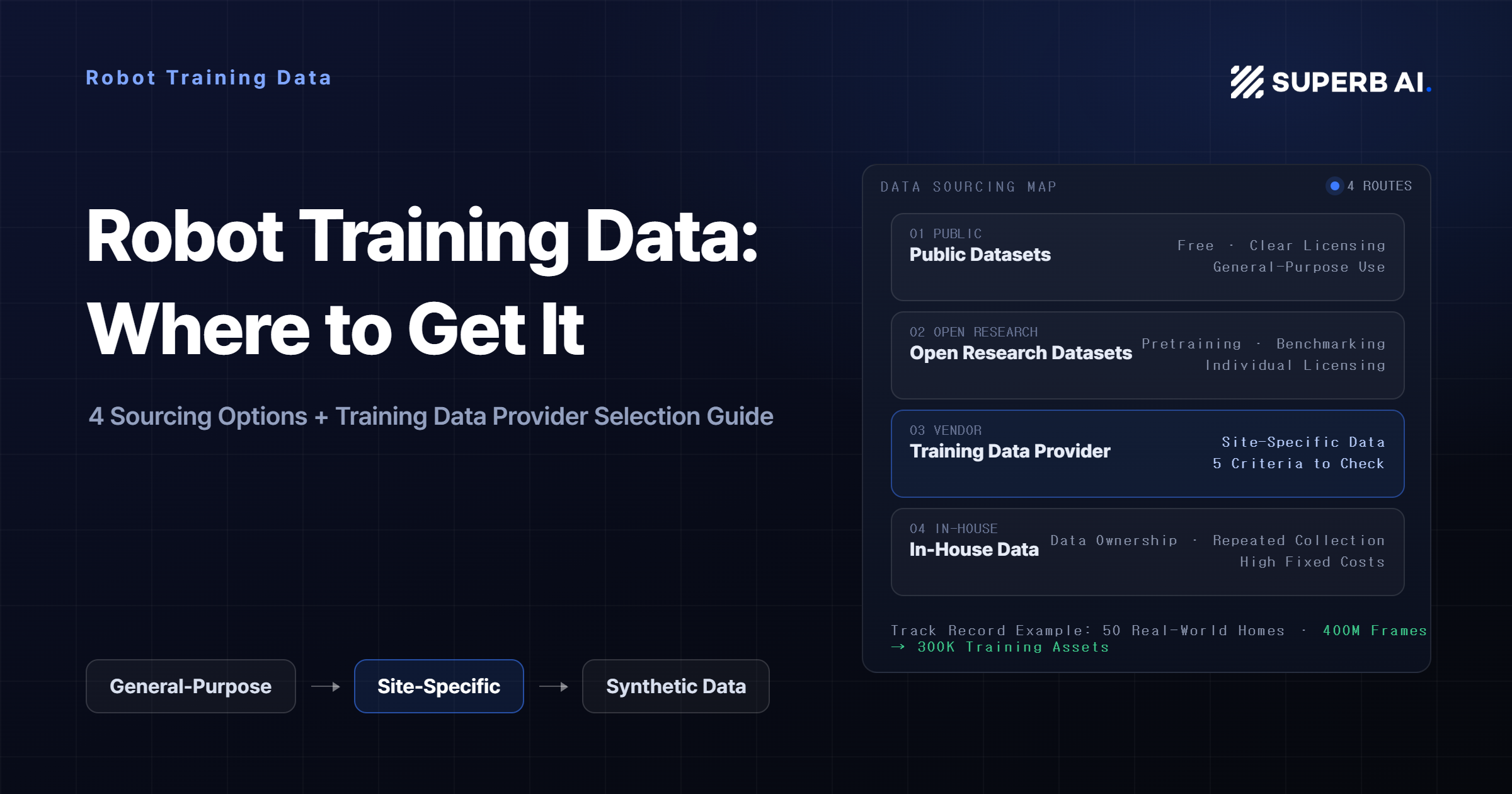
Robot Training Data Sourcing Guide: 4 Options and How to Choose a Training Data Provider
Hyun Kim
Co-Founder & CEO | 7 min read
Insight
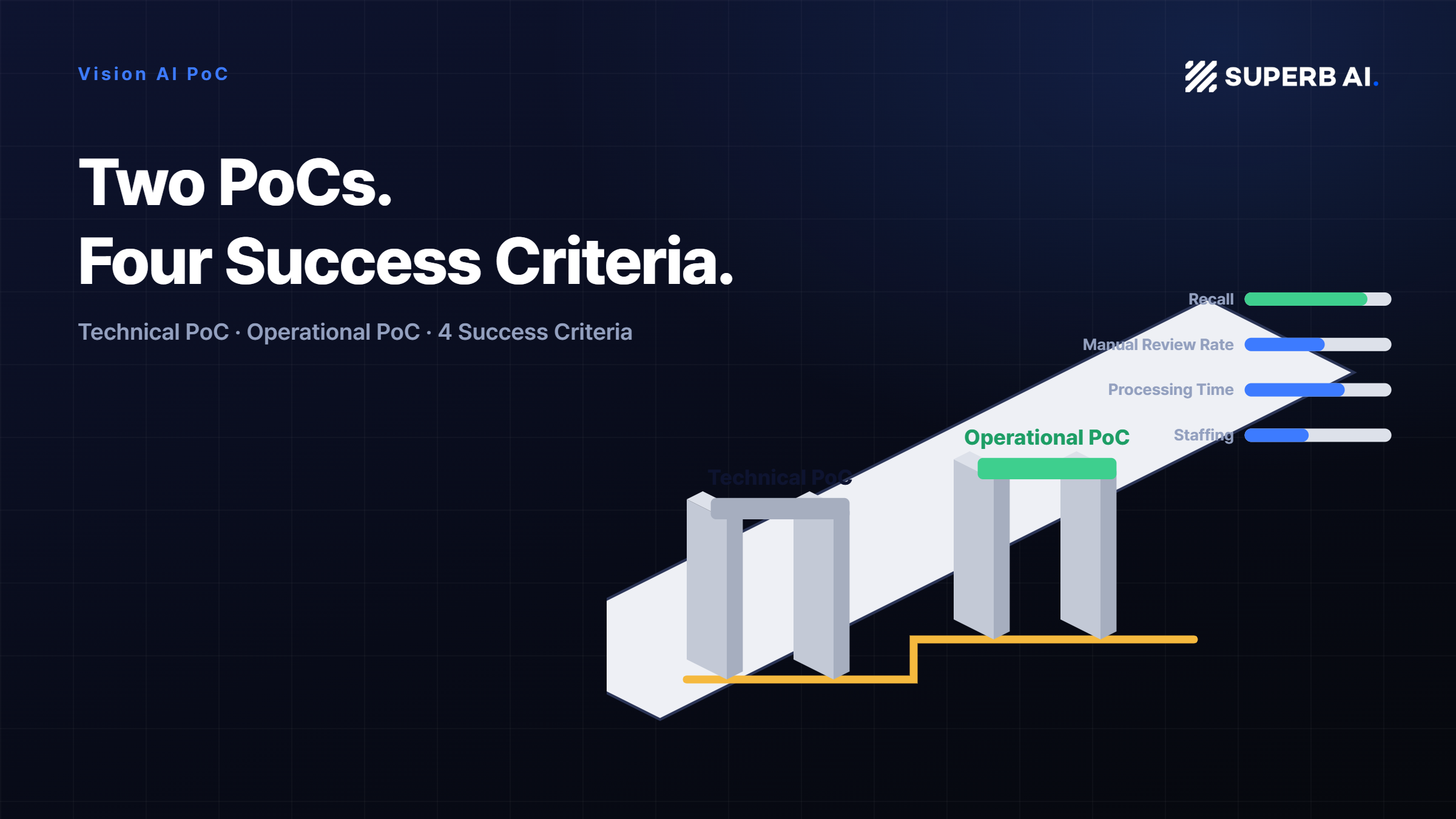
Vision AI PoC Design Guide: Timeline, Data, and Success Criteria
Hyun Kim
Co-Founder & CEO | 7 min read

About Superb AI
Superb AI is an enterprise-level training data platform that is reinventing the way ML teams manage and deliver training data within organizations. Launched in 2018, the Superb AI Suite provides a unique blend of automation, collaboration and plug-and-play modularity, helping teams drastically reduce the time it takes to prepare high quality training datasets. If you want to experience the transformation, sign up for free today.