Insight
⑩ Big Tech Physical AI Trends (2): Tesla vs. Amazon Strategy Breakdown

Hyun Kim
Co-Founder & CEO | 2026/04/06 | 10 min read
![[Physical AI Series 10] Strategy Breakdown: Tesla vs. Amazon](https://cdn.sanity.io/images/31qskqlc/production/a74438f21bb5260caa0cb58aab449ed303fafe6b-2000x1125.png?fit=max&auto=format)
In Q3 2025, the global technology market entered a historic boom. The Nasdaq crossed 20,000, and NVIDIA’s market capitalization pushed toward the $5 trillion mark. But beneath those numbers, a persistent anxiety remained: can generative AI move beyond chatbots and image generation to drive real industrial productivity? That question sits at the heart of the so-called AI bubble debate. The market is no longer satisfied with potential alone. It now wants proof that AI can create tangible value in the physical world.
In the previous post, we traced how NVIDIA and Google are digitizing the laws of physics in virtual environments and expanding the reasoning capabilities of AI. NVIDIA, through Cosmos, and Google, through Gemini, have built the logical foundation, the mind, on which Physical AI can operate.
Now the conversation shifts from mind to body and field: from intelligence as abstraction to intelligence that moves, manipulates, and works in the real world. In this post, we examine the humanoid robotics race between Tesla and Figure AI across Q3 and Q4 2025, as well as Amazon’s role in redefining labor at an industrial scale. We also look at how China’s rapid rise intersects with America’s re-industrialization strategy, and why Physical AI is increasingly becoming a geopolitical issue as much as a technological one.
1. The Humanoid Robot War: Tesla’s Struggles and the Rise of the Alliance Model
In the second half of 2025, the humanoid robotics market turned into a high-stakes contest between two competing models: Tesla’s vertically integrated strategy and an alliance-driven approach led by companies such as Figure AI and 1X. At the same time, two new variables entered the picture: intensifying safety concerns and the opening of the consumer market.
1.1 Tesla Optimus: Delayed Innovation and Real-World Tradeoffs
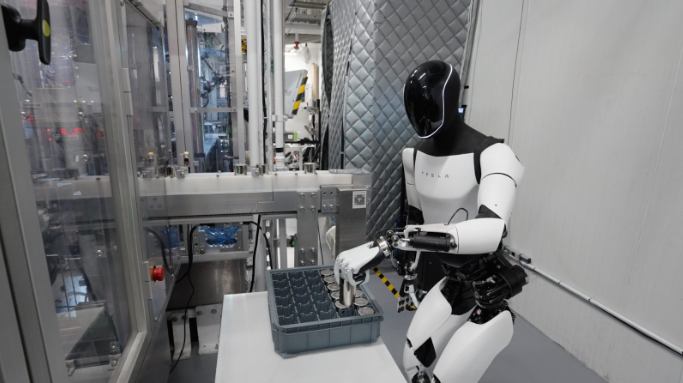
Elon Musk has repeatedly claimed that as much as 80% of Tesla’s future value could come from Optimus. But the second half of 2025 was defined less by breakthrough execution than by production delays and revised targets.
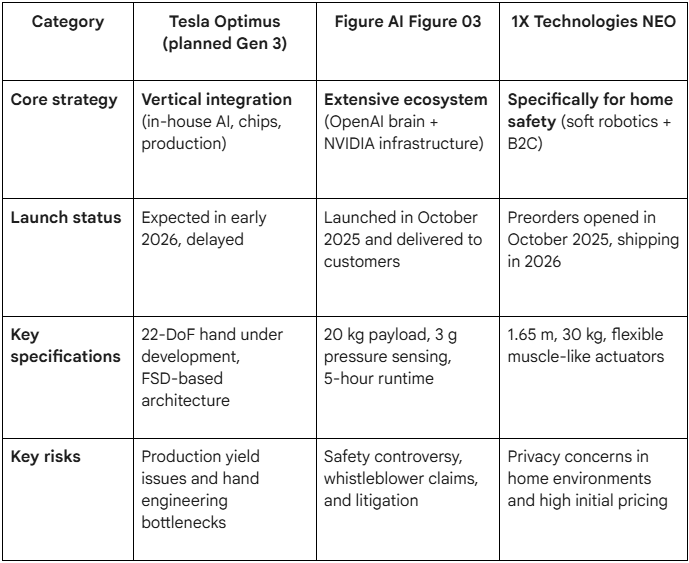
- Gen 3 delayed: In Tesla’s Q3 earnings call on Oct. 3, 2025, Musk officially pushed the launch of Optimus Gen 3 from late 2025 to early 2026.
- The technical bottleneck: the hand: The primary source of delay is the engineering difficulty of Tesla’s 22-degree-of-freedom robotic hand, designed to replicate human dexterity. Combining fine tactile sensitivity with industrial-grade durability has proven far harder than expected. At one point, production bottlenecks were so severe that Tesla reportedly accumulated robot bodies without finished hands.
1.2 Figure AI: Ecosystem Leverage Meets Safety Scrutiny
Figure AI took a different path. Backed by strong partnerships with NVIDIA for infrastructure, OpenAI for intelligence, and Microsoft for cloud, the company successfully launched Figure 03 in October 2025.
- Aggressive hardware specifications: Figure 03 pairs a lightweight 173 cm, 24 kg body with a 20 kg payload capacity. Its fingertip sensors can detect pressure as low as 3 grams, while a 10 Gbps mmWave communications module enables real-time processing of high-volume data. A battery with 94% higher energy density delivers up to five hours of runtime.
- The outsourced intelligence model: Figure AI’s strategy is clear: OpenAI for the brain, NVIDIA for simulation, and Azure for cloud. That optimization-first approach helped the company move faster than Tesla in commercialization, including deployments into BMW factories.
- Safety issues come into focus: That speed, however, has come with growing scrutiny. According to claims raised by a former engineer in a whistleblower complaint and lawsuit, a Figure 03 robot malfunctioned and punched through a refrigerator door. The complaint also alleged that the robot possessed enough force to fracture a human skull, while safety protocols were ignored. If substantiated, these issues could become an early trigger for tighter robot safety regulation, especially as commercialization accelerates.
1.3 1X Technologies: Safe Robotics for the Home
Another OpenAI-backed robotics company, 1X Technologies, is pursuing a fundamentally different market: the home.
- NEO and soft robotics: NEO, which opened for preorders in October 2025, takes a radically different design approach from rigid metal humanoids. It uses soft goods and flexible actuation systems, a choice that is essential in environments where collisions with children or pets must not result in injury.
- Pricing and go-to-market: Early access pricing starts at $20,000, with deliveries targeted for 2026. Unlike Tesla and Figure AI, which are competing in industrial B2B markets, 1X is targeting a B2C blue ocean.
[Table 1] Comparative Analysis of Major Humanoid Robots (as of November 2025)
2. Scaling at Industrial Magnitude: Amazon, DeepFleet, and the Redefinition of Labor
While humanoid robots captured headlines, Amazon quietly continued executing the world’s largest robotics operation, pushing logistics automation into a new phase.
2.1 DeepFleet: Swarm Intelligence for 1 Million Robots
As of the second half of 2025, Amazon’s robot fleet had surpassed 1 million units. Coordinating that fleet is DeepFleet, a generative AI-based swarm control system.
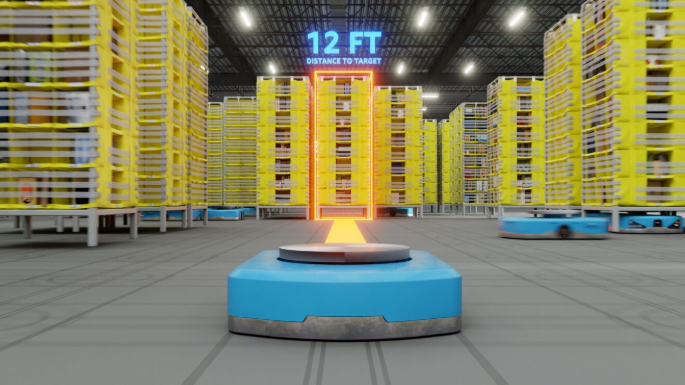
- Predictive traffic control: Built on Amazon SageMaker and trained on millions of hours of operational robot data, DeepFleet goes beyond conventional routing algorithms. Instead of merely avoiding current obstacles, it simulates traffic flow across fulfillment centers and proactively reroutes robots before congestion emerges.
- Graph-floor modeling: Amazon also introduced a technique called Graph-floor, which converts complex 2D grid maps into 1D vectors, enabling transformer models to learn spatial and temporal patterns at the same time. The result is roughly a 10% gain in movement efficiency, which translates into billions of dollars in annual savings at Amazon’s scale.
2.2 A Blunt Statement About the Future of Work
At Web Summit in November 2025, Amazon Robotics CTO Tye Brady put it plainly: he wants to eliminate “every menial, mundane and repetitive job out there.”
That statement landed in a broader context. In the second half of 2025, Amazon cut 14,000 management roles, reinforcing the idea that AI and robotics are no longer confined to replacing simple physical labor. They are beginning to reshape middle-management functions as well. Amazon’s fulfillment centers are no longer spaces where robots assist people. They are increasingly becoming spaces where robots do the work and people supervise the system.
3. The Third Force and the Geopolitical Challenge: Skild AI and China’s Rise
The second half of 2025 was shaped not only by U.S. big tech, but also by new challengers and geopolitical competitors capable of reshaping the field.
3.1 Skild AI: A General-Purpose Brain for Robots
Pittsburgh-based startup Skild AI emerged as one of the most closely watched players in robotics in late 2025. Its vision is ambitious: build an omni-bodied brain, a general-purpose robot intelligence layer that is not tied to any single hardware form factor.
- Omni-bodied model: Skild AI’s model can be applied across different robot types, whether single-arm or dual-arm, wheeled or legged. With only a few hours of new data collection, it can adapt to unfamiliar hardware and achieve 60% to 80% task performance.
- A cost revolution: The broader implication is economic. If this software layer works as intended, relatively inexpensive hardware priced in the $4,000 to $15,000 range could begin to deliver performance closer to robots that cost $250,000. The market is clearly paying attention. Reports that SoftBank is investing $500 million, pushing the company toward a $4 billion valuation, reflect growing conviction in a software-centric robotics ecosystem.
3.2 China Striking Back
While the U.S. has focused on technical sophistication, China is advancing with overwhelming speed in deployment.
- UBTech and the Zeekr factory: Chinese robotics company UBTech has deployed humanoid robots inside Zeekr’s EV manufacturing facilities. These robots use reasoning models based on DeepSeek R1 and operate around the clock, handling assembly, parts transport, and quality inspection.
- Walker S2 and self-swapping batteries: UBTech’s Walker S2 can replace its own battery without human intervention, allowing it to continue operating with minimal downtime. This directly supports China’s push toward fully unmanned “dark factories,” where automation is so complete that lighting for human workers is no longer required.
- Geopolitical implications: The U.S. still leads in AI infrastructure and foundational models, with NVIDIA at the center of that advantage. But China is emerging as a serious competitor in real-world manufacturing data collection and large-scale hardware deployment. The U.S.-China technology race is now expanding beyond semiconductors into robot data and physical infrastructure.
4. Conclusion: The Beginning of Re-Industrialization
Taken together, the developments of late 2025 show that U.S. big tech is using Physical AI to fundamentally reshape industrial systems. This is not just another AI product cycle. It is part of a broader re-industrialization effort aimed at rebuilding American manufacturing strength through intelligence embedded in physical operations.
2026 Outlook: The First Year of Large-Scale Deployment
- Infrastructure is in place: NVIDIA’s Cosmos and Omniverse Blueprint have begun to establish the roads, rules, and control systems of the Physical AI era.
- Intelligence is becoming generalizable: Google’s Gemini 3 and Skild AI’s general-purpose robotics brain are expanding robots’ ability to understand, adapt, and operate across increasingly complex environments.
- The labor market is being redefined: Amazon’s million-robot fleet and the growing deployment of humanoids are changing the meaning of work itself. The decline of some blue-collar roles, and the rise of new jobs centered on AI operations and system oversight, now look less like a possibility and more like an inevitability.
2026 is likely to be remembered as the year these technologies moved beyond prototypes and into large-scale deployment across factories and homes. Big tech competition is no longer confined to cloud infrastructure and digital interfaces. It is now expanding into the physical world we inhabit every day. The winners will not be the companies that merely build smarter AI. They will be the ones who can apply it to the physical world more safely, more efficiently, and at a real economic scale.
Related Posts
Insight
Why Doesn’t Robot AI Have an ImageNet? A Test You Can’t Grade with a Single Answer Key
Hyun Kim
Co-Founder & CEO | 10 min read
Insight
Robot Training Data Sourcing Guide: 4 Options and How to Choose a Training Data Provider
Hyun Kim
Co-Founder & CEO | 7 min read
Insight
Vision AI PoC Design Guide: Timeline, Data, and Success Criteria
Hyun Kim
Co-Founder & CEO | 7 min read

About Superb AI
Superb AI is an enterprise-level training data platform that is reinventing the way ML teams manage and deliver training data within organizations. Launched in 2018, the Superb AI Suite provides a unique blend of automation, collaboration and plug-and-play modularity, helping teams drastically reduce the time it takes to prepare high quality training datasets. If you want to experience the transformation, sign up for free today.