Insight
⑪ Germany's Physical AI Moment: Siemens, BMW, and the Robot Unicorn Counteroffensive

Hyun Kim
Co-Founder & CEO | 2026/04/14 | 15 min read
![[Physical AI Series 11] A Look into Germany’s Physical AI: Siemens, BMW, and Robot Unicorns](https://cdn.sanity.io/images/31qskqlc/production/d08fa2b7c77d7e76e459eb1697aed081a1297d1c-2000x1125.png?fit=max&auto=format)
Once celebrated as "the engine of Europe" and the global benchmark for precision engineering, Germany's industrial landscape is under siege. A rapidly aging workforce, energy costs inflated by geopolitical upheaval, and fierce competitive pressure from the US and China in digital innovation are shaking the foundations of German manufacturing. Productivity has barely budged in 15 years, and export share in autos and machinery continues to erode.
Industry experts are sounding a stark alarm: Germany has roughly 24 months to get this right. Miss that window, and the risk is permanent — handing industrial leadership to nations that successfully navigate next-generation factory digitalization first.
Our last post covered the Big Tech-led Physical AI race in the US. This time, we're diving into how Germany's industrial establishment is putting Physical AI to work on the factory floor.
1. Why Germany Is Going All-In on Physical AI
For the better part of a decade, "Industrie 4.0" was the north star of German manufacturing policy — focused on IoT connectivity, mass data collection, and cyber-physical systems (CPS). But there's a critical distinction: Industrie 4.0 was about monitoring processes and digitizing data. Physical AI means digitizing action itself and moving toward autonomous execution.
As of 2025, three technology shifts are driving Physical AI's rapid rise in Germany:
- Foundation models for robotics: Vision-Language-Action (VLA) models are rewriting the rules of robot control. The "brains" built by organizations like Google DeepMind enable robots to perform generalist tasks rather than being locked to a single programmed operation.
- Simulation & digital twins: Hyperrealistic virtual environments like NVIDIA Omniverse let robots accumulate millions of trial-and-error cycles in seconds — dramatically compressing the training timeline.
- High-performance edge computing: Next-gen edge chips capable of running complex AI models onboard — without cloud dependency — are critical to meeting Germany's stringent industrial safety standards around low latency and data security.
Germany's Physical AI push isn't driven by technological curiosity — it's an economic survival instinct. The WEF's Future of Jobs 2025 report warns of robots displacing workers, but Germany's reality is the inverse: robots aren't replacing jobs that exist, they're filling positions that can't be staffed due to demographic decline. To keep manufacturing onshore, Germany must dramatically raise the ratio of robots to humans.
Meanwhile, China's "Made in China 2025" strategy is maturing and directly threatening Germany's core competitive domains — automotive and mechanical engineering. Germany's strategic response is to deploy its most defensible asset: tacit knowledge. Decades of accumulated process expertise, encoded into Physical AI agents, transform the factory from a site of simple automation into what might be called a "skilled craftsman machine."
2. Automotive's Humanoid Race
The automotive sector — Germany's economic heartbeat — is under simultaneous pressure from the shift to electrification, collapsing ICE demand, and aggressive European expansion by Chinese EV makers like BYD and XPeng. German automakers are pushing Physical AI to drive efficiency gains and the operational flexibility needed to weather market volatility.
2.1 Mercedes-Benz: The Berlin-Marienfelde Digital Experiment
Mercedes-Benz has transformed its Berlin-Marienfelde plant — formerly a major internal combustion engine production site — into the "Mercedes-Benz Digital Factory Campus (MBDFC)," a living laboratory for next-generation manufacturing technology.
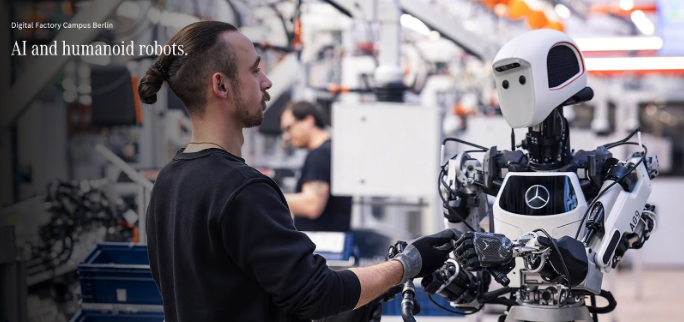
The company has also partnered with Texas-based robotics firm Apptronik to pilot the humanoid robot Apollo on the production line. Apollo handles intra-facility logistics — moving assembly kit boxes and inspecting components — integrated directly into Mercedes' MO360 digital production ecosystem. In the initial phase, skilled operators use teleoperation to teach Apollo tasks; that data then trains the AI models that will eventually drive full autonomy. Skilled human workers are freed to focus exclusively on high-precision assembly tasks.
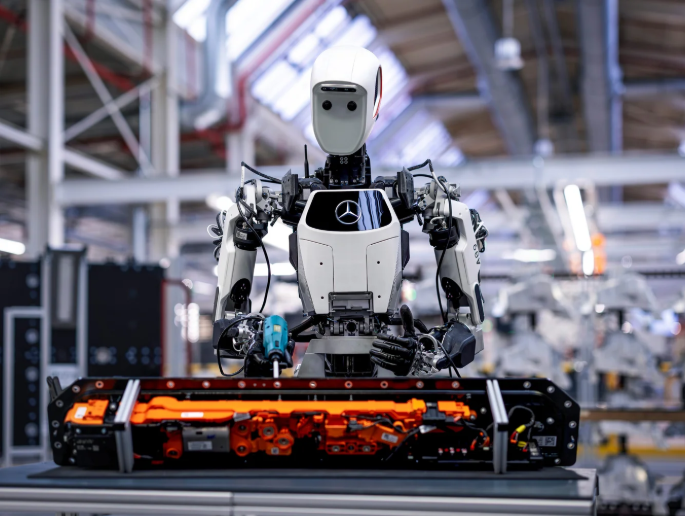
The humanoid form factor delivers a major CAPEX advantage: brownfield factories don't need to be retooled. Narrow aisles, staircases, workbenches built for human ergonomics — existing infrastructure works as-is.
2.2 BMW: Figure 02 and the iFACTORY
BMW Group has long operated under its Lean, Green, Digital iFACTORY strategy — and in 2025, it's hitting the accelerator on the "Digital" pillar through Physical AI. Buoyed by successful tests at its Spartanburg, US plant, BMW is moving quickly to roll out humanoids across its German facilities.
- Figure 02 deployment: Figure AI's latest model — 3x more powerful than its predecessor — has been piloted in body assembly, with the ability to understand and respond to natural voice commands in real time.
- Smart Robotics Platform: To avoid vendor lock-in, BMW is building a proprietary robot operating platform where any robot, from any manufacturer, can plug into the iFACTORY production system and begin operating immediately.

3. Siemens: The Brain of Industrial AI Agent
If BMW and Mercedes own the hardware story, Siemens owns the software. In 2025, Siemens declared it is moving beyond "copilot" AI into the era of agentic AI.
3.1 From "AI That Tells You" to "AI That Acts"
- Autonomous problem-solving: Where previous AI systems answered questions, Siemens' industrial AI agents identify and resolve problems on their own. If a production line's efficiency drops, the agent adjusts equipment parameters or reroutes logistics autonomously — no human prompt required.
- Up to 50% productivity gains: Siemens projects productivity improvements of up to 50% for customers deploying this technology. At the SPS trade show in Nuremberg in November 2025, the company unveiled "Engineering Copilot TIA," capable of autonomously handling entire engineering workflows end-to-end.
3.2 The Industrial Metaverse
In partnership with NVIDIA, Siemens has replicated entire factories in virtual space. Robots undergo millions of training iterations inside this "industrial metaverse" before ever touching the real factory floor. Siemens provides the factory digital twin; NVIDIA brings the physics engine and AI training environment (Isaac Sim).
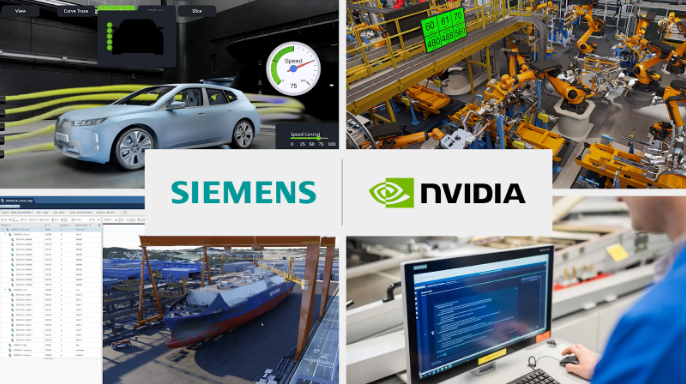
Source: NVIDIA
4. Germany's Robot Unicorns and the Big Deals
In the second half of 2025, a wave of landmark M&A and partnership deals reshaped Germany's robotics landscape.
4.1 Agile Robots: Swallowing Industrial Giants
Munich-based unicorn Agile Robots made two aggressive acquisitions that catapulted it into full-stack robotics in a single leap.
- Acquisition of thyssenkrupp Automation Engineering (November 2025): By acquiring the automation division of German industrial giant thyssenkrupp, Agile Robots inherited decades of process know-how and a tier-1 automotive customer network. The plan: graft Agile's AI-powered force/torque sensing technology onto thyssenkrupp's legacy assembly lines, turning rigid automation into "intelligent adaptive systems." The acquired unit will operate under the name Krause Automation within the Agile Robots Group.
- Acquisition of idealworks (September 2025): Agile acquired 100% of idealworks — BMW's logistics robotics subsidiary — adding autonomous mobile robot (AMR) capabilities to its robotic arm expertise. The combination now spans manipulation and mobility.
4.2 Neura Robotics: Thousands of Robots Contracted
Cognitive robotics maker Neura Robotics closed multiple landmark deals in November 2025.
- Schaeffler partnership: German automotive components giant Schaeffler committed to deploying thousands of Neura's humanoid robots by 2035 — in a two-way arrangement where Schaeffler supplies joint actuators and Neura delivers the finished robots. It's a supply chain partnership, not just a procurement deal.
- SAP integration: In a partnership with enterprise ERP giant SAP, Neura's robots are connected directly to SAP's Extended Warehouse Management (EWM) system — effectively making the robots agents of the SAP platform. When supply chain conditions shift, robots autonomously reprioritize physical tasks in real time based on live SAP data.
Physical AI, the German Way
The global Physical AI race is playing out with each nation's strengths and philosophy in sharp contrast.
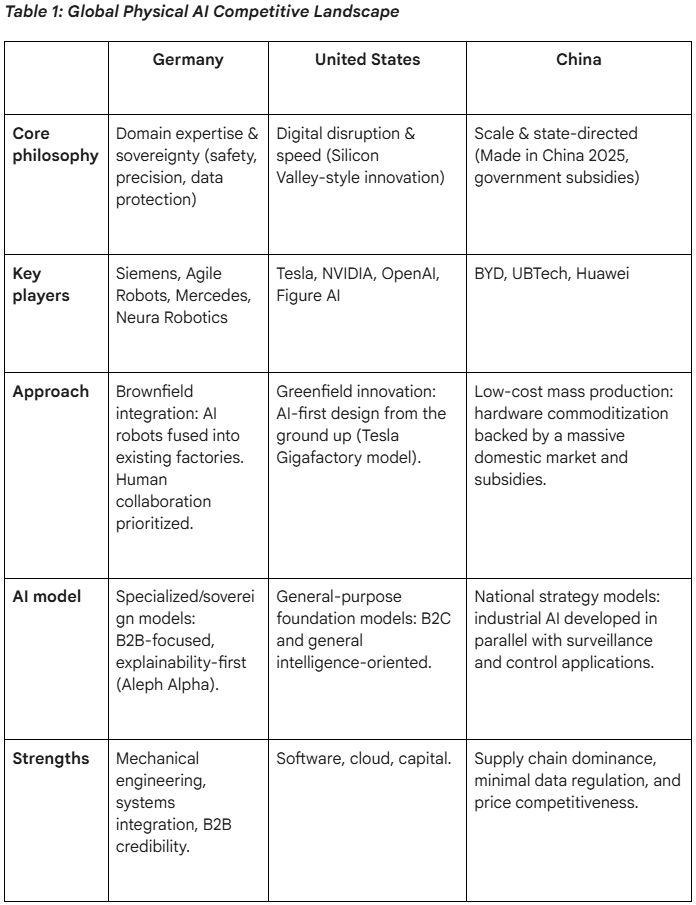
Germany's Physical AI story can be summed up as "awakening under pressure." The shift from spectator to active participant is underway: Siemens is laying down the OS for industrial AI, unicorns like Agile Robots are consolidating the hardware ecosystem, and automakers are deploying cutting-edge robots directly on the factory floor.
Challenges remain real: energy costs are high, regulation is complex, and the talent war is fierce. But Germany is playing to its deepest strengths — the seamless integration of software and hardware, and the delivery of systems that industrial customers can trust.
Beyond 2026, the trajectory points toward a gradual shift from "human-on-the-loop" oversight to "human-out-of-the-loop" full autonomy. The vision of the Autonomous Factory — where an entire plant thinks and moves as a single organism — is being made concrete by companies like Siemens. And in the sight of century-old enterprises (Siemens, Mercedes, Schaeffler) actively embracing startup technology (Agile, Neura), there's every reason to believe Germany's Physical AI transformation is just getting started.
Related Posts
Insight
Why Doesn’t Robot AI Have an ImageNet? A Test You Can’t Grade with a Single Answer Key
Hyun Kim
Co-Founder & CEO | 10 min read
Insight
Robot Training Data Sourcing Guide: 4 Options and How to Choose a Training Data Provider
Hyun Kim
Co-Founder & CEO | 7 min read
Insight
Vision AI PoC Design Guide: Timeline, Data, and Success Criteria
Hyun Kim
Co-Founder & CEO | 7 min read

About Superb AI
Superb AI is an enterprise-level training data platform that is reinventing the way ML teams manage and deliver training data within organizations. Launched in 2018, the Superb AI Suite provides a unique blend of automation, collaboration and plug-and-play modularity, helping teams drastically reduce the time it takes to prepare high quality training datasets. If you want to experience the transformation, sign up for free today.