Tech
Targeted Synthetic Data for Model Failure Cases: From Diagnosis to Retraining

Hyun Kim
Co-Founder & CEO | 2026/11/25 | 7 min read
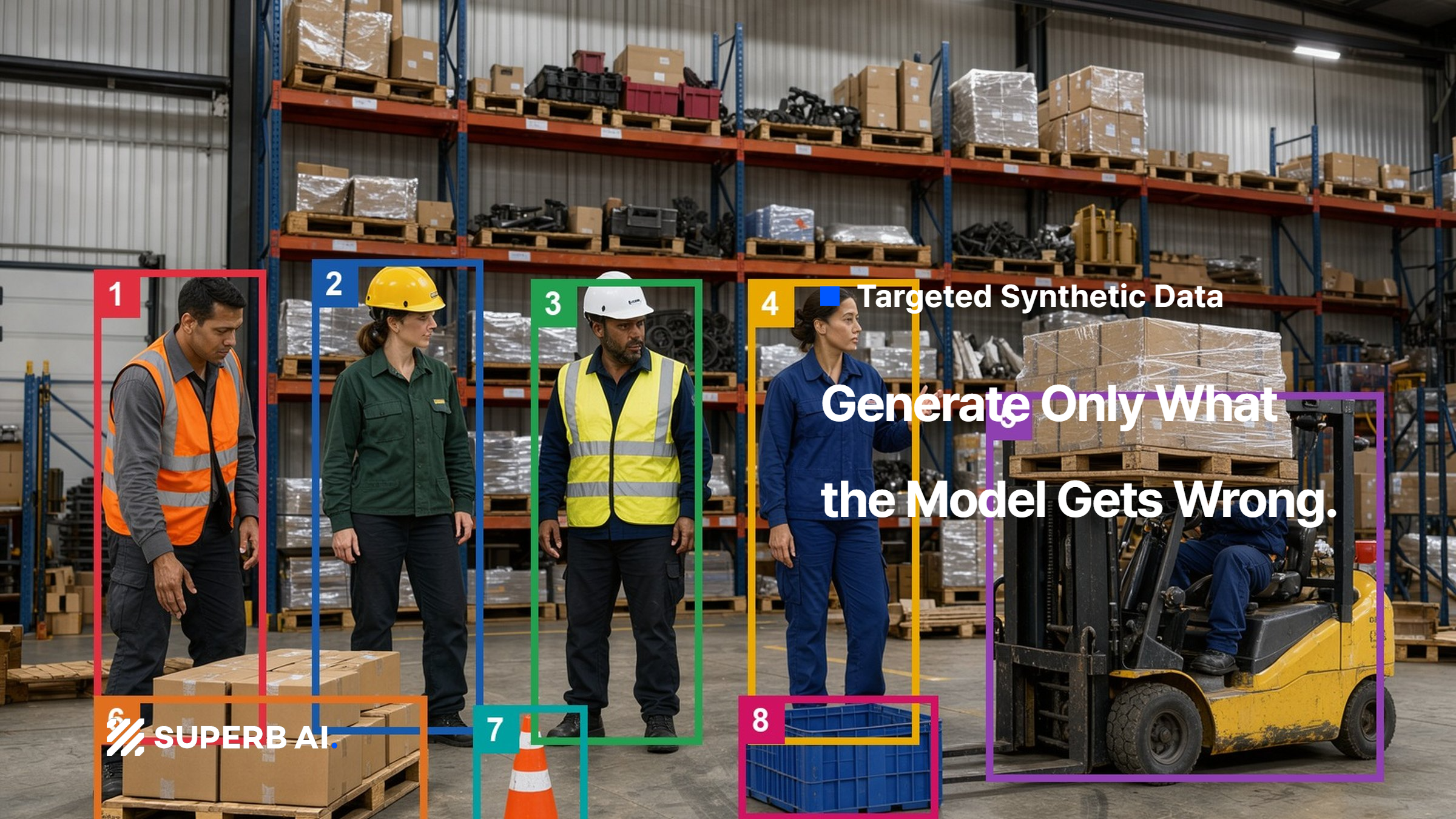
More data is often assumed to lead to better model performance. Once a model reaches a certain level of performance, however, adding more data yields diminishing returns. The model already performs well on common, straightforward cases. Data for difficult and rare cases is hard to collect in real-world environments. Repeating the cycle of data collection, processing, and retraining under these conditions continues to drive up costs with little improvement in performance.
Superb AI's research team reversed the order of this process. The team first identifies the types of cases where a model fails, then generates only the small amounts of synthetic training data needed to address those cases and retrains the model.
Our previous article covered how images and ground truth labels can be generated together in a simulator. The approach introduced here uses generative models to create images and determines what to generate based on the results of model diagnosis.
Read more → Building Superb AI's Synthetic Data Pipeline with NVIDIA Isaac Sim
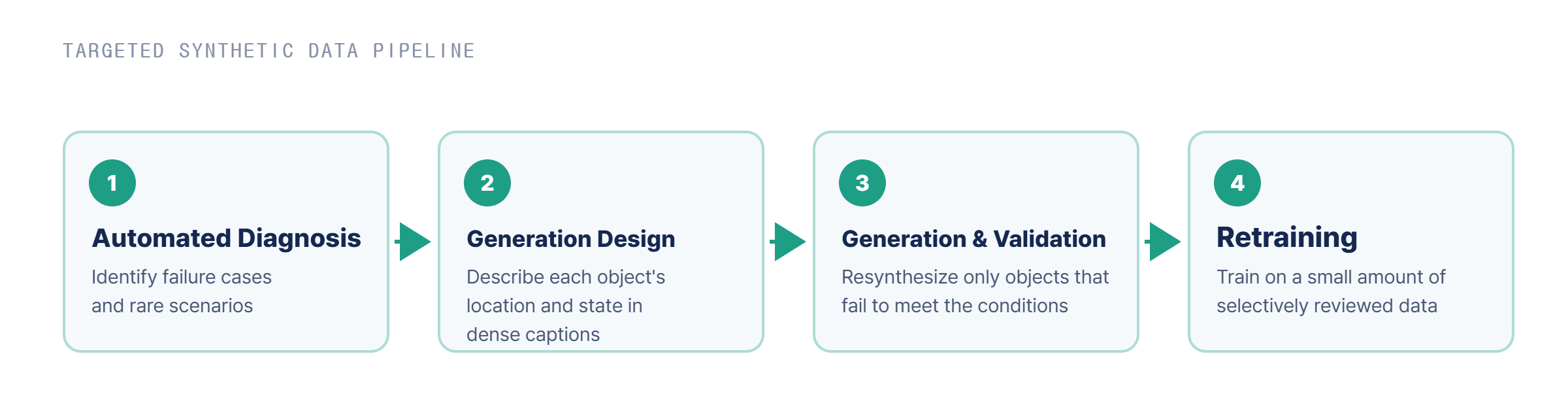
The targeted synthetic data pipeline, from model diagnosis to retraining
Diagnosis: Identifying Model Failure Cases
The system automatically diagnoses the performance of a trained model to identify cases where the model underperforms or training data is scarce. Common cases that the model already handles well are excluded from data generation. The failure cases identified during diagnosis are passed to the next stage as text descriptions and example images.
Design: Defining What to Generate with Dense Captions
Dense captioning is a technique that provides detailed, region-level descriptions of multiple objects in an image, including their locations, states, relationships, and actions. For industrial Vision AI to detect and assess situations such as "a worker without a hard hat is near a forklift," the model needs to learn relationships between objects and the finer details of the scene. Models learn these scenarios from datasets that pair images with dense captions. ZERO, Superb AI's industry-focused Vision Foundation Model, is also trained on dense caption data.
During data generation, dense captions serve as inputs that specify which objects should appear in a scene and how they should be arranged. The agent translates the failure cases identified during diagnosis into detailed scene descriptions that specify the location and state of each object.
Generation and Validation: Object-Level Resynthesis
Images are generated using these descriptions as conditioning inputs. An object detector or a vision-language model (VLM) is then applied to each generated image to verify that the specified objects appear at their intended locations.
If an object does not meet the specified conditions, only the corresponding object region is edited and resynthesized. This reduces generation time and costs. The iterative process of validation via automated labeling followed by object-level resynthesis is protected by registered patents in Korea and Japan (KR 10-2896662 · JP 7876244).
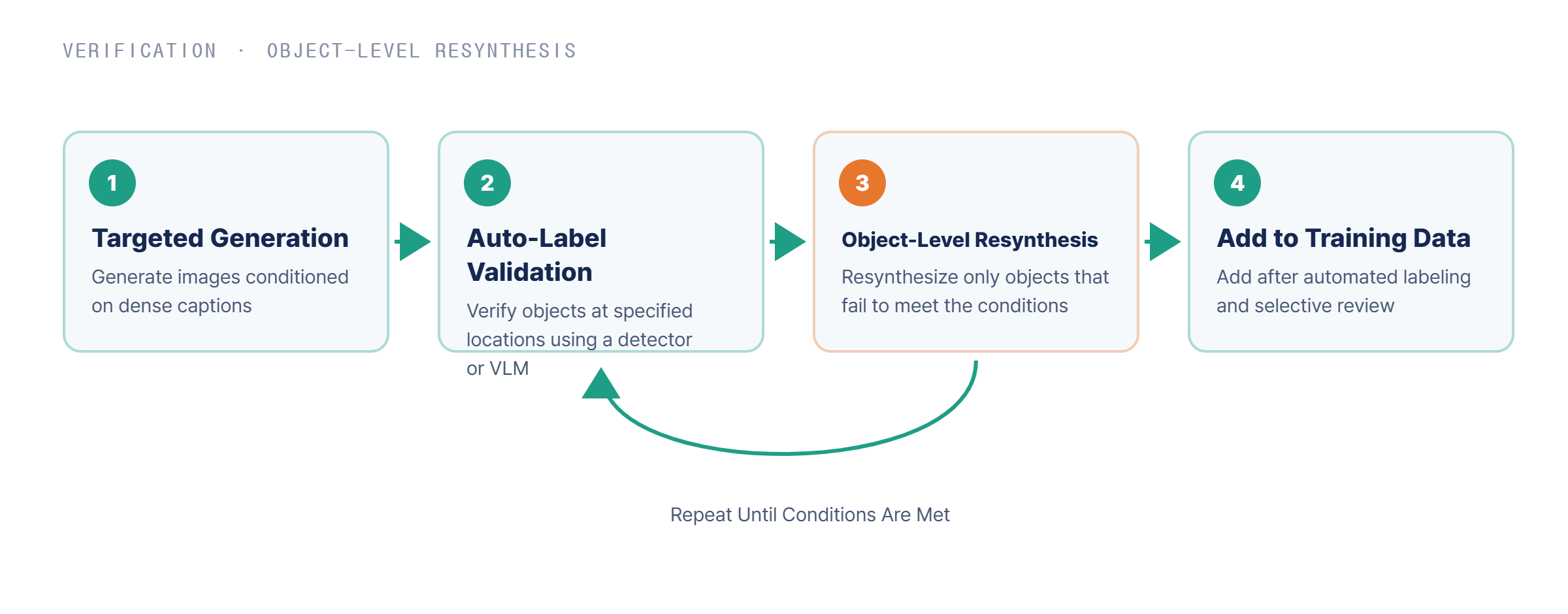
The validation stage, where only objects that fail to meet the specified conditions are resynthesized
Images that pass validation undergo automated labeling and uncertainty-based selective review in Superb Platform before being added to the training dataset. The model is then retrained using this data.
This approach makes it possible to generate specific combinations of scenarios that are rare or too dangerous to capture in real-world environments, such as workers not wearing personal protective equipment (PPE) or equipment defects. By targeting only the cases where the model underperforms, it can also improve model performance with relatively small amounts of additional data.
Generation Example 1: Personal Protective Equipment (PPE) Combinations
In factory and warehouse scenes, the team independently specified whether each worker was wearing a hard hat and a safety vest. In one warehouse scene, four workers were assigned different PPE combinations: wearing only a safety vest, wearing only a hard hat, wearing both, and wearing neither. After generation, each object was checked against its specified location and attributes, and the bounding boxes and class labels that passed validation were used directly as object detection labels.
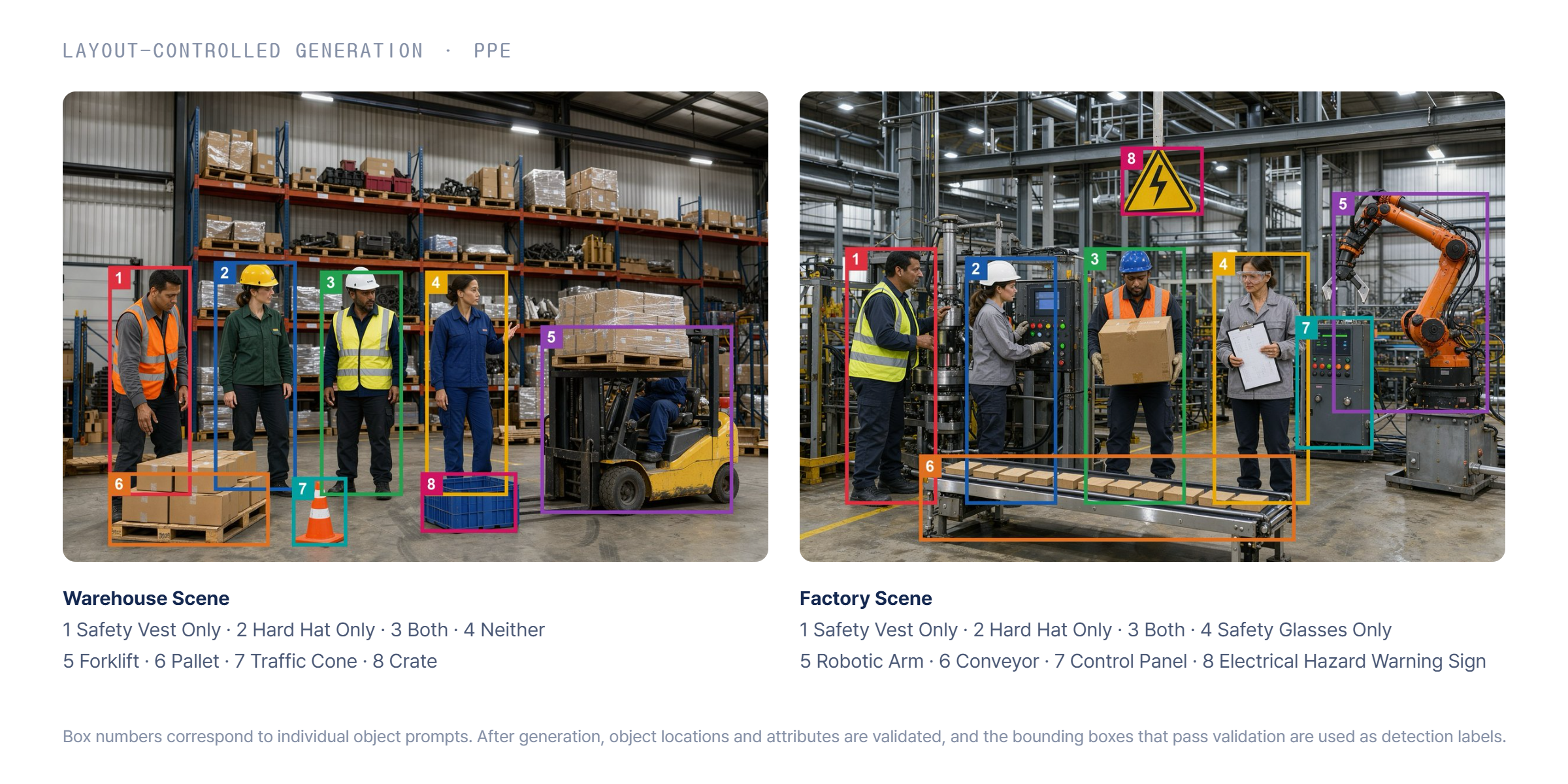
Warehouse and factory scenes generated by specifying individual object locations and PPE status
Generation Example 2: Rail Joint Bar (Fishplate) Defects
General-purpose generative models struggle to accurately depict specialized industrial components. When prompted with only the name of a fishplate, a rail joint bar that connects two sections of rail, the model may generate a grilled fish on a plate or a fish-shaped metal plate. To address this, the team divided the generation process into three steps.
First, the team used domain knowledge to define the component's structure, shape, bolt arrangement, and installation environment, incorporating these details into the generation conditions. A defect-free component was defined as follows:
A rail joint bar: a flat, elongated steel plate about 60-90 cm long, bolted against the side (web) of the rail where two rail ends meet, with 4 or 6 large hex bolts and nuts in a row; dull grey or rusty brown.
Next, the team increased background diversity by changing only the surrounding background while preserving the rail joint bar region in the reference image. Only ground conditions unrelated to the component's structure were varied.
Finally, the team introduced defects, such as missing bolts, into the same component to create datasets containing both normal and defective examples. An agent edits a specific region, and a VLM verifies whether the specified defect has been generated. If validation fails, the system retries the edit or reverts to the original state.
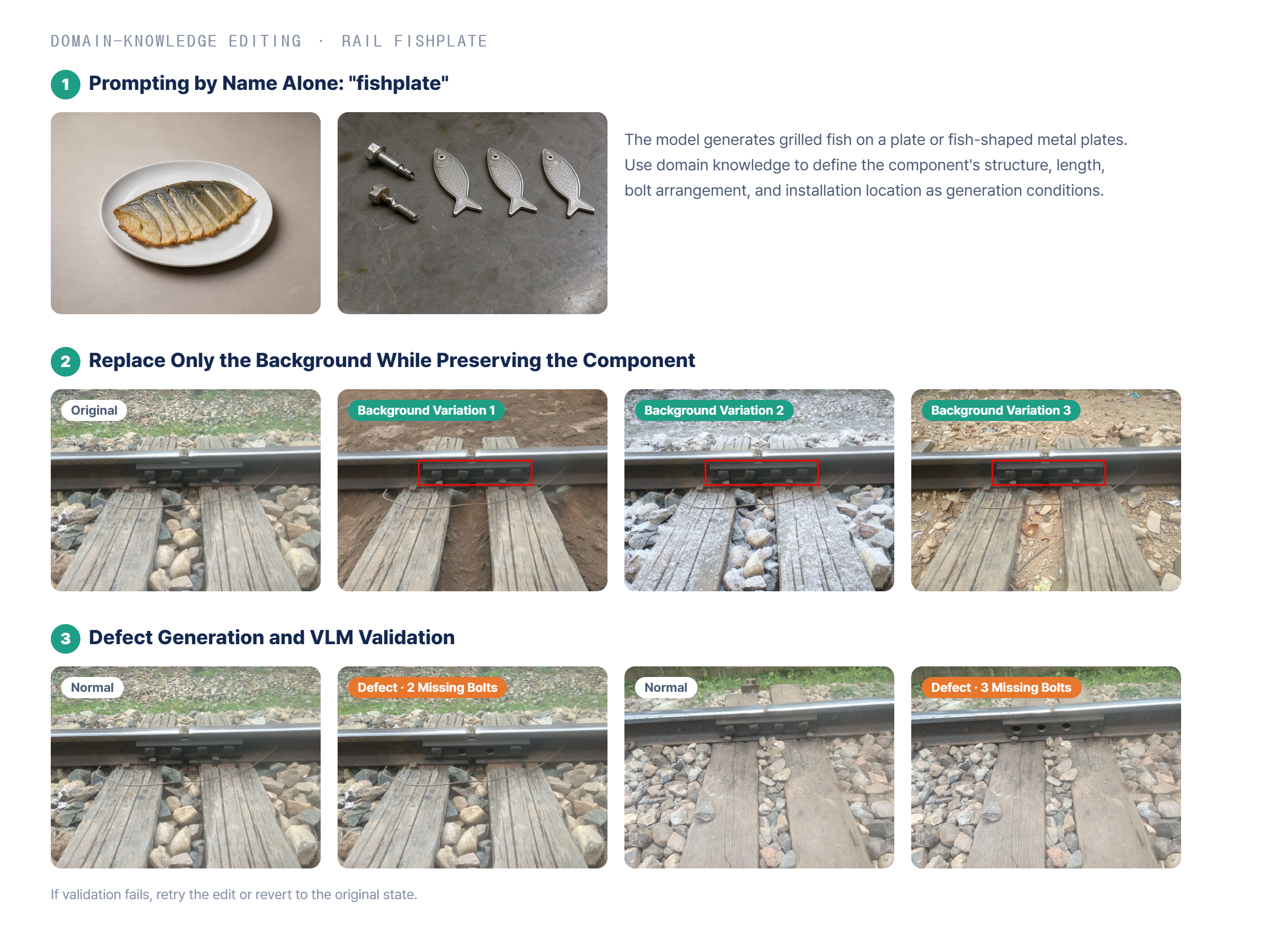
Rail joint bar generation: results from prompting with the component name alone, background replacement, and missing-bolt defect generation. Original image: Roboflow100-VL defect-detection dataset (original source: cse499, CC BY 4.0)
Experimental Results
The approach was evaluated across six industrial datasets against models trained exclusively on real data. Overall performance improved by an average of 4%, while accuracy on out-of-distribution (OOD) scenarios improved by 29%. The researchers suggest that the greater improvement in OOD scenarios is attributable to focusing data generation specifically on model failure cases.
On BDD100K, a public autonomous driving dataset, mAP increased from 38.9 to 42.9, a relative improvement of 10.3%.
Across 50 classes of the public ImageNet-R benchmark, a model was trained exclusively on synthetic data, without any real training images. The model achieved a Top-1 accuracy of 78.4%. This was 40.6 percentage points higher than the accuracy achieved using only 5% of the real training data (37.8%) and approximately 87% of the accuracy achieved using the full real training dataset (90.2%). In 11 of the 50 classes, the model matched or exceeded the accuracy achieved using the full real training dataset.
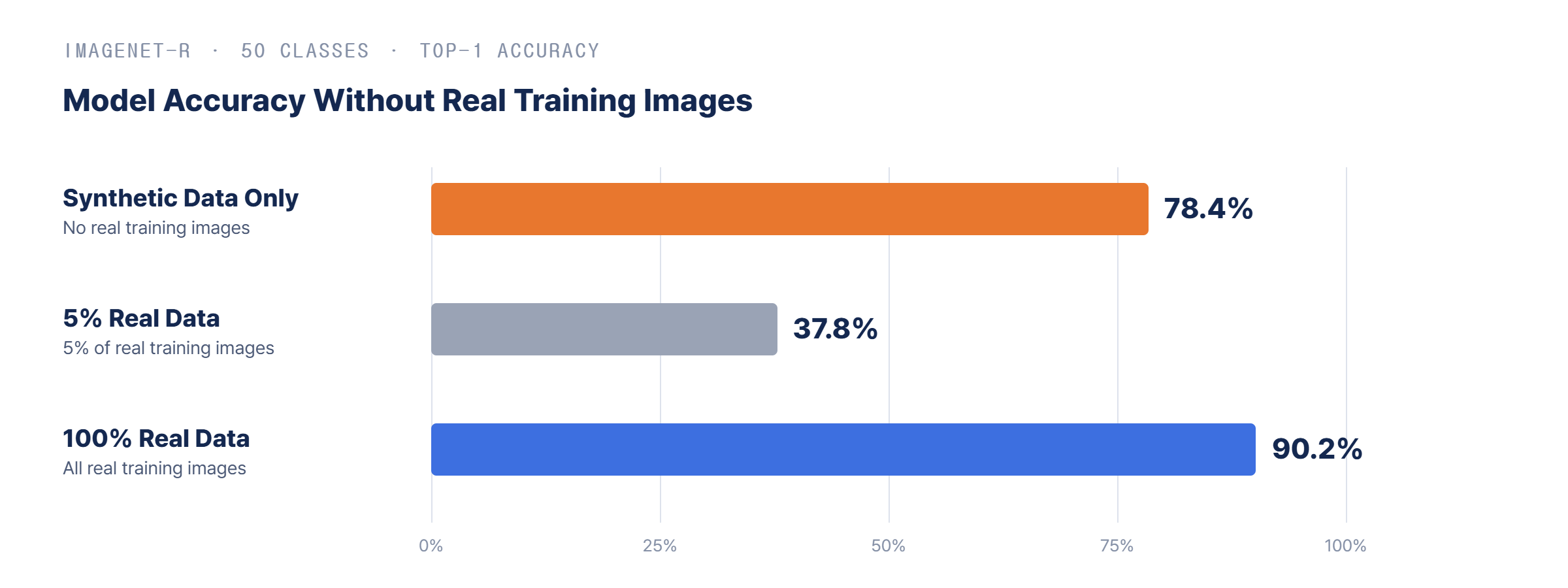
Top-1 accuracy across 50 ImageNet-R classes for a model trained without real training images
💬 Looking to address model failure cases with targeted training data? Tell us about your requirements using the form below. A Superb AI expert will get in touch with you shortly.
Superb AI is a Vision Intelligence company that transforms visual data from industrial sites into intelligence enterprises can act on. The company researches technologies for diagnosing model failure cases and generating training data specifically tailored to those cases.
Related Posts
Tech
How Should Robots Search When Detectors Miss Targets or Produce False Results?
Hyun Kim
Co-Founder & CEO | 15 min read
Tech
Superb AI Wins Silver at the Humanoid Robot Challenge in a Supermarket Environment
Hyun Kim
Co-Founder & CEO | 10 min read
Tech
Three Barriers to Industrial AI and the Role of Vision Foundation Models: NAIRL Seminar Recap
Hyun Kim
Co-Founder & CEO | 32 min read

About Superb AI
Superb AI is an enterprise-level training data platform that is reinventing the way ML teams manage and deliver training data within organizations. Launched in 2018, the Superb AI Suite provides a unique blend of automation, collaboration and plug-and-play modularity, helping teams drastically reduce the time it takes to prepare high quality training datasets. If you want to experience the transformation, sign up for free today.