Tech
How Should Robots Search When Detectors Miss Targets or Produce False Results?

Hyun Kim
Co-Founder & CEO | 2026/11/25 | 15 min read
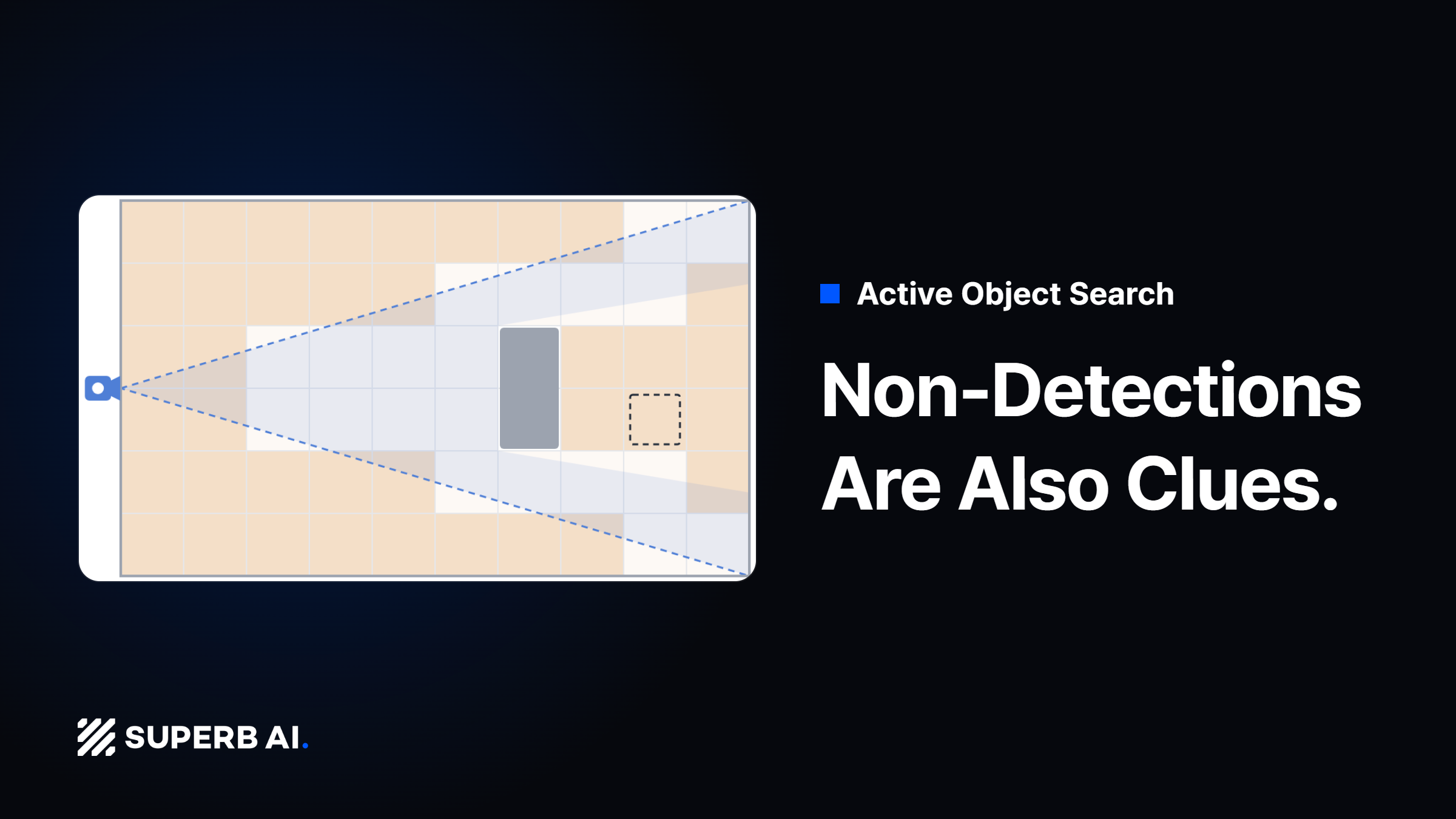
When a robot is asked to bring someone a mug, it first needs to find the mug. If the mug is hidden behind a box on a shelf, the robot must decide where to look next and when it has enough evidence to conclude that it has found the object.
Superb AI's research team proposed Bayesian Active Miss-Aware Object Search (BAMOS), a probabilistic model that estimates the location and size of a target object even when a detector misses it or produces false detections. The team also systematically evaluated, in simulation, which components of a world model are needed to account for this uncertainty when deciding where a robot should search and when it should stop.
The experiments produced four key findings. As observations accumulated, the probability distribution over the target's location became increasingly concentrated around its actual position. Non-detections were as important to search success as detections. Success rates dropped more sharply when detectors falsely identified targets in the wrong locations. As detector errors increased, the target belief and the rules that used it to select the next viewpoint and decide when to stop generally had a greater impact on search performance.
The research was accepted as a paper at the CoRL 2026 "Do Robots Need World Models?" Workshop.
Can We Always Trust a Detector's Results?
Suppose a robot captures an image from a particular viewpoint, but the detector fails to find the target. There are three possible explanations.
The target may be occluded by another object. It may be outside the camera's field of view. Or it may be visible in the image but missed by the detector.
Open-vocabulary detectors, which let users specify targets through text, frequently miss objects even when they are visible. These errors are called false negatives. They can also report a target where none exists, producing false positives. A single detection therefore does not necessarily establish the target's location.
In robotics research, a world model typically refers to a model that reconstructs a scene or predicts future observations. This study defines the prediction needed for object search more narrowly: What is the probability that a target will be detected from a given viewpoint, accounting for the detector's error rates?
Search methods that maintain probability distributions over target locations already exist. What this research adds is a method for fitting detector error rates from data and a controlled ablation study that removes individual components to compare their contributions under identical conditions.
BAMOS: A Probabilistic Model That Predicts Detection Probability by Viewpoint
BAMOS (Bayesian Active Miss-Aware Object Search) is a probabilistic model that estimates a target object's location in space using object detection results from image frames collected by a robot as its camera moves through the environment. Without training a separate neural network, BAMOS periodically updates two probabilistic representations:
- Target Belief: A probability distribution representing where the center of the target object is likely to be located in space and how large the object is likely to be.
- Occupancy Belief: A probabilistic map that divides space into small voxels, or three-dimensional pixels, and represents the probability that each voxel is occupied.
This allows the model to estimate whether the target object might be occluded by another object from a particular viewpoint. The observation model calculates the probability of detecting the target from a given viewpoint for each hypothesis about the target's location and size. It accounts for the probability of occlusion derived from the occupancy belief, the target's apparent size in the image, how much of it falls near the image boundaries, and the detector's error rates. Six detector constants and three occupancy map constants are fitted using calibration frames.
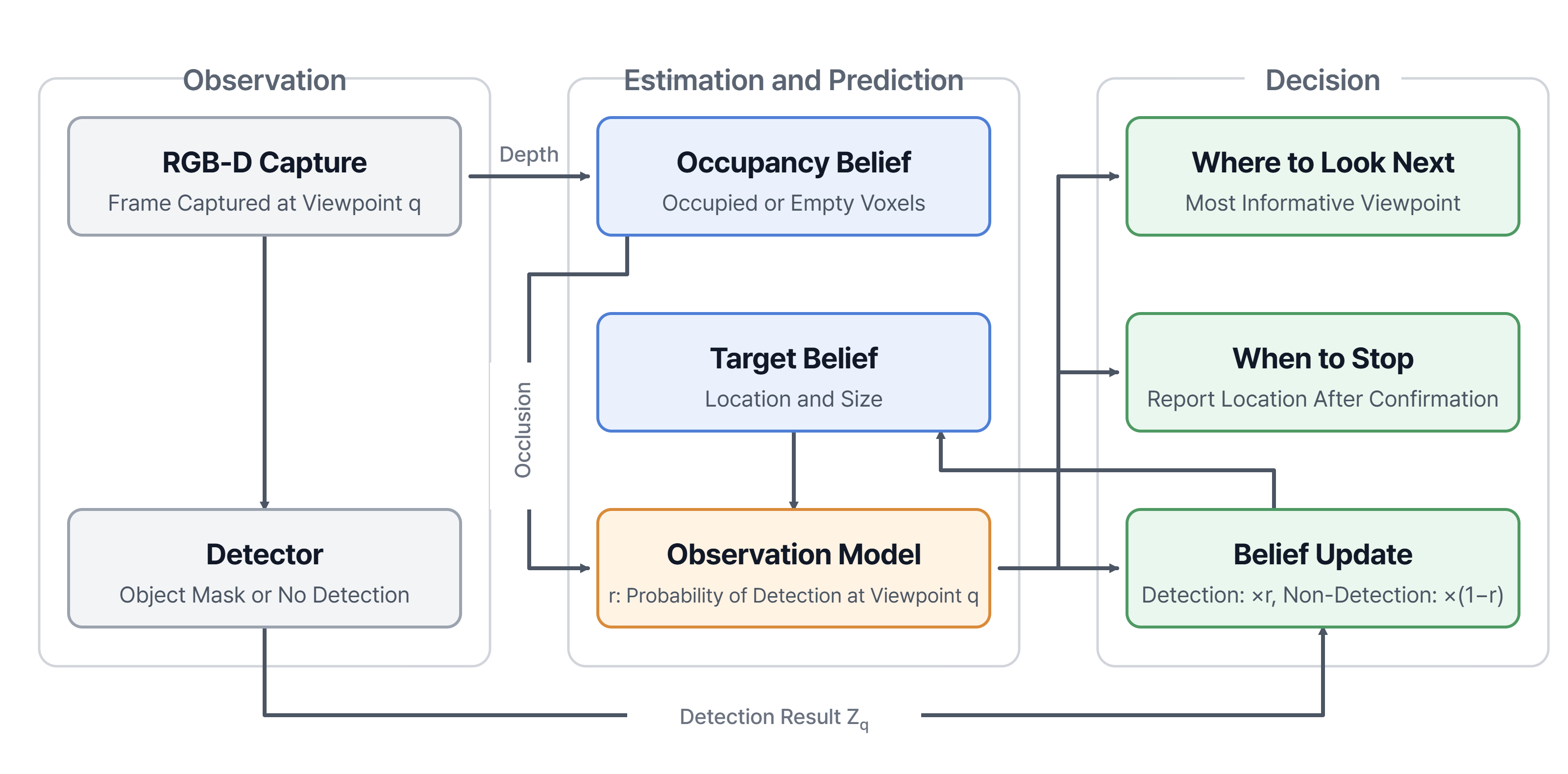
Figure 1 from the paper, redrawn to illustrate the sequence BAMOS follows after each camera observation. Source: Go, CoRL 2026 Workshop
How Does the Robot Choose Its Next Viewpoint and Decide When to Stop?
The robot selects the next viewpoint based on maximum information gain, choosing the location expected to reduce uncertainty about the target's position the most.
Images in which the target is not detected are also used to update the target belief. If the target is not detected from a viewpoint where it should have been clearly visible, the probability assigned to that location decreases substantially.
If the target was occluded or outside the camera's field of view, the observation provides little information, so the corresponding probability remains largely unchanged. Because the probabilities must always sum to one, accumulating non-detections shifts more probability toward locations that have not yet been adequately observed.
As the robot repeatedly captures images and updates the target belief, the probability assigned to a particular location may eventually exceed 0.5. When this happens, the robot moves to the viewpoint offering the clearest view of that location and captures another image for confirmation.
If the target is detected again and the probability that it lies within the accepted distance from the proposed location, called the success radius, is at least 0.5, the robot reports that location as its answer and ends the search. If confirmation fails, the robot removes that location from consideration as an answer candidate and selects another viewpoint.
Experimental Environments: Isaac Sim Warehouse and HSSD Houses
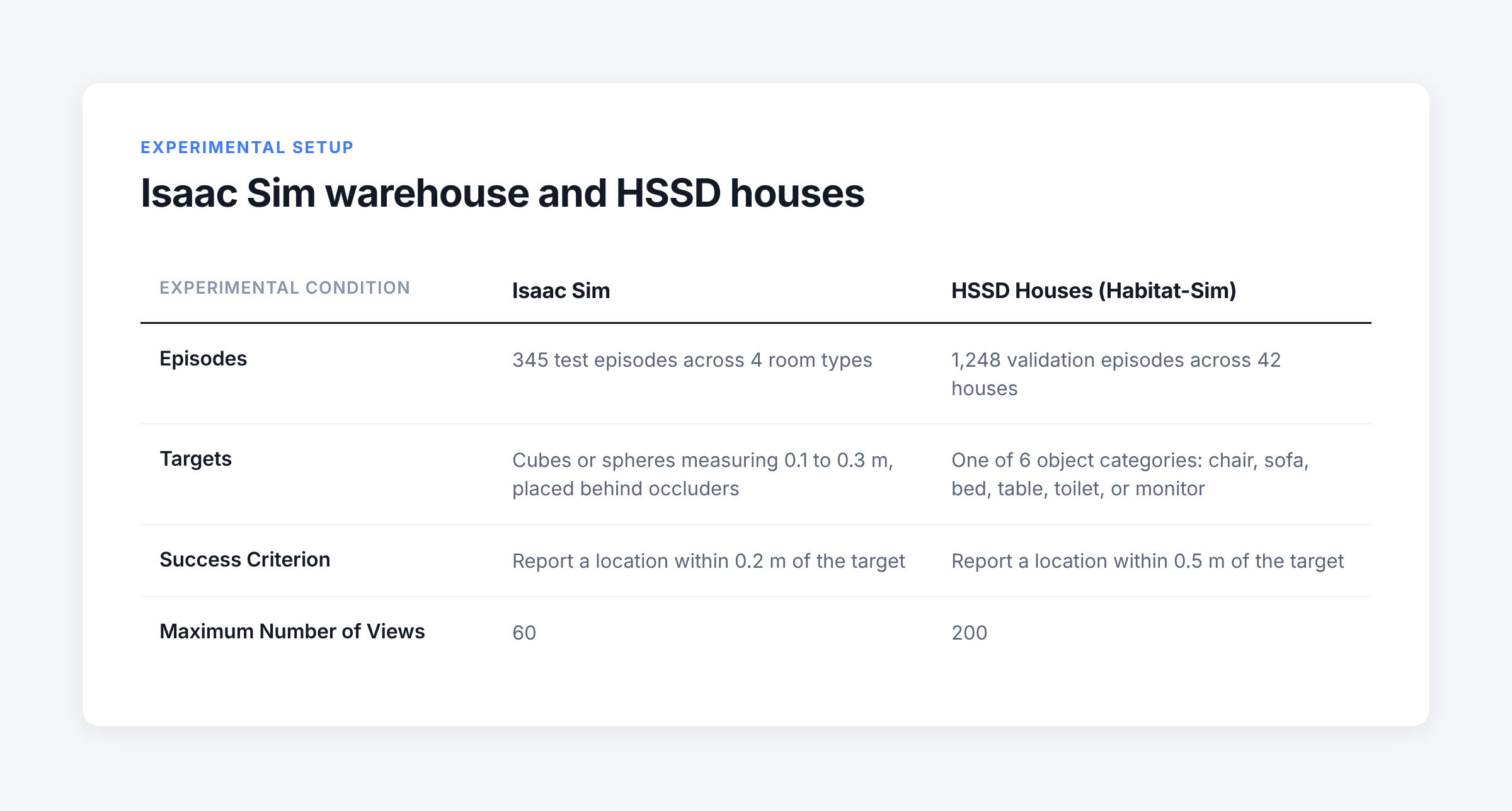
The experiments compared three detectors.
The first was an oracle detector, used as a reference. It detects a target without missing it whenever the target is visible above a specified size threshold.
The other two detectors were SAM 3 and Falcon-Perception. Both are open-vocabulary detectors that identify objects based on text descriptions of the target.
Compared with the oracle, however, Falcon-Perception produced more false positives, incorrectly identifying targets in locations where they were absent. SAM 3 produced more false negatives, missing targets that were visible in the image.
The evaluation metric was success rate. Across repeated search episodes, the study measured the percentage of episodes in which the robot found the target within the maximum allowed number of views. A search counted as successful only if the target was located within the specified success radius of the position reported by the robot.
How Does the Target Belief Narrow as Observations Accumulate?
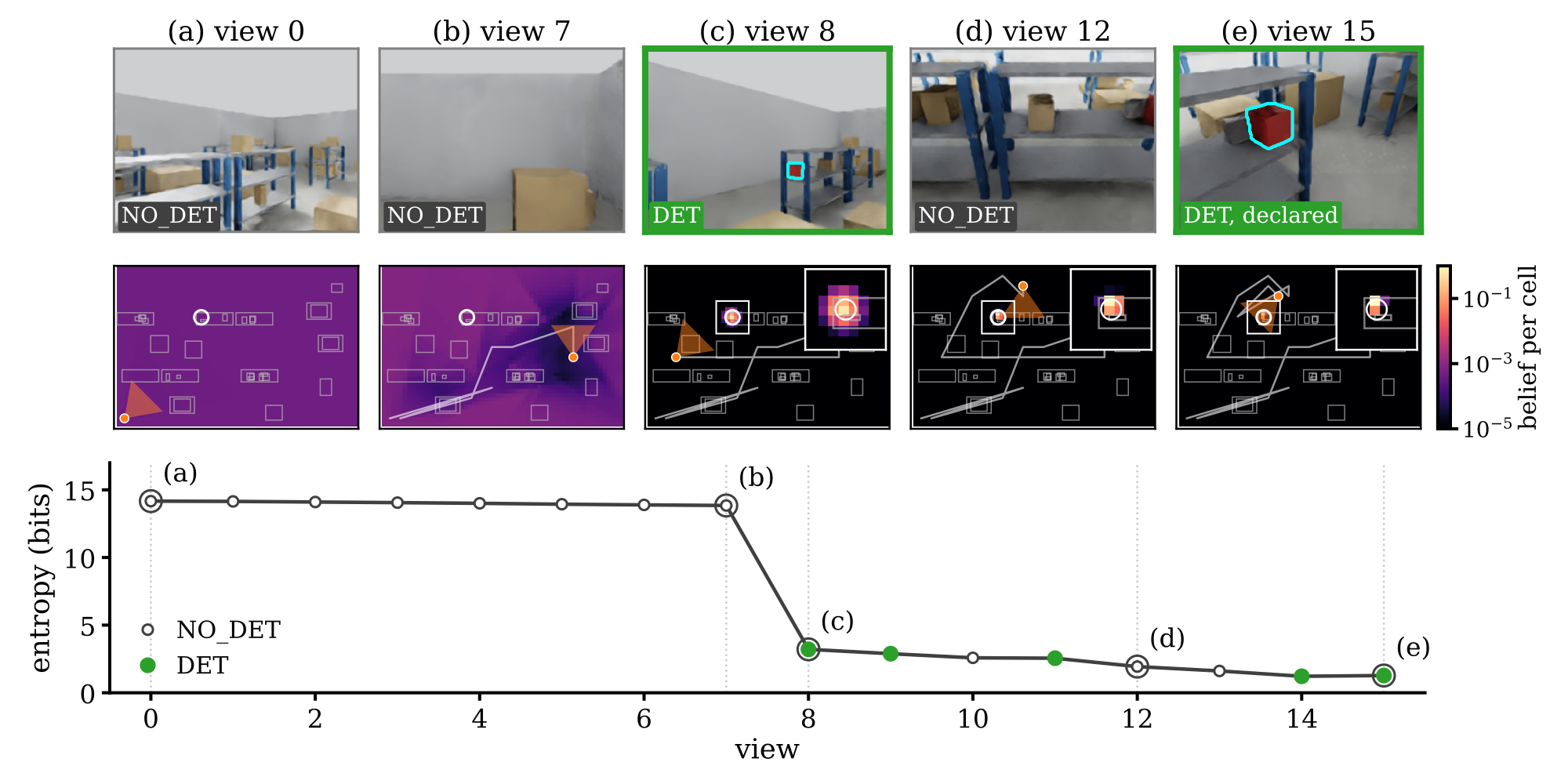
An episode in which SAM 3 searches for a cube on a warehouse shelf in Isaac Sim. The top row shows frames captured at five views, the middle row shows the target belief from above, and the bottom graph shows entropy across observations. Source: Go, CoRL 2026 Workshop
Figure 3 follows one search episode from beginning to end. The robot searches for a cube measuring 30 cm on each side, placed on a shelf in a simulated Isaac Sim warehouse, using SAM 3 as its detector. The graph uses entropy to indicate how widely the probability distribution over the target's possible location is spread. Lower entropy means that probability is more concentrated in a particular area.
Because the warehouse is large, the target is not detected in frames captured at the first seven views. During this period, entropy decreases only slightly, from 14.2 bits to 13.8 bits. The first detection occurs at View 8, as labeled in the figure. As the probability concentrates around the region identified by SAM 3, entropy drops sharply to 3.2 bits. Subsequent views narrow the probable target location further.
At View 12, the target is partially cut off by the edge of the frame, causing SAM 3 to miss it. At View 14, the target is detected again, and the probability assigned to one location exceeds 0.5. The robot then captures a confirmation frame at View 15. The target is detected in that frame as well. The robot reports a location 0.19 m from the target's center and ends the search.
Do Non-Detections Affect Search Success Rate?
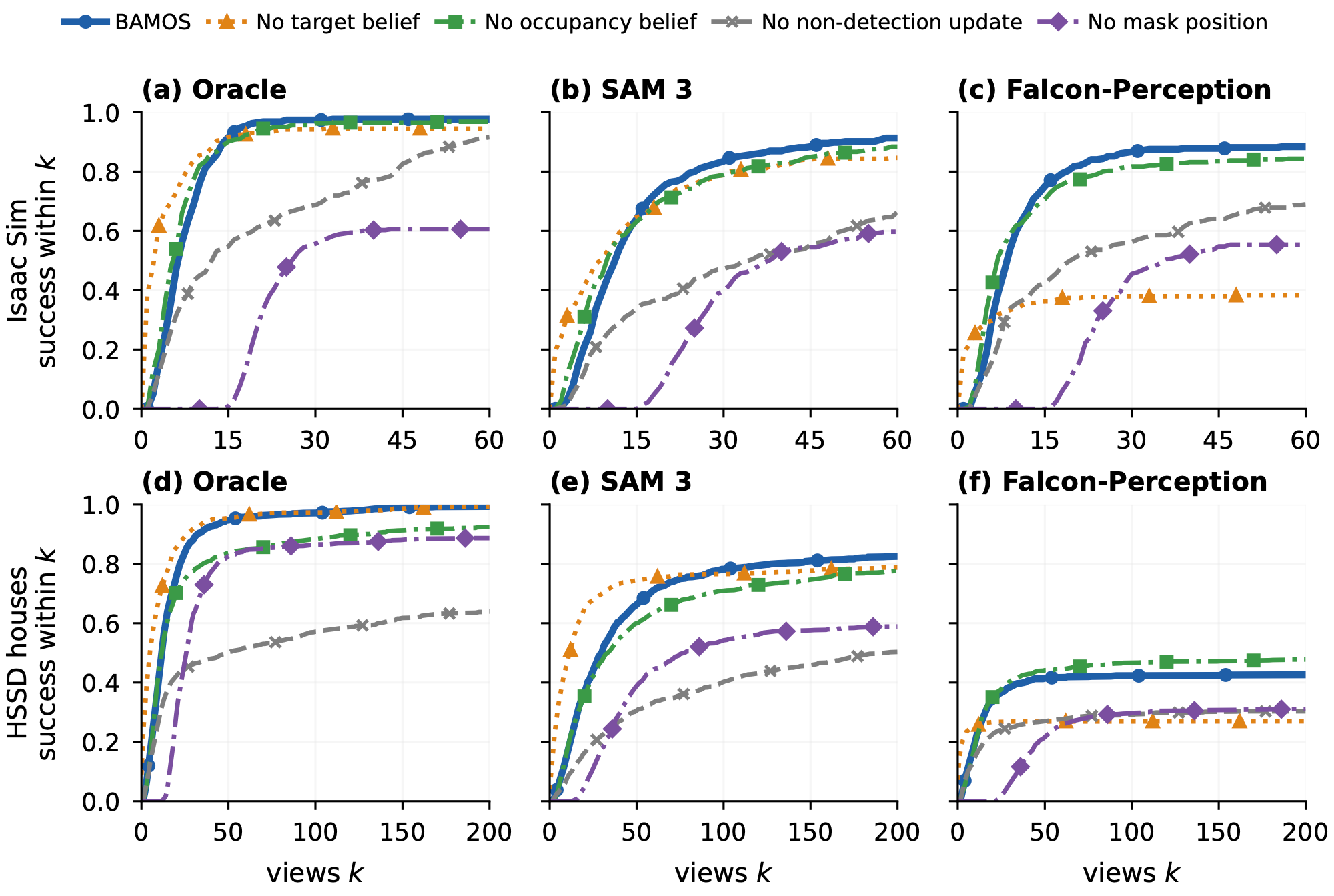
uccess rate versus number of views. Isaac Sim results are shown in the top row and HSSD house results in the bottom row, with columns corresponding to different detectors. Blue: full BAMOS. Orange: without target belief. Green: without occupancy belief. Gray: without non-detection updates. Purple: without mask position information. Source: Go, CoRL 2026 Workshop
Figure 2 shows how the success rate changes when individual components are removed from BAMOS.
Each curve represents how the success rate increases as the robot captures more views. The blue curve represents the full BAMOS method. The gray curve represents a variant that does not use non-detections to update the target belief. The purple curve represents a variant that ignores where a detected target appears within the image.
Both variants achieved lower success rates than the full BAMOS method across all six experimental configurations. When non-detection updates were removed, the success rate with SAM 3 in Isaac Sim fell from 91.3% to 66.4%.
In HSSD houses, the success rate fell from 99.4% to 63.9% even when using the oracle detector. When mask position information was excluded, a detection increased the probability of all visible locations rather than concentrating it around the detected region. As a result, the robot was more likely to report an incorrect location where the target was not present. With the oracle detector in Isaac Sim, the success rate dropped from 97.7% to 60.6%.
Which Is More Damaging: False Negatives or False Positives?
To evaluate how well BAMOS handles different types of detector errors, the researchers deliberately introduced errors into the oracle detector. For each image, the detector was configured to either miss the target with a specified probability, producing a false negative, or incorrectly report a target at another location, producing a false positive.
After introducing these errors, the researchers refitted the six detector constants and three occupancy map constants.
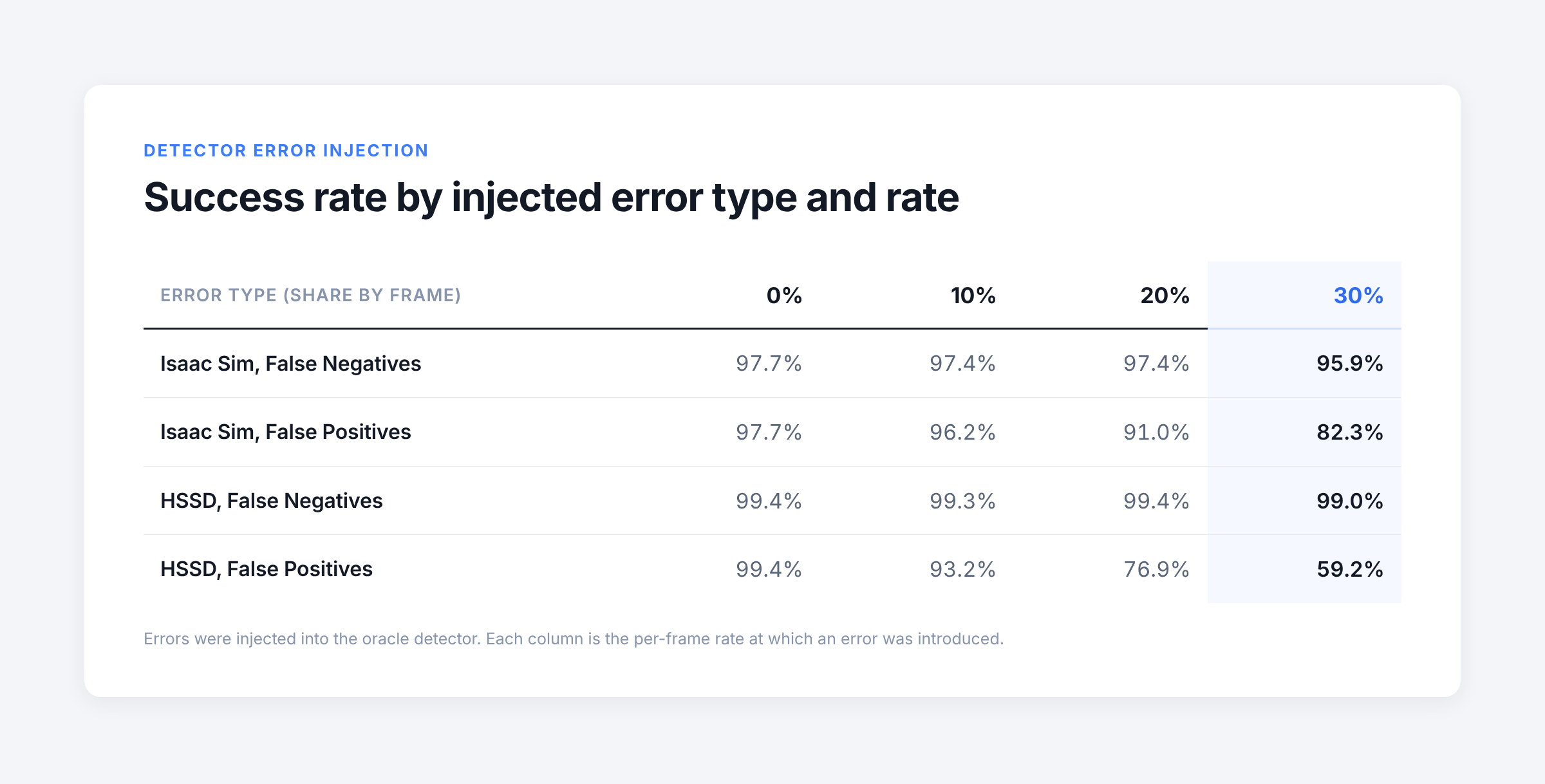
The two error types produced substantially different outcomes. Even with a 30% false negative rate, the success rate decreased by no more than 1.8 percentage points. False positives had a much greater impact, reducing the success rate by as much as 15.4 percentage points in Isaac Sim and 40.2 percentage points in HSSD.
The paper offers a possible explanation.
Many of the injected false positives occurred on other objects that were actually present in the environment. As a result, the detector could identify those same objects as the target again during confirmation. The researchers suggest that more accurate detectors or stricter confirmation rules could help reduce this problem.
The paper also found that as detector errors became more frequent, the BAMOS approach generally had a greater impact on success rates. Here, the BAMOS approach refers to maintaining a target belief and using it to decide where to observe next and when to stop. Further results are available in the research paper.
Experimental Conditions and Limitations
All reported results come from simulation experiments conducted in Isaac Sim 6.1.0 and Habitat-Sim. The approach was not evaluated on a physical robot.
The experiments assumed that objects in the environment remained stationary. The robot was assumed to know the spatial structure of the environment, such as walls and floors, but not the locations of furniture or the target object. Depth measurements from the camera and camera poses were assumed to be error-free. The robot was assumed to move directly to each selected viewpoint.
Search cost was measured only by the number of views, without accounting for travel distance. Frames captured while moving between viewpoints were not used. Each experimental configuration was run once per search task. Model parameters were calibrated using separate tasks that did not overlap with those used to measure success rates.
The experiments used three detectors: SAM 3, Falcon-Perception, and an oracle detector.
The paper was accepted at the CoRL 2026 "Do Robots Need World Models?" Workshop.
💬 Exploring how to use vision models for robotic object search? Tell us about your robot and the object search tasks you're working on using the form below. A Superb AI expert will review your inquiry and get in touch.
Research and Resources
Research by Kyeongryeol Go
Code: github.com/gokyeongryeol/BAMOS
Our previous article covers how robot training data can be generated in simulation and collected using physical robots → Three Paths to Robot Training Data: Simulation, Real-Robot Collection, and Autonomous Patrol
Superb AI is a Vision Intelligence company that transforms visual data from industrial sites into intelligence enterprises can act on. The company researches how robots can use the outputs of vision models to determine their next actions.
Related Posts

Tech
Superb AI Wins Silver at the Humanoid Robot Challenge in a Supermarket Environment
Hyun Kim
Co-Founder & CEO | 10 min read

Tech
Three Barriers to Industrial AI and the Role of Vision Foundation Models: NAIRL Seminar Recap
Hyun Kim
Co-Founder & CEO | 32 min read
Tech
VLM Video Analytics: How It Differs from Traditional AI CCTV
Hyun Kim
Co-Founder & CEO | 7 min read

About Superb AI
Superb AI is an enterprise-level training data platform that is reinventing the way ML teams manage and deliver training data within organizations. Launched in 2018, the Superb AI Suite provides a unique blend of automation, collaboration and plug-and-play modularity, helping teams drastically reduce the time it takes to prepare high quality training datasets. If you want to experience the transformation, sign up for free today.