Insight
Data Labeling Outsourcing Costs: 5 Factors That Determine Pricing and a Quote Checklist

Hyun Kim
Co-Founder & CEO | 2026/09/22 | 7 min read
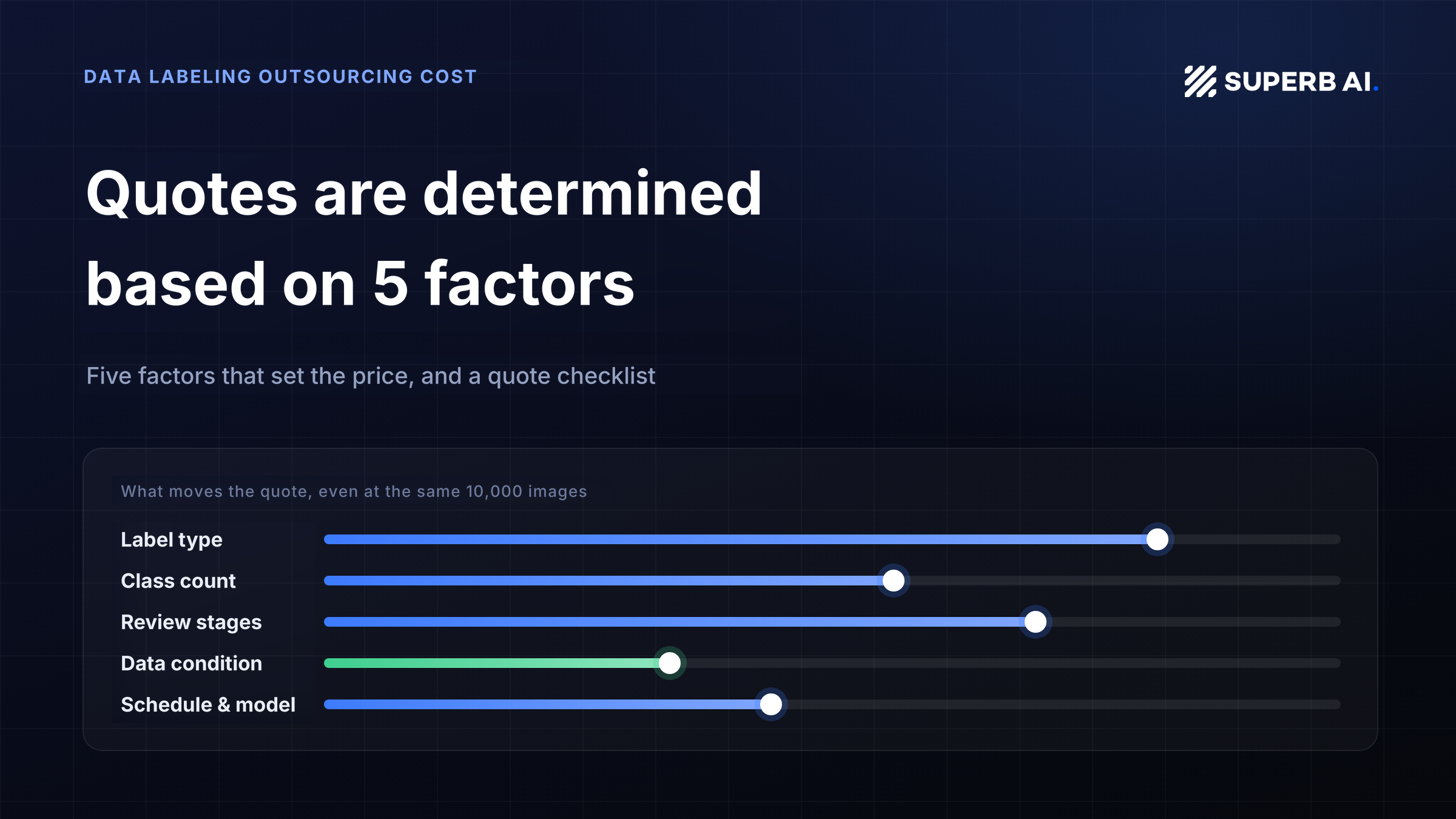
There is no single rate card for outsourced data labeling. Even for the same 10,000 images, quotes can vary severalfold. That is because label types, number of classes, required accuracy, and review processes differ. The factors that drive pricing, however, are consistent. This post explains five of them and provides a checklist to prepare before requesting a quote. This post reflects information available as of September 2026.
📌 Key Takeaways
- Data labeling outsourcing costs are determined by five factors: label type, number of classes and attributes, required accuracy and review stages, data condition, and turnaround time and engagement model.
- The lowest unit price does not necessarily mean the lowest total cost. Rework and quality review can account for a significant portion of the total.
- Including these five factors in your request for quotation makes it easier to compare vendors on the same basis. A pilot batch can also help you measure the actual rework rate before committing to full production.
5 Factors That Determine Cost
1. Label Type
Image classification may require only a single tag per image. Bounding boxes, polygons, instance segmentation, keypoints, and 3D cuboids require progressively more work per image.
Segmentation can take several times longer than bounding-box annotation, while keypoint annotation requires additional clicks for every joint. That is why the annotation type should be specified clearly when requesting a quote.
2. Number of Classes and Attributes
A task with five classes is very different from one with 50. As the number of classes increases, so do annotator training time and the risk of misclassification.
Adding attributes such as color, status, or orientation to each class increases the workload further. Providing clear class definitions and example images can reduce training effort and, in turn, lower the quote.
3. Required Accuracy and Review Stages
Whether the target accuracy is 95% or 99% can determine whether quality review requires one, two, or three stages.
Quality review can be more expensive than labeling itself. For tasks such as medical imaging, defect inspection, or PCB component identification, reviewers may also need domain expertise, which comes with a different labor cost.
4. Data Condition
Resolution, lighting, occlusion, and frame duplication all affect annotation time.
Frames extracted from video often contain substantial duplication. Removing redundant frames through data curation can reduce the amount of data that needs to be labeled in the first place.
Data that requires de-identification, such as footage containing pedestrians or vehicle license plates, may also incur additional processing costs.
5. Turnaround Time and Engagement Model
A one-time project and an ongoing engagement in which new data arrives every month have different pricing structures.
For recurring workloads, it can often be more cost-effective to establish the labeling workflow in a platform and use labeling services to process the incoming volume. Shorter deadlines generally require more annotators, which increases the unit cost.
Comparing Approaches: Crowdsourcing, Professional Labeling, and Automation-Assisted Workflows
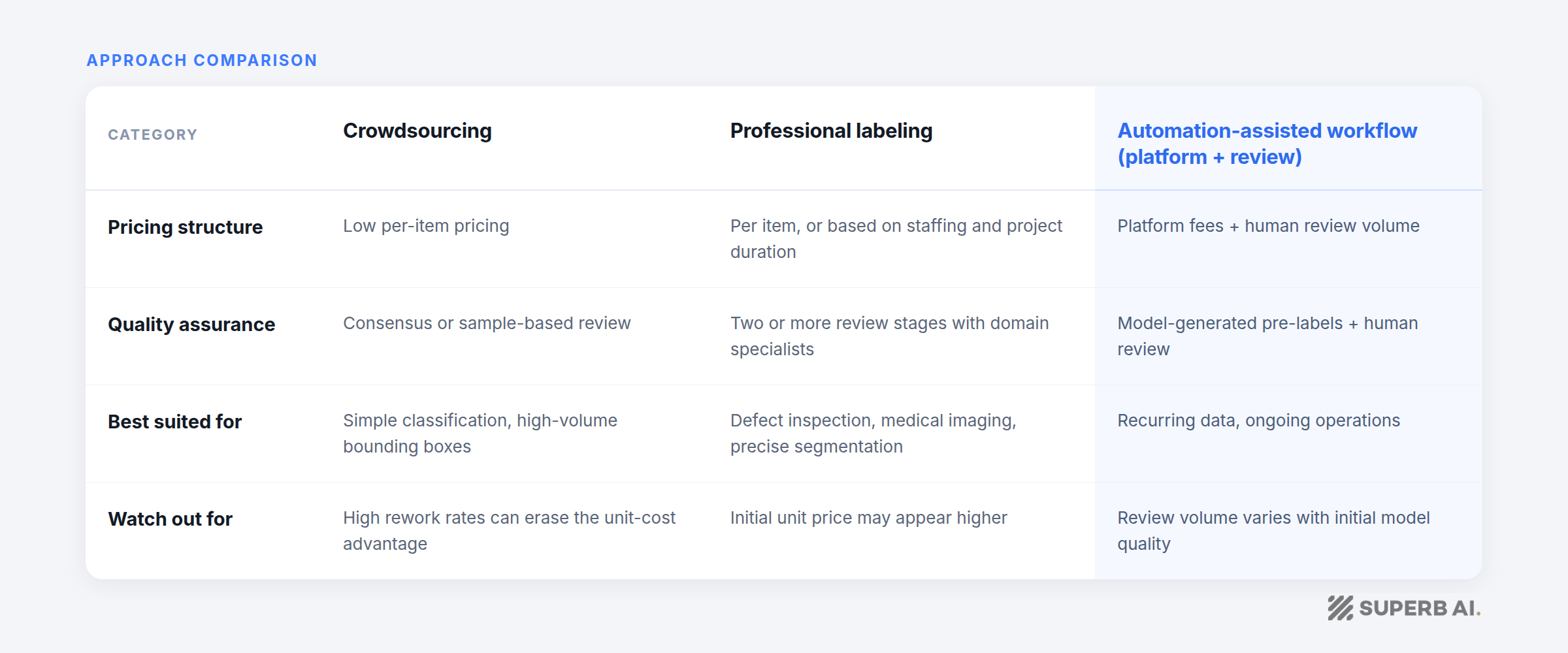
The guide below explains how far labeling automation has progressed, broken down by generation.
In Practice: How Labeling Operations Change the Cost Structure
An industrial automation component manufacturer had been labeling PCB components and defects with open-source tools. When class management and quality review became bottlenecks, the company moved to a platform-based workflow.
A behavior analysis AI company divided the work into two parts. The labeling workflow was established in Superb Platform, while high-volume annotation was handled through data labeling services. This is how the company built its keypoint dataset.
🔗Related post: [Customer Success Story] How a Video-Based Behavior Analysis AI Company Built a Scalable Keypoint Labeling Workflow
An autonomous mobile robot company has been labeling multisensor data as an ongoing operation for five years. The case shows how the pricing structure of a recurring labeling program can evolve over time.
Quote Request Checklist
Providing the following eight items makes it easier to compare quotes from different vendors on the same basis.
- Data type and volume: Images, video, or 3D data; number of images or frames; resolution
- Label type: Classification, bounding boxes, polygons, segmentation, keypoints, or 3D; average number of objects per image
- Class definitions: Number of classes, attributes, and whether example images are available
- Required accuracy and review stages: Target accuracy, whether multiple review stages are required, and whether domain specialists are needed
- Data condition: Whether de-identification is required, proportion of duplicate frames, and security requirements such as on-premise deployment or network isolation
- Timeline and engagement model: One-time project or recurring monthly operation, and the first delivery deadline
- Pilot batch: Whether to use 1–3% of the total volume to measure the rework rate
- Output format: Formats such as COCO or YOLO, and whether review history within the platform is required
3 Questions to Ask Before Choosing an Approach
First, determine whether the data arrives once or continues to come in over time. If it is recurring, the cost of establishing a labeling workflow can be recovered through repeated use.
Second, determine whether annotation decisions require domain expertise. If they do, the lower unit cost of crowdsourcing may be offset by rework.
Third, review the security requirements. If on-premises deployment is mandatory, the number of available options will be smaller. This should be confirmed before requesting quotes.
Frequently Asked Questions
Q. Is there a minimum project volume?
It varies by vendor. A common approach is to begin with a pilot batch, measure the rework rate, and then determine the size of the full production run.
Q. Should we simply choose the quote with the lowest unit price?
No. To compare total cost, evaluate the review process, expected rework rate, and terms for delivery delays alongside the unit price.
Q. Does automated labeling eliminate the need for outsourcing?
Automated systems can generate initial labels. Human reviewers are still needed for quality control and exception handling. Automation reduces the amount of manual labeling required, but the review workflow remains necessary.
Q. Is de-identification charged separately?
In most cases, it is a separate process. If your data requires de-identification of faces, license plates, or other sensitive visual information, it is best to disclose that requirement when requesting a quote.
Superb AI is a Vision Intelligence company that transforms visual data from industrial environments into actionable intelligence for enterprises. Superb AI provides both Superb Platform for establishing labeling workflows and data labeling services for processing labeling volume.
💬 Reviewing quotes for outsourced data labeling? Tell us your data type and volume below. Rather than starting with a sales call, we’ll begin by assessing the labeling workflow that makes sense for the data you already have.
Related Posts

Insight
Why Doesn’t Robot AI Have an ImageNet? A Test You Can’t Grade with a Single Answer Key
Hyun Kim
Co-Founder & CEO | 10 min read
Insight
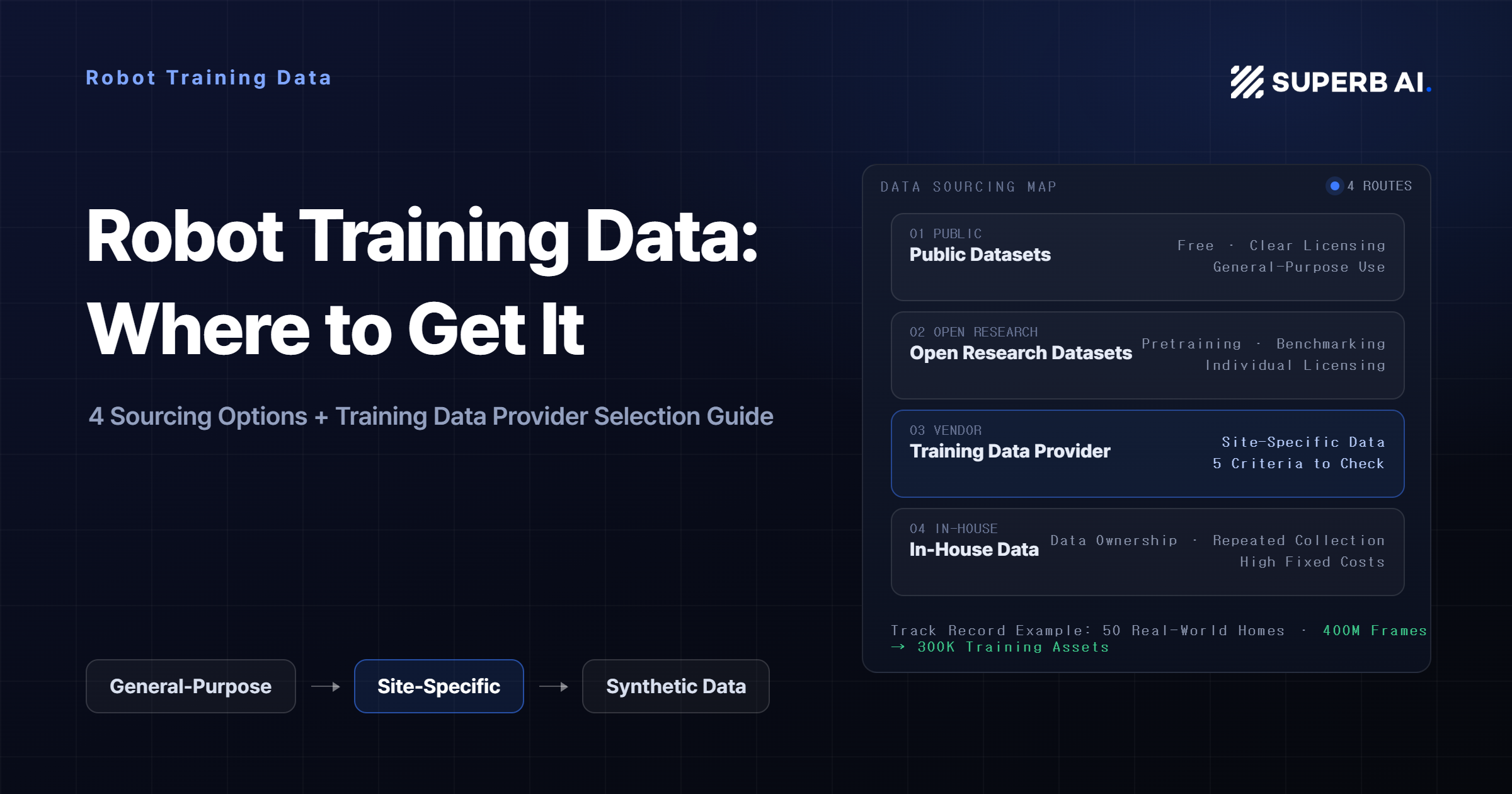
Robot Training Data Sourcing Guide: 4 Options and How to Choose a Training Data Provider
Hyun Kim
Co-Founder & CEO | 7 min read
Insight
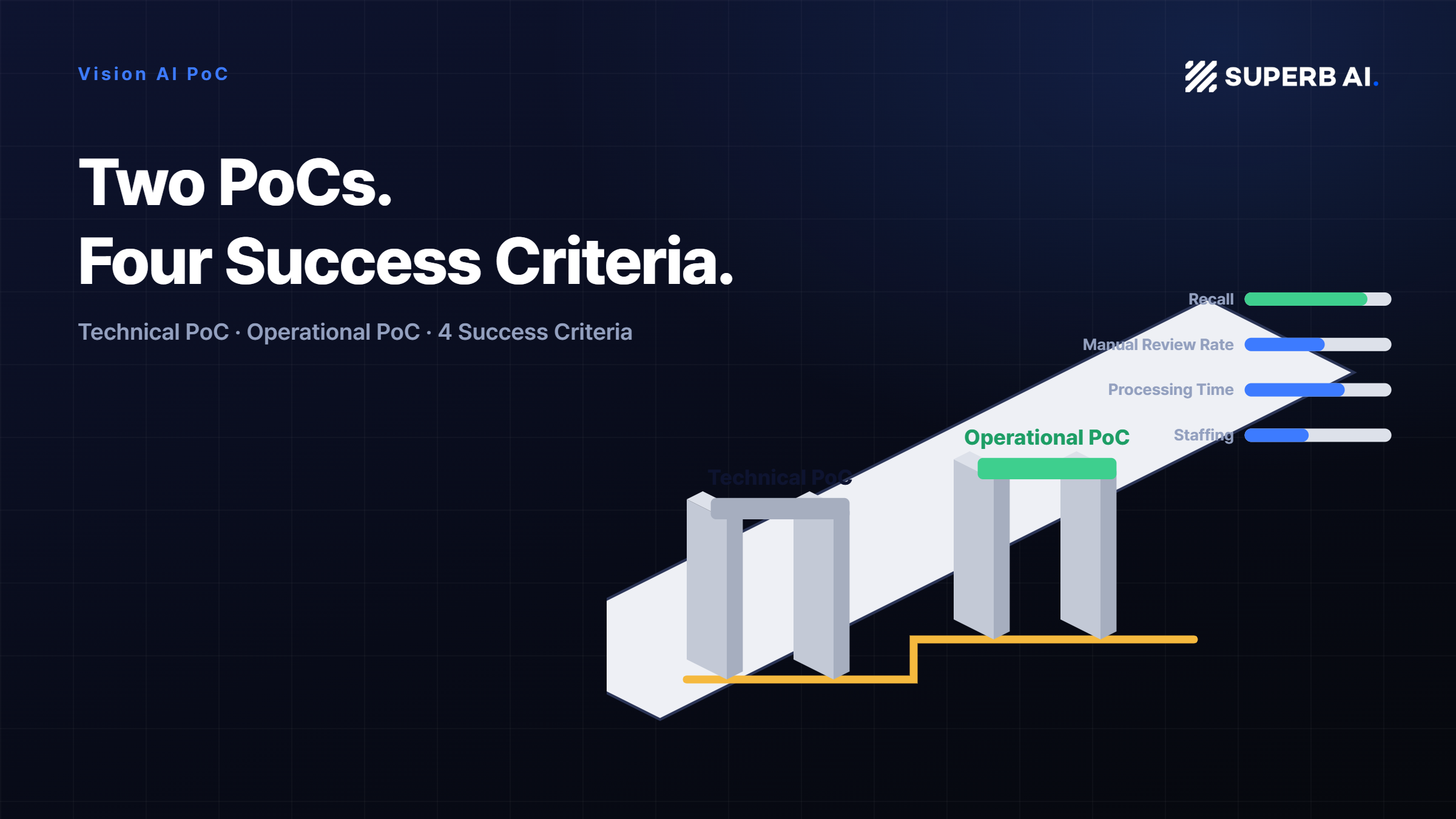
Vision AI PoC Design Guide: Timeline, Data, and Success Criteria
Hyun Kim
Co-Founder & CEO | 7 min read

About Superb AI
Superb AI is an enterprise-level training data platform that is reinventing the way ML teams manage and deliver training data within organizations. Launched in 2018, the Superb AI Suite provides a unique blend of automation, collaboration and plug-and-play modularity, helping teams drastically reduce the time it takes to prepare high quality training datasets. If you want to experience the transformation, sign up for free today.