Insight
Vision AI PoC Design Guide: Timeline, Data, and Success Criteria

Hyun Kim
Co-Founder & CEO | 2026/10/07 | 7 min read
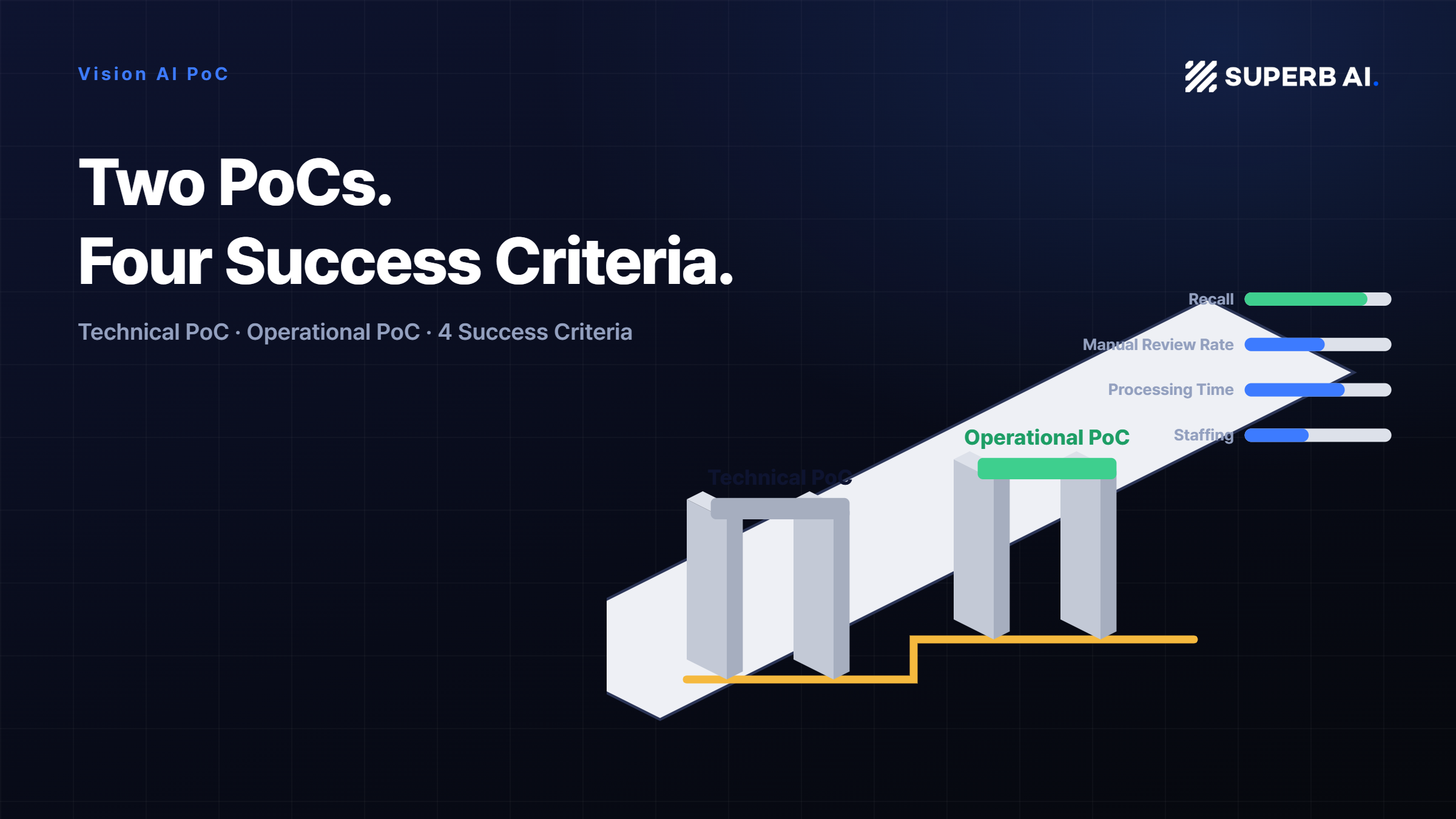
A Vision AI proof of concept (PoC) should be designed in two stages: a technical PoC and an operational PoC. To make an informed decision about full deployment, success criteria should cover four areas: model performance (accuracy and recall), manual review rate, processing time, and staffing requirements. Most PoCs fail for reasons beyond model performance. Common causes include defining success by accuracy alone, validating on data that does not reflect real operating conditions, and failing to account for the people required to run the system. This guide explains how to design a Vision AI PoC, including the timeline, data, and success criteria to consider.
📌 Key Takeaways
- A PoC has two stages: a technical PoC and an operational PoC. Whether the model can solve the task and whether it can operate effectively in the field are two different questions.
- Success criteria should go beyond accuracy to include manual review rate, processing time, and staffing requirements. Looking at a single metric can lead to problems during full deployment.
- Start with a small amount of data that reflects real operating conditions. ZERO, Superb AI's industry-focused Vision Foundation Model, can begin a PoC with around 10 images.
Two Stages of a Vision AI PoC: Technical and Operational
A technical PoC asks whether the model can solve the task. An operational PoC asks whether that model can work alongside people in the actual operating environment.
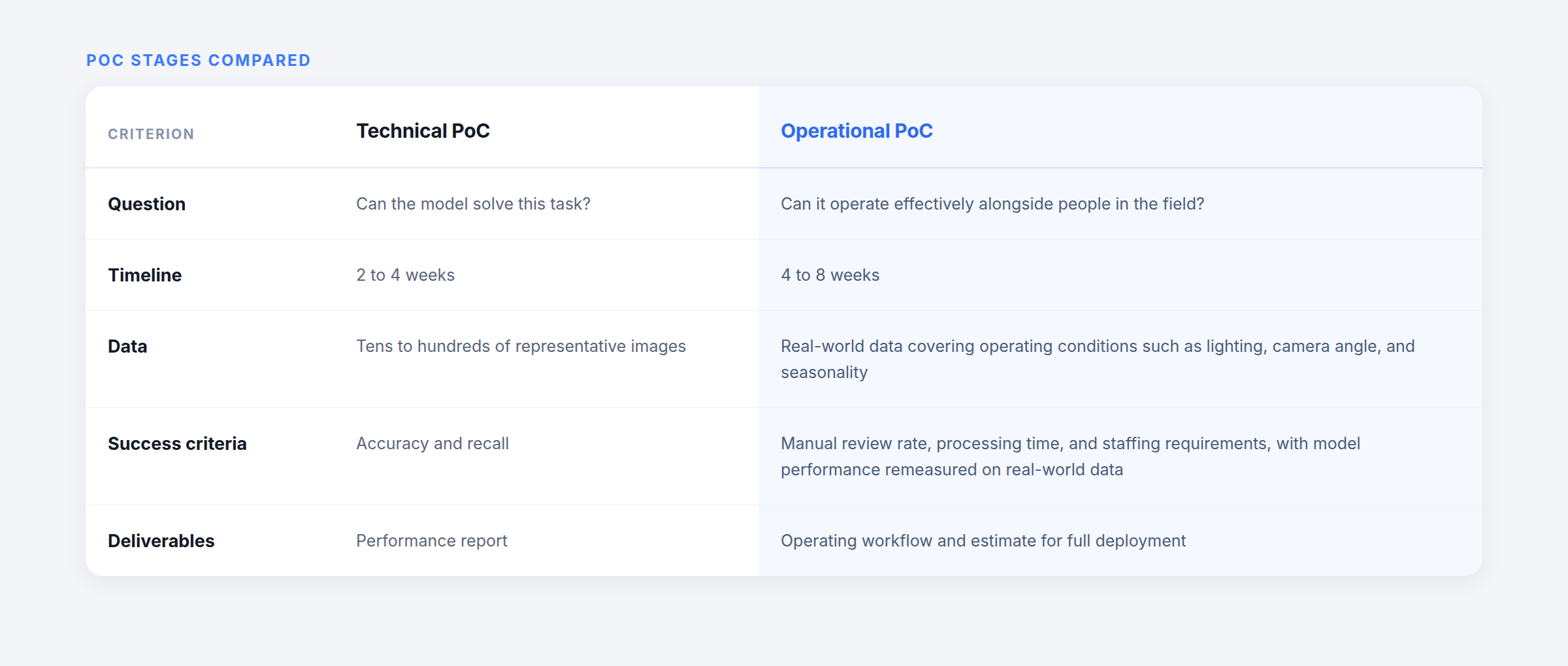
Moving directly from a technical PoC to full deployment can expose problems that did not appear during model testing. An operational PoC is needed to determine whether the system is ready for actual deployment.
4 Success Criteria for a Vision AI PoC
1. Accuracy, Precision, and Recall
For tasks where misses carry a high cost, such as defect detection or safety monitoring, recall should take priority. For tasks where false alarms create a significant operational burden, precision becomes more important.
These metrics should be tracked separately rather than collapsed into a single accuracy figure. That gives teams a clearer basis for deciding whether the system will work in practice.
2. Manual Review Rate
This is the percentage of cases the AI does not decide automatically and instead sends to a person for review. Even if a model achieves 99% accuracy, a 40% manual review rate means the human workload has not been reduced significantly.
3. Processing Time
The system must make a decision within the speed requirements of the production line or monitoring workflow. Measure how many channels a single server can process and the actual decision latency under operating conditions.
4. Staffing Requirements
Track how many hours of human work are required during the PoC. Time spent on labeling, review, and exception handling becomes part of the operating cost after full deployment.
How Much Data Does a PoC Need?
In the past, teams often began by collecting thousands of images per class and training a task-specific model.
Today, pretrained foundation models can detect objects using text and image prompts without additional task-specific training. This makes it possible to validate a use case with a small amount of data first, then add data only where performance needs improvement.
🔗 Related post: How to Restart an AI Project That Stalled for Lack of Data—with Just 10 Images
The PoC data still needs to reflect real operating conditions. Include images that represent changes in lighting, camera angle, season, and products so that performance during the PoC is more likely to carry over into production. The limitations of zero-shot approaches and how to address them should also be evaluated.
Real-World Case: Moving Beyond the PoC with a Human Review Workflow
A global electronic components manufacturer had been manually reinspecting every defect missed by its rule-based inspection equipment.
During the PoC, the company validated a deep-learning-based review workflow while measuring both the straight-through processing rate and the volume requiring manual reinspection. After designing the operational workflow as well as the model itself, the company began moving toward full deployment.
🔗 Related post: [Customer Success Story] How a Global Electronics and Precision Equipment Manufacturer Is Transforming Visual Inspection with AI
5 Steps to Designing a Vision AI PoC
- Define the task. Specify what needs to be detected, the cost of missing it, and the cost created by false alarms.
- Agree on success criteria. Set target values for model performance, manual review rate, processing time, and staffing requirements together with the business team.
- Prepare the data. Collect a small dataset that represents real operating conditions, and keep a separate validation set.
- Run an operational pilot. Have the actual operators use the system for at least four weeks. The pilot should experience at least one meaningful change in operating conditions, such as a lighting change or product change.
- Make the deployment decision. Summarize the four success criteria in a single table, then determine the scope and cost of full deployment.
Frequently Asked Questions
Q. How long should a Vision AI PoC take?
A technical PoC typically takes two to four weeks, followed by four to eight weeks for an operational pilot. The actual timeline depends on how prepared the data is.
Q. Who pays for the PoC?
It depends on the scope and the vendor. In many cases, the customer is responsible for data preparation and the internal staff needed to operate the PoC, so those costs should be estimated in advance.
Q. How should we set an accuracy target?
Start by measuring the accuracy and throughput of the current human process. Those numbers provide the baseline for evaluating the AI system.
Q. Can we reuse PoC data later?
Yes. If labels and review histories are retained in standard formats, the same data can be reused for production training and future revalidation.
Superb AI is a Vision Intelligence company that transforms visual data from industrial sites into intelligence enterprises can act on. With ZERO, Superb AI's industry-focused Vision Foundation Model, Superb AI supports PoCs that can begin without additional task-specific training, together with Human-in-the-Loop workflow design.
💬 Preparing a Vision AI PoC? Tell us about your task and operating conditions below. Rather than starting with a sales call, we'll begin by defining the right success criteria and assessing the data you need.
Related Posts
Insight
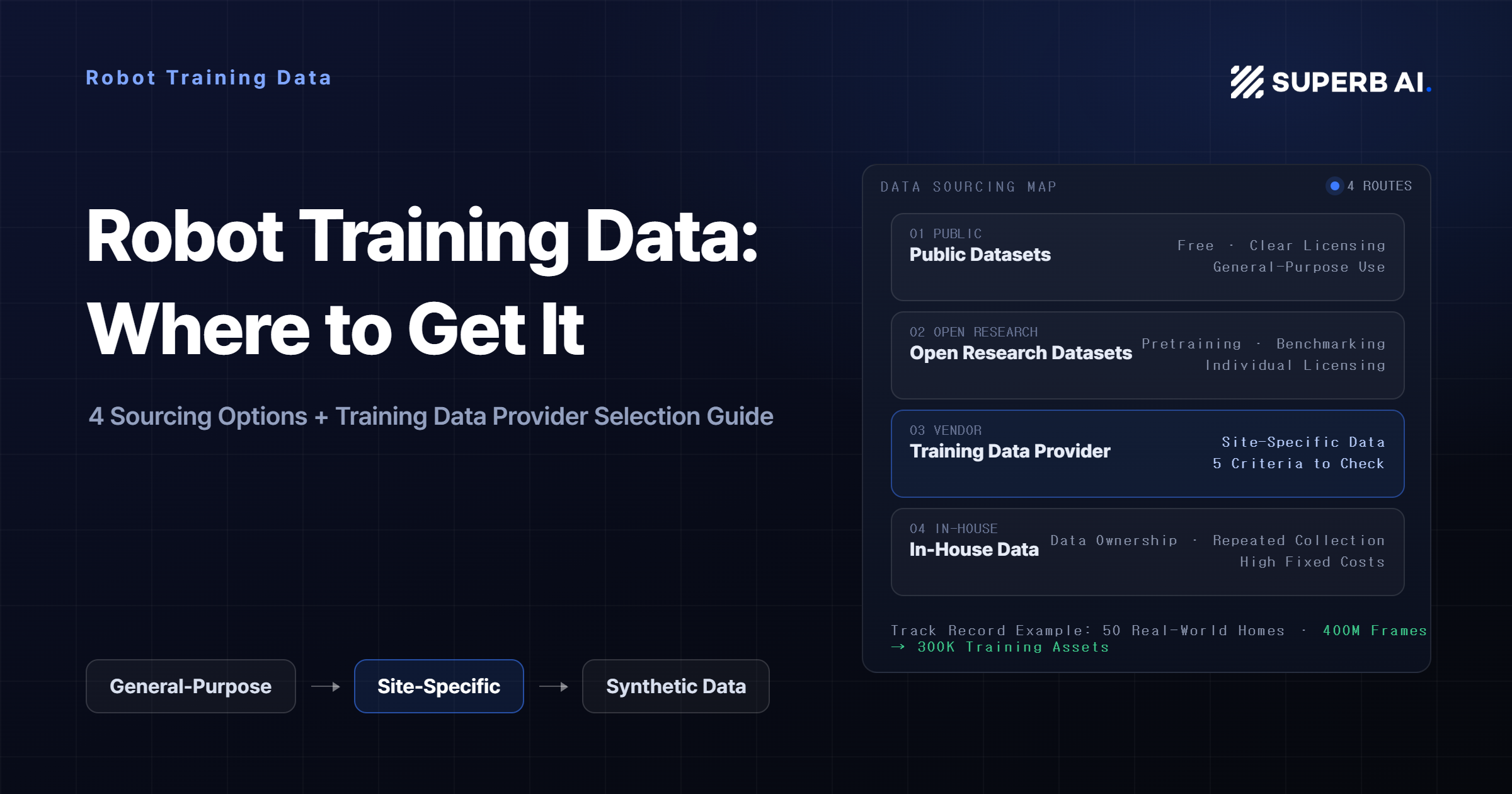
Robot Training Data Sourcing Guide: 4 Options and How to Choose a Training Data Provider
Hyun Kim
Co-Founder & CEO | 7 min read
Insight
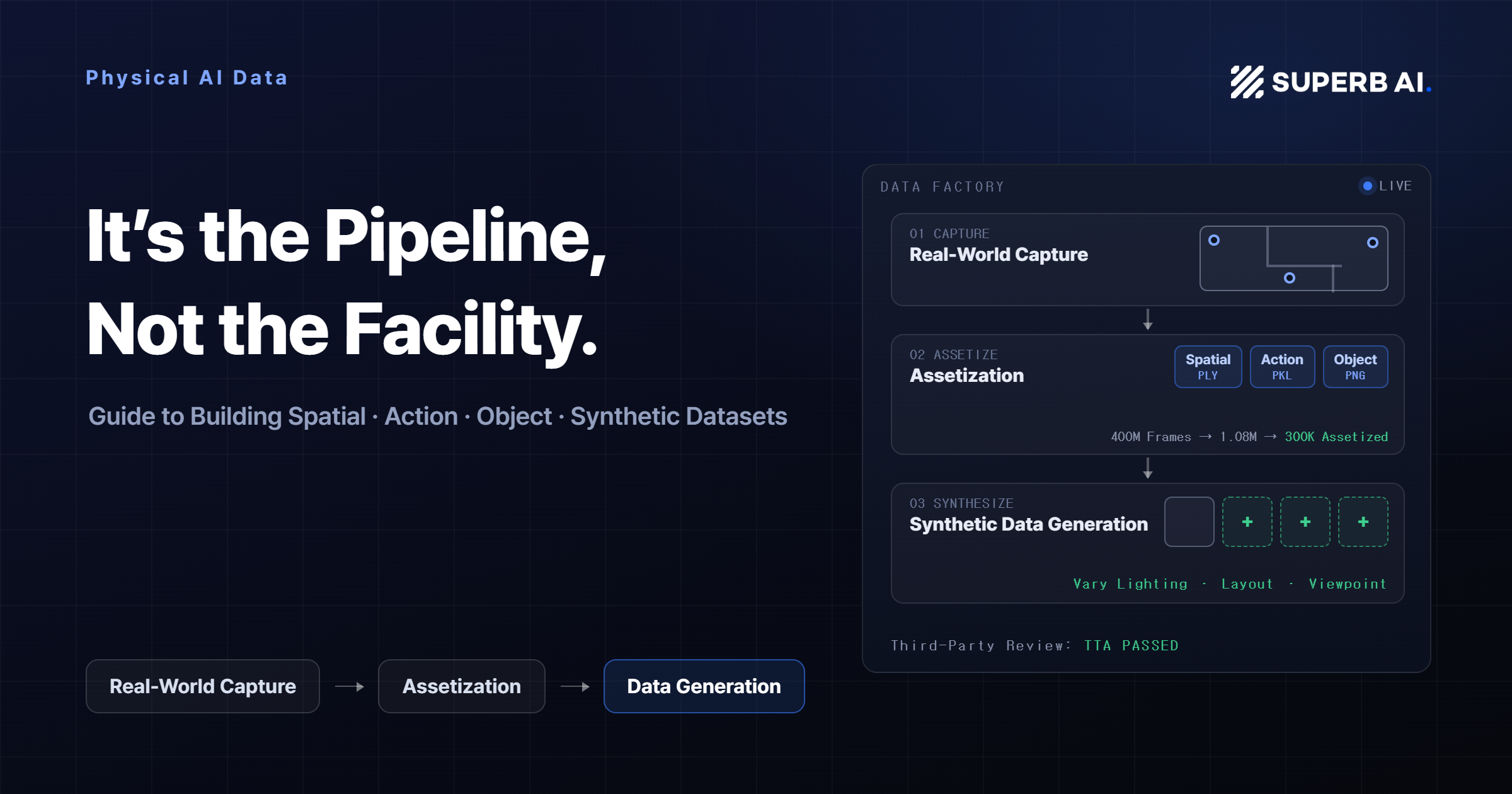
Physical AI Dataset Development Guide: 4 Data Types and a 3-Step Pipeline
Hyun Kim
Co-Founder & CEO | 7 min read
Insight
Guide to Selecting a Data Labeling Vendor: 3 Types and 8 RFP Questions
Hyun Kim
Co-Founder & CEO | 5 min read

About Superb AI
Superb AI is an enterprise-level training data platform that is reinventing the way ML teams manage and deliver training data within organizations. Launched in 2018, the Superb AI Suite provides a unique blend of automation, collaboration and plug-and-play modularity, helping teams drastically reduce the time it takes to prepare high quality training datasets. If you want to experience the transformation, sign up for free today.