Insight
Robot Training Data Sourcing Guide: 4 Options and How to Choose a Training Data Provider

Hyun Kim
Co-Founder & CEO | 2026/10/07 | 7 min read
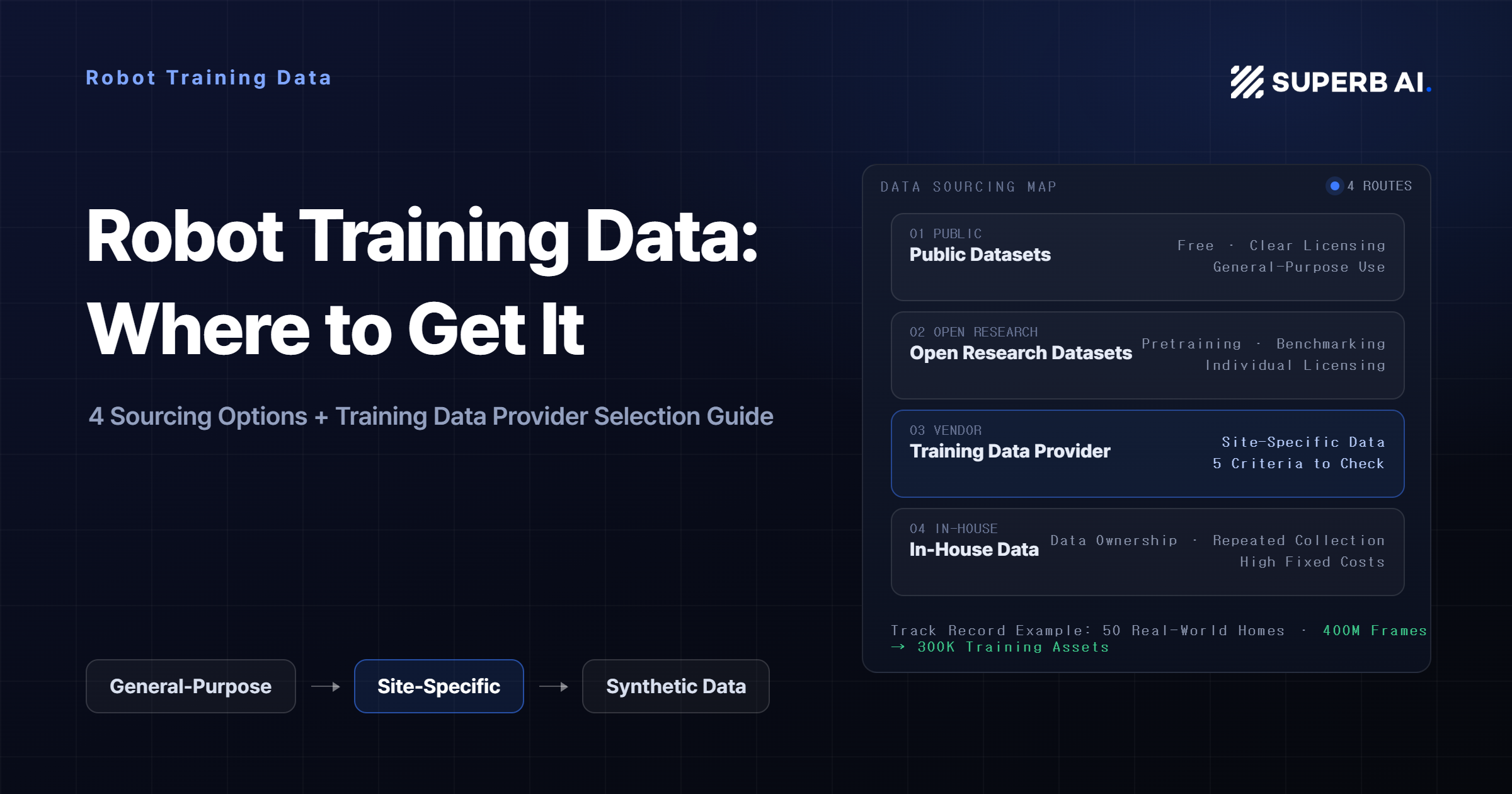
One of the first questions in robotics and Physical AI development is: Where does the training data come from?
Unlike text or web images, robot training data is not readily available on the internet. It needs to capture real environments, real actions, and real objects, and it needs to be structured so that the data can be reused in simulation. This guide explains four ways to source robot training data and the criteria to consider when working with a specialist training data provider.
In Korea, public investment is already signaling this demand. In June 2026, the government announced three major national projects that included plans to build Physical AI data factories across 10 industries, with KRW 20 trillion (approx. USD 14.9 billion) in joint public-private investment planned through 2030. As investment grows, how training data is sourced, and at what quality, is becoming a bottleneck for entire projects.
📌 Key Takeaways
- There are four main ways to source robot training data: public datasets, open research datasets, specialist training data providers, and in-house collection. Each covers a different part of the data pipeline.
- Public and open datasets are useful starting points, but they do not capture your specific environments, objects, and tasks. Site-specific requirements need to be covered through custom data development or collection.
- When choosing a training data provider, look at the validation method before the scale of past projects. The criteria used to approve the data and whether the outputs can be reused in simulation have a direct impact on rework costs.
4 Ways to Source Robot Training Data
1. Public Datasets
Public data portals such as AI-Hub provide visual and action data from Korean environments at no cost. Their advantages are clear licensing and no acquisition fee.
The tradeoff is that these datasets are built for general-purpose use. They may not reflect the environment in which your robot will actually operate, and you cannot add the exact data you need whenever requirements change.
Public datasets are best suited for baseline training and early technical validation.
2. Open Research Datasets
Open robot manipulation datasets such as Open X-Embodiment aggregate demonstration data from a wide range of robot form factors.
They are useful for pretraining foundation models and benchmarking model performance. However, much of the data was collected in laboratory environments from different countries, so its distribution can differ from specific residential and industrial settings that you need.
Commercial-use terms also vary by dataset, so each license needs to be reviewed individually.
3. Training Data Providers
This route involves outsourcing the development of data tailored to your own environments and tasks.
Examples include scanning real spaces and converting them into 3D assets for simulation, capturing human actions with multiview camera systems, and generating large volumes of variations through simulation.
This is typically the most expensive option, but it is also a practical way to cover site-specific requirements without building an entire collection operation in-house. We cover the criteria for choosing a provider later in this guide.
4. In-House Collection
Organizations can also bring data collection in-house by deploying teleoperation equipment, motion capture systems, or other collection infrastructure.
This provides greater data sovereignty and the ability to collect repeatedly, but it also requires the organization to internalize the equipment, staffing, and quality management systems needed to operate the pipeline.
It is often a good fit for robot manufacturers and other organizations where continuous data collection is closely tied to the core business. For organizations with intermittent demand, however, the fixed costs can be substantial.
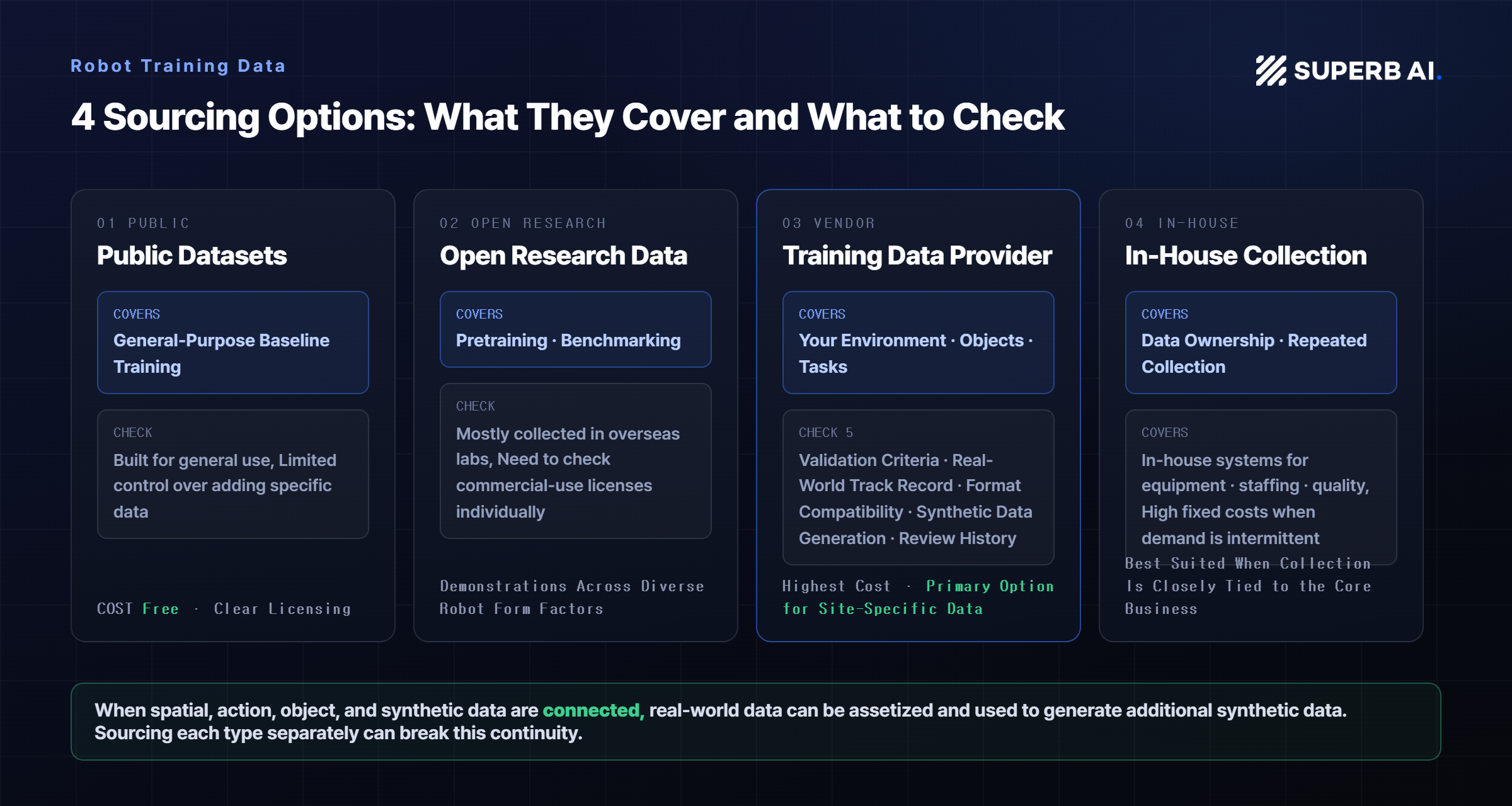
Conceptual diagram: Four robot training data sourcing options, what each one covers, and what to evaluate. Assetization and repeated synthetic data generation become possible when the four data types are connected
What Each Sourcing Option Can and Cannot Cover
Public and open datasets are useful through the general-purpose pretraining stage.
The moment a robot needs to interact with the shelves in your store, the equipment in your factory, or the specific geometry of your products, however, you need data that captures those environments and objects.
Physical AI data generally falls into four categories: spatial data for 3D environments, action data for human or robot motion, object data for manipulation targets, and synthetic data generated through simulation. Our Physical AI Dataset Development Guide explains how each type is built.
The key is continuity across these four types.
A 3D asset captured from a real environment provides the environment in which additional synthetic data can be generated. Real action data helps validate whether simulated behavior remains physically plausible. If each type is sourced independently without considering how they connect, that continuity can break.
5 Things to Check When Choosing a Training Data Provider
1. Are the Validation Criteria Written into the Contract?
Quality acceptance criteria should be defined explicitly in the contract. A contract that specifies only the quantity of data can create disputes when rework becomes necessary. In a government-backed project involving Superb AI, completed datasets passed external validation against criteria including IoU 0.7 and 90% semantic accuracy.
Whatever metrics are used, the important point is to agree on criteria that can be evaluated objectively by a third party before production begins. This reduces ambiguity around rework.
2. Does the Provider Have Experience Collecting Data in Real Environments?
A laboratory demo and real-world collection are very different challenges. Check whether the provider has collected data in environments with changing lighting, reflections, occlusion, and human activity, and at what scale.
As part of Korea's Sovereign AI Foundation Model project, Superb AI collected human action data across 50 real residential environments using a multiview rig with 17 GoPro cameras. Approximately 400 million raw frames were reduced to 1.08 million curated frames, and then to 300,000 training assets.
3. Are the Outputs Compatible with Simulators?
Check whether spatial data is delivered in formats that can be loaded into a simulator, such as 3DGS or USD, and whether action data preserves information such as viewpoint and joint states. If the formats are incompatible, additional conversion costs can arise even after the data has been delivered.
Our article on reconstructing real residential environments with 3D Gaussian Splatting explains one example of creating simulation-ready digital twins.
4. Can the Data Be Reused for Synthetic Data Generation?
If collected real-world data is assetized and can be used to generate variations in simulation, the amount of training data available from the same collection effort can increase substantially.
When comparing quotes, ask not only about the cost of collection but also about the unit cost of generating additional synthetic data from the resulting assets. Our Isaac Sim-based synthetic data pipeline is one example of this approach.
5. Is There a Review and Traceability System?
Check whether metadata records when, where, and with what equipment the data was collected, as well as the environmental conditions.
You should also be able to trace which data was rejected during quality review and why. This matters when model performance falls short, and teams need to trace the problem back to the underlying data.
What Drives the Cost of Robot Training Data?
There is no fixed price list for developing robot training data. Quotes are largely driven by four variables:
- Number and diversity of collection environments. Collecting at one location and collecting across 50 locations require very different levels of equipment transport, site coordination, and scheduling. Costs can grow faster than linearly as the number and diversity of environments increase.
- Number of viewpoints. A single-camera setup and a multiview rig differ in equipment, synchronization, and post-processing requirements.
- Depth of processing. Delivering raw footage costs differently from delivering curated, annotated, and assetized data, even when the original capture is the same.
- Whether synthetic data generation is included. This can increase upfront costs, but it can lower the cost per additional data sample over time.
Government-funded programs can also change an organization's actual out-of-pocket cost. Superb AI participates in Korea's Sovereign AI Foundation Model project as part of a consortium led by LG AI Research, while public investment in Physical AI continues to expand.
Frequently Asked Questions
Q. Where Can I Get Robot Training Data?
There are four main options: public datasets such as AI-Hub, open research datasets such as Open X-Embodiment, outsourcing to a specialist training data provider, and collecting the data in-house. Public and open datasets can cover general-purpose requirements. When the robot needs to learn your specific environment, objects, or tasks, custom data development or collection becomes necessary.
Q. Are Public Datasets Enough to Train a Robot?
They can be useful for baseline training, but they are rarely sufficient for deployment on their own. Public datasets are built for general-purpose use, so their environments and objects may differ from what your robot will encounter in production. They also cannot necessarily be expanded with the exact missing cases when you need them. Site-specific data is therefore typically required before deployment.
Q. What Should I Look for in a Humanoid Training Data Provider?
Check five things: validation criteria defined in the contract, real-world collection experience, simulator-compatible output formats, the ability to generate additional synthetic data, and a traceable review and quality history. The scale of a provider's previous projects matters less than whether the data is evaluated using objective criteria that can be independently verified.
Q. How Is the Cost of Custom Robot Training Data Determined?
There is no fixed unit price. Cost depends primarily on four variables: the number of collection environments, the number of viewpoints, the depth of processing, and whether synthetic data generation is included. Comparing collection costs alone can overlook downstream costs associated with assetization, format conversion, and repeated data generation.
💬 Considering how to source training data for robotics or Physical AI? Tell us the type of data you need and your target scale below. Rather than starting with a sales call, we'll begin by identifying what can be covered with public datasets and where custom data development is required.
Superb AI is a Vision Intelligence company that transforms visual data from industrial sites into intelligence enterprises can act on. Superb AI provides the full Physical AI data pipeline, from real-world capture and assetization to synthetic data generation.
Related Posts
Insight
Vision AI PoC Design Guide: Timeline, Data, and Success Criteria
Hyun Kim
Co-Founder & CEO | 7 min read
Insight
Physical AI Dataset Development Guide: 4 Data Types and a 3-Step Pipeline
Hyun Kim
Co-Founder & CEO | 7 min read
Insight
Guide to Selecting a Data Labeling Vendor: 3 Types and 8 RFP Questions
Hyun Kim
Co-Founder & CEO | 5 min read

About Superb AI
Superb AI is an enterprise-level training data platform that is reinventing the way ML teams manage and deliver training data within organizations. Launched in 2018, the Superb AI Suite provides a unique blend of automation, collaboration and plug-and-play modularity, helping teams drastically reduce the time it takes to prepare high quality training datasets. If you want to experience the transformation, sign up for free today.