Insight
Guide to Selecting a Data Labeling Vendor: 3 Types and 8 RFP Questions

Hyun Kim
Co-Founder & CEO | 2026/10/02 | 5 min read
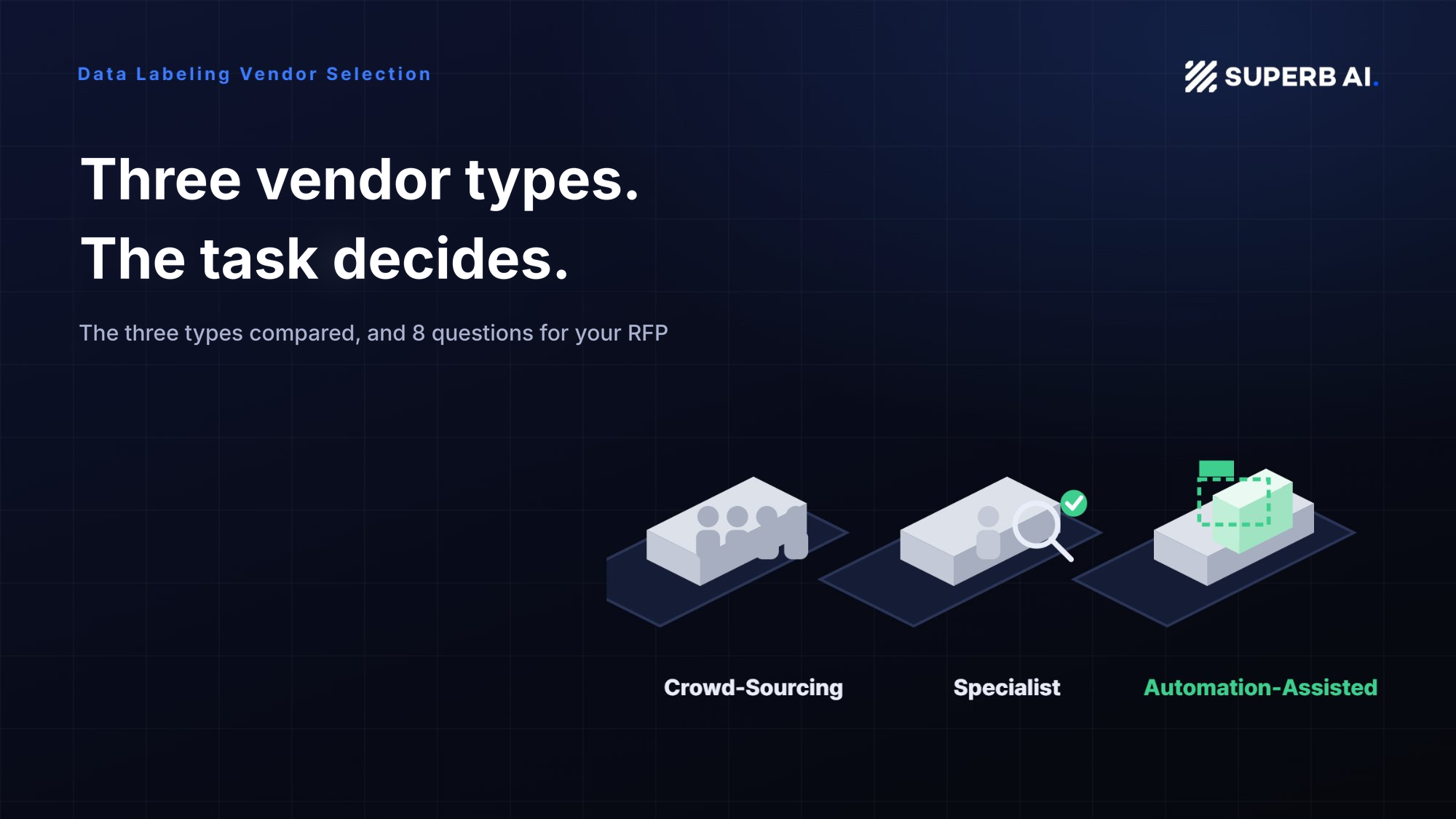
Data labeling vendors fall into three categories: crowdsourcing, specialist, and automation-assisted providers. The most important selection criteria are quality assurance and the ability to accommodate changing labeling requirements—not simply price per label. Choosing a vendor based on workforce size or unit pricing alone can lead to unexpected rework costs that substantially increase the total project cost. Start by asking three questions: Does your task require domain expertise? Will new data arrive continuously? Are there specific security requirements? This guide compares the three types of data labeling vendors and outlines eight questions to include in your request for proposal (RFP). It reflects information available as of September 2026.
📌 Key Takeaways
- Data labeling vendors fall into three categories: crowdsourcing providers, specialist providers with domain-specific quality assurance, and automation-assisted providers that combine a platform with auto-labeling.
- Quality assurance matters more than unit pricing alone. Review stages, rework procedures, and the ability to accommodate changing guidelines all affect the total cost.
- Including eight questions in your RFP allows you to compare vendors on the same basis. Validate their answers with a pilot dataset before committing to the full project.
Comparing 3 Types of Data Labeling Vendors
The three types differ primarily in who performs the labeling and who reviews the results. Crowdsourcing may appear less expensive based on unit pricing alone, but that comparison can change once rework and quality assurance costs are included.
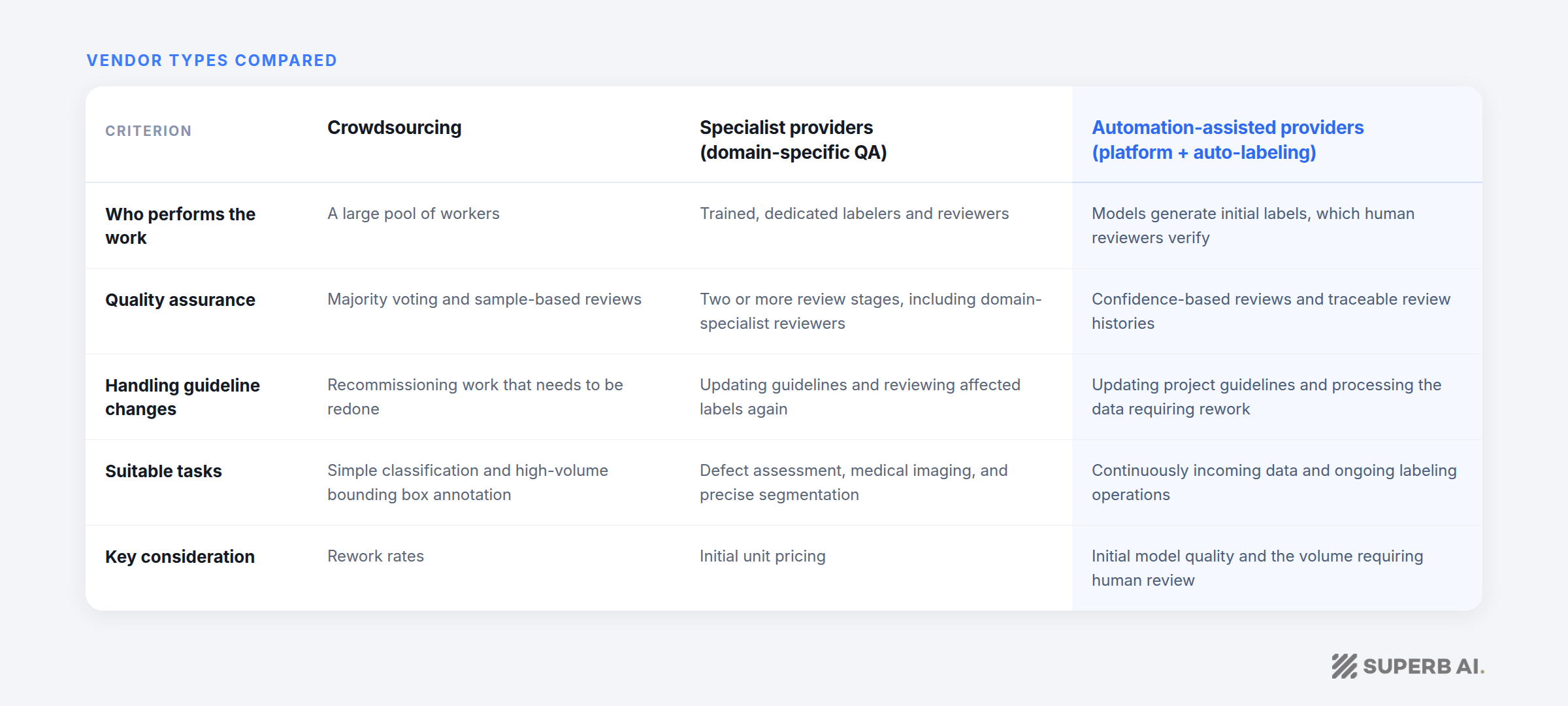
These three approaches are not mutually exclusive. In practice, many organizations manage labeling workflows and review histories on a platform while relying on specialist labelers to handle production volume. Regardless of the approach, the following five criteria should be part of every vendor evaluation.
5 Criteria for Choosing a Data Labeling Vendor
1. How Does the Vendor Handle Quality Assurance?
Labeling quality depends on the review process. Check how many review stages are involved, whether reviewers have relevant domain expertise, and whether the system maintains a record of their reviews. Vendors that rely solely on sample-based reviews may not be suitable for tasks requiring high precision.
2. What Happens When Labeling Guidelines Change?
Labeling requirements often change midway through a project. Before signing a contract, confirm how previously labeled data will be reviewed again and who will bear the associated costs. In one keypoint labeling project, a video-based behavior analysis AI company addressed rework caused by guideline changes by combining platform workflows with labeling services.
🔗 Related post: [Customer Success Story] How a Video-Based Behavior Analysis AI Company Built a Scalable Keypoint Labeling Workflow
3. Does the Vendor Have Relevant Domain Expertise?
Tasks such as identifying PCB components, assessing defects, and annotating medical images can be difficult for general-purpose labelers. Review the vendor's experience with similar domains and the qualifications of its review team. One industrial automation component manufacturer replaced its open-source PCB labeling tools with a platform-based workflow.
4. Can the Vendor Support Your Project Over the Long Term?
Labeling specifications evolve as AI systems move into production. New sensors are introduced, and additional classes need to be labeled. Look for evidence that a vendor has successfully expanded data pipelines alongside its customers. One autonomous mobile robot company has maintained a five-year partnership to build multisensor datasets.
5. Can the Vendor Meet Your Security Requirements?
When video data cannot leave a facility, labeling may need to take place in an on-premises or network-isolated environment. Check whether the vendor has a process for de-identifying sensitive data and how worker access is controlled.
8 Questions to Include in Your RFP
- How many review stages are involved in quality assurance, and what criteria are used to assign reviewers?
- How is the rework rate measured, and who covers the cost of reviewing existing labels when guidelines change?
- Has the vendor completed projects in domains similar to ours?
- Who develops the labeling guidelines, and how are updates implemented during production?
- Can the vendor work in an on-premises or network-isolated environment?
- Does the vendor have an established process for handling data that requires de-identification?
- Can the vendor deliver annotations in our required format, such as COCO or YOLO, together with the review history?
- Can we validate quality using a pilot dataset before proceeding with a full contract?
3 Criteria to Guide Your Decision
First, does your task require domain expertise? If accurate annotation depends on specialist knowledge, consider specialist or automation-assisted providers. The lower unit prices offered by crowdsourcing providers may be offset by rework costs.
Second, will new data arrive continuously? If so, consider establishing a repeatable labeling workflow. Repeatedly commissioning separate labeling projects can lead to inconsistencies in how guidelines are applied.
Third, have you validated the vendor with a pilot dataset? Start with 1–3% of your total dataset. Measure the rework rate and examine the review history before committing to the full production volume.
Frequently Asked Questions
Q. When Is Crowdsourcing a Good Fit?
Crowdsourcing is suitable for large-scale tasks with relatively few classes and straightforward labeling decisions. Common examples include image classification and bounding box annotation for large objects.
Q. Can We Use a Platform While Keeping Labeling In-House?
Yes. Many organizations use a platform to manage labeling workflows and review histories, then add external labeling services only when they need additional production capacity.
Q. What Happens to Our Existing Data If We Switch Vendors?
You can transfer your existing datasets if you have received the annotations in standard formats. This is why it is important to confirm the required output formats and the availability of review histories before signing a contract.
Q. How Should We Compare Vendor Quotes?
Use the same pilot dataset across multiple vendors and compare their measured rework rates and turnaround times. This provides a more reliable basis for comparison than unit pricing alone.
Superb AI is a Vision Intelligence company that transforms visual data from industrial environments into actionable intelligence for enterprises. We provide both a platform for building and managing labeling workflows and labeling services for handling production volume.
💬 Comparing data labeling vendors? Tell us about your data and labeling requirements below. Rather than starting with a sales call, we'll begin by assessing the quality assurance workflow your dataset needs.
Related Posts

Insight
Why Doesn’t Robot AI Have an ImageNet? A Test You Can’t Grade with a Single Answer Key
Hyun Kim
Co-Founder & CEO | 10 min read
Insight
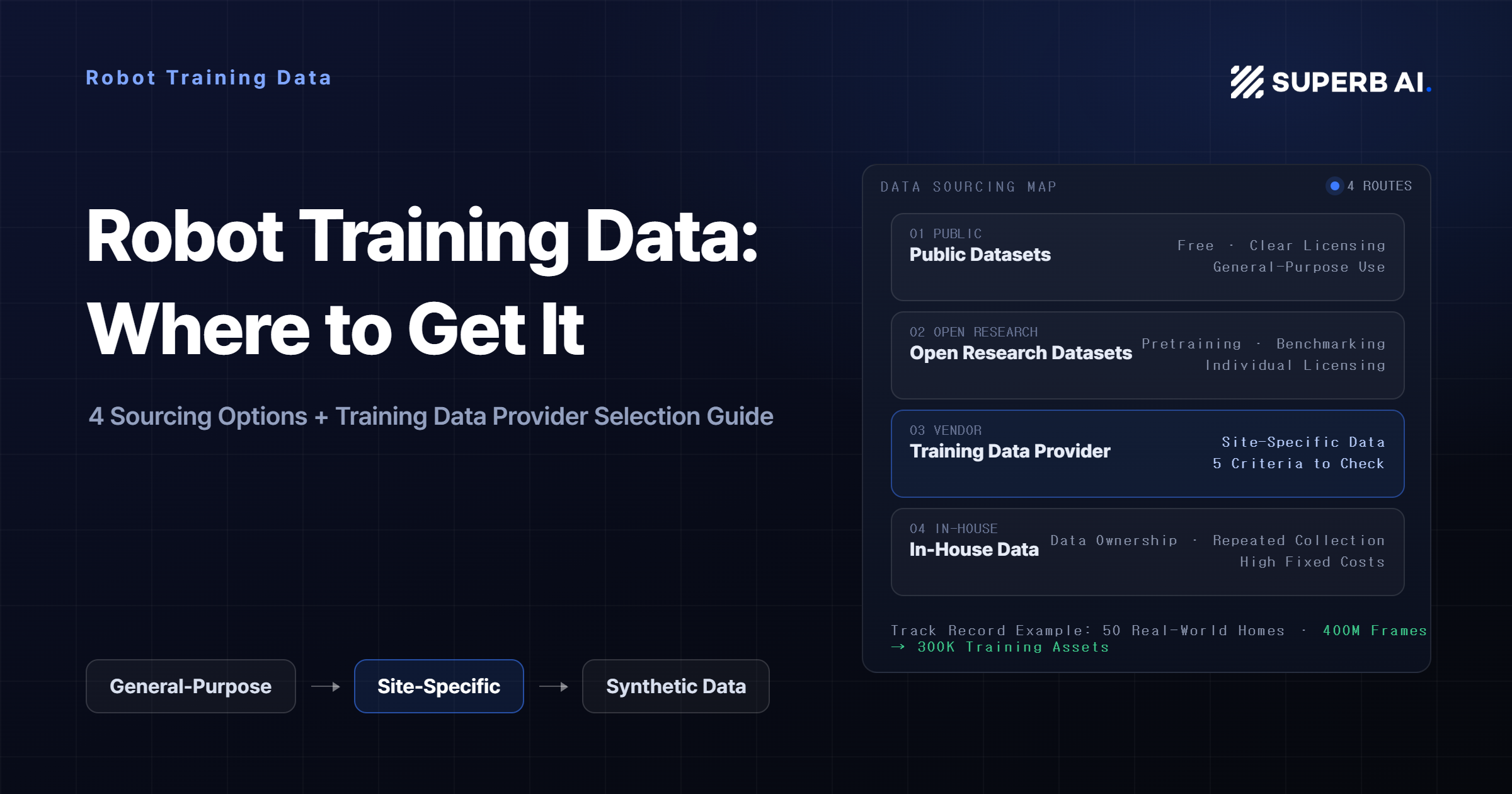
Robot Training Data Sourcing Guide: 4 Options and How to Choose a Training Data Provider
Hyun Kim
Co-Founder & CEO | 7 min read
Insight
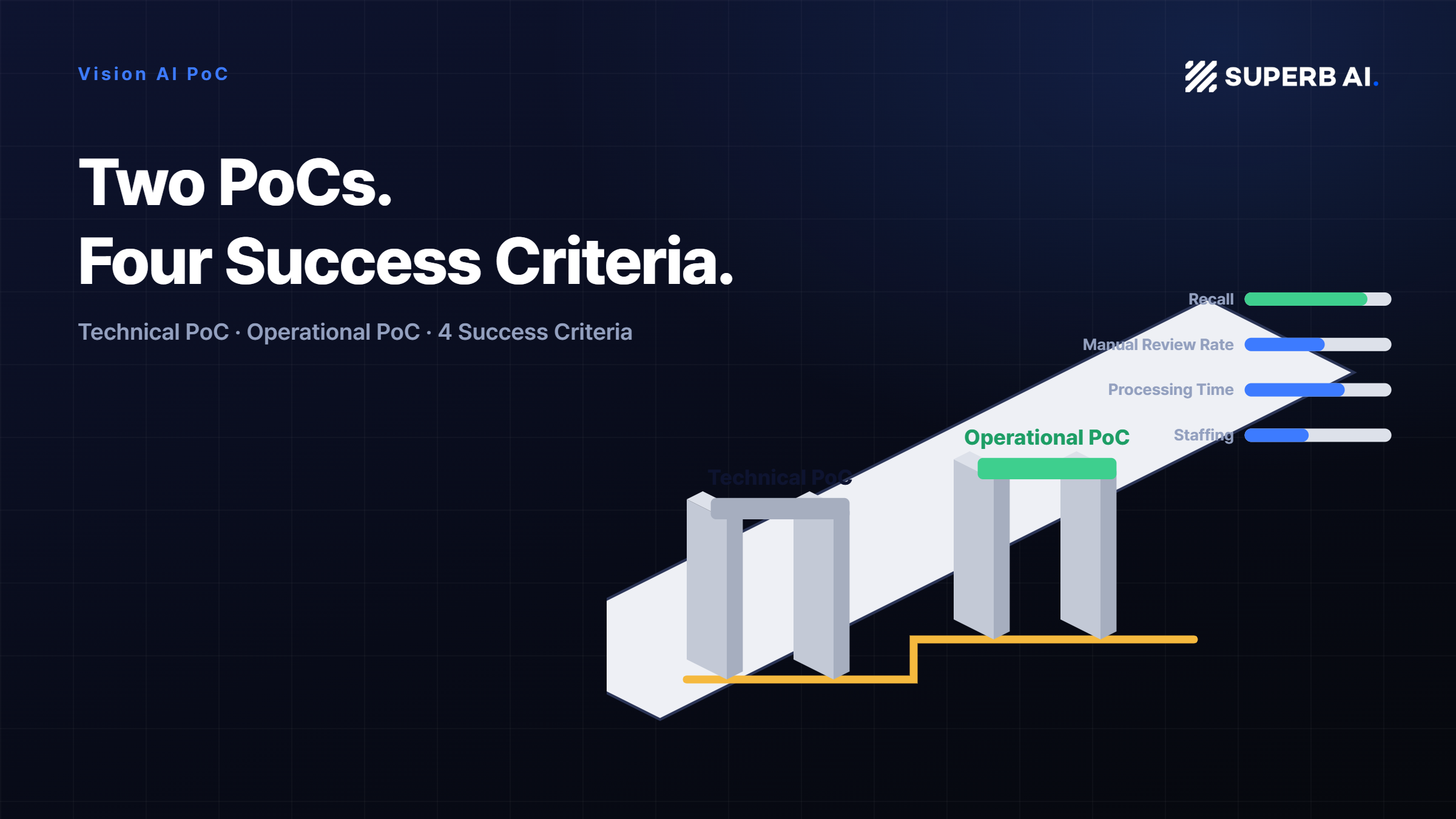
Vision AI PoC Design Guide: Timeline, Data, and Success Criteria
Hyun Kim
Co-Founder & CEO | 7 min read

About Superb AI
Superb AI is an enterprise-level training data platform that is reinventing the way ML teams manage and deliver training data within organizations. Launched in 2018, the Superb AI Suite provides a unique blend of automation, collaboration and plug-and-play modularity, helping teams drastically reduce the time it takes to prepare high quality training datasets. If you want to experience the transformation, sign up for free today.