Insight
Physical AI Dataset Development Guide: 4 Data Types and a 3-Step Pipeline

Hyun Kim
Co-Founder & CEO | 2026/10/06 | 7 min read
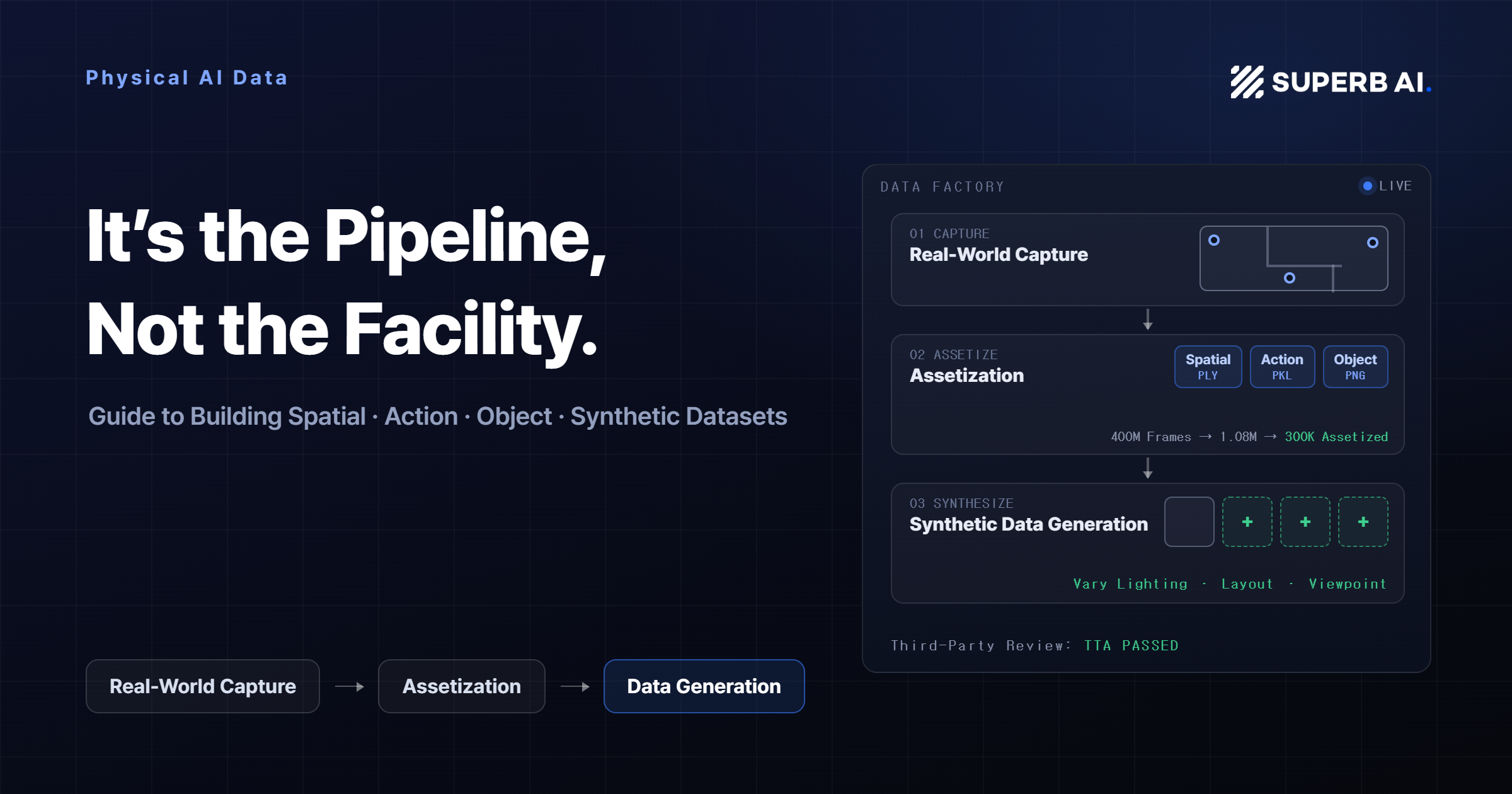
Physical AI data consists of spatial, action, and object data used to train robots and autonomous systems to perceive and act in the physical world. Unlike language models that learn from text, Physical AI requires data that captures 3D environments, human motion, and interactions with objects. This guide explains the four types of Physical AI datasets and the three-step development pipeline from real-world capture to synthetic data generation.
📌 Key Takeaways
- Physical AI datasets consist of four types: spatial, action, object, and synthetic data. Each type has its own output formats and validation criteria.
- Dataset quality depends on the pipeline, not on individual files. Real-world capture, assetization, and synthetic data generation must work together to enable repeatable data production.
- Superb AI has built Physical AI data for robotics and manufacturing using 50 real residential environments, and the resulting deliverables passed third-party validation.
Why Physical AI Data Matters Now
In July 2026, the Korean government announced its Strategy to Secure Core Competitiveness in Physical AI, placing data first among four strategic priorities: data, technology, adoption, and ecosystem development.
Model architectures are shared rapidly through open research, but training data that captures the physical world remains scarce. Companies preparing robot foundation models therefore face the same fundamental questions: What data should be built, in what format, and at what scale?
4 Types of Physical AI Datasets
Robot training datasets generally fall into four categories. The sections below explain the form and validation criteria for each type, based on deliverables Superb AI built as part of a government-backed project.
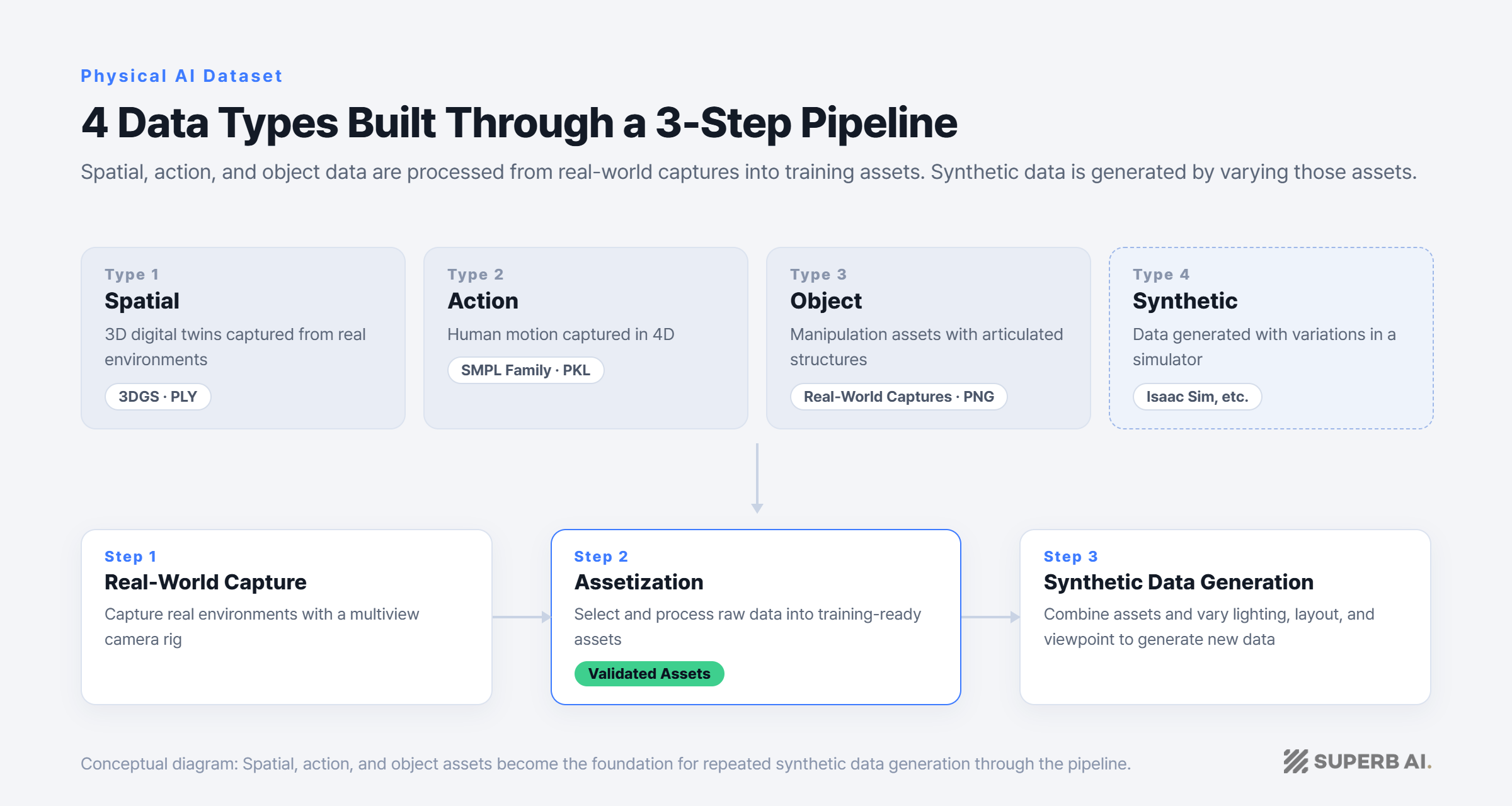
Conceptual diagram: Spatial, action, and object assets become the foundation for repeated synthetic data generation through the pipeline.
① Spatial Data: The Environment Where Robots Operate
Spatial data consists of digital twins reconstructed from real environments using 3D Gaussian Splatting (3DGS). Robots need environments based on real-world measurements to learn navigation and collision avoidance in simulation.
Superb AI built 3DGS assets in PLY format from 50 real residential environments. The process of creating digital twins of Korean residential spaces is covered in our article on 3D Gaussian Splatting.
② Action Data: Human Motion
Action data captures in 4D how people perform tasks such as picking up and moving objects.
An increasingly common approach reconstructs human motion from multiview video using SMPL-family body models, without requiring teleoperation equipment. Superb AI built 5,000 human action assets in PKL format using SMPL-X.
We explain the differences between these approaches in our guide to 4D human action data.
③ Object Data: What Robots Manipulate
Object data consists of interactive object assets that reproduce articulated structures, such as doors that open and drawers that slide out.
Unlike static 3D scans, these assets need to be directly usable for robot manipulation training. Superb AI built 10,000 object images based on real-world captures.
The production process is explained in our guide to interactive object assets.
④ Synthetic Data: Scaling Real-World Data
Synthetic data is generated by loading the three asset types above into a simulator and creating variations as needed.
Once spatial, action, and object assets are available, simulators such as NVIDIA Isaac Sim can generate training data while varying lighting, layout, and viewpoint.
We explain how to build this workflow in our article on the Isaac Sim synthetic data pipeline.
Dataset Quality Is Determined by the Pipeline
Discussions around Physical AI data often focus on training facilities and infrastructure. But based on our experience building datasets that passed third-party validation, the determining factor in quality is not the facility itself. It is the pipeline.
Superb AI's development pipeline consists of three steps.
Step 1: Capture Real-World Environments
Real environments are captured using a multiview camera rig.
In the Phase 1 project, Superb AI captured 50 real residential environments using a synchronized multiview rig with 17 GoPro cameras. This captured both third-person views of the overall space and first-person views designed to represent what a robot would see.
Step 2: Assetization
The raw captures are selected and processed into assets that can be used for training.
Approximately 400 million raw frames were reduced to 1.08 million frames through Auto-Curate, and 300,000 frames with high expected training value were assetized.
The full process is documented in our Phase 1 report for Korea's Sovereign AI Foundation Model project.
Step 3: Synthetic Data Generation
The assetized spatial, action, and object data is combined in a simulator to generate additional data.
Because assets created once can serve as the source for repeated data production, the cost structure of dataset development no longer needs to scale directly with the amount of real-world capture.
The outputs from this pipeline underwent third-party validation. In Phase 2, 50 spatial assets, 5,000 action assets, and 10,000 object images passed the final review by the Telecommunications Technology Association (TTA) and were officially accepted as completed deliverables. An additional 10,000 synthetic data images are currently being built.
More details are available in our Phase 2 results overview for Korea's Sovereign AI Foundation Model project.
Based on these results, Superb AI advanced to Phase 3 of Korea's Sovereign AI Foundation Model project and continues to build Physical AI data.
4 Questions for Evaluating a Physical AI Dataset
If you are considering an external dataset or evaluating a data development partner, these four questions can serve as a practical framework.
- Was the data captured in real-world environments? Lab environments differ from real-world sites in lighting, noise, and occlusion. Check both the number and diversity of collection environments.
- Who validated the data? A supplier's own quality claims are different from third-party validation. Check the reviewing organization and the evaluation criteria, such as accuracy and IoU.
- Are the formats compatible with your training pipeline? Confirm that output formats such as PLY, PKL, and PNG, along with the metadata structure, are compatible with the simulator and training framework you plan to use.
- Can additional data be generated from the assets? Total cost differs significantly depending on whether the dataset is a one-time delivery or whether additional synthetic data can be generated repeatedly from reusable assets.
Frequently Asked Questions
Q. What is Physical AI data?
Physical AI data is used to train robots and autonomous systems to perceive and act in the physical world. It consists of four types: spatial data for 3D environments, action data for human motion, object data for manipulation targets, and synthetic data generated in simulators.
Q. Can robots be trained using only synthetic data?
Synthetic data does not replace real-world data. It amplifies it. Assets created from real-world captures are needed to generate synthetic data in simulation while reducing the Sim-to-Real Gap.
Q. What is required to build a Physical AI dataset?
Building a Physical AI dataset requires multiview capture infrastructure, curation tools for selecting and processing raw data, assetization technologies such as 3DGS and SMPL, and a simulator-based synthetic data pipeline. Superb AI has implemented this full pipeline as part of a government-backed project.
Q. How is dataset quality validated?
The most reliable approach is to define quantitative criteria such as accuracy and IoU and have the outputs reviewed by a third-party organization. Superb AI's Phase 2 deliverables passed the final review by the Telecommunications Technology Association (TTA).
💬 Considering building Physical AI data? Tell us about your target environment and the types of data you need below. We'll start by reviewing your project requirements.
Superb AI is a Vision Intelligence company that transforms visual data from industrial sites into intelligence enterprises can act on.
Related Posts
Insight
Robot Training Data Sourcing Guide: 4 Options and How to Choose a Training Data Provider
Hyun Kim
Co-Founder & CEO | 7 min read
Insight
Vision AI PoC Design Guide: Timeline, Data, and Success Criteria
Hyun Kim
Co-Founder & CEO | 7 min read
Insight
Guide to Selecting a Data Labeling Vendor: 3 Types and 8 RFP Questions
Hyun Kim
Co-Founder & CEO | 5 min read

About Superb AI
Superb AI is an enterprise-level training data platform that is reinventing the way ML teams manage and deliver training data within organizations. Launched in 2018, the Superb AI Suite provides a unique blend of automation, collaboration and plug-and-play modularity, helping teams drastically reduce the time it takes to prepare high quality training datasets. If you want to experience the transformation, sign up for free today.