Insight
In-House vs. Outsourcing vs. Platform: The Total Cost of a Vision AI Data Pipeline

Hyun Kim
Co-Founder & CEO | 2026/09/21 | 5 min read
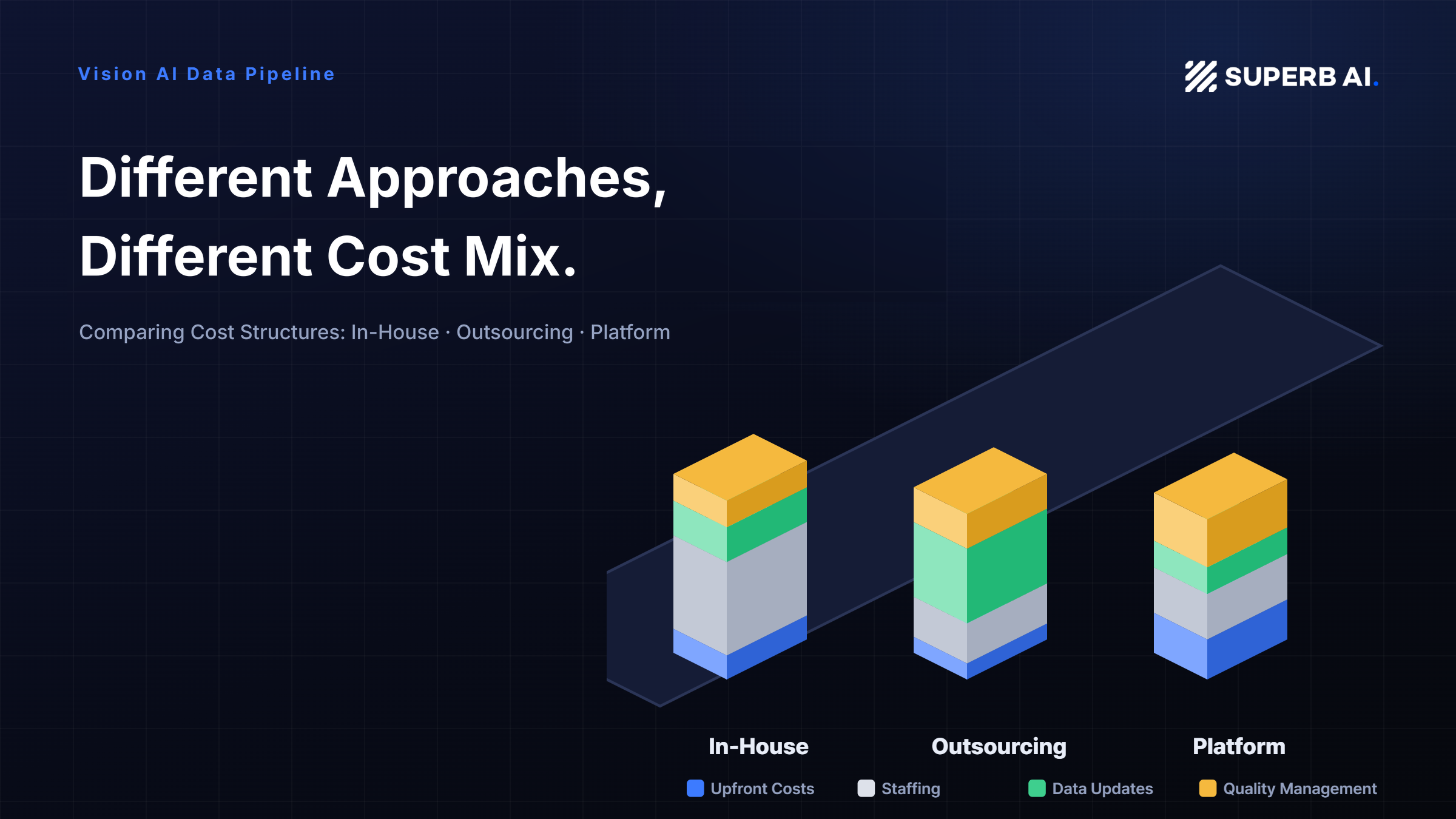
The total cost of ownership (TCO) of a Vision AI data pipeline is structured differently depending on whether you build in-house, outsource the work, or use a platform. In-house approaches are driven primarily by staffing costs. Outsourcing centers on per-item costs, while a platform shifts the focus to platform fees and the volume of data that requires human review.
We use a three-year comparison period because model updates and dataset rebuilds typically occur at least twice within that timeframe. Rather than comparing specific prices, this post breaks down the cost components of each approach and explains which approach fits under different conditions. This post reflects information available as of September 2026.
📌 Key Takeaways
- To compare the three approaches, costs need to be broken down into four categories: upfront costs, staffing, data updates, and quality management.
- The biggest factor affecting total cost is whether data is needed once or continues to arrive over time. For recurring data, the cost of establishing a repeatable pipeline can be recovered through continued use.
- Approaches that start without additional task-specific training can reduce the amount of initial labeling required, while synthetic data shifts part of the cost from labeling to simulator development.
Comparing the Cost Structure: In-House, Outsourcing, and Platform
The table below compares the three approaches across four cost categories: upfront costs, staffing, data updates, and quality management. Rather than ranking them by price, it shows where the major costs tend to occur.
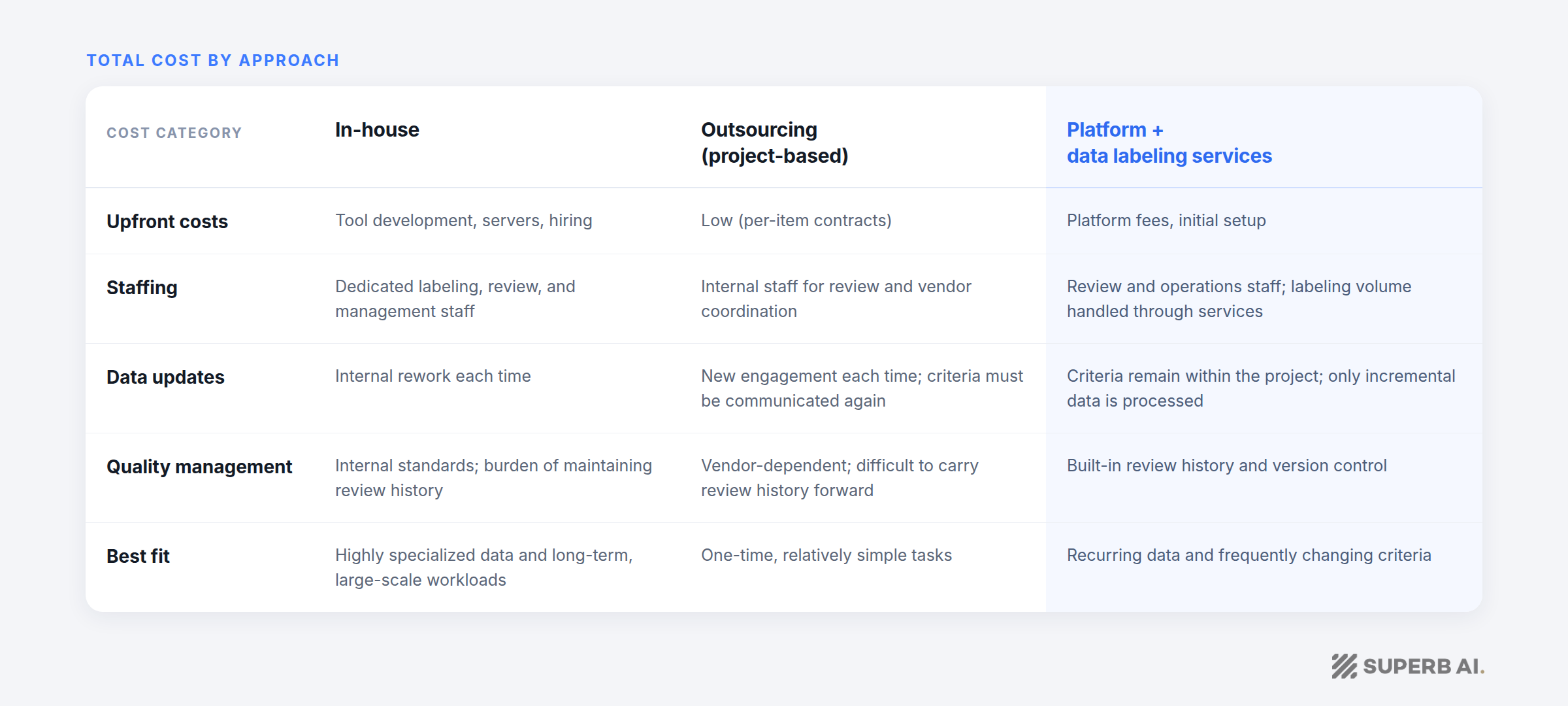
Actual costs in each category vary by organization. When requesting quotes, ask vendors to break costs down into these four categories—upfront costs, staffing, data updates, and quality management. This makes it easier to compare different approaches on the same basis.
4 Variables That Change the Total Cost of a Data Pipeline
1. How Often New Data Arrives
If you need to build a dataset once and then stop, outsourcing is often the simplest option. If products change, more cameras are added, and new data continues to arrive, the cost of establishing a repeatable pipeline can be recovered over time.
2. How Often Labeling Criteria Change
If classes are frequently added or decision criteria change, rework can significantly alter the total cost. In these cases, it is more efficient to retain the criteria within the project and process only incremental data as it arrives.
3. How Much Labeled Training Data You Need Upfront
A prompt-based approach that can detect objects without additional task-specific training can reduce the amount of initial labeling required. Instead of building a large labeled dataset first, teams can start with the model and supplement data only where additional training is needed.
🔗 Featured post: Introducing ZERO: Korea’s First Vision Foundation Model Tailored for Industry
4. Whether Real-World Data Can Be Collected
When real-world data cannot be collected, synthetic data can be used to generate the required volume. Because labels can be generated automatically, labeling costs decrease—but simulator development becomes a new cost category.
🔗 Featured post: Building Superb AI’s Synthetic Data Pipeline with NVIDIA Isaac Sim
In Practice: How Changing the Approach Changes the Cost Structure
In one case, 90,000 instances were processed in eight days using Auto-Label, shifting the labor mix from manual annotation toward review. The guide below explains how to build an automated labeling workflow.
🔗 Featured post: How to Build the Ultimate Automated Data Labeling Workflow Using Superb AI
The following post explains how to break down the cost of an AI video analytics system into hardware, software, deployment, and operations. Data pipeline costs can be analyzed in the same way.
🔗 Featured post: AI Video Analytics System Costs: 4 Factors That Determine Your Quote
3 Questions to Ask Before Choosing an Approach
First, estimate how many times your data will need to be updated over the next three years. If you expect two or more updates, prioritize approaches that establish a repeatable pipeline.
Second, determine whether you have dedicated internal staff for labeling and quality review. If not, staffing is likely to become the largest cost component of an in-house approach.
Third, determine whether your task can get started without labeling data upfront. If it can, the upfront cost structure changes, so the comparison should be recalculated accordingly.
Frequently Asked Questions
Q. Isn’t building in-house the cheapest option?
Usually not once staffing costs are included. An in-house approach tends to be more favorable when the data requirements are highly specialized, and the workload is both large-scale and long-term.
Q. How are platform fees calculated?
Pricing varies by provider. Common factors include the number of users, data volume, and the range of features required. Ask for an itemized quote so the costs can be compared on the same basis.
Q. Can we use outsourcing and a platform together?
Yes. A common approach is to keep the labeling workflow, criteria, and review history in the platform while using data labeling services to handle production volume.
Q. Can synthetic data eliminate labeling costs?
Labels can be generated automatically, but validation against real-world data and simulator development still create costs. It is more accurate to think of the cost as shifting from one category to another rather than disappearing.
Superb AI is a Vision Intelligence company that transforms visual data from industrial environments into actionable intelligence for enterprises. Superb AI provides Superb Platform for establishing labeling workflows, data labeling services for handling production volume, and ZERO for getting started without additional task-specific training.
💬 Comparing approaches for building your data pipeline? Tell us how often new data arrives and what your AI task involves. Rather than starting with a sales call, we’ll begin by mapping out the total cost components for each approach.
Related Posts
Insight
Why Doesn’t Robot AI Have an ImageNet? A Test You Can’t Grade with a Single Answer Key
Hyun Kim
Co-Founder & CEO | 10 min read
Insight
Robot Training Data Sourcing Guide: 4 Options and How to Choose a Training Data Provider
Hyun Kim
Co-Founder & CEO | 7 min read
Insight
Vision AI PoC Design Guide: Timeline, Data, and Success Criteria
Hyun Kim
Co-Founder & CEO | 7 min read

About Superb AI
Superb AI is an enterprise-level training data platform that is reinventing the way ML teams manage and deliver training data within organizations. Launched in 2018, the Superb AI Suite provides a unique blend of automation, collaboration and plug-and-play modularity, helping teams drastically reduce the time it takes to prepare high quality training datasets. If you want to experience the transformation, sign up for free today.