Insight
Choosing an AI CCTV Vendor: 7 Things to Check

Hyun Kim
Co-Founder & CEO | 2026/09/30 | 5 min read
When choosing an AI CCTV vendor, there are seven things to check: compatibility with existing CCTV, on-premises deployment, measured false alarm rates, how detection events are defined, whether event and response records are retained, the scope of maintenance, and experience at similar sites. A strong demo does not guarantee any of these. Once a system is deployed on-site, camera conditions, network infrastructure, and lighting can all be different. This post walks through the seven criteria one by one and provides a template for comparing vendors on the same basis. This post reflects information available as of September 2026.
📌 Key Takeaways
- The seven criteria fall into three groups: cost factors (existing CCTV compatibility and on-premises deployment), operational quality (false alarm rates and event definition), and compliance and long-term reliability (event records, maintenance, and reference deployments).
- One of the biggest cost differences comes down to whether new cameras are required. Start by checking whether your existing CCTV infrastructure can be reused.
- False alarm rates should be measured using footage from your own site. Treat demo results as a reference only, and validate performance through a two- to four-week pilot in one designated area.
7 Things to Check Before Choosing an AI CCTV Vendor
1. Can It Work with Your Existing CCTV?
Installing new cameras adds both equipment and installation costs to the quote. Check whether the solution can analyze video from your existing IP cameras and network video recorders (NVRs). You should also confirm whether the resolution and installation angles of your current cameras meet the requirements for analysis.
2. Does It Support On-Premise Deployment?
Public institutions, power plants, and manufacturing facilities often restrict video from leaving their networks. A cloud-only solution may therefore be unsuitable for deployment. Check whether the vendor supports on-premises and edge configurations, and ask what server capacity each configuration requires.
3. Can the Vendor Provide Measured False Alarm Rates?
Too many false alarms can cause monitoring personnel to start ignoring alerts. When a vendor presents accuracy figures, ask where and under what conditions they were measured.
To take an example, our EV fire detection system, developed in collaboration with the National Fire Research Institute of Korea, achieved an 80% reduction in false alarms.
4. How Are Detection Events Defined?
Every site has different events it needs to detect. Whether adding a new event requires model retraining or can be handled through prompts and configuration can have a direct impact on operating costs.
For instance, Gimcheon City's smart city monitoring system addressed this challenge with a hybrid approach combining fine-tuned models and prompt-based AI.
🔗 Related post: [Customer Testimonial] AI-Powered Monitoring Transforms Public Safety and Transportation in Gimcheon City
5. Are Event and Response Records Retained?
For organizations subject to Korea's Serious Accidents Punishment Act, it is important to maintain records that can support how safety-related obligations were carried out. Check whether detected events, alerts, and subsequent actions are retained as data. It is important to understand that there could be differences between what the law requires and what technology can support.
6. Is the Scope of Maintenance Clearly Defined?
Changes to cameras and site layouts can affect model performance. Check whether the contract specifies regular inspections, model updates, and incident response times. Whether the license is subscription-based or perpetual also affects the total cost of ownership.
7. Does the Vendor Have Experience at Sites Like Yours?
An indoor parking garage and an outdoor industrial plant present very different challenges. Ask for deployment examples and measurable results from sites similar to yours.
Review the following posts for reference: an energy company addressed blind spots across a large site using mobile AI video monitoring, while a manufacturing company achieved a 98% personal protective equipment (PPE) compliance rate.
🔗 Related post: [Customer Testimonial] “Zero Blind Spots” in Safety Monitoring: How Energy Company E Upgraded Safety Compliance with AI Video Analytics
🔗 Related post: [Customer Testimonial] Achieving 98% PPE Compliance with AI Video Surveillance
Vendor Comparison Template: 7 Questions to Ask
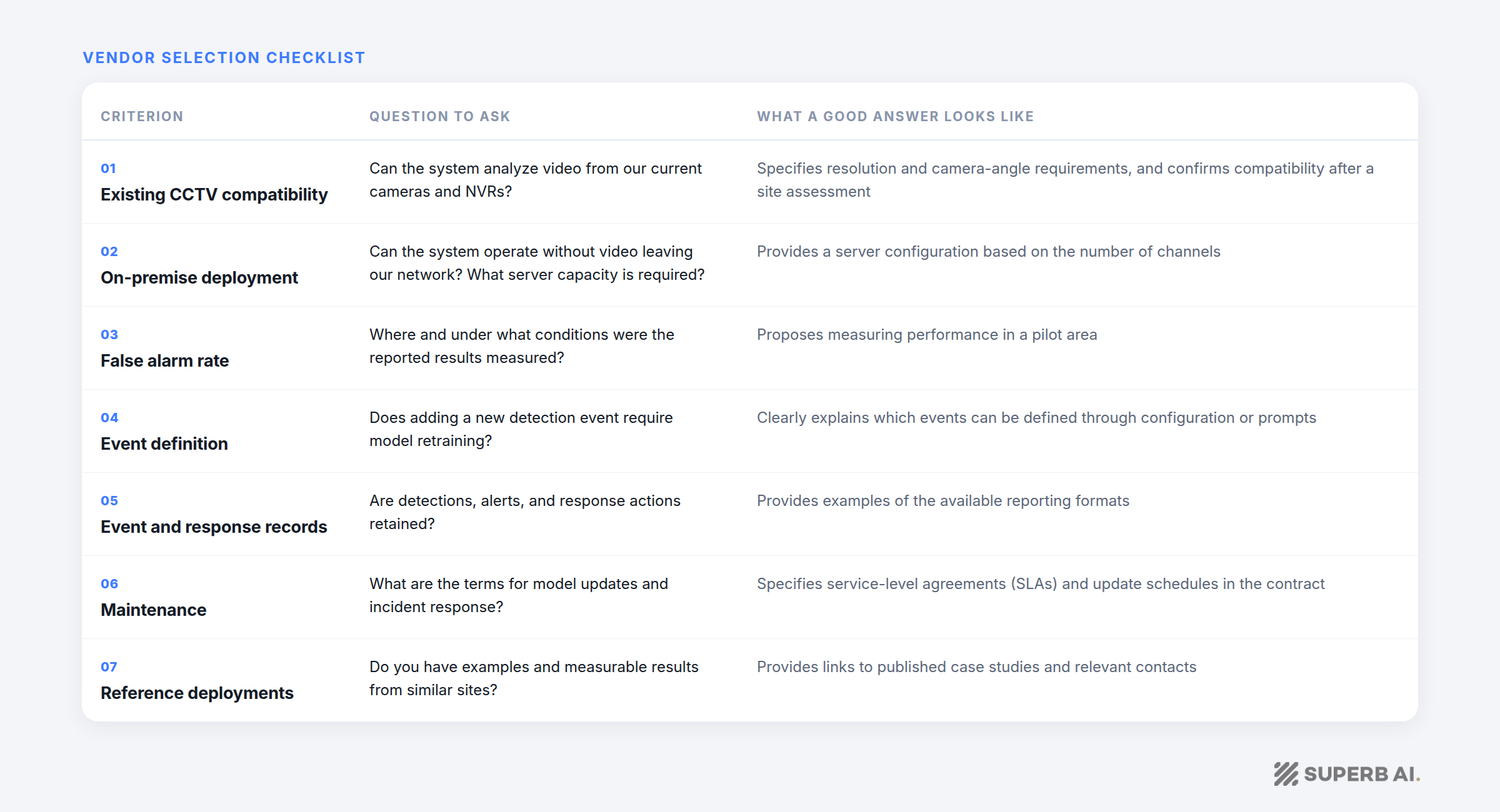
Ask every vendor the same seven questions and record the answers in one table. Strong answers have two things in common: they clearly state the conditions under which the system works and propose a way to validate performance at your site.
Compare the Cost Structure, Too
Once you have received responses from vendors, break down their quotes into four cost categories: hardware, software, deployment, and operations. Comparing each category separately makes it easier to see where costs differ and where they can be reduced.
We cover the cost structure and potential savings in the following post.
🔗 Related post: AI Video Analytics System Costs: 4 Factors That Determine Your Quote
4 Steps to Deploying AI CCTV
- Site Assessment: Review camera positions, resolution, and network infrastructure, and identify which existing channels can be reused.
- Pilot Deployment: Run the system in one area for two to four weeks to measure false alarm rates and validate the alert workflow.
- Event and Evidence Design: Define the events to detect and the records to retain, then connect them to the monitoring and response process.
- Phased Rollout: Expand the number of channels and incorporate maintenance requirements into the contract.
Frequently Asked Questions
Q. Our existing CCTV cameras are old. Can we still use them?
In most cases, yes, as long as their resolution and installation angles meet the requirements for analysis. Each channel should be assessed individually during the site evaluation.
Q. What false alarm rate is acceptable for daily operations?
It depends on the site and the event being monitored. The practical threshold is a rate that does not cause monitoring personnel to start ignoring alerts. This should be determined through actual measurements during the pilot.
Q. Our site cannot use the cloud. Can we still deploy AI CCTV?
Yes. On-premises and edge configurations make deployment possible without relying on an external cloud environment. The required server capacity depends on the number of channels.
Q. Can AI CCTV help with compliance under security regulations worldwide?
AI monitoring can support hazard detection and the retention of event and response records. However, it may not replace the full set of obligations imposed by different regulations, so organizations need to understand where the role of the technology begins and ends.
💬 Comparing AI CCTV vendors? Tell us your site type and number of cameras below. Rather than starting with a sales call, we'll begin by assessing how much of your existing CCTV infrastructure can be reused.
Superb AI is a Vision Intelligence company that transforms visual data from industrial environments into actionable intelligence for enterprises. Superb AI provides video monitoring solutions that work with existing CCTV infrastructure, along with ZERO, its industry-focused Vision Foundation Model, within a unified platform.
Related Posts
Insight
Why Doesn’t Robot AI Have an ImageNet? A Test You Can’t Grade with a Single Answer Key
Hyun Kim
Co-Founder & CEO | 10 min read
Insight
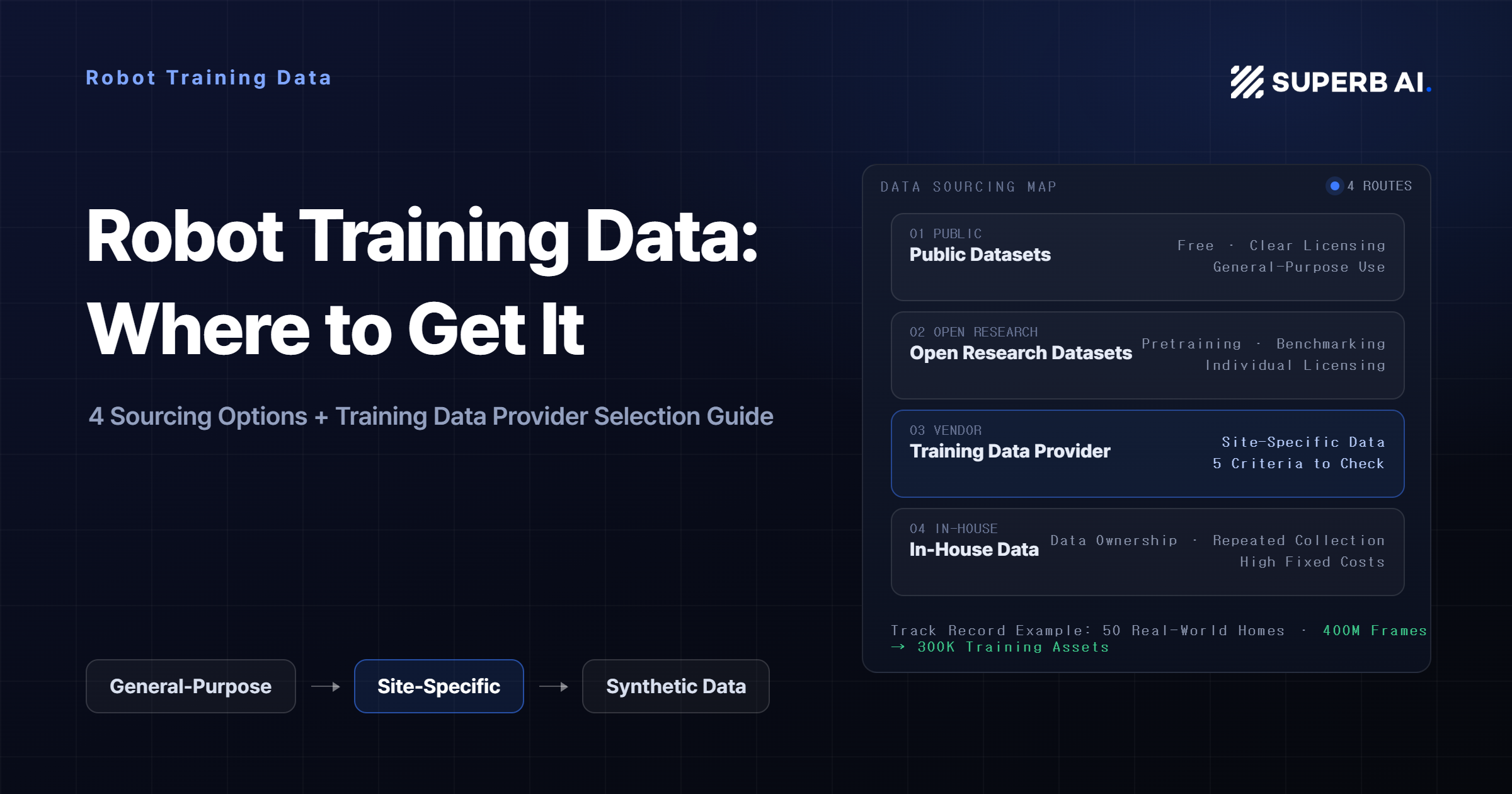
Robot Training Data Sourcing Guide: 4 Options and How to Choose a Training Data Provider
Hyun Kim
Co-Founder & CEO | 7 min read
Insight
Vision AI PoC Design Guide: Timeline, Data, and Success Criteria
Hyun Kim
Co-Founder & CEO | 7 min read

About Superb AI
Superb AI is an enterprise-level training data platform that is reinventing the way ML teams manage and deliver training data within organizations. Launched in 2018, the Superb AI Suite provides a unique blend of automation, collaboration and plug-and-play modularity, helping teams drastically reduce the time it takes to prepare high quality training datasets. If you want to experience the transformation, sign up for free today.